Men's Printed Shirts Guide
Printed shirts are woven shirts - button-front, collared, in cotton, linen or rayon cloth - carrying a printed pattern: florals, geometrics, paisleys, conversational motifs and the whole illustrated tribe. Where this letter's printed t-shirt guides deal with graphics applied to a knit tee, this guide deals with pattern woven into a shirt's whole surface, and with the shirt as a tailored garment underneath it. The questions are a shirt buyer's questions - scale, color, collar and fit - with the print as the additional variable that decides where the shirt may go.
Shop Men's Printed Shirts Now
Shop Men's Printed Shirts on Amazon Shop Men's Printed Shirts on eBayThe Amazon and eBay links on this page are affiliate links. If you make a purchase through them, Apparel Search may earn a commission.
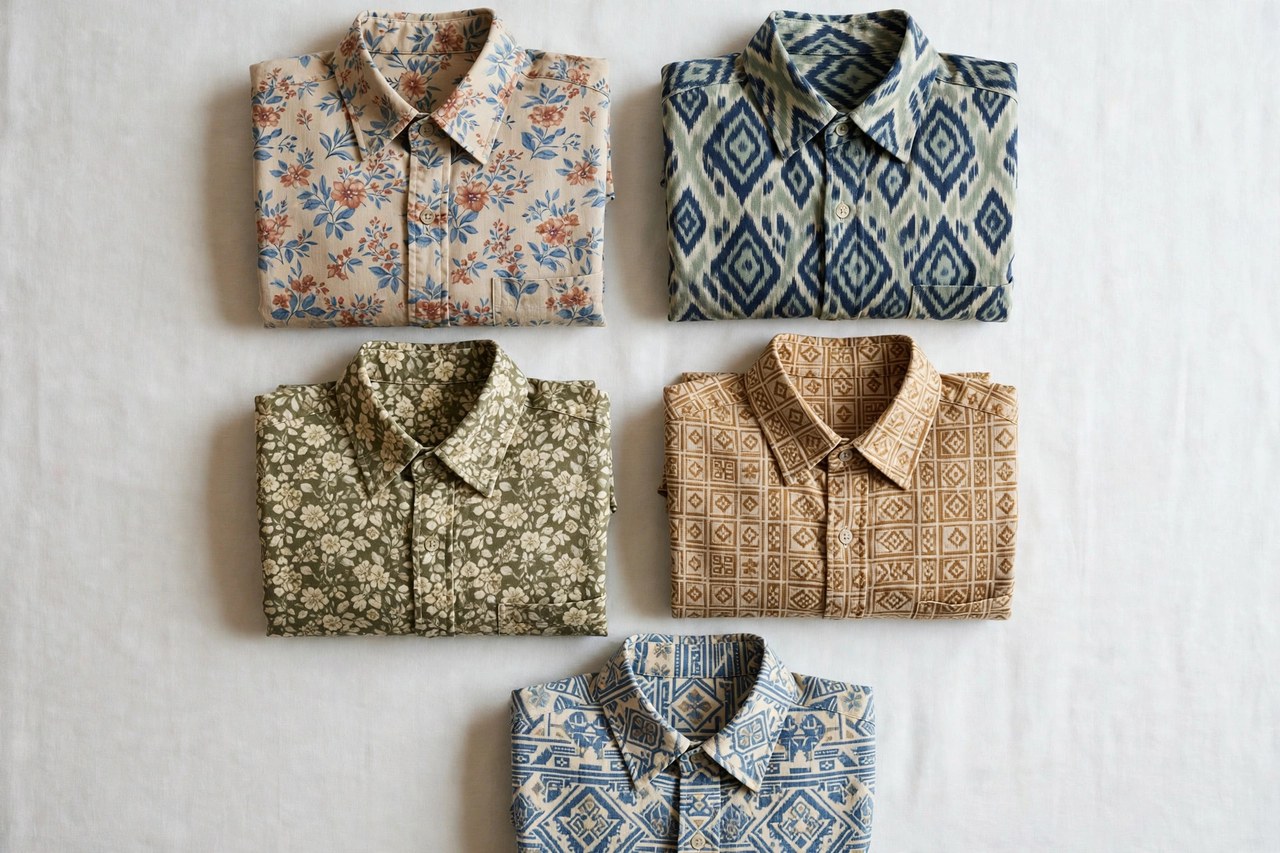
Printed shirts are woven shirts - button-front, collared, in cotton, linen or rayon cloth - carrying a printed pattern: florals, geometrics, paisleys, conversational motifs and the whole illustrated tribe. Where this letter's printed t-shirt guides deal with graphics applied to a knit tee, this guide deals with pattern woven into a shirt's whole surface, and with the shirt as a tailored garment underneath it. The questions are a shirt buyer's questions - scale, color, collar and fit - with the print as the additional variable that decides where the shirt may go. This guide covers the styles worth knowing, the fit points that decide comfort, the fabrics and construction that separate a good buy from a regret, and the simple care that makes the garment last.
Scale Is the Master Variable
Print scale is the master variable. Small prints - tight geometrics, micro florals, dotted grounds - read as texture at distance and behave almost like solids: they pair under jackets, sit down in offices, and forgive bold color because the dose is small. Medium prints are the shirt's home ground: clear florals, paisleys and block prints that carry an outfit's interest, worn open-collared with plain trousers doing the quiet work. Large and conversational prints - scenes, animals, oversized motifs - are statements that headline an outfit and belong to leisure, holidays and the Hawaiian tradition that is their famous branch. Two craft checks separate good printing in every scale: pattern matching, where the print continues unbroken across the placket, pockets and yoke seams on better shirts; and print quality itself, sharp registration and color that survives washing, since a woven shirt is expected to live for years beside your plain ones, not a season beside your tees.
A top earns its keep in finishing: seams that hang straight and stay even at eight to twelve stitches per inch, collars and plackets that lie flat after washing, buttons sewn with thread shanks so they sit in their holes without pulling. Hold the cloth to the light - a tight, even weave or knit outwears a loose one at the same labeled weight, and pattern pieces cut on grain keep the garment from twisting around your body by the third wash.
A Shirt First, a Print Second
Fit a printed shirt as a shirt first. Shoulders at the bone, a collar that closes without strain if you will ever button it, sleeves to the wrist bone, and a body with the ease to sit and reach - the print will not rescue a shirt that pulls, and a busy pattern on a straining placket is the loudest version of a wrong size. Then judge the print on the body: the pattern's scale should suit your frame's scale, a truth mirrors deliver honestly - small men disappear inside enormous florals, large men make micro prints buzz. Tucked, the print should continue into the trousers without a hard visual stop at the belt, which argues for pattern-matched plackets and a length that stays tucked. Untucked summer cuts - camp collars and short sleeves - end at mid-fly and are the print's natural habitat, judged by the same length rules as any untucked shirt.
Fit tops shoulders and chest first, because tailors cannot cheaply move either: the shoulder seam ends at the shoulder bone, the chest closes without pulling, and both arms raise without the hem escaping the waistband. Tucked lengths must stay tucked sitting; untucked lengths should end mid-fly. Sleeves are the cheap alteration, shoulders the permanent one - reject a wrong shoulder for any reason, forgive a long sleeve for many.
Print Discipline in the Wash
Printed woven shirts wash like their plain brothers with print discipline added: inside out, cool or warm, like colors together, because a strong print's first washes can share dye with a careless load. Line or low drying protects both color and the cotton or linen cloth; rayon prints are the fragile branch and follow their labels to the letter. Iron on the reverse to keep the print's surface crisp, and store hanging - a woven shirt's collar and placket are architecture that folds damage. The reward for this ordinariness is longevity: a well-printed shirt in a scale you chose honestly will be worn for a decade, and prints, unlike graphics, do not date by their technique - only by your taste, which chose them. Rotate bold shirts rather than repeating them weekly; pattern is memorable, and spacing is what keeps a signature shirt a pleasure instead of a uniform.
Launder tops by the label with three defaults: cool or warm water to protect color and trims, dark and printed pieces inside out, and low or line drying, which is the largest single lever on a shirt's lifespan. Fasten buttons and zips before washing to protect the whole load, treat stains before the dryer can set them, and store knits folded so their shoulders keep the shape they were knitted with.
Common Questions
How do I choose the right print scale for a shirt?
Match scale to setting and to your frame. Small prints read as texture, work under jackets and in offices, and carry strong color safely. Medium prints - clear florals and paisleys - are the versatile center, worn as the outfit's interest with plain trousers. Large and conversational prints are leisure statements. Against your own build: very large motifs overwhelm smaller frames, and micro prints can look busy on larger ones. The fitting-room step back - view from six feet - tells you what the room will see.
Should a printed shirt's pattern match across the placket and pockets?
On a quality shirt, yes - pattern matching is a craft signature. The print should flow unbroken across the button placket, align at the chest pocket and continue across the yoke, which requires the maker to cut panels deliberately and use more cloth. Cheap printing cuts panels wherever they fall, and the pattern breaks at every seam. Check the placket first when judging a shirt in hand: aligned pattern there almost always means the rest of the construction was taken seriously too.
Can printed shirts be worn for business?
The quiet end can. Small-scale prints in restrained colors - micro geometrics, subtle florals, dotted grounds - read as texture at office distance and pair under a jacket like a solid with better manners. Medium prints belong to creative and casual offices, worn open-collared; large and conversational prints are leisure wear anywhere that a dress code exists. When in doubt, scale down and let the jacket do the formal work - a printed shirt glimpsed under tailoring is a classic, not a risk.
More in Men's Clothes Guide P
Textile Printing, Defined
Textile printing is the process of applying color to fabric in definite patterns or designs; a shirt is a cloth garment for the upper body; and a printed shirt is clothing for the upper body that has been printed with those patterns or designs — the whole category in two definitions.
Looking for Men's Clothing Stores?
This guide explains men's printed shirts. To browse where to buy, visit our men's clothing store directory, where you can find retailers that carry them.