Women's Heavyweight Microfleece Quarter Zip Mock Guide
The warmest pullover in the microfleece family: heavyweight fleece, a quarter-length zip and a mock neck that stands up around your throat against the cold.
Shop Women's Heavyweight Microfleece Quarter Zip Mock Now
Shop Women's Heavyweight Microfleece Quarter Zip Mock on Amazon Shop Women's Heavyweight Microfleece Quarter Zip Mock on eBayThe Amazon and eBay links on this page are affiliate links. If you make a purchase through them, Apparel Search may earn a commission.
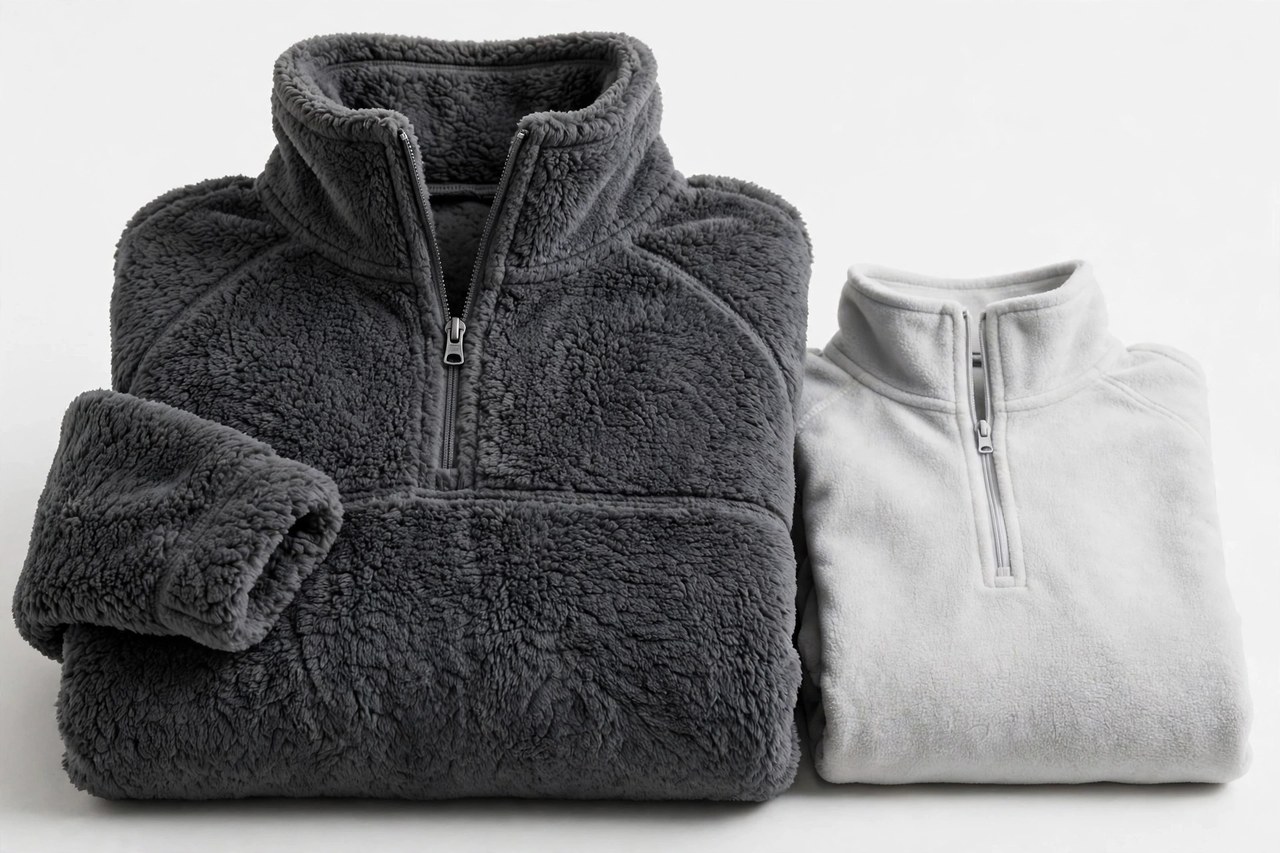
Every family has its heavyweight, and in the microfleece family it is this pullover: a quarter-zip top built from the thickest fleece weights, finished with a stand-up mock neck. Fleece weights run micro, 100, 200 and 300, and heavyweight means the top of that scale — dense polyester fleece that trades the usual fleece lightness for maximum warmth. The quarter zip and mock collar are not decoration on such a garment; they are how you get in, vent it, and seal its warmest feature — the neck — against serious cold.
Set it against its relatives. The standard quarter-zip pullover in micro or 100 weight is a polished, mild-weather top; the half-zip is the athlete's venting layer. The heavyweight quarter-zip mock is the cold-weather specialist: the pullover for winter walks, cold stands and sidelines, and the insulating mid layer under a winter coat when temperatures drop properly. It still starts from the same fabric — soft napped polyester fleece, first manufactured in 1979 by Malden Mills, now Polartec LLC — but at two to three times the thickness, it plays a different role.
What a Mock Neck Is
The mock in the name refers to the collar. A collar is the part of a top that fastens around or frames the neck, and a mock neck — short for mock turtleneck, or mock polo neck — is the turtleneck's simpler relative. A true turtleneck is a tall tube of fabric that folds over on itself; the mock version resembles it, standing up around the neck with a soft finish at its top, but both ends of the shorter tube forming the collar are sewn to the neckline. Nothing folds, nothing doubles back. The mock clings to the neck smoothly, is easy to manufacture, and works particularly well with a zip closure — which is exactly the combination used here.
On a cold-weather pullover, that construction is practical genius. The mock gives most of a turtleneck's throat coverage — the spot where scarves gap and wind sneaks in — with less fabric bunched under the chin and no fold to arrange. It lies flat under a coat collar or a zipped shell, and because it is sewn down at both edges it keeps its stand-up shape wash after wash instead of slumping. Zipped fully, the quarter zip closes right through the mock, so the collar seals into a continuous ring of heavy fleece around the neck.
Heavyweight Fleece in Cold Weather
Weight is warmth in fleece, because insulation is trapped air and thicker fleece traps more of it. A 200-weight garment is the family's all-round cold-weather layer; 300 is the thickest grade and the least flexible, a dense fleece that approaches a soft shell in hand-feel. Even at these weights, the polyester keeps its character: hydrophobic, holding less than 1% of its weight in water, insulating when damp, quick to dry and far lighter than equivalent wool — fleece offers wool's good qualities at a fraction of the weight of the lightest woolens, and it suits women who cannot wear wool at all.
Use the heavyweight mock as the middle of a winter system. Over a base layer and under a coat or shell, it is the insulation while the outer layer stops the wind — because even heavyweight fleece is not windproof, and moving air will strip its warmth on an exposed day. Worn alone, it shines on still, dry, cold days: frosty walks, outdoor markets, watching winter sports. The quarter zip earns its place even here, venting on the uphill or indoors before you overheat — a pullover this warm has no other escape valve.
Wearing the Heavyweight Mock Well
Fit a heavyweight pullover with its job in mind. Leave room for a base layer beneath — the dense fleece has less give than thin grades, and 300 weight is the least flexible of all — but avoid bagginess, which lets cold air circulate. The mock neck should hug the throat gently when zipped, never strangle, and a zip garage at the top keeps the pull off your chin. Long sleeves with snug cuffs and a hem that sits at the hip seal the other openings; check that the thicker fabric still lets you raise your arms without the whole garment riding up.
Care for heavy fleece as for any fleece, respecting its bulk. Machine wash cool and dry on low heat or line-dry: high temperatures in washing, tumble drying or ironing can damage polyester fleece, and a thick garment holds heat longer. Dense, quality heavyweight fleece resists the pilling that plagues cheap light fleece, but inspect rub zones like the sides and cuffs. Static builds readily in dry winter air, bringing the usual lint and pet hair. Stored clean and folded rather than hung — heavy knit stretches on a hanger — this pullover will anchor winter wardrobes for years.
Related Women's Guides
More to Explore on Apparel Search
- mock neck tops
- fabric unit of measure
- Women's Heavyweight Micro-fleece Quarter Zip Mock
- Women's Lightweight Microfleece Full Zip Jacket
- Women's Lightweight Microfleece Jackets
- Women's Microfleece Full Zip Jackets
- Women's Microfleece Hats
- Women's Microfleece Pajamas
- Women's Microfleece Pants
- Women's Microfleece PJ
- Women's Microfleece PJ Set
- Women's Microfleece Robes
- Women's Microfleece Shirts
- Women's Microfleece Unlined Jacket
- women's fleece clothing
Looking for Women's Clothing Stores?
This guide helps you choose women's heavyweight microfleece quarter zip mock. To browse where to buy, visit our women's clothing store directory, where you can find retailers that carry them.