Leather Jacket
Clothing Definitions — definitions of garments and clothing terms from Apparel Search
Search Apparel Search
At a Glance
Definition: A leather jacket is a jacket made from animal hide — most often cowhide, lambskin or goatskin — in styles that include the motorcycle jacket, the flight or bomber jacket and the tailored leather blazer.
Category: Clothing Definitions
A leather jacket is a jacket made of leather — a garment of clothing whose material is its definition. Most are black, dark grey or brown, and the family covers sharply different garments: the close, zippered motorcycle jacket, the waist-length flight or bomber jacket worn by military aviators, and soft tailored blazers and coats. This page explains the hides jackets are cut from, the principal styles and how each arose, the difference between fashion and protective jackets, and the care that lets a leather garment last for decades.
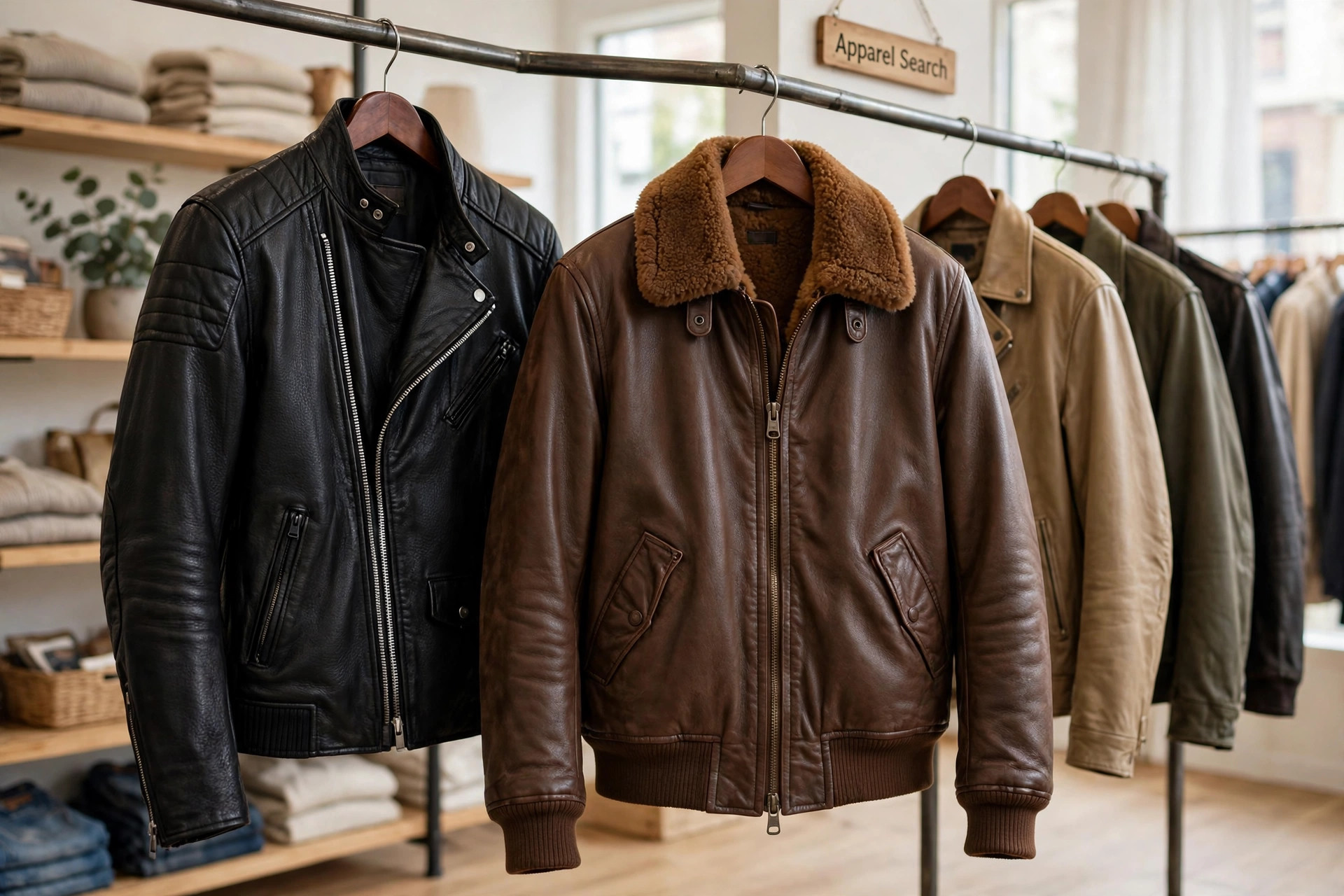
Hides and Construction
Cowhide is the working standard: thick, abrasion-resistant and durable, it is the hide of motorcycle and flight jackets, and it softens and moulds to the wearer over years without losing strength. Lambskin sits at the opposite end — thin, soft and light, with a smooth surface that suits tailored fashion jackets and blazers but marks more easily. Goatskin falls between the two, with a fine pebbled grain, good strength for its weight and a natural flexibility that made it a classic flight-jacket hide. Rougher traditional forms include buckskin, the soft deerskin of frontier dress — see buckskins — while patent leather, with its hard gloss finish, appears only in dressy novelty styles.
Construction follows use. A protective motorcycle jacket is cut close, with a heavy front zip, a lining that may carry armour pockets at shoulder, elbow and back, and seams sewn to survive a slide. A fashion jacket can be far lighter: thinner hide, simpler lining, decorative zips and quilting that carry the look of the protective garment without its weight. In both cases the hide is tanned, dyed through or surface-finished, and cut so that panels of even thickness meet at the seams — the quality checks a buyer makes on any leather jacket, at any price.
The Principal Styles
The motorcycle jacket is the most recognisable: waist-length, close-fitting, with an asymmetric front zip, snap-down lapels and collar, zippered cuffs and pockets, and usually a belt or belted hem. Every detail began as rider's equipment — the angled zip keeps the front flat when leaning over a tank, the snaps stop the collar flapping, the zips close pockets and cuffs against the wind. The flight jacket, or bomber, is the aviator's counterpart: waist-length and bloused, with a front zip, knit or fur collar, and knit cuffs and hem to seal out the slipstream, in the brown hide of its military origin, often with a sheepskin collar in the cold-weather versions.
Around those two anchors sit the tailored forms: the leather blazer, cut like a suit jacket in soft lambskin; the car coat and longer leather coats; the café racer, a minimal motorcycle style with a small stand collar and a straight centre zip; and leather versions of field and safari jackets. The rider's world also produced the jacket's legwear counterpart, chaps — open-backed leather leggings worn over trousers for protection — and the pairing of jacket, chaps and biker boots remains the full working outfit, surveyed in the women's biker fashion guide.
From Workwear to Icon
The leather jacket began as equipment — for aviators in open cockpits, for police patrols and for motorcyclists — and its second life as a symbol grew directly out of that practicality. Film carried it: the motorcycle jacket worn by Marlon Brando's gang leader in The Wild One (1953) and by James Dean in Rebel Without a Cause (1955) fixed the black zippered jacket as the uniform of the 1950s greaser and of screen rebellion generally; the Fonz of Happy Days wore the same jacket a generation later, and the aviator's bomber returned to the screen in Top Gun (1986). Musicians took it up in turn — punk bands such as the Ramones made the motorcycle jacket a stage uniform, and heavy metal and rock dress kept it in view for decades.
The symbol has since changed hands again. The plain black leather jacket became the personal signature of technology founder Jensen Huang, worn so consistently that it is now read as a deliberate uniform rather than a rebellion — Apparel Search's crossover profile Jensen Huang's leather jacket traces how the same garment moved from the motorcycle to the keynote stage. Through every change of meaning, the garment itself has stayed remarkably constant: hide, zip, close fit, waist length.
Fashion Jackets, Protective Jackets and Care
The distinction that matters when buying is the one the original definition insisted on: a jacket made for fashion is not protective equipment. A true riding jacket uses thick hide throughout, armour at the impact points, and construction tested as safety gear; a fashion jacket borrows the styling in thinner, softer leather and will not protect its wearer in a fall. Neither is a lesser garment — they are different products sharing a silhouette — but they should be bought, priced and used as what they are.
Care is simple and repays itself. Leather should be kept dry where possible, dried slowly at room temperature when wet — never on direct heat — and fed occasionally with a leather conditioner so the fibres do not dry and crack. Jackets store best on a wide, shaped hanger in a breathable cover, away from plastic, which traps moisture. Treated so, a cowhide jacket outlasts most wardrobes: the creases, sheen and moulding to one wearer's shape that develop over years are the patina buyers of vintage leather jackets pay for.
Common Questions
What is a leather jacket?
A leather jacket is a jacket made of leather, usually black, dark grey or brown in colour. Styles include the motorcycle jacket, the bomber or flight jacket, and tailored leather blazers.
What leather are jackets made from?
Jackets are most often made from cowhide for toughness, with lambskin used for softer, lighter fashion jackets and goatskin for a fine, durable grain. The hide is tanned and finished to resist wind and light rain.
Why are leather jackets associated with motorcyclists?
The zippered motorcycle jacket was designed for riders: its tough hide protected against wind and road abrasion, and its angled zip, snaps and belt kept it close at speed. The style then spread into general fashion.