Import Merchandiser Job Description
Merchandising lines made overseas — costing, production calendars and deliveries from factories abroad
An import merchandiser merchandises clothing lines that are manufactured overseas and imported for sale at home. The product judgement is the merchandiser's usual craft — the right garments, quantities and prices — but every decision runs through the realities of distance: factories in other countries and time zones, production calendars measured in months, costing that includes freight and duty, and deliveries that travel by sea or air before they reach a warehouse. Importers, high-street sourcing offices and private-label suppliers all employ import merchandisers as the link between the range plan and the foreign factory. This page explains the role's work and how it differs from domestic merchandising.
More Design Job Descriptions by Letter:
What an Import Merchandiser Does
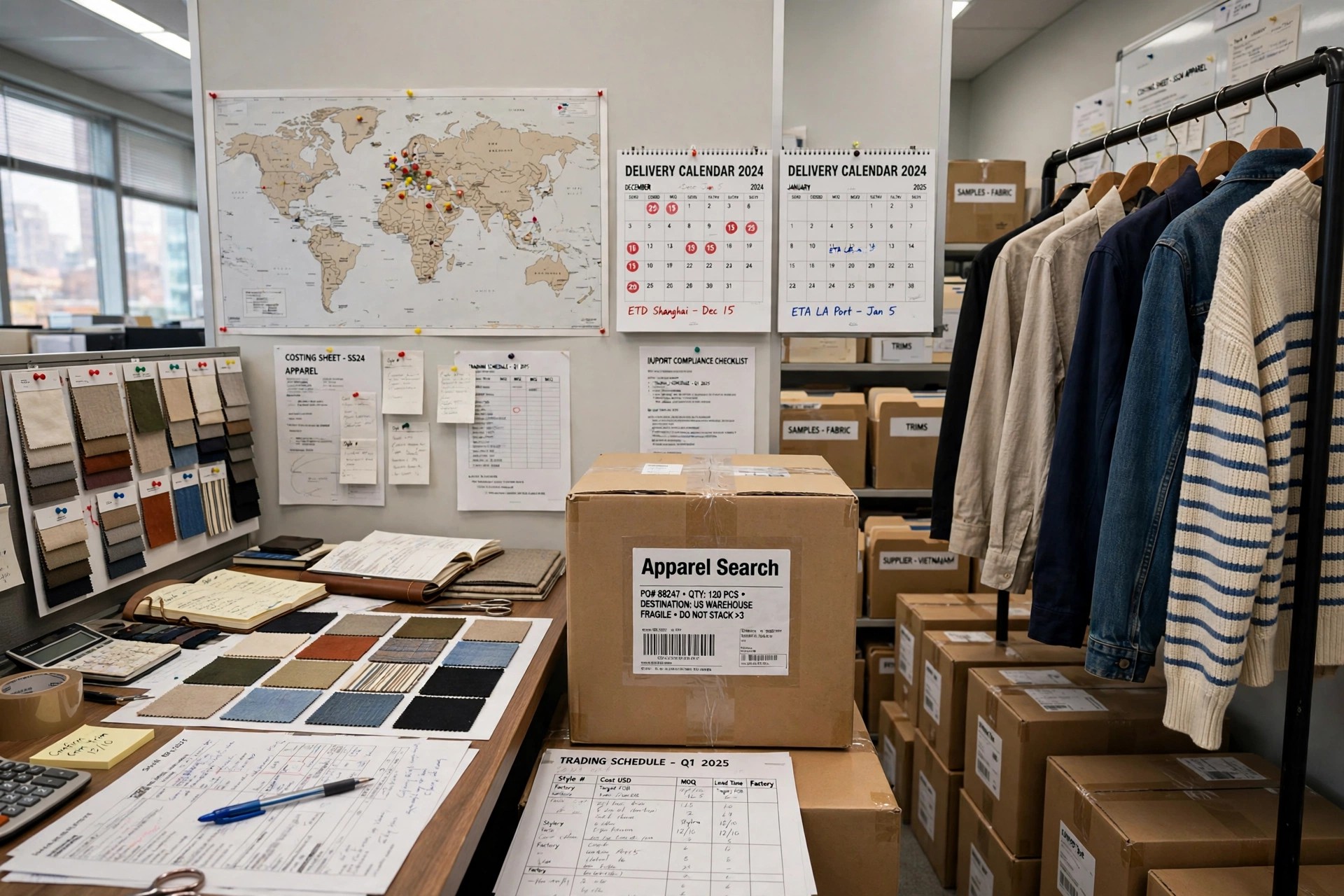
The role begins where the range is planned. The import merchandiser takes the styles a buyer or designer wants, places them with suitable overseas factories from the company's supplier base, and manages each style's journey: initial costing, sample requests, sample comments and approvals, order confirmation, production monitoring and shipment. A single season may involve dozens of styles across several factories and countries, each at a different stage, and the merchandiser's critical path — the timetable every stage must hit for goods to land on time — is the document the whole job is organised around.
Communication is the daily substance. The merchandiser corresponds with factories and agents on samples, prices, materials, labels, packaging and delivery dates, translating the buying team's intentions into instructions a factory can act on and the factory's constraints back into decisions the buying team must take. Sample rounds are judged and commented, production samples approved, and problems — a fabric delayed, a price moved, a shipment slipping — surfaced early with options attached, because an import problem discovered late cannot be fixed quickly across an ocean.
Costing, Calendars and Landed Goods
Import costing is the role's technical core. The price of an imported garment is built from the factory price plus freight, insurance, import duty and delivery to warehouse — the landed cost — and the merchandiser calculates and negotiates each element against the target retail price and margin. Currency movements can erase a margin between order and shipment, so exchange-rate awareness and, in larger companies, working with forward currency arrangements form part of the desk's routine. A style that costs beautifully at the factory gate can still fail at the warehouse door, and the import merchandiser is paid to see the whole journey's arithmetic.
Time is the second currency. Sea freight takes weeks, factory production slots are booked ahead, and public holidays in producing countries close factories on calendars the home office must plan around. The merchandiser builds these realities into the critical path, decides with buyers when a slipping style justifies air freight at a margin cost, and coordinates with shipping and warehouse teams so containers arrive, clear customs with correct documentation and land when the range needs them. Seasonal product that misses its selling window is worth a fraction of its price; protecting the window is the job.
Skills and Abilities the Role Requires
Commercial and numerical fluency come first: landed-cost calculation, margin arithmetic, order-quantity judgement and the spreadsheet discipline to run many styles' figures without cross-contamination. Product knowledge matters equally — the merchandiser handles samples daily, comments on fit and make with garment technologists, and must recognise when a factory's substitution or shortcut changes the product the buyer approved.
The human skills are distinctive. Negotiating with factories firmly without destroying relationships the company needs next season, writing instructions so clearly they survive translation and time zones, chasing without alienating, and staying systematic when fifty styles demand attention the same morning — this is the temperament the role selects for. Language skills and experience of producing countries are advantages employers value, and travel to factories for production and development visits is a normal, prized part of the senior role.
Qualifications, Training and Career Path
Import merchandisers typically come through merchandising, buying-support or production-coordination roles, or through fashion business and supply-chain qualifications that teach costing and sourcing. Many employers train from assistant import merchandiser or import coordinator posts, where the critical path, documentation and factory correspondence are learned style by style. Practical knowledge of garment construction, fabrics and print and wash processes strengthens applications, because sample comments are a core duty from early on.
Progression runs to senior import merchandiser owning a product area or a group of factories, then to import or sourcing management with responsibility for supplier strategy across countries. The experience also transfers into production management, supply-chain and private-label development roles. In a trade where much of the world's clothing crosses a border before it is sold, the import merchandiser's combination of product judgement, arithmetic and international working is a durable and well-rewarded expertise.
Common Questions
How is an import merchandiser different from a fashion merchandiser?
A fashion merchandiser plans ranges and manages sales and stock performance. The import merchandiser's centre of gravity is supply: costing and ordering lines from overseas factories, managing samples and production on a critical path, and landing goods on time at a landed cost that protects the margin.
What is landed cost and why does it matter?
Landed cost is the full cost of an imported garment when it reaches the warehouse: factory price plus freight, insurance, import duty and delivery. Retail prices and margins are judged against landed cost, so miscalculating any element turns a profitable style into a loss-making one.
Do import merchandisers travel to factories?
Often, especially at senior level — for development trips, production checks and supplier relationship work. Day to day, the job runs on structured correspondence, samples and critical-path management with factories and agents across time zones.