Licensed Print Designer Job Description
Designing prints for licensed clothing — repeats, placements and artwork built inside a licensor's style guide
A licensed print designer creates the printed artwork for clothing made under licence: the all-over repeat on a character pajama set, the placement print across a licensed band t-shirt, the pattern built from a film studio's icon library. The print craft is the textile designer's craft — repeats, colourways, scale and fabric behaviour — but every motif belongs to someone else. The designer works from the licensor's style guide and asset files, builds prints the owner's brand-assurance team will approve, and engineers them so a factory can print them identically on ten thousand garments. This page explains that double discipline of artistry and permission.
More Design Job Descriptions by Letter:
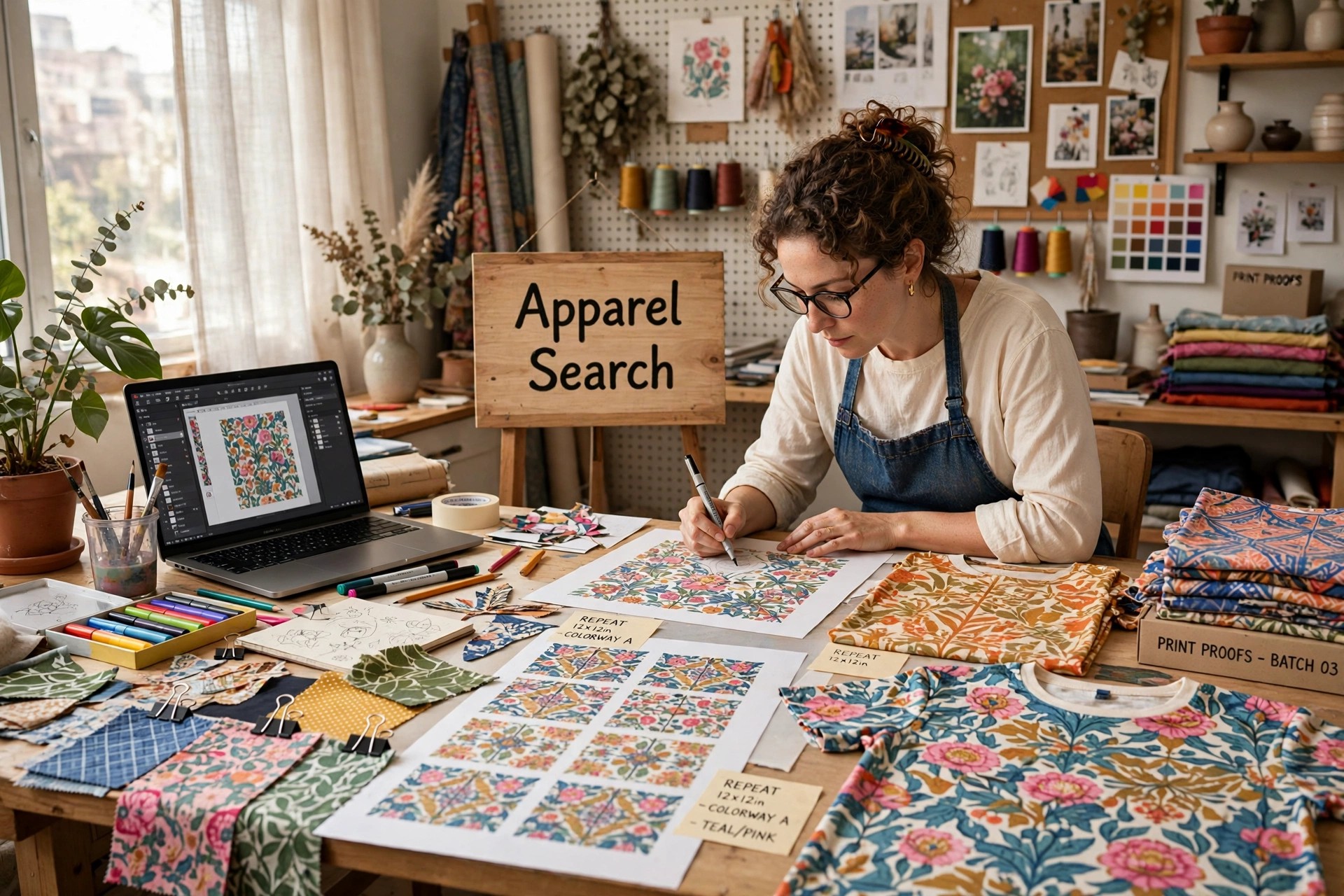
What a Licensed Print Designer Does
The work begins with the property and its assets. For each licensed property the designer receives the style guide and the approved artwork library — characters, logos, icons, patterns and colour standards — together with the licence's category list, which fixes what kinds of garments the prints may appear on. From those ingredients the designer develops print stories for the season: all-over repeats for fabrics, placement prints for chests and backs, border and engineered prints for specific garment shapes, each matched to the retail channels and price points the licensed range serves.
Nothing is finished until the licensor approves it. Designs are submitted at concept stage with the assets used identified, developed into print-ready artwork, and submitted again with colourways and garment mock-ups before production. The designer tracks every submission, answers brand-assurance comments — a character repositioned, a colour corrected to the property standard, a forbidden combination removed — and keeps the approved artwork, and only the approved artwork, flowing to the printers. Strike-offs of each print are checked against the approval before bulk printing begins.
Repeats, Colourways and Print Engineering
Underneath the licensing sits ordinary, demanding print engineering. An all-over design must repeat seamlessly — the motif joins at every edge of the repeat tile without a visible seam — and the repeat size is chosen for the garment and the printing method: rotary screen printing fixes repeat dimensions to the screen circumference, digital printing frees the size but charges by coverage. The designer separates the artwork into its print colours, sets the repeat in the factory's required format, and specifies scale relative to the garment so a motif reads correctly on a child's size six and an adult extra-large alike.
Colourway work multiplies every design. Each print is developed in the property's approved palette and in the seasonal colour stories the range needs, with backgrounds, motif colours and outline weights adjusted per colourway so contrast survives on dark and light grounds. The designer also designs for the substrate: the same artwork prints differently on cotton jersey, fleece and synthetic sportswear fabrics, and ink coverage, fine line and half-tone limits differ by mill. Print designers who ignore the cloth produce beautiful files and disappointing garments.
Skills and Abilities the Role Requires
Print design skill is the foundation: drawing and motif development, seamless repeat construction, colour separation and confident work in the standard artwork software at production standard. Layered on it is style-guide fluency — the ability to absorb a long guide's hard rules (character proportions that may not change, logos that may not be recoloured, assets that may not be combined) and design freely inside them, because every rule broken is an approval lost and a week gone from a calendar that has no spare weeks.
Accuracy and record-keeping carry unusual weight in this specialism. Asset versions, approval stages and colourway variants multiply quickly across several properties at once, and sending a factory an unapproved or superseded file can mean reprinting a production run at the licensee's cost — or worse, selling product the licensor never passed. Employers therefore look for designers whose files, names and submission records are meticulous, alongside the creative evidence of prints that feel native to each property they serve.
Qualifications, Training and Career Path
Licensed print designers usually train in textile design, surface pattern or graphic design with a print focus, and hiring is portfolio-led: employers want repeats that join invisibly, colourways that work, and evidence of designing inside a brief's constraints. Entry is commonly through a licensee's print studio as a junior designer or artwork assistant, learning the approval systems and the asset discipline on live properties while building production speed.
Progression runs to senior print designer owning a property portfolio's print direction, and into print studio management across many licences. The skills also transfer into unlicensed textile print design, licensed product design beyond prints, and brand-assurance roles on the licensor's side, where yesterday's submitters become today's approvers. Wherever entertainment, sport and brand properties extend into clothing, printed product is usually the largest category — and this designer is the one who makes it.
Common Questions
How is licensed print design different from ordinary textile print design?
The craft — repeats, colourways, separations — is the same, but the motifs belong to a licensor. The designer works only from approved assets, follows the property's style guide exactly, and passes staged licensor approvals before any print may be produced.
What is a seamless repeat?
A pattern tile engineered so its edges join invisibly when repeated across fabric: motifs crossing one edge re-enter on the opposite edge, producing continuous pattern with no visible grid. Building clean repeats at production scale is a core skill of this role.
How do you become a licensed print designer?
Train in textile, surface pattern or graphic design with a print focus, build a portfolio of production-standard repeats and colourways, and enter a licensee's print studio in a junior role to learn style guides and approval systems on live properties.
More to Explore
- Designer Search
- Apparel Licensing
- Licensing Agents
- Licensing Companies
- Licensing by Brand Name
- Graphic Designers Guide
- Merchandising Clothing
- Fashion Artists Guide
- CAD Services
- Computer Assisted Design
- Fashion Job Description Directory
- Fashion Employment Agencies
- Employment Search Engines
- Fashion Schools and Education
- Fashion Careers