Product Development Engineer Job Description
The engineering side of garment development — materials, construction, testing and specifications that make clothing perform as designed
A product development engineer brings engineering method to the making of clothing. Where the product development developer coordinates the journey of a garment from concept to sample, the engineer solves the technical problems along that journey: will this fabric hold this construction, will this seam survive its wearer's use, does this garment meet its performance claims, and how should it be specified so that a factory can reproduce it exactly, thousands of times? The role is strongest where clothing must perform — sportswear, outdoor clothing, workwear, protective garments and technical products — but any complex garment benefits from an engineer's eye. This page explains the technical desk inside apparel development.
More Design Job Descriptions by Letter:
What a Product Development Engineer Does
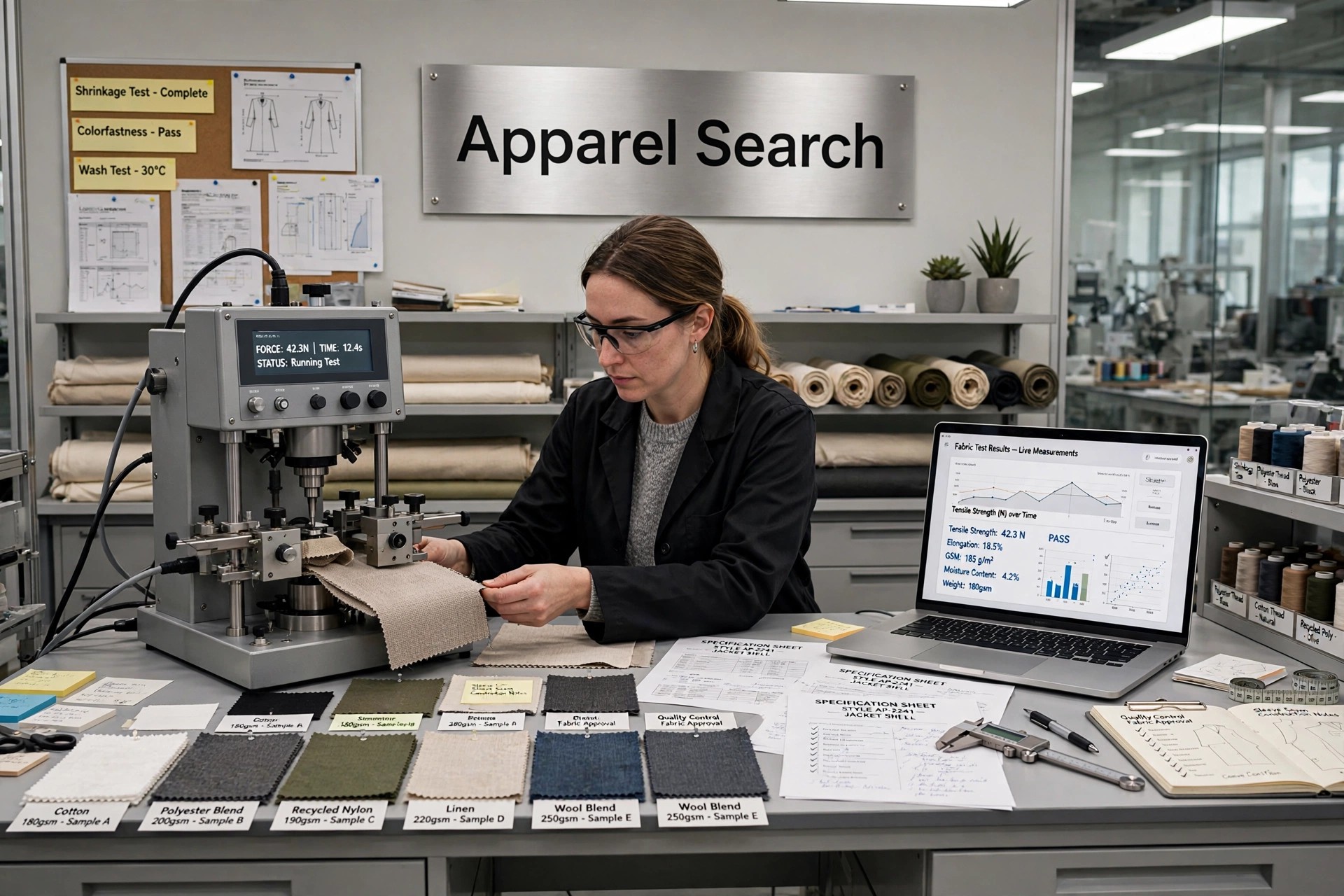
The engineer's work starts with requirements. A brief for a waterproof jacket, a compression garment or a uniform is translated into measurable targets: water resistance and breathability figures, stretch and recovery ranges, seam strengths, dimensional stability after washing, colourfastness grades and weight limits. The engineer then works backwards from those targets to materials and construction — selecting membranes, yarns, fabrics and trims against test data rather than hand-feel alone, and choosing seam types, stitch densities, bonding or welding methods and reinforcement placements that will deliver the required performance in a garment a factory can actually build.
Development proceeds by test and iteration. Prototype garments and material samples go through laboratory testing — in-house or at external test houses — and the engineer reads the results forensically: a failed seam-slippage test is traced to yarn, weave, stitch or seam allowance; a delaminating bonded seam sends the team back to adhesive, temperature or pressure settings. Each finding is written into the specification, because the engineer's end product is not only a working sample but a technical file — materials, construction, tolerances and test standards stated precisely — from which production can be made and against which production can be audited.
Materials, Testing and the Performance Specification
Materials knowledge at engineering depth is the role's distinguishing asset. The engineer understands fibres and fabric structures as physical systems: how a knit recovers, why a woven slips at the seam, what a membrane's ratings mean in rain rather than in a brochure, and how finishes — water repellency, antimicrobial treatments, flame retardancy — behave over the garment's washed life. That knowledge is applied commercially: performance has a cost curve, and the engineer advises where a higher specification genuinely protects the wearer or the brand, and where a cheaper material meets the real requirement just as honestly.
The work environment divides between laboratory, sample room and supplier. Test equipment, microscopes and specification systems share the week with factory trials, wear-test programmes — garments issued to real users whose feedback is logged and analysed — and technical meetings with mills and component suppliers about new materials. Regulatory and standards knowledge matters more here than anywhere else in design: protective and children's products in particular carry legal requirements, and the engineer is usually the person who ensures a development does not design its way into non-compliance. Precision is the culture of the desk; opinions are expected to arrive with data attached.
Skills and Abilities the Role Requires
Analytical problem-solving is the headline skill: isolating variables, reading test results, forming a cause hypothesis and proving it with the next trial, in a trade where the temptation is to change three things at once and learn nothing. That method rests on technical fluency — textile and garment construction knowledge, testing standards and methods, specification and technical drawing, and the data tools to record and compare results across development rounds and seasons.
Communication is the skill that makes the analysis useful. The engineer must explain a technical finding to designers in design language, to buyers in cost language and to factories in unambiguous instruction, and must sometimes deliver unwelcome news — a beloved fabric cannot do what the brief asks — early enough and constructively enough that the team can act on it. Patience with iteration, care with records, and genuine curiosity about materials complete the profile. It is a role for someone who loves clothing and loves evidence, and refuses to choose between them.
Qualifications, Training and Career Path
Product development engineers usually hold degrees in textile technology, materials science, product or mechanical engineering, or apparel technology, often with postgraduate or industry training in garment construction and testing. Entry routes include materials and testing roles in mills and test houses, garment technology posts, and development engineering assistant positions in performance brands. Employers test for applied knowledge: candidates who can discuss why a fabric failed a test, or how they would engineer a garment to a stated performance target, stand out over those with theory alone.
Progression leads to senior engineer and technical management — heading materials research, development engineering or innovation teams — with specialist paths in areas such as wearable technology, sustainability engineering and protective clothing certification. The role's alumni also move into quality and compliance leadership, where the same evidence discipline governs production rather than development. As clothing becomes more technical — heated, sensing, protective, recyclable by design — the engineer inside the development team moves from specialist support to strategic centre, and this desk is where that future is being built.
Common Questions
How is a product development engineer different from a product developer?
The developer coordinates a style's whole journey — calendar, samples, costing and factories. The engineer solves its technical problems: translating performance requirements into materials, construction and testable specifications, and proving by laboratory and wear testing that the garment meets them.
What products most need a product development engineer?
Clothing with measurable performance duties: sportswear and outdoor garments, workwear and uniforms, protective and certified products, compression and medical textiles, and any garment whose brand promise rests on claims that testing must support.
How do you become a product development engineer in apparel?
Study textile technology, materials science, engineering or apparel technology, build garment construction and testing knowledge in mills, test houses, garment technology or performance-brand development roles, and learn to write specifications factories can build and audit against.
More to Explore
- Fashion Employment Agencies
- Employment Search Engines
- Fashion Job Description Directory
- Fashion Industry News
- Fashion Directory
- Product Development Process
- Fashion Schools and Education
- Fashion Careers
- Fashion Product Development
- Fashion Merchandising
- Merchandising Clothing
- Fashion Artists Guide
- Computer Assisted Design
- CAD Services