Window Design Job Description
Conceiving store windows as design work — themes, sketches, props and schemes that stop people on the pavement
Window design is the conception stage of the shop window: inventing the idea, developing it on paper and in model form, and specifying everything needed to build it. A window designer answers a brief — a new season, a product launch, a sale, a festival moment — with a scheme that must stop a moving pedestrian in roughly three seconds, express the brand without a word of explanation, and remain buildable within a real budget, a real window's dimensions and a real installation night. The designer may never touch the finished window; the work is the quality of the conception others will construct.
More Design Job Descriptions by Letter:
Conceiving the Window: Theme, Story and Brief
Every scheme starts from the brief's commercial core — what must the window sell, celebrate or announce — and from the brand's current campaign imagery, which the window usually extends into three dimensions. The designer researches visual references far beyond retail: theatre sets, exhibition design, sculpture, film stills and street art all feed a concept board, from which two or three distinct routes are developed. A strong concept can be summarised in one sentence and one dominant image; if the idea needs a paragraph to explain, it will not survive the pavement test.
Design judgement includes knowing what a window cannot do. Sunlight fades fabrics and washes out subtle colour, glass reflects the street back at the viewer, and a scheme that reads beautifully in a render may vanish at an angle from across the road. Experienced designers build these constraints into the concept — bold silhouettes, controlled colour fields, layered depth that rewards both the distant glance and the close look at the product placed nearest the glass.
Sketching, Modelling and Specifying the Scheme
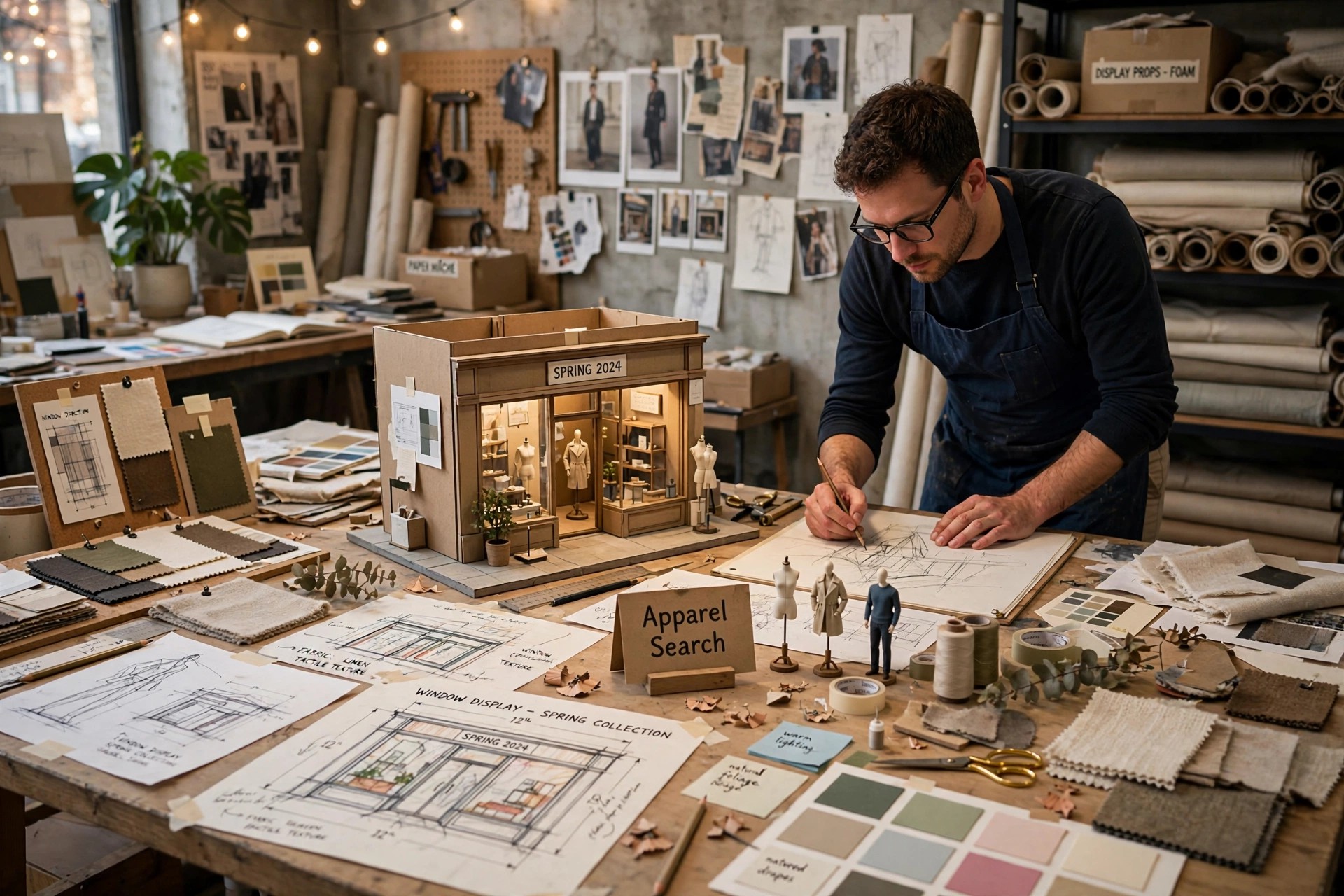
Concepts are developed through sketching, digital visualisation and, for major schemes, scale models or full-size mock-ups of critical elements. The designer draws elevations and plans, experiments with mannequin poses and groupings on paper, and tests how props, graphics and product will share the space. Colour and material samples are gathered early, because a prop's actual finish under spotlights decides whether a scheme feels premium or pantomime.
The finished design is issued as a specification others can build from: dimensioned drawings, a prop and materials list with sources or fabrication instructions, graphic artwork and typography, a lighting intention, the product list with styling notes, and an installation sequence. For chains, the designer also writes the adaptation rules — how the scheme scales to the flagship's six windows, the standard store's two and the concession's single vitrine — which is design work of a particularly unforgiving kind.
The Window Calendar: Seasons, Launches and Campaigns
Window designers plan in calendars. The year divides into major seasonal statements, campaign windows tied to marketing moments, product-launch features and trading windows for sales and clearances, each with different design weights and budgets. Lead times are long: a Christmas scheme may be designed in spring, its props fabricated over summer, because fabrication, shipping and multi-store rollout consume months. The designer therefore works on several seasons simultaneously and keeps a library of adaptable concepts for the unplanned window — the sudden collaboration, the heatwave, the product that must be famous by Friday.
Budgets shape creativity directly. The designer costs each route, separates one-off fabrication from reusable stock, and designs props with second lives in mind — a structure that re-skins for three campaigns is worth more than a masterpiece used once. Sustainability expectations now enter the brief itself, favouring hired, recyclable and reusable elements over landfill-bound spectacle.
Collaborating With Buyers, Brands and Builders
The designer sits between marketing, buying and the people who install. Buyers argue for the product that must feature; marketing guards campaign consistency; installation teams report what cannot be built in the time a night allows. The designer's craft includes absorbing these pressures without diluting the idea into a committee average — and knowing when a builder's objection is a gift that improves the scheme. Presentations, approvals and revisions are a large share of working hours, and the ability to defend an idea with references, models and costs is as employable as the idea itself.
Skills and Training for Window Designers
Drawing remains the core tool, now partnered with digital visualisation and 3D software; spatial imagination — thinking in volumes, sightlines and scale — is the talent underneath both. A working knowledge of materials, basic construction, graphics and lighting lets designs stay buildable, and fashion literacy keeps the product styling inside the scheme credible. Training routes include display and exhibition design, visual merchandising and theatre design courses, and apprenticeship inside retail design studios, where juniors build the research boards, models and specifications from which senior designers learn to trust them with concepts.
Work Environment and Career Path
Designers work in retailer and brand head-office studios, in specialist display design agencies serving many clients, and freelance. The environment is studio-based — drawing boards, screens, material libraries, model benches — with site visits to measure windows and review installations. Career progression runs from junior designer to designer to senior or head of window design, agency creative lead, or into broader retail design and brand experience roles. The portfolio is the career document: photographed windows and the drawings behind them, showing ideas that were actually built and traded.
Common Questions
What does a window designer actually produce?
Concepts and the means to build them: concept boards, sketches and visualisations, scale models where needed, dimensioned drawings, prop and graphics specifications, product and styling lists, and adaptation rules for different window sizes across a chain.
How is window design different from window display?
Design is the conception and specification; display is the physical realisation — building, dressing and installing the scheme in the glass. They are covered on separate pages of this directory because the skills, settings and daily work differ, even though careers often cross between them.
When is Christmas window designed?
Usually in spring. Major seasonal schemes need months for approval, prop fabrication, shipping and rollout to many stores before the autumn installation night, so window designers habitually work two or three seasons ahead of the street.