Royalty Accountant Job Description
Accounting for licensed fashion — royalty statements, guarantees and audits where brand licences meet the ledger
A royalty accountant keeps the money side of fashion licensing accurate. When a brand licenses its name to an apparel maker — or a clothing company licenses a character, team, college or celebrity property for its garments — the licence agreement promises the property owner a royalty on sales, usually with minimum guarantees and advances. The royalty accountant calculates what is owed, prepares and checks the statements that report it, tracks guarantees against earnings, and audits the other side's figures when the company is the licensor. It is accounting with contracts open beside the ledger.
More Miscellaneous Job Descriptions by Letter:
Statements, Calculations and Guarantees
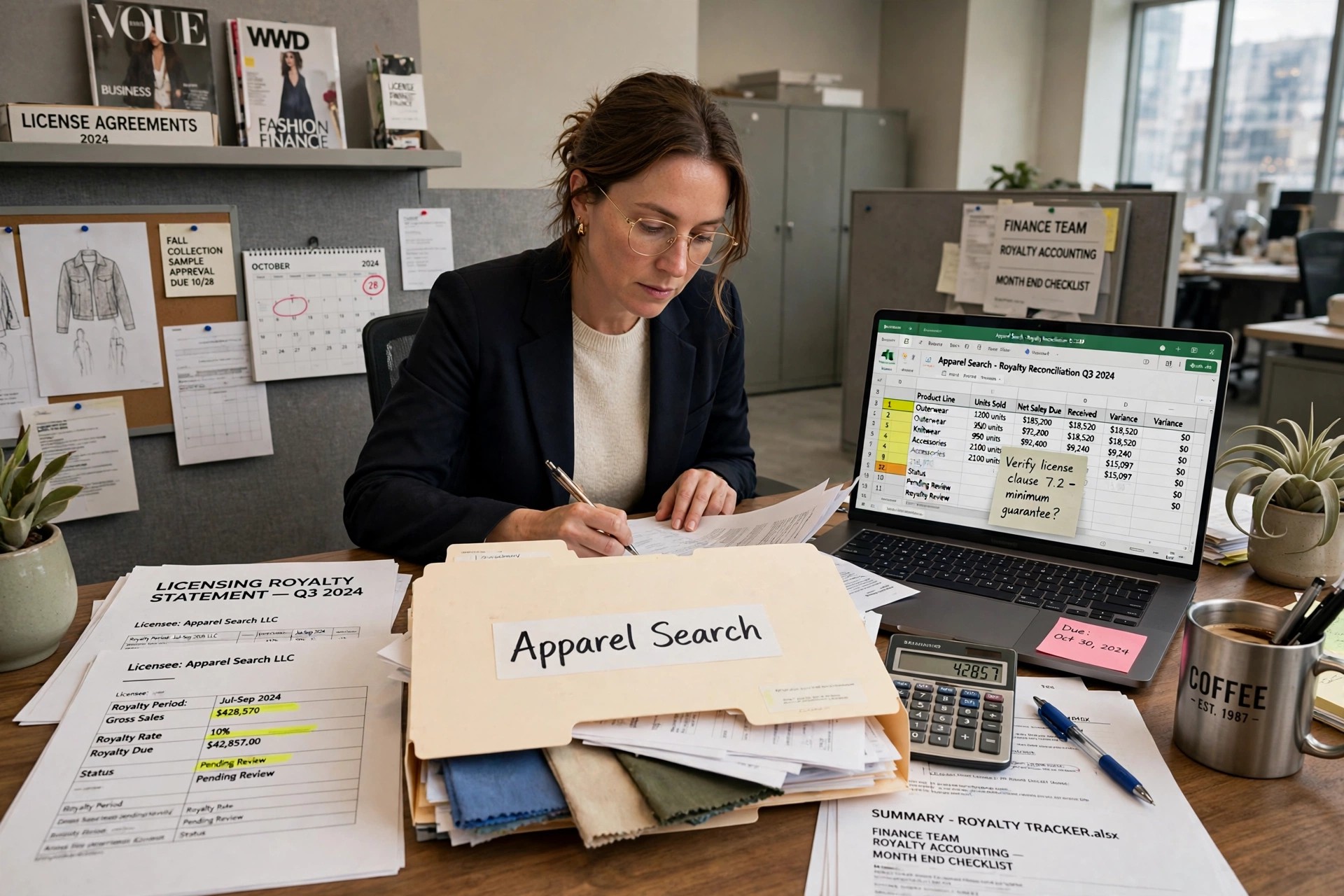
The working cycle is the royalty statement. Royalty accountants collect sales data by licensee, product category and territory, apply each agreement's royalty rate to the correct definition of net sales — agreements differ on deductions for returns, discounts and freight, and reading the contract precisely is the job's first skill — and produce statements and payments for licensors, or check incoming statements against the company's own sales records when the company manufactures under licence. Errors are rarely dramatic; they are definitional, a rate applied to the wrong sales base, repeated faithfully for four quarters, which is exactly why a specialist checks them.
Guarantees and advances give the work its forward view. Licence agreements commonly promise minimum royalties regardless of sales, with advances paid up front and recouped from royalties as they earn out. The royalty accountant tracks each agreement's position — how much of an advance remains unearned, which guarantees fall due this year, which licences are underperforming their minimums badly enough to matter — and reports that position to licensing and finance leadership in time for renewals, renegotiations and exits to be decided on facts rather than surprises.
Audits, Compliance and the Licensing Relationship
Audit is the function's enforcement arm. Licensors hold rights to inspect a licensee's records, and royalty accountants on the licensor side plan and conduct — or brief external auditors to conduct — royalty audits: sampling sales records, testing deductions, tracing products in the market back to reported sales. On the licensee side, the same accountant prepares for those audits by keeping records that would survive one. Findings in this field are usually resolved commercially — an underpayment calculated, paid, and the reporting process fixed — and the accountant's credibility with both sides rests on being exact without being theatrical.
Compliance runs alongside the arithmetic. Royalty accountants verify that reported sales match the products and territories the agreement actually permits, flag unlicensed product or unreported channels, and keep agreement records — rates, terms, expiries, approvals — organised so no licence is traded on after it ends or renewed on terms nobody checked. The daily partners are the licensing team, who negotiate and manage the deals, and general finance, into whose accounts royalty income and cost must land correctly each period. The accountant does not make the deals; the accountant makes the deals true.
Skills and Abilities the Role Requires
Accounting technique is the foundation: reconciliations, accruals, multi-currency sales where licences cross borders, and spreadsheet and accounting-system fluency strong enough to reperform a licensee's whole calculation from raw sales data. Contract literacy is the specialism — royalty bases, deduction definitions, guarantee structures, audit and interest clauses — read at the level where a single defined term moves five figures. Fashion knowledge is practical rather than decorative: categories, seasons and channels explain the shape of sales data, and an accountant who understands a licensed apparel programme spots the missing category in a statement by its absence.
Temperament decides trust. Royalty work sits between two parties whose interests differ by exactly the amount being calculated, so the accountant's exactness, documentation habits and even-handedness are the function's reputation with licensors, licensees and auditors alike. Confidentiality is absolute — sales by licence and partner are among the most sensitive numbers a brand holds — and persistence matters practically, because statements arrive late, data arrives badly formatted, and the quarter closes whether the licensee's spreadsheet made sense or not.
Qualifications, Training and Career Path
Royalty accountants hold accounting qualifications or degrees and typically build toward full professional accountancy status while working, entering through accounts assistant, royalty assistant or licensing-finance posts with licensors, licensees, licensing agencies and entertainment and sports property owners. Employers train accountants in their royalty and rights-management systems and in the agreement portfolio they will administer. Experience with licensed products — apparel above all, where volumes, seasons and returns complicate every rate — is the background licensors ask for by name.
Progression runs to senior royalty accountant and royalty or licensing finance manager — owning the statement calendar, audit programme and a portfolio of major agreements — and onward into licensing commercial leadership for those who broaden from the ledger into deal economics. Specialists also move between licensor and licensee sides across a career, and that double perspective is prized: an accountant who has prepared statements and audited them knows precisely where the errors hide, on both sides of the signature.
Common Questions
What does a royalty accountant do in fashion?
They administer the money in licensing agreements: calculating royalties on licensed apparel sales, preparing and checking royalty statements, tracking minimum guarantees and advances, supporting royalty audits, and making sure royalty income and costs land correctly in the accounts.
How is a royalty accountant different from a licensing manager?
Licensing managers negotiate and manage the deals and relationships. Royalty accountants administer what the signed deals promise — the calculations, statements, guarantees and audits. The roles work as partners, but the accountant's ground is the contract's numbers, not its negotiation.
What qualifications do royalty accountants need?
Accounting qualifications or a degree, usually progressing to full professional status, plus experience in licensing or royalty administration. Contract literacy — royalty bases, deductions and guarantees — and exact reconciliation skills are the specialism employers test.
More to Explore
- Fashion Employment Agencies
- Employment Search Engines
- Fashion Job Description Directory
- Fashion Directory
- Fashion Industry News
- Fashion Schools and Education
- Fashion Careers
- Licensed Apparel Merchandiser Job Description
- Licensed Print Designer Job Description
- Licensed Apparel Designer Job Description
- Apparel Industry Links
- Fashion Licensing