Sample Maker Job Description
Sewing complete prototype garments in the sample room — the first physical version of every new style
A sample maker sews the first real versions of new garments: complete prototype, fit, photo and pre-production samples, made one at a time from a pattern and a designer’s or developer’s instructions. Before a style can be costed, fitted, sold or put into production, someone has to prove it can actually be made — and that proof is the sample maker’s work. It is whole-garment, high-skill sewing: every operation in the garment, performed by one pair of hands, on styles that have never been sewn before.
More Production Job Descriptions by Letter:
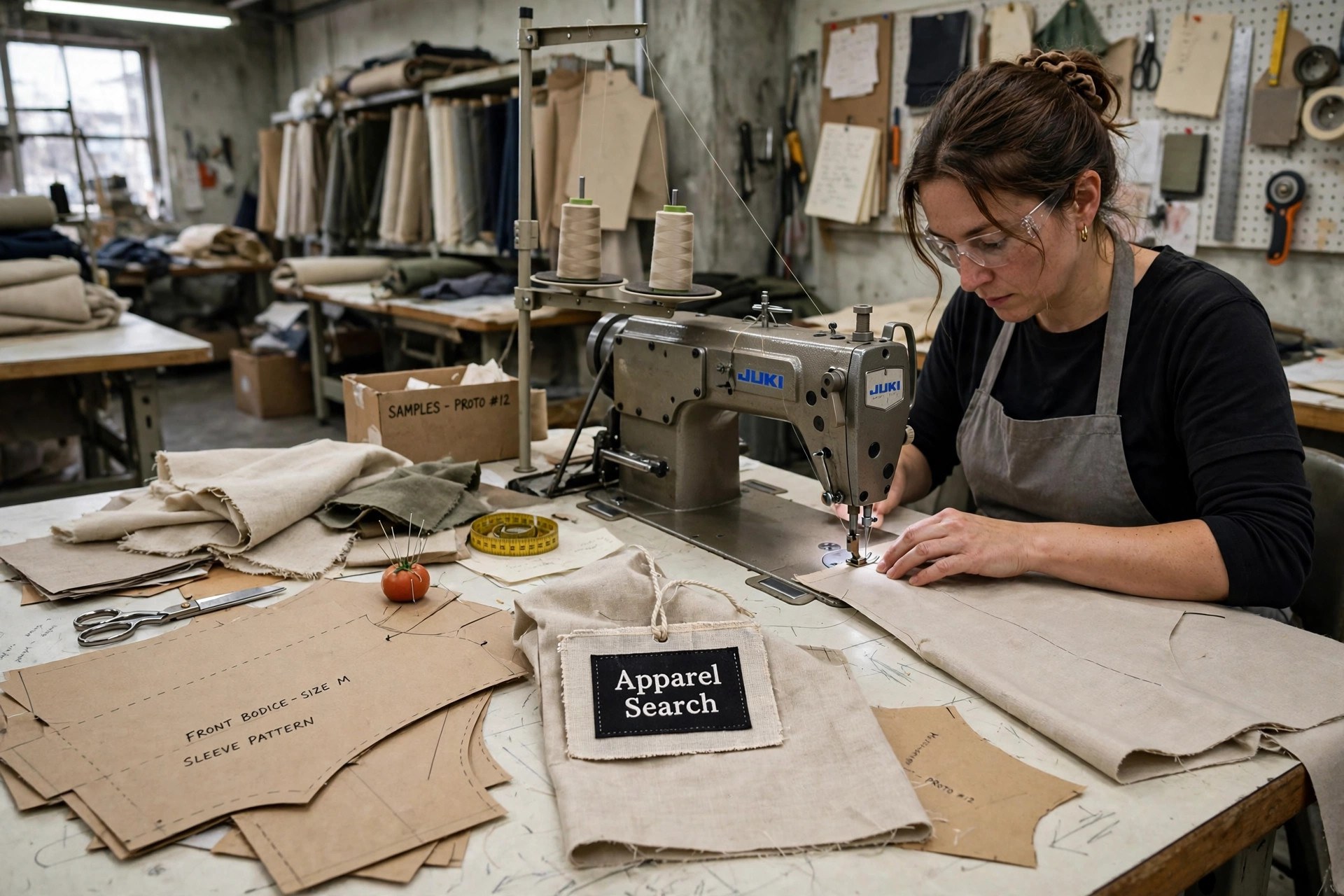
Sewing Prototypes and Development Samples
The sample maker receives cut pieces — or cuts them from the pattern where the sample room works that way — together with the style’s instructions, and constructs the entire garment: seams, linings, collars, cuffs, pockets, zips, buttonholes, hems and finishing, in the order that makes construction sense rather than the order a production line would impose. First samples are deliberately experimental: construction methods are tried, changed and tried again until the garment looks and behaves as intended.
Sample stages structure the work. A proto or mock-up proves the basic shape, often in substitute fabric; fit samples are sewn accurately enough to be measured and fitted on a model or stand; revised samples embody each round of corrections; sales and photo samples must be finished to retail standard; and the pre-production sample sets the exact construction standard the factory will follow in bulk. Each stage raises the bar, and the sample maker’s consistency is what lets the team trust comparisons between them.
Working With Pattern Makers, Designers and Factories
Sample making is a conversation. The sample maker is usually the first person to discover that a pattern piece is missing a notch, that two seams cannot be joined in the designed order, or that a fabric behaves nothing like the toile suggested — and the feedback goes straight back to the pattern maker and designer while the style can still change cheaply. Experienced sample makers suggest construction improvements instinctively: a seam moved for strength, a facing reshaped, an operation simplified for the factory’s machines.
That production awareness matters because the sample is also the factory’s teacher. The approved pre-production sample, with its construction notes, shows bulk production exactly how the garment goes together, and sample makers in brand sample rooms often review factory-made samples against their own work. Where samples are made inside factories, the sample machinist is the most skilled sewer in the building, pulled onto every difficult new style before it reaches the lines.
How Sample Making Differs From Line Sewing and Seamstress Work
Against line sewing, the contrast is breadth against repetition: a sewing operator performs one operation thousands of times, while a sample maker performs every operation once, on a new style each time, reading patterns and instructions rather than following a bundle routine. Against seamstress work, the difference is purpose: the seamstress finishes, alters and perfects garments that already exist, with hand craft at the centre, while the sample maker constructs new garments from pieces, with machine construction and pattern interpretation at the centre. The crafts overlap in skill, and people move between them, but the sample room recruits for construction knowledge above all.
Pace follows the development calendar rather than the production line: intense before range deadlines, fittings and trade shows, and varied in between. Sample makers work in brand and factory sample rooms, in pattern and development studios, and in the workrooms of designers who still develop in-house — settings where their output is small in quantity and decisive in influence, because a style lives or dies by its samples.
Skills, Training and Career Path
The requirement is complete garment construction ability: industrial machine mastery across operations, pattern reading, fabric knowledge, and the problem-solving to make an untested style come together. Most sample makers arrive with years of sewing behind them — production machining, seamstress and alteration work, or dressmaking — plus fashion construction study where available. Employers test with a real sample: give the candidate pieces and instructions, and watch how the garment is built.
Senior sample makers become sample room supervisors, pattern-room and development coordinators, garment technologists and production specialists, valued because they know what factories can and cannot do. Some specialise — tailoring, dresses, swim and stretch fabrics, outerwear — where construction knowledge is deepest; others found sample and development studios serving several brands. In an industry trying to sample faster with fewer physical iterations, the sample maker who gets a style right first time is worth more every season.
Common Questions
What does a sample maker do?
Sews complete sample garments — prototypes, fit samples, sales samples and pre-production samples — from patterns and instructions, one garment at a time, and feeds back construction and pattern problems to designers and pattern makers before bulk production.
How is a sample maker different from a sewing operator?
A sewing operator repeats one machine operation on a production line. A sample maker constructs an entire new garment each time, performing every operation, interpreting the pattern and solving construction problems as they appear.
How do you become a sample maker?
By building complete garment construction skill: years of machine sewing, dressmaking or alteration work, or fashion construction study, then junior sample-room roles. Hiring is by practical test — sewing a sample garment from pieces and instructions.
More to Explore
Sample Room Resources
References & Further Reading
More Job Description Categories
- Buying Job Descriptions
- Design Job Descriptions
- Marketing & PR Job Descriptions
- Miscellaneous Job Descriptions
- Planning & Allocation Job Descriptions
- Production & Sourcing Job Descriptions (current)
- Sales & Selling Job Descriptions
- Transportation & Warehouse Job Descriptions