VP Distribution Job Description
The executive over the whole distribution network — every building, lane and service promise between factory and customer
A VP distribution — a vice president of distribution — is the executive accountable for how an apparel company physically gets its clothing to stores and customers. The remit is the network, not a single building: every distribution center the company runs or rents, the transport lanes between them and out to stores, the inventory placed across them, and the service levels and costs the whole system produces. It is the most senior distribution role in this directory, and the desk where warehouse performance stops being an operational matter and becomes a company decision.
More Transportation & Warehouse Job Descriptions by Letter:
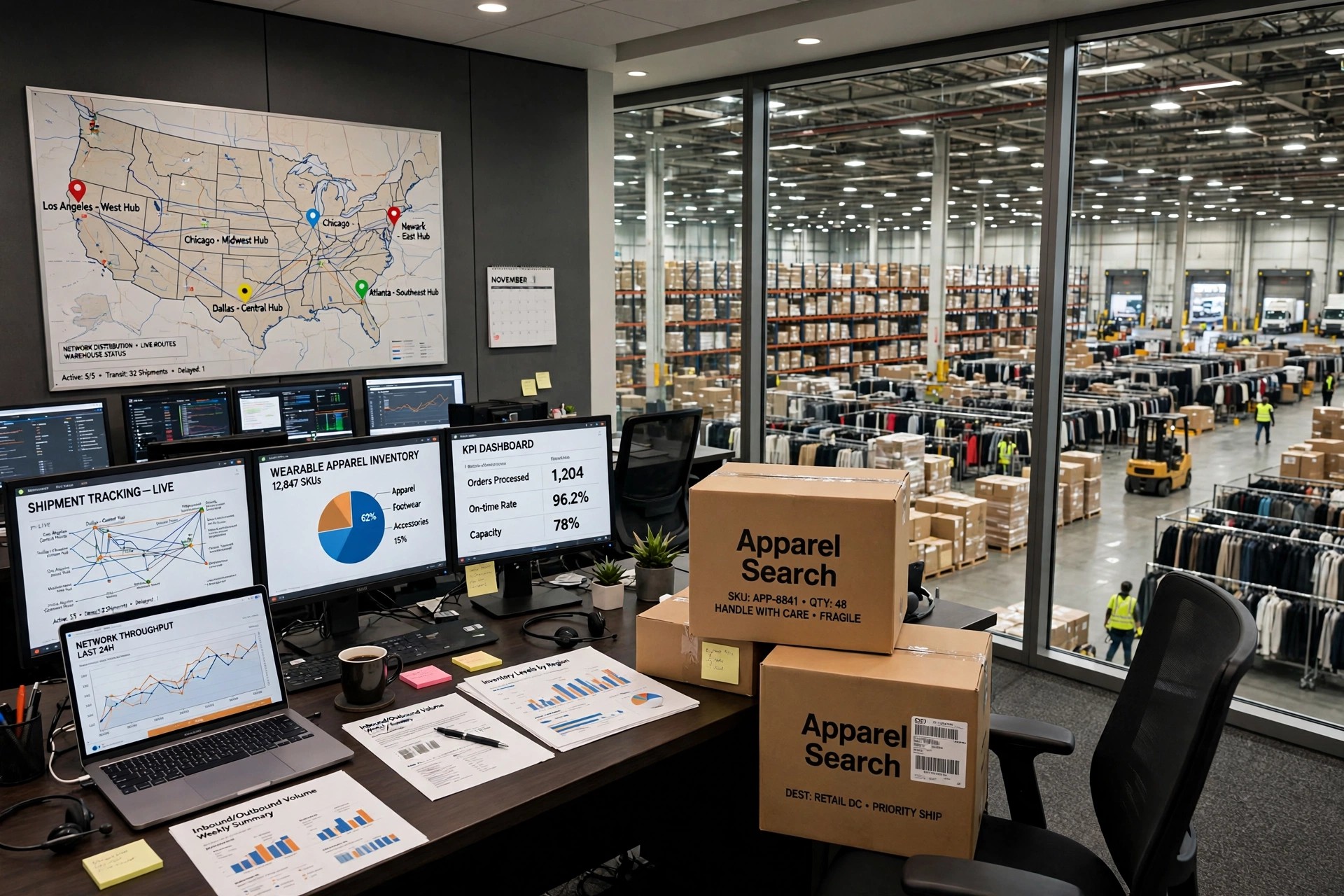
The Network This Role Owns: Every Building, Every Lane
The defining question of the role is where distribution should happen. The VP weighs the number, size and location of distribution centers against the geography of the company's stores, its e-commerce growth, its import ports and its delivery promises, and recommends the network the business should run — opening, closing, expanding or consolidating buildings as the trade changes. A network designed for store replenishment behaves differently from one built for direct-to-customer parcels, and most apparel companies now run both through the same buildings, which makes the design judgement harder and more valuable.
Inside that design, the VP owns capacity and flow at network level: how much inventory each site holds and for which channels, how stock is rebalanced between buildings, which sites take the import intake and which take returns, and how the peaks of the fashion calendar are spread so that no single building becomes the bottleneck for a season. Transport strategy sits here too — the balance between the company's own fleet, contracted carriers and parcel networks, and the service standards each channel is promised.
Strategy, Money and the Executive Table
Distribution is one of the largest cost lines an apparel business carries, and the VP is its author at budget time: labor, rent, transport, packaging and systems across every site, presented as cost per unit and per order so the executive team can see what a service promise actually costs. Capital decisions belong to this desk as well — warehouse automation, materials-handling equipment, building fit-outs and warehouse systems are proposed, costed and defended here, with payback argued in units, accuracy and delivery speed rather than in machinery for its own sake.
The VP also makes the structural calls that site managers cannot: whether a function stays in-house or goes to a third-party logistics provider, whether a new market is served from an existing building or a new one, and how distribution absorbs shocks — a port delay, a carrier failure, a sudden volume surge — without the customer seeing the seams. Those decisions are taken with merchandising, finance and retail leadership, but the distribution analysis and the recommendation are prepared by this role.
People and Performance Across Sites
The VP leads through the site leaders: distribution managers and warehouse managers who run individual buildings report upward into this role, and its leadership is exercised by setting the standards they all share — safety discipline, inventory accuracy, despatch performance, housekeeping and cost control — and by reviewing each site against them. A network where every building invents its own measures cannot be compared or improved, so the common scorecard, honestly reported, is one of this role's main creations.
Talent across the network is also this desk's concern: which site managers are ready for a larger building, where supervisory depth is thin before a peak, and how experienced people are moved around the network when a site opens, closes or fails. In a crisis at any one building — a systems outage in peak week, a labor shortage, a flood of returns — the VP is the escalation point who can commit other sites' capacity and the company's money to the fix.
Skills, Qualifications and Career Path — and the Site-Level Neighbour
Appointments are made from senior distribution leadership: years running large distribution centers or multi-site operations, with a record on cost, service and safety at scale. Employers look for network and capacity planning, capital budgeting, carrier and third-party provider negotiation, warehouse and transport systems knowledge, and the standing to argue a distribution case in an executive room. A degree in logistics, supply chain, business or a related field is common, and an advanced degree is frequently held at this level.
The boundary that defines the role is against the distribution manager under D. That role runs one distribution operation — its building, its shifts, its budget. The VP distribution runs the network those buildings form: several sites, the lanes between them, and the strategy that decides whether they should exist in their present shape at all. Progression into the role comes from multi-site or very large single-site leadership; progression from it runs to senior vice president of operations or supply chain, and to chief operating officer tracks in distribution-heavy businesses.
Common Questions
What does a VP distribution do?
Owns the distribution network as an executive: how many distribution centers the company runs and where, capacity and inventory placement across them, transport strategy, network budgets and capital projects, common performance standards, and the site leaders who run each building.
How is a VP distribution different from a distribution manager?
Scope. A distribution manager runs one distribution operation — a building, its people and its budget. A VP distribution runs the network of buildings, sets the strategy and standards they share, and makes the open, close, expand and outsource decisions no single site can make.
What experience leads to a VP distribution role?
Senior distribution leadership — running large or multiple distribution centers with cost, service and safety results at scale — plus capital budgeting, carrier and provider negotiation, systems fluency and executive-level communication. Supply chain or business degrees are common.
More to Explore
Distribution Leadership Resources
Transportation & Warehouse Directory Pages by Letter
References & Further Reading
More Job Description Categories
- Buying Job Descriptions
- Design Job Descriptions
- Marketing & PR Job Descriptions
- Miscellaneous Job Descriptions
- Planning & Allocation Job Descriptions
- Production & Sourcing Job Descriptions
- Sales & Selling Job Descriptions
- Transportation & Warehouse Job Descriptions (current)