The Short Answer
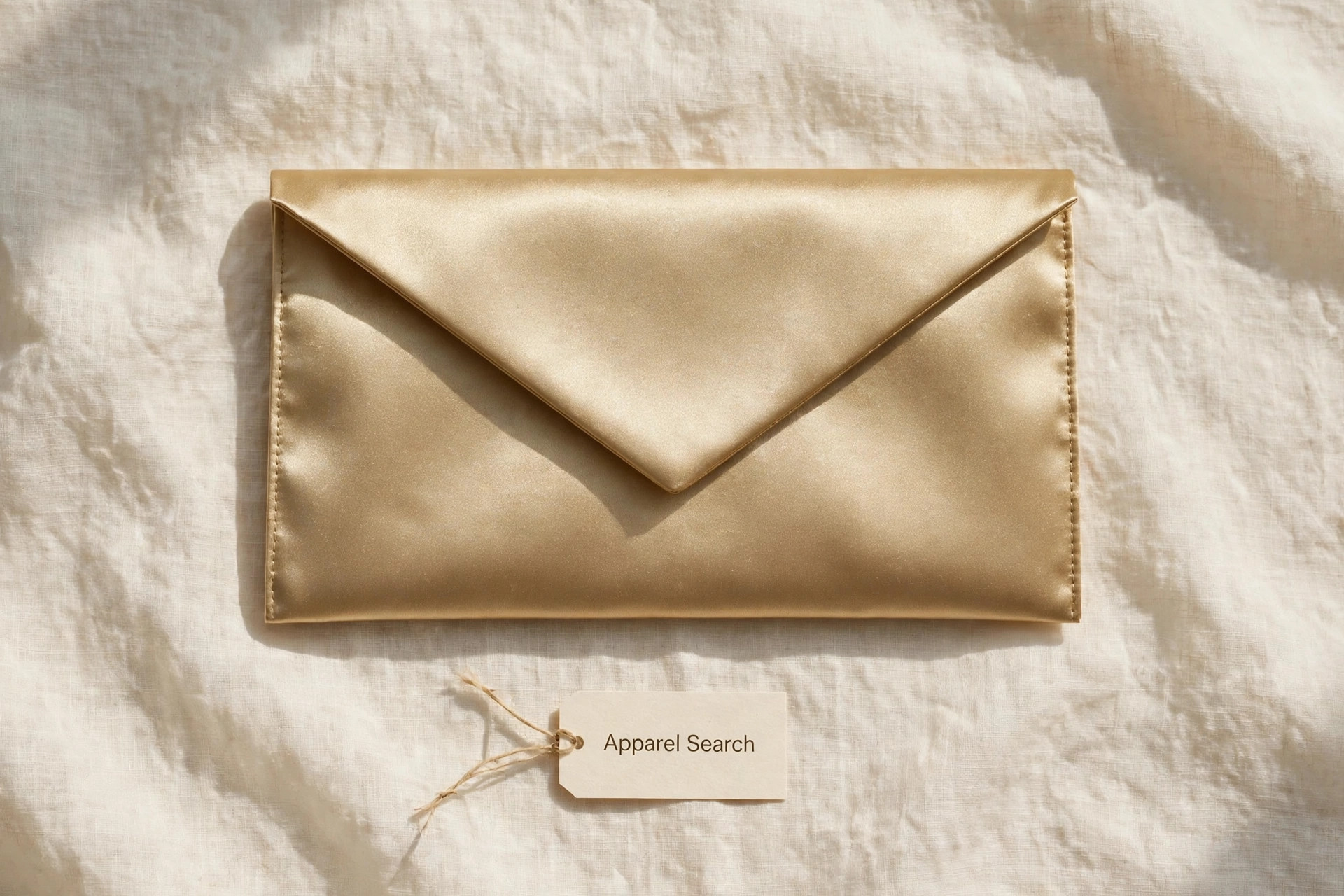
An envelope clutch is a flat, usually rectangular clutch whose front is formed by a pointed, triangular flap folded over the body — exactly like the flap of a paper envelope. It has no frame and minimal structure: the fold is the design. Sizes run from small evening versions to large, document-scale day clutches, and many carry a detachable chain or wrist strap.
01 / Anatomy of an Envelope Clutch
Anatomy of an Envelope Clutch
The construction is a study in economy: a single shaped piece (or a few panels) folded into a flat pocket, its top edge extending into the triangular flap that folds down over the front and fastens with a magnetic snap, a small clasp or a tuck. There is no frame to hold a line — the materials provide what structure exists, from firm leather that keeps the rectangle crisp to satin and soft leather versions that drape slightly. A slim interior — sometimes one flat pocket — holds flat things only: the envelope admits what an envelope admits.
Options divide the family. Chain or wrist straps (detachable on better versions) convert the clutch to a shoulder or wrist carry for part of the evening. Day sizes — large enough for documents or a slim tablet — bridge into workwear, where the envelope's flatness slides into a tote as an organizer that becomes the bag at lunch. Evening sizes are calibrated to phone, card case, key and lipstick, and their materials — satin, metallic leather, beading, patent — carry the formality.
02 / A Short History of the Fold
A Short History of the Fold
Flat document cases and letter wallets are centuries old, and the envelope fold entered women's bags with the slim clutches of the early twentieth century, when evening dress demanded a bag with no bulk at all. The pointed-flap envelope became a recurring classic — sharpened in the 1970s, oversized for day in the 2010s, miniaturized again since — because it is less a design than a piece of geometry: any era's materials dropped into the same elegant fold. Its cousins in our evening guide are the framed minaudière and the wristlet; the envelope is the softest and flattest of the three.
03 / Carrying & Styling an Envelope Clutch
Carrying & Styling an Envelope Clutch
Carry it in the hand, flap forward, or tucked under the arm for the classic clutch line; use the wrist strap when hands are needed and the chain when the evening allows a shoulder. The envelope is the formal minimalist's clutch: with evening dresses it contributes line without ornament, letting fabric and jewelry lead; in metallic or patent it supplies the outfit's shine; in a strong color it is the single deliberate accent against a neutral dress — the oldest clutch trick there is, and still the most reliable.
For day, the large envelope works like a folio: with tailoring it reads as a document case with intent, and it disciplines a soft outfit with one crisp rectangle. In every size, respect the flatness — an envelope clutch stuffed into a bulge has lost its one idea, so edit the contents to the flat set and let a tote carry the rest if the day demands both.
04 / Choosing Well: Fold & Fastening Checks
Choosing Well: Fold & Fastening Checks
Judge the fold. The flap's point should land centered, the edges should align parallel to the body, and the fastening — usually a magnetic snap — should catch with the flap lying flat, not levered up by strain. On leather, check the fold lines for early cracking (the flap's bend is the wear point), and prefer versions whose flap bend is a soft roll rather than a hard crease. Stitching should be fine and even — on a bag this minimal, the stitching is half the visible quality. Test with your actual phone inside: many evening envelopes predate large phones, and 'fits the phone' is the first specification to verify, not assume.
05 / Care & Storage
Care & Storage
Store envelope clutches flat, flap closed, with tissue inside to keep the pocket's shape and a dust bag against scratches — satin and patent mark easily and forgive nothing. Never store one folded backward or under weight, which sets the flap's crease off-line. Wipe leather with a dry cloth; satin spots dabbed, never rubbed. The magnetic snap is the only mechanism: if it weakens, a repairer can usually replace it invisibly — a small fix that returns the bag to service, in keeping with a design that has very little else to go wrong.
Shop Envelope Clutches
Ready to shop? Product links are kept in one place on the Apparel Search shopping guide:
Shop Envelope Clutches on AmazonThis link opens the Apparel Search shopping guide for Amazon, where the product links are kept in one place.
Questions
Common Questions
What fits in an envelope clutch?
Flat things: a phone, a card case or slim wallet, a key, lipstick and a compact in evening sizes. Day sizes add documents or a slim tablet. The shape is the discipline — if it is not flat, it does not belong in an envelope clutch.
Is an envelope clutch only for evening?
No. Evening versions in satin and metallics are the famous ones, but large leather envelopes are established day pieces with tailoring, and mid-size versions bridge smart-casual dress. Material and size set the register — the fold itself is neutral.
How do you hold an envelope clutch?
In the hand with the flap facing outward, or tucked under the arm. Many come with a detachable wrist strap or fine chain for hands-free moments — use them as the evening requires, and remove them when you want the clutch's clean line unbroken.
Envelope clutch or frame clutch — which is better for a formal event?
Both are correct; they differ in character. The frame clutch (minaudière) is harder, more jeweled, more of an object. The envelope is softer, quieter and more modern in line. Choose the frame for ornament, the envelope for minimalism — and either in a metal or finish that agrees with your jewelry.
More to Explore
Back to the Handbag Types & Styles Guide
The full accessories map — every named handbag shape defined in brief, with the deep-dive guides for each type.