Lab-Grown Emerald
Real emerald — green beryl — grown slowly in a laboratory instead of mined from the earth
A lab-grown emerald is emerald in the full material sense: the mineral beryl, a beryllium aluminum silicate, colored green by trace amounts of chromium and vanadium, with the same hardness, luster and behavior in a setting as an emerald dug from the ground. The only difference is origin. A natural emerald crystallized in water-bearing rock under rare geological conditions and was mined, sorted and cut; a lab-grown emerald crystallizes from a hot solution in a sealed vessel or from a molten flux, over months of slow growth, and is then cut and polished by the same craftspeople as a natural stone. Emerald is the member of the lab-grown set where origin changes the most about what you see, because natural emerald is almost never clean, while a grown crystal can be nearly free of its famous inclusions, the jardin. What also changes is price and paperwork: lab-grown stones cost a fraction of comparable natural stones, and their origin must be stated clearly wherever they are sold. This guide explains how the stones are grown and why one familiar growth method is missing, how gemologists tell grown from mined, what they cost and why, and how to buy and care for one well. For the overview of the whole set, see our Lab-Grown Gemstones Guide.
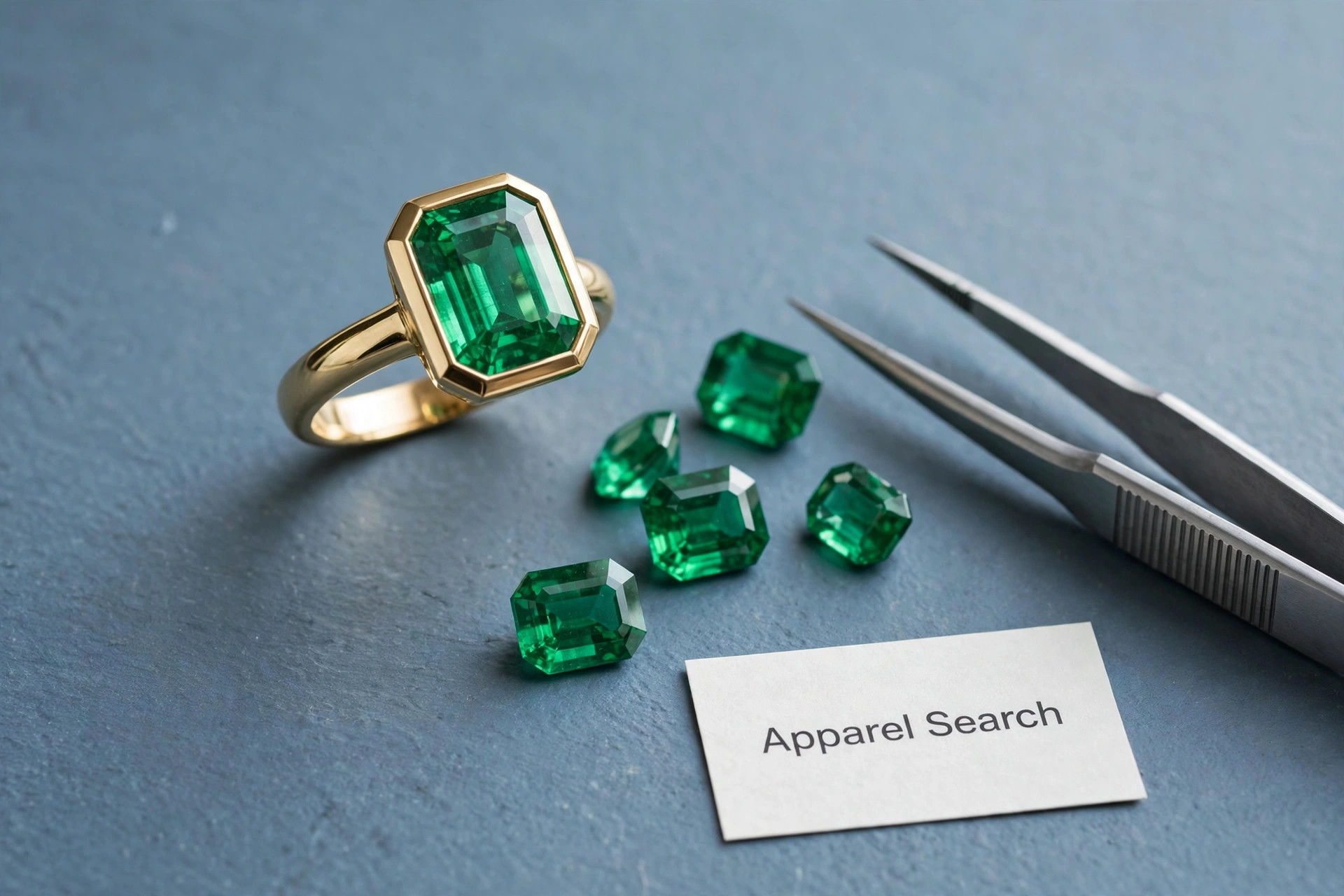
What a Lab-Grown Emerald Is
Emerald is the green variety of beryl, the same mineral family as aquamarine and morganite. Pure beryl is colorless; emerald's green comes from chromium, and in many stones vanadium as well, with iron sometimes modifying the hue. The chemistry explains emerald's rarity in nature: beryllium and chromium almost never occur in the same rocks, so the deposits where they meet, in Colombia, Zambia, Brazil and a handful of other places, are geological accidents. At 7.5 to 8 on the Mohs scale, emerald is hard enough to resist scratching in normal wear, but it is the brittle member of the precious-gem set. Its crystal structure and many inclusions make it prone to chipping at corners and along fractures in a way that ruby, sapphire and diamond are not. Everything in this guide, from settings to cleaning, follows from that single fact: emerald is hard but fragile.
A lab-grown emerald shares the material exactly: same chemistry, same crystal structure, same refractive index and specific gravity range, same green. That identity is what separates lab-grown emerald from imitations. Green glass, green synthetic spinel, dyed quartz and doublet stones only imitate emerald's appearance; a lab-grown emerald is the material itself, produced by a different route, as ice from a freezer is the same material as ice on a winter lake. Where grown emerald genuinely differs from most natural emerald is not in what it is, but in what it contains.
Natural Emerald's Character: The Jardin
Natural emerald forms in geologically violent settings, and it shows. Nearly every natural emerald carries visible internal features: tiny crystals, fluid-filled cavities and fine fractures, a soft internal landscape the French named the jardin, the garden. Unlike diamond, where inclusions are graded as flaws, the emerald trade accepts eye-visible inclusions as part of the stone's character and even as evidence of natural origin; a completely clean natural emerald of any size is one of the rarest objects in the gem trade. The jardin is also why most natural emeralds are treated. For centuries, dealers have filled the fine surface-reaching fissures with oil, traditionally cedarwood oil whose optics closely match beryl, and more recently with resins, so the fractures nearly vanish and the stone looks cleaner. Almost every natural emerald on the market has been oiled or filled to some degree; laboratories grade it minor, moderate or significant, and it must be disclosed when the stone is sold.
Hold that picture in mind and the lab-grown stone's appeal becomes clear. A crystal grown slowly in a clean solution, with no surrounding rock to invade it, can come out with strong, even color and little or no jardin at all, its clarity arriving without any filler. The clarity that nature almost never grants emerald is routine in the laboratory. That is the honest center of the lab-grown emerald offer: not a cheaper copy of the natural look, but the same material in a clarity grade that, in a mined stone, would be a museum-level rarity.
How Lab Emerald Is Grown
Emerald resisted synthesis longer than ruby or sapphire, and the methods that finally worked share one trait: they grow the crystal slowly, out of a solution, rather than freezing it quickly from a melt. Two of them produce essentially all the lab-grown emerald on the market.
Hydrothermal Growth: The Main Gem-Quality Route
The hydrothermal method imitates the process that formed natural emerald underground: growth from hot water under pressure. Inside a thick-walled steel vessel called an autoclave, nutrient beryl material is dissolved in water held at several hundred degrees Celsius and at pressures far above atmospheric. Thin seed plates of beryl crystal are suspended in the solution, and dissolved material deposits onto them atom by atom, building new emerald crystal outward from the seed. Growth is slow, a matter of weeks to months for gem-size crystals, which is why hydrothermal emerald costs more than a flame-fusion ruby. Developed commercially from the 1960s onward by producers including Linde, Lechleitner and later Tairus, hydrothermal growth is today the main source of gem-quality lab-grown emerald.
Flux Growth: Chatham's Original Process
Flux growth is the older route, and the one that first put synthetic emerald on the market. The ingredients are dissolved in a molten chemical solvent, classically a lithium molybdate flux, held in a platinum crucible at around 800 degrees Celsius, far below beryl's melting point. Emerald crystals nucleate and grow in the flux over many months of patient temperature control; producing a crystal large enough to cut a one-carat stone can take the better part of a year. Carroll Chatham in San Francisco built his company on this process, achieving commercial flux emerald in the 1930s and 1940s, after a German flux product, Igmerald, had appeared in 1934. Flux emerald tends to contain wispy, veil-like residues of trapped flux, and its slow growth puts it at the premium end of the lab-grown emerald market.
Why There Is No Flame-Fusion Emerald
Shoppers who know that ruby and sapphire are grown cheaply by flame-fusion often ask why emerald is not. The answer is in beryl's chemistry. When powdered beryl ingredients are passed through an oxy-hydrogen flame and melted, the fused material does not crystallize on cooling; it solidifies as a glass with beryl's composition instead of as beryl crystal. Beryl will not refreeze into its own structure from a pure melt, so the quick, inexpensive boule-growing process that transformed the ruby and sapphire markets has never been made to work commercially for emerald, despite early attempts. Every lab-grown emerald is therefore a solution-grown stone, from water or from flux, and its price reflects months of growth rather than hours: lab emerald is a bargain beside natural emerald, but never the rock-bottom product that flame-fusion ruby can be.
However it was grown, a finished emerald crystal is cut the same way as a natural one. Most take the emerald cut, the rectangular or square step cut with clipped corners developed for this material: its broad, open facets show off the color, and the beveled corners remove the points most vulnerable to chipping. A well-cut lab-grown stone handles light exactly as a well-cut natural one does.
Lab-Grown vs Natural: Reading the Inclusions
Because the material is identical, the standard property tests largely overlap between a lab-grown emerald and a natural one, and no one can separate them by looking at a stone in a ring. Hydrothermal stones do tend to read at slightly lower refractive index and specific gravity than most natural emeralds, which gives a gemologist a first screen, but the real evidence is internal. A natural emerald's jardin contains the minerals of its deposit: mica plates, calcite or pyrite crystals, needles of tremolite or actinolite, and in Colombian stones the famous three-phase inclusions, tiny cavities holding liquid, a gas bubble and a solid crystal together. A hydrothermal lab-grown emerald can carry its own characteristic features instead: nail-head spicules, tapered inclusions capped by a small crystal, often of phenakite; angular growth zoning from its layered regrowth on the seed; and sometimes a remnant of the seed plate itself. Flux-grown stones show wispy flux veils and fingerprint-like residues, and occasionally phenakite crystals or a flake of platinum from the crucible.
The most useful field clue runs in the opposite direction from most gems. In diamond or ruby, exceptional clarity is merely unusual; in emerald, a stone of good size with saturated color and no visible inclusions at all is itself a reason to suspect laboratory origin, precisely because clean natural emerald is so extraordinarily rare. Gemologists treat that absence as a finding, and a laboratory can settle origin conclusively when value depends on it. None of this is a reason to distrust a disclosed lab-grown stone, and many buyers prefer clarity that is real rather than the product of filler hiding a fracture network.
Price: What Natural Emerald's Scarcity Costs, and What Grown Emerald Costs Instead
Natural emerald's price is set by how rarely its geology cooperates. The benchmark origin is Colombia, whose Muzo, Chivor and Coscuez mines have produced the standard of vivid, slightly bluish green for centuries, and fine Colombian stones with minor treatment carry the market's highest prices. Zambian emerald, generally a deeper, slightly bluer green with less jardin, and Brazilian material supply much of the commercial market at lower levels. Across all origins the same drivers apply: saturated color first, then transparency, then the degree of treatment, with untreated or minimally oiled stones of fine color commanding a steep premium over identical-looking stones with significant filling. At the top of the range, fine natural emerald reaches prices per carat in the same conversation as fine ruby and sapphire.
A lab-grown emerald's price carries factory costs instead: ingredients, the autoclave or crucible, months of controlled growth and cutting. Because every grown emerald is solution-grown, it never reaches the very low prices of flame-fusion ruby, but it still typically sells for a fraction of a natural emerald of the same size and apparent quality, commonly on the order of 70 to 90 percent less, with flux-grown stones at the top of the lab range and hydrothermal stones below them. Treat any single percentage as approximate, but the structure is stable: the budget that buys a small, heavily included, significantly filled natural emerald commonly buys a lab-grown stone that is larger, cleaner and untreated, in strong color. Like other grown gems, a lab-grown emerald is bought for how it looks and wears, not as a store of value.
Disclosure and the Rules of Sale
Because origin cannot be seen, the trade polices it with disclosure rules. In the United States, the Federal Trade Commission's Jewelry Guides govern how gemstones may be described. A laboratory-grown emerald may truthfully be called emerald, but its origin must be made clear with a qualifier such as "laboratory-grown," "laboratory-created" or "[manufacturer name]-created" placed immediately before the word emerald, with equal prominence, so no buyer can mistake it for a mined stone. The FTC's plain-language summary for sellers, In the Loupe: Advertising Diamond, Gemstones and Pearls, sets the rules out in full. The Guides cover treatments with the same seriousness, and emerald is where that matters most: the oiling or resin filling in most natural emeralds affects value, durability and care, so it must be disclosed, with laboratory reports grading it minor, moderate or significant. Reputable sellers label lab-grown stones in the product name itself and state origin and treatment on the receipt.
Buying Guidance: Settings That Protect a Brittle Stone
Emerald buying starts with color: look for a vivid green to slightly bluish green, in a medium to medium-dark tone, with strong saturation, and view candidates in daylight as well as under shop lights, since emerald's green shifts more between light sources than most stones. Clarity is where lab-grown changes the shopping itself. In a natural stone you are budgeting for jardin; in a lab-grown stone you can simply choose the clarity you like, and the sensible economy is to pay for color and cut rather than a perfection grade your eye cannot distinguish. Ask which growth method produced the stone, hydrothermal or flux, and expect flux material to cost more for its slower growth; for a larger stone, a report from an established gemological laboratory confirming laboratory-grown beryl gives you an independent record of what you bought.
Then set the stone as the brittle gem it is. Emerald's corners and any included areas are its weak points, so protective settings earn their keep: a bezel that wraps the stone's edge in metal, or a halo of small diamonds that takes the knocks first, will guard a ring stone far better than tall, exposed prongs. Prong settings are not forbidden, but the prongs should be substantial, the stone seated low, and the ring taken off for heavy work and the gym. Because the stone costs a fraction of a natural emerald, the setting is a larger share of the price and the part that decides how long the piece lasts: choose solid gold or platinum and sound construction.
Lab-grown stones sit inside a wider family of grown gems covered elsewhere in this guide. The ring, bracelet, earring and necklace pages on lab created stones explain the shared background for emerald, ruby and sapphire as well as diamond: lab created gemstone rings, lab created gemstone bracelets, lab created gemstone earrings and lab created gemstone necklaces. Those pages and this one use the same vocabulary, so a reader can move between the emerald-specific detail here and the colored-stone picture there without relearning terms.
Care: The Gentlest Routine in the Set
Emerald asks for the gentlest care of any stone in this guide, and the rule covers lab-grown stones exactly as it covers natural ones, because the brittleness is in the material itself. Clean emerald jewelry only with lukewarm water and a drop of mild soap: let the piece sit briefly in the water, lift away film with a soft cloth or a very soft brush, rinse in lukewarm water and pat dry with a lint-free cloth. Lukewarm is a specification, not a suggestion; hot water and sudden temperature changes stress a stone that may contain fine fractures. Never put an emerald in an ultrasonic cleaner, whose vibration can extend existing inclusions and loosen stones in their settings, and never steam-clean one. Keep emerald away from harsh chemicals and prolonged soaking, and store each piece separately in a soft pouch or lined box, away from harder diamond, ruby and sapphire jewelry. Have the setting checked by a jeweler once a year or so, since a protective setting only protects while it is sound. One natural-stone chore you are spared: a lab-grown emerald contains no oil or resin filler, so it never needs the professional re-oiling natural emerald periodically requires. The section's fuller guidance applies throughout: the Jewelry Care and Cleaning Guide covers cleaning and storage by material, and How to Clean Jewelry at Home walks through at-home methods.
Common Questions
Is a lab-grown emerald a real emerald?
Yes. A lab-grown emerald is emerald: the mineral beryl colored green by chromium and vanadium, with the same hardness, refractive index and other physical properties as a mined emerald. It is not green glass and not an imitation. The only difference is origin: the crystal grew in a laboratory over months instead of underground over geological time, and that origin must be disclosed when the stone is sold.
Why is there no flame-fusion lab-grown emerald?
Because beryl will not crystallize from its own melt. When emerald's ingredients are powdered and put through a flame-fusion furnace, the fused material cools as glass with a beryl composition instead of growing into a crystal, so the quick, cheap process that works for ruby and sapphire has never worked commercially for emerald. Growers instead use the two slow solution methods, hydrothermal growth and flux growth, which let beryl crystals form gradually below their melting behavior.
Can I clean a lab-grown emerald in an ultrasonic cleaner?
No. Emerald is the brittle member of the precious gems, and the safe rule covers natural and lab-grown stones alike: never ultrasonic, never steam, especially for any stone with visible inclusions, which vibration and heat can extend or damage. Clean emerald jewelry the gentle way, in lukewarm water with a drop of mild soap, using a soft cloth or a very soft brush, then rinse in lukewarm water and pat dry.