Lab-Grown Gemstones
Real gemstones, grown in a laboratory instead of mined from the earth
A lab-grown gemstone is a real gemstone crystal grown by people instead of by geology. A lab-grown sapphire is corundum, a lab-grown emerald is beryl, a lab-grown ruby is red corundum and a lab-grown diamond is diamond, each with the same chemistry, hardness and sparkle as the mined gem of the same kind, because it is the same material. Only the birthplace differs: a mined crystal formed in rock over geological time, while a grown crystal forms in a furnace, a pressure vessel or a growth chamber in days, weeks or months. That one difference drives everything else in this guide: how the stones are made, how laboratories tell the origins apart, why grown stones cost a fraction of mined ones, and the disclosure rules that govern their sale. This page is the overview for the whole lab-grown set; each gem then gets its own full guide, linked below.
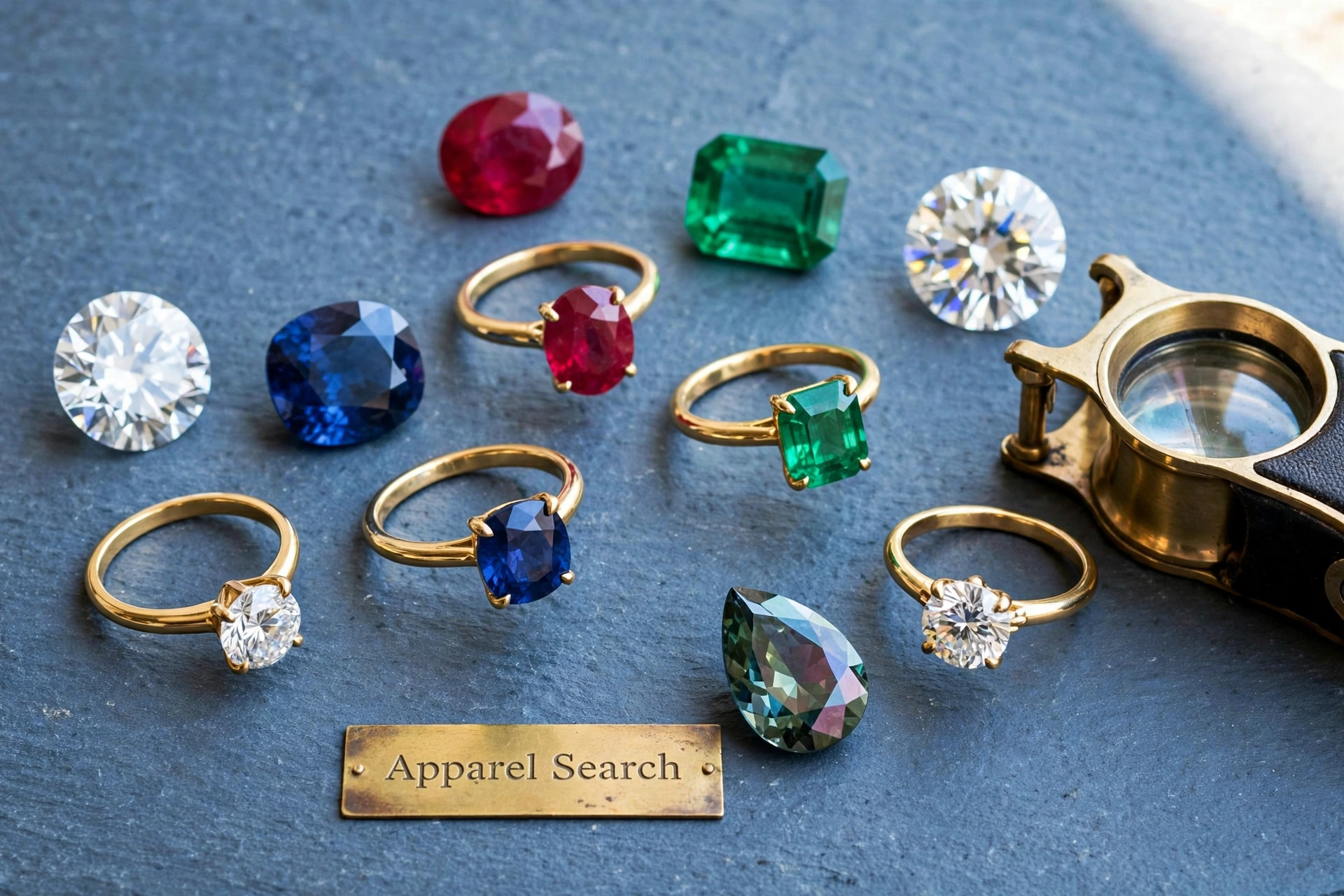
Three Kinds of Stone: Grown, Mined and Imitation
Almost every confusion in this market comes from mixing up three categories, so it pays to keep them separate. A mined gemstone crystallized inside the earth and was dug out, cut and polished. A lab-grown gemstone, also called laboratory-created or, in gemological writing, synthetic, is the same mineral grown under controlled conditions: GIA, the Gemological Institute of America, defines a synthetic gem material as one made in a laboratory that shares virtually all the chemical, optical and physical characteristics of its natural counterpart. A simulant, or imitation, is a different material altogether that merely looks like the gem: glass imitating emerald, cubic zirconia imitating diamond, or blue spinel imitating sapphire. A simulant may be pretty and may be honestly sold under its own name, but it is not the gem it resembles, and it usually differs in hardness, sparkle character and durability.
The grown-versus-mined line is therefore a line about origin, not about authenticity of material. Ice from a freezer and ice from a frozen lake are both ice; champagne made in two different cellars is still wine of the same kind. What a buyer is entitled to know, and what the disclosure rules below exist to guarantee, is which origin a particular stone has, because origin is what the price mostly pays for. A fourth category also needs separating from all three: a mined stone that has been treated, for example heated, diffusion-treated or filled with glass to improve its look. A treated mined stone is not lab-grown, and a lab-grown stone is not a treated mined stone; honest listings say which of the four situations applies.
How Lab-Grown Gemstones Are Made
Gem growers use a handful of methods, and GIA groups most of them into two families. In melt processes the material is melted and the crystal freezes out of its own melt, so melt and crystal have the same composition. In solution processes the gem ingredients are dissolved in something else, a molten flux or hot pressurized water, and the crystal builds slowly out of that solution. Melt methods are generally faster and cheaper; solution methods are slower, costlier, and often produce crystals whose internal features look closer to natural ones. Diamond growing, covered in its own guide, adds two further methods, HPHT and CVD.
Flame Fusion: The Verneuil Process
The oldest and cheapest method, announced by Auguste Verneuil in 1902, drops finely powdered ingredients through a very hot flame onto a rotating pedestal, where the molten droplets build up a cylindrical crystal called a boule. Flame fusion grows most of the world’s lab-grown ruby and sapphire, and also spinel. Because growth is fast, flame-fusion corundum often carries telltale curved growth lines and tiny spherical gas bubbles, features that never occur in earth-grown corundum and that make this material the easiest grown gem to identify.
Flux Growth
In flux growth the gem ingredients are dissolved in a molten solvent, the flux, which works the way water dissolves sugar. As the solution cools very gradually, crystals form and grow over weeks or months. Flux growth is a principal method for emerald, and is also used for ruby, sapphire, alexandrite and spinel. The slow pace costs more, and the stones can contain wispy, fingerprint-like flux inclusions and occasional platelets of platinum shed by the crucible, details a gemologist reads as evidence of grown origin.
Hydrothermal Growth
Hydrothermal growth imitates the hot-water conditions in which many gems form underground. Ingredients are dissolved in water inside a sealed steel vessel, an autoclave, under high temperature and pressure, and crystals grow on seed plates as the solution circulates and cools in the growth zone. It is the standard method for synthetic quartz and a major method for emerald, and it is also used for beryl varieties and corundum. Hydrothermal stones grow slowly and can show characteristic graining patterns that laboratories use to identify them.
Crystal Pulling: The Czochralski Process
In pulling, the ingredients are melted in a crucible, a seed crystal is dipped into the melt, and the crystal is drawn slowly upward as it grows, producing a long, clean boule. Developed in the early 1900s, the Czochralski process grows sapphire, ruby, alexandrite and garnet-type materials, and much industrial crystal besides. Pulled crystals tend to be large and clean, which is one reason pulled sapphire is used far beyond jewelry, as the sapphire guide explains.
Sublimation: How Moissanite Grows
Moissanite, silicon carbide, cannot simply be melted and frozen at ordinary pressures, so gem moissanite is grown by sublimation, also called physical vapor transport. Silicon carbide powder is heated until it vaporizes, and the vapor travels to a slightly cooler seed crystal, where it deposits and builds a single large crystal layer by layer. The process runs at extremely high temperatures and takes far longer than flame fusion, which is part of why moissanite costs more than other diamond look-alikes while remaining a distinct material in its own right, not a form of diamond.
Lab-Grown vs Mined: The Same Gem, a Different Story Inside
For the classic colored gems, corundum (ruby and sapphire), beryl (emerald) and chrysoberyl (alexandrite), the grown material is chemically and physically the same gem as the mined material: same mineral, same hardness, same refractive behavior, same response to light. A lab-grown sapphire resists scratching exactly as a mined sapphire does, and a lab-grown emerald is exactly as brittle as a mined one, because those traits belong to the mineral, not to the birthplace. Anything a guide says about a gem’s durability, cutting or wear applies to both origins alike.
What differs is the crystal’s internal diary. An earth-grown crystal records its geology in mineral inclusions, healed fractures and straight, angular bands of stronger and weaker color that follow its flat crystal faces. A grown crystal records its recipe instead: curved striae and bubbles from a flame, flux fingerprints, hydrothermal graining, or the clean, inclusion-poor interior that controlled growth often produces. Gemological laboratories identify origin by reading that diary under magnification, backed where needed by spectroscopy and trace-element analysis, and their reports state the conclusion plainly. The practical lesson for buyers is the same one the diamond guide teaches: you cannot shop by eye for origin, so you shop by paperwork, choosing sellers who disclose and laboratories that report.
Disclosure: The Rules That Keep the Lines Bright
In the United States, the Federal Trade Commission’s Jewelry Guides govern how gemstones may be described, and its plain-language summary for sellers, In the Loupe: Advertising Diamond, Gemstones and Pearls, sets the rules out clearly. A laboratory-created gemstone must be described so the buyer knows it is not mined: the words “laboratory-grown,” “laboratory-created” or “[manufacturer name]-created,” or a phrase of like meaning, must come immediately before the gem’s name, with equal conspicuousness. Using the bare gem name alone, “sapphire” or “emerald” with nothing in front of it, is reserved for mined stones. The FTC also says the word “faux” does not adequately disclose that a stone is not mined, and that the laboratory terms themselves may only be used when the stone really does have essentially the same optical, physical and chemical properties as the mined gem.
One word deserves special care: “synthetic.” In gemology it is the technical term for a grown gem with the same properties as its natural counterpart, and the FTC permits it on those terms. But many shoppers hear “synthetic” as “fake plastic,” which is why the FTC dropped it from its recommended descriptors for lab-grown diamonds and why careful sellers prefer “laboratory-grown” or “laboratory-created,” which say exactly what happened. The same guidance requires disclosure of treatments that affect value or care, and bars calling glass-filled composite material by the plain gem name or as laboratory-grown: a composite is a different, more fragile product. As with diamonds, clear disclosure is itself a quality signal: a seller precise about origin is usually precise about everything else.
Price: Why Grown Gems Cost a Fraction, and the Resale Reality
A mined gem’s price carries geology in it. Fine crystals are rare, most rough is commercial grade, and a celebrated origin or an untreated stone in a top color can multiply the price many times over. A lab-grown gem’s price carries factory costs instead: ingredients, energy, equipment time and cutting. Flame-fusion corundum is inexpensive to produce, slower flux and hydrothermal crystals cost more to grow, and pulled and sublimation-grown crystals sit higher still, but none of them carries scarcity, because another crystal can always be grown. The result is that lab-grown gems commonly sell for a small fraction of the price of mined stones of similar size and appearance, and the same budget buys a larger, cleaner grown stone, or the same stone with money left for a better setting.
Resale follows the same logic in reverse. Because supply can expand whenever demand does, lab-grown gems hold little second-hand value beyond the worth of their settings, and prices for new grown stones have tended to soften as production improves. Mined gems also resell below retail, sometimes far below, but fine mined stones retain a larger share. The honest way to buy any lab-grown gem is therefore the way jewelers advise buying jewelry generally: for beauty, durability and pleasure in wearing, in a well-made gold or platinum setting that will outlast fashion, and not as a financial asset.
A Tour of the Lab-Grown Gem Guides
Each gem in the set earns its own guide, because each material grows differently, identifies differently and rewards a different buying strategy. The Lab-Grown Diamond Guide covers the one gem grown by high-pressure presses and vapor deposition rather than the methods above, and explains HPHT and CVD growth, grading reports and the steepest price gap in the set. The Lab-Grown Sapphire Guide takes up corundum in every color but red: flame-fusion sapphire is the workhorse grown gem of the jewelry trade, and the same crystal covers watch faces and scanner windows across industry. The Lab-Grown Ruby Guide treats red corundum on its own, because ruby’s color standard, its fluorescence and the glass-filled composite stones that must never be confused with it all need separate handling.
The remaining three guides cover the gems where grown material answers a real scarcity. The Lab-Grown Emerald Guide explains green beryl grown by flux and hydrothermal methods, and why a clean grown emerald is easy while a clean mined one is famously rare. The Lab-Grown Moissanite Guide gives silicon carbide its own hearing: moissanite is not grown diamond but a brilliant, hard gem in its own right, with more rainbow fire than diamond and a sublimation growth story unlike any other stone here. Finally, the Lab-Grown Alexandrite Guide covers the color-change chrysoberyl, greenish in daylight and reddish under lamplight, where pulled lab-grown crystals make a genuinely rare natural phenomenon available at everyday prices.
Lab-grown stones sit inside a wider family of grown gems covered elsewhere in this guide. The ring, bracelet, earring and necklace pages on lab created stones explain the shared background for sapphire, ruby and emerald as well as diamond: lab created gemstone rings, lab created gemstone bracelets, lab created gemstone earrings and lab created gemstone necklaces. Those pages and this one use the same vocabulary, so a reader can move between the general picture here and the jewelry forms there without relearning terms.
Care: Care Follows the Gem, Not the Origin
Because a grown gem is the same mineral as its mined counterpart, it takes the same care, gem by gem. Hard, tough corundum, ruby and sapphire at Mohs 9, shrugs off daily wear and cleans happily in warm water with a drop of mild dish soap and a soft brush. Diamond at Mohs 10 needs the same soap-and-water routine to clear the film that dulls it. Emerald, at Mohs 7.5 to 8 but brittle and usually included, wants gentler handling, no ultrasonic cleaning for fragile stones, and settings that protect its corners, whether it was mined or grown. Moissanite and alexandrite are hard, durable stones that clean like sapphire. In every case the vulnerable part of the piece is the setting, not the stone’s origin: have prongs checked regularly, store hard gems apart so they cannot scratch softer ones, and keep glass-filled composite stones away from heat, acids and ultrasonic baths altogether. The section’s fuller guidance applies word for word: the Jewelry Care and Cleaning Guide covers cleaning and storage by material, and How to Clean Jewelry at Home walks through the at-home methods step by step.
Buying Guidance: Paperwork, Color and the Setting
Start with the description itself. The listing, the receipt and any report should all carry the laboratory-grown disclosure in front of the gem name, name the gem and its weight plainly, and disclose any treatment. For a significant purchase, a report from an established gemological laboratory that states origin gives you a document that matches the stone and settles arguments later. If a price looks like a mined stone’s price on a grown stone, or a grown stone is described with no origin words at all, walk away: both are disclosure failures, whatever the stone turns out to be.
Then buy the things origin cannot change. Color is the great lever in colored gems, so choose the hue and saturation you actually love, in daylight as well as shop light, rather than paying for origin lore. Cut governs sparkle in grown stones exactly as in mined ones, and grown material’s usual cleanliness means clarity premiums are rarely worth paying. Finally, spend the saving where it lasts: because the stone costs less, the setting is a larger share of the total, and solid gold or platinum, sound prongs or a protective bezel and honest construction will decide how the piece looks in twenty years. Bought that way, a lab-grown gemstone is not a substitute for anything. It is the gem itself, with its origin stated, its price explained and its beauty fully available.
Common Questions
Are lab-grown gemstones real gemstones?
Yes, in the material sense that matters. A lab-grown sapphire is corundum, a lab-grown emerald is beryl and a lab-grown diamond is diamond, with the same chemical composition, crystal structure, hardness and optical behavior as the mined gem of the same kind. What differs is origin: the crystal grew in a laboratory or factory instead of in the earth. A lab-grown gem is not a simulant. Glass, cubic zirconia and other imitations only copy a gem’s appearance with a different, usually softer material.
How can you tell a lab-grown gemstone from a mined one?
Not by looking at it in a setting, because the properties that meet the eye are the same. Gemologists separate grown from mined stones under magnification and with laboratory instruments, reading the inclusions and growth features each origin leaves inside the crystal: curved growth lines and gas bubbles in flame-fusion corundum, flux residues in flux-grown stones, and the natural mineral inclusions and straight, angular color zoning of earth-grown crystals. For any valuable stone, a report from an established gemological laboratory is the reliable answer.
Do lab-grown gemstones hold their value?
Resale values are low compared with purchase price, and generally much lower than for comparable mined stones, because grown supply can expand whenever demand does and carries no rarity. A lab-grown gem is best bought the way jewelry itself is best bought: for the pleasure of wearing a beautiful, durable stone, with the money saved put toward a well-made setting. The precious metal in the piece often accounts for most of what a second-hand piece retains.