Lab-Grown Moissanite
Silicon carbide: the brilliant gem that exists only because laboratories grow it
Moissanite is the gemstone with the strangest family tree in this guide. Every other stone in the lab-grown set has a mined counterpart that the laboratory version imitates or replaces; moissanite barely has a natural version at all. It is silicon carbide, a crystal first identified in fragments of a meteorite, so rare in nature that it occurs only as microscopic grains, and essentially every moissanite gem ever set in jewelry was grown in a laboratory. That makes this page different from the others in the Lab-Grown Gemstones overview: there is no meaningful mined market to compare prices against, no origin debate, and no question about whether the stone is "really" lab-grown. It is, by necessity. What a buyer does need to understand is how moissanite differs from diamond, the stone it is most often compared with and most often bought instead of: it is harder than almost anything else you can wear, it throws more rainbow fire than diamond, it fools the basic testers jewelers use at the counter, and it costs a small fraction of a diamond's price. This guide explains where the material came from, how it is grown, how its properties compare honestly with diamond, what the disclosure rules require, and how to buy and care for it well.
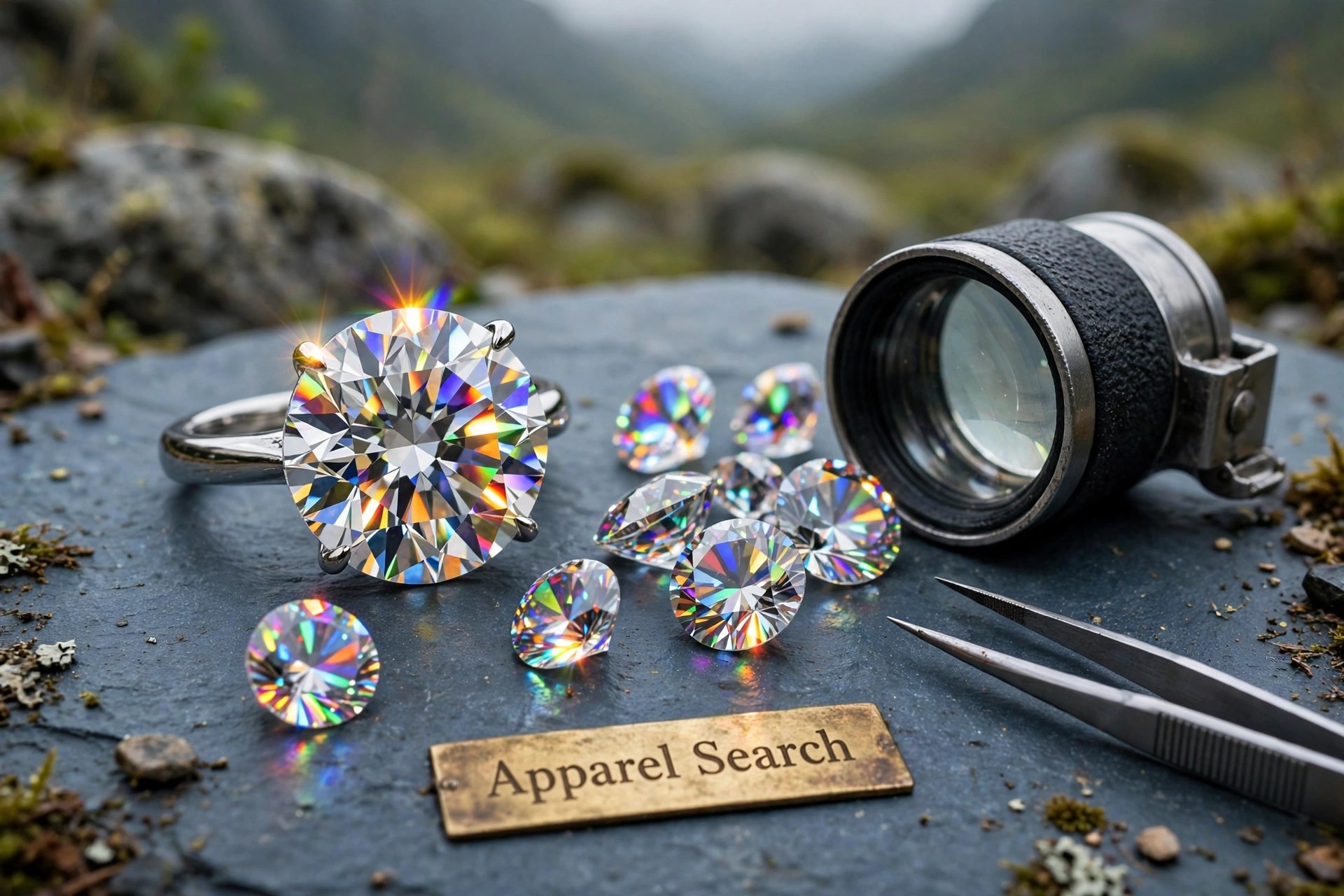
What Moissanite Is: Silicon Carbide from a Meteor Crater
Moissanite is silicon carbide, chemical formula SiC: silicon and carbon atoms locked together in a hard, bright crystal. Diamond, by contrast, is carbon alone. The two materials are chemical cousins, which is part of why they look alike, but they are different substances with measurably different behavior, and keeping that distinction clear is the foundation of honest buying and selling.
The natural mineral was found by the French chemist Henri Moissan, who examined rock samples from the Canyon Diablo meteorite, the iron meteorite whose impact formed Meteor Crater in Arizona. Moissan first reported tiny crystals from the meteorite material in 1893 and at first took them for diamond; in 1904 he identified them correctly as silicon carbide, the first time that compound had been found in nature, and the mineral was named moissanite in his honor. The discovery was debated for years, partly because silicon carbide was already manufactured as an industrial abrasive and contamination was hard to rule out, but natural moissanite has since been confirmed in meteorites and a handful of earthly rocks. The important point for a buyer is scale: natural moissanite occurs as grains far too small to cut, so no jeweler can sell you a mined moissanite gem. Every faceted moissanite on the market was grown.
That history gives moissanite an unusual position. Lab-grown diamond, sapphire, ruby, emerald and alexandrite all answer "why not buy the natural one?" with a price argument. Moissanite never has to: the laboratory is not a budget substitute for the mine, but the only source the gem has ever had.
How Moissanite Is Grown: Seeded Sublimation
Silicon carbide was an industrial material long before it was a gem: extremely hard, heat-resistant and made for well over a century as an abrasive and, in purer single-crystal form, as a semiconductor. Gem moissanite borrows the electronics industry's crystal-growing technology in pursuit of large, clear crystals that can be cut.
Sublimation and Physical Vapor Transport
Gem crystals are grown by sublimation, in the modern seeded form generally called physical vapor transport, a technique whose lineage runs back to the Lely process developed in the 1950s for growing silicon carbide crystals. Silicon carbide does not melt at ordinary pressures; heated hot enough, it passes directly from solid to vapor. In the growth furnace, silicon carbide powder at the hotter end of a graphite crucible, at temperatures on the order of 2,300 degrees Celsius, sublimes into vapor, which travels through the chamber and deposits onto a slightly cooler seed crystal of silicon carbide held at the other end. Atom by atom the seed grows into a large single crystal, called a boule, in the hexagonal crystal form used for gems. Growth takes days for a boule yielding a limited number of cut stones, and controlling color and clarity through that run is the grower's real skill: early gem moissanite often carried a greenish or greyish tint, while the best modern material is near-colorless or colorless.
The Charles & Colvard Patent Era and What Changed in 2015
For roughly its first two decades as a gem, moissanite effectively meant one company. Charles & Colvard, working with silicon carbide crystals developed by Cree in North Carolina, patented the manufacture of silicon carbide gemstones in the late 1990s and was the first, and for years the only, producer marketing gem moissanite, which reached jewelers in 1998. The key United States patents expired in 2015, with the remaining foreign protections running out over the following few years. Production is now worldwide, with growers in several countries supplying cut stones and finished jewelry at a wide range of prices and quality levels. The practical consequence for buyers is that "moissanite" on a label no longer guarantees a single standard: color, clarity and cut quality vary between producers far more than they did when one firm controlled supply, so the buying guidance later in this guide, judge the individual stone and the seller, matters more than the brand name on the box.
Cutting a Grown Crystal
A finished boule is cut much as diamond is cut: planned, sawn, shaped and faceted by cutters using diamond abrasives, since few materials can work a stone this hard. Moissanite is usually cut with proportions that manage its very high dispersion, and it is sold in the same shapes as diamond, round brilliant above all, plus oval, cushion, emerald, pear and other familiar outlines. One sizing convention deserves attention: because moissanite is less dense than diamond, a moissanite of the same millimeter size weighs less in carats, so sellers commonly list it by its millimeter dimensions or by a "diamond equivalent" carat weight. Compare stones by millimeters, the size your eye actually sees, and the comparison stays honest.
Moissanite vs Diamond: The Properties, Honestly Compared
Moissanite earns its place in jewelry on performance, and the comparison with diamond is best done property by property, because the stone wins some categories, loses others narrowly, and differs in one, its sparkle character, in a way that is purely a matter of taste.
Hardness and Durability
On the Mohs hardness scale moissanite rates about 9.25, between corundum (sapphire and ruby, at 9) and diamond (at 10). In practical terms it is harder than every gemstone a ring is likely to meet except diamond itself, far harder than the quartz dust that slowly abrades softer stones, and tough enough for daily wear in rings, including engagement rings. It is also thermally stable and chemically inert in normal use: it does not fade, cloud or change color with exposure to light, water or household chemicals. Hardness is the one headline category where diamond still leads, but the gap between 9.25 and 10 matters far less in a lifetime of wear than the gap between either stone and softer gems such as emerald or opal.
Fire, Brilliance and the "Disco" Question
Here moissanite does not imitate diamond so much as outdo it, and whether that is praise depends on the wearer. Dispersion, the splitting of white light into spectral colors that jewelers call fire, measures about 0.104 for moissanite against about 0.044 for diamond: more than double. Its refractive index, roughly 2.65 to 2.69 against diamond's roughly 2.42, is also higher, so a well-cut moissanite returns light very strongly. The visible result is a stone that throws large, colorful flashes, especially in sunlight and under spot lighting. Many buyers love exactly that liveliness. Others find the rainbow effect too much, noticeably different from diamond's whiter, crisper sparkle, and in large stones the effect is sometimes described as a "disco ball" look. Neither reaction is wrong. The honest advice is to view moissanite in person, in more than one kind of light, before committing: this is the single biggest aesthetic difference between the two stones, and photographs and videos exaggerate or flatten it unpredictably.
Double Refraction and the Tester Problem
Two of moissanite's properties matter mainly because they affect identification. First, moissanite is doubly refractive: light splits into two rays inside the crystal, so under a loupe the edges of the back facets appear doubled when viewed through the stone at an angle. Diamond is singly refractive and never shows this doubling, which makes the loupe test a quick, reliable way for a jeweler to separate them. Second, moissanite conducts heat nearly as well as diamond. The basic diamond testers used at sales counters measure exactly that property, thermal conductivity, so moissanite commonly passes them and reads as "diamond," a behavior the Federal Trade Commission's own guidance for jewelers explicitly warns about. Newer testers add an electrical conductivity measurement, and there the stones part company: moissanite typically conducts electricity while diamond typically does not, so a dual-mode tester flags moissanite correctly. The lesson for buyers is not that moissanite is deceptive; it is that a thermal tester alone proves nothing, and paperwork and a reputable seller are worth more than a beep from a pen.
Price: A Fraction of Diamond, With No Mined Comparison
Moissanite sells for far less than diamond, per carat, than any stone in this guide except the simplest simulants. Exact prices vary by producer, color grade and seller, but as an approximate guide a one-carat moissanite commonly costs on the order of a few hundred dollars where a lab-grown diamond of similar size costs noticeably more and a mined diamond costs many times that. Larger sizes widen the gap rather than narrowing it, because moissanite pricing rises gently with size while diamond pricing climbs steeply. The reasons are structural: the raw material is manufactured silicon carbide rather than a scarce mineral or a slow-grown carbon crystal, growth is comparatively fast, and since the 2015 patent expiry, competing producers worldwide have kept prices down.
Two honest qualifications belong with that good news. First, quality spreads have widened along with supply: the cheapest moissanite on the market can show the tinted color and weaker cutting that the best producers have eliminated, so a very low price is a prompt to inspect the stone, not automatically a bargain. Second, resale value is minimal. Moissanite is plentiful, manufactured and inexpensive new, so second-hand stones recover little of their price; as with lab-grown diamond, buy it to wear, and let any lasting value in the piece live in its gold or platinum setting and its craftsmanship. Judged as a purchase of appearance and durability per dollar, though, moissanite is arguably the strongest value in the white-gem market, which is precisely why it has kept a loyal following even as lab-grown diamond prices have fallen toward it.
Disclosure: A Gemstone in Its Own Right, Never "Diamond"
The disclosure rule for moissanite is simple and absolute: it is sold as moissanite, under its own name, and it must never be marketed as diamond. United States trade guidance from the Federal Trade Commission treats the unqualified word "diamond" as reserved for the carbon material itself; a stone that merely looks like diamond, however convincingly, must be described with a qualifier such as "imitation" or "simulated" immediately before the word diamond if the word is used at all, and reputable sellers simply do not use it. The FTC's plain-language summary for the trade, In the Loupe: Advertising Diamond, Gemstones and Pearls, covers these naming rules and even singles out moissanite and the tester issue described above. A listing that calls moissanite a "lab diamond," a "synthetic diamond" or just "diamond" in the headline with the truth buried in fine print is mislabeling the product, and it is also a reliable sign to buy elsewhere.
Correct labeling is not a demotion. Moissanite's sellers can honestly claim a hard, brilliant, durable gemstone with a genuinely interesting origin story, and the stone's name carries that identity. When you shop, expect the product name, the receipt and any certificate to say moissanite plainly, expect the seller to be able to explain how it differs from diamond without embarrassment, and treat that openness as part of the product you are paying for.
Moissanite is set across the same jewelry categories as the other lab created stones in this section. The category pages explain the forms and settings: lab created gemstone rings, lab created gem bracelets, lab created gemstone earrings and lab created gem necklaces cover rings, bracelets, earrings and necklaces built around grown gems, and moissanite appears in all of them, most often as the center stone of rings and as studs, where its hardness and fire are shown to best advantage.
Care: Hard, Stable and Easy
Moissanite asks very little of its owner. Its hardness resists scratching from everything in ordinary life except diamond jewelry stored against it, so keep pieces separated in a soft pouch or compartmented box, as you would for any fine stone. It has no cleavage-driven fragility concerns in normal wear, tolerates heat well, and is unaffected by the light exposure that can trouble some colored gems. What dulls it is the same surface film that dulls diamond: skin oil, lotion and soap residue gathering on the facets and under the setting, muting the fire the stone is bought for. Warm water, a drop of mild dish soap, a soak and a gentle pass with a very soft brush, followed by a rinse and a pat dry with a lint-free cloth, restores it fully. Ultrasonic cleaning is generally suitable for sound moissanite settings. The broader routines in the Jewelry Care and Cleaning Guide and How to Clean Jewelry at Home apply unchanged, and a ring worn daily deserves the same yearly prong inspection as any diamond ring: the stone will outlast its mounting if the mounting is neglected.
Buying Guidance: Judge the Stone, Not Just the Name
Buy moissanite the way the post-patent market requires: stone by stone. Look first at color, because producers differ most there; the best current material is colorless to near-colorless and stays white in all lights, while lesser goods can lean green, grey or yellow, a tint easiest to spot against a white card and in daylight. Look next at cut, which governs how the stone handles its abundant fire: a well-cut stone looks lively and crisp rather than glittery and confused. Check clarity with a loupe if you can, since grown crystals can carry needle-like inclusions, though most gem material is eye-clean. Compare sizes in millimeters rather than carat weight, for the density reason explained above, and compare prices across several sellers, because the same apparent specification is sold at widely different prices in a young, competitive market.
Finally, decide with your eyes whether moissanite's character suits you, ideally side by side with a diamond of similar size. If the extra fire delights you, you are getting one of the hardest, brightest gems available at a price that leaves most of the budget for a beautifully made setting, and there is no compromise in that choice to apologize for. If the rainbow flashes read as too much, that is useful knowledge too, and the lab-grown diamond guide in this set describes the stone that will suit you better. Either way, insist on the name on the paperwork: moissanite, proudly and plainly stated, is what a good stone and a good seller both look like.
Common Questions
Is moissanite a fake diamond?
No. Moissanite is a distinct gemstone in its own right: silicon carbide, a different material from diamond, with its own hardness, sparkle character and price. It is often chosen as a diamond alternative because it is white, brilliant and durable, but a reputable seller always names it as moissanite, never as diamond, and it should be bought and enjoyed for what it is.
Will moissanite pass a diamond tester?
It can pass a basic one. Moissanite conducts heat almost as well as diamond, so a thermal-only tester commonly reads it as diamond. Testers that also measure electrical conductivity separate the two, because moissanite usually conducts electricity and diamond usually does not, and under a loupe moissanite's double refraction makes its back facet edges look doubled where diamond's stay single.
Does moissanite last in an everyday ring?
Yes. At 9.25 on the Mohs scale it is harder than every common gemstone except diamond, it is tough and stable, and it does not cloud or fade with normal wear. Warm soapy water and a soft brush keep it clean, and like any ring it benefits from a yearly check of the prongs that hold it.