Lab-Grown Ruby
Real ruby — red corundum — grown in a laboratory instead of mined from the earth
A lab-grown ruby is ruby: the mineral corundum, aluminum oxide, colored red by trace amounts of chromium, with the same hardness, brilliance and durability as a mined ruby. The only difference is origin. A natural ruby crystallized inside metamorphic rock over geological time and was mined, sorted and cut; a lab-grown ruby crystallizes in a furnace, a crucible or a pressure vessel in days, weeks or months, and is then cut and polished by the same craftspeople as a natural stone. What changes is price and disclosure: lab-grown stones cost a small fraction of comparable natural stones, and their origin must be stated clearly wherever they are sold. Ruby is also the senior member of the lab-grown family, among the very first gems ever grown. This guide explains how the stones are grown, how gemologists tell grown from mined, and how to buy one well. For the overview of the whole set, see our Lab-Grown Gemstones Guide.
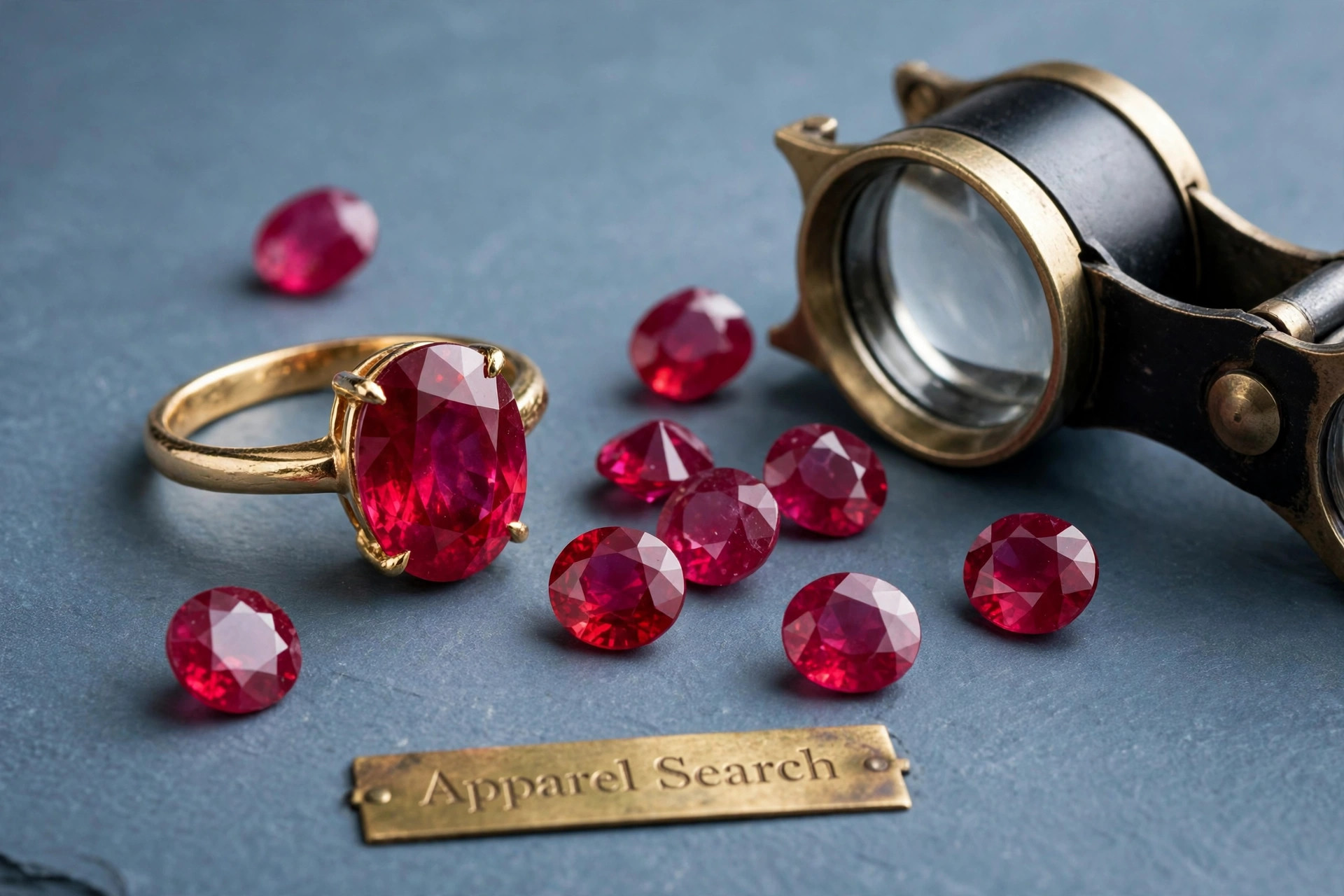
What a Lab-Grown Ruby Is
Ruby is the red variety of corundum, the same mineral species as sapphire. Pure corundum is colorless; ruby's red comes from chromium atoms replacing a small share of the aluminum in the crystal lattice. Chromium does double duty: it produces the red color, and the red fluorescence, discussed below, that makes the finest rubies appear to glow. Where chromium-colored corundum is too pale, the trade calls it pink sapphire instead; the boundary is a judgment about color, not a difference in material.
Corundum is an exceptionally wearable gem. At 9 on the Mohs scale it is the second-hardest gem material in common use, behind only diamond, and it has no cleavage plane along which it splits easily, so a ruby shrugs off daily knocks better than its hardness figure alone suggests. A lab-grown ruby shares all of this exactly: same chemistry, same crystal structure, same behavior in a setting. That identity separates it from imitations. Red glass, red synthetic spinel and quench-crackled dyed quartz only imitate ruby's appearance; a lab-grown ruby is the material itself, produced by a different route, as ice from a freezer is the same material as ice on a winter lake.
A Short History: Among the First Gems Ever Grown
Ruby's laboratory history is longer than that of any other precious gem. Small flux-grown ruby crystals were produced in France in the 1870s, and in the mid-1880s so-called Geneva rubies appeared on the market at high prices, surrounded at first by claims that they were natural stones reconstructed from fragments. Gemologists found gas bubbles in them and concluded they were artificial: an early flame-fusion product, made a generation before the process had a name. The decisive step came in Paris, where Auguste Verneuil announced his flame-fusion process in 1902 and published the details in 1904. Within a few years factories were producing synthetic ruby in quantities mining could never approach, for industry as well as jewelry.
One consequence matters to a shopper: much antique and vintage jewelry, from Edwardian and Art Deco pieces onward, is set with early lab-grown rubies that are genuine corundum and correct for their period; finding one is not finding a fraud. Grown ruby also went on to a scientific career no natural stone could have filled: the first working laser, built in 1960, used a synthetic ruby crystal, because only a grown crystal could be made large and consistent enough.
How Lab Ruby Is Grown Today
Four growth methods produce the lab-grown rubies on the market, each leaving its own fingerprints inside the crystal, which is why the method matters to identification and price. All four start from the same ingredients: high-purity alumina powder, with chromium added for the red.
Verneuil Flame-Fusion: The Original Process
In the Verneuil process, fine alumina powder mixed with a little chromium oxide is sifted through an oxy-hydrogen flame hot enough to melt it. The molten droplets land on a slowly rotating pedestal and build up, drop by drop, into a pear-shaped crystal called a boule, grown in a matter of hours. Flame-fusion is fast and inexpensive, and it still accounts for most lab-grown ruby sold. Its speed leaves evidence: because the crystal builds in layers following the curved top of the boule, the finished stone carries faint curved growth lines, called curved striae, and often tiny gas bubbles.
Flux Growth: Slow Crystals, Natural-Like Inclusions
Flux growth trades speed for resemblance to nature. The ingredients are dissolved in a molten chemical solvent, the flux, held in a platinum crucible at high temperature for weeks or months. As the solution is very slowly cooled, ruby crystals grow from it at a pace closer to geological patience than to factory output, developing natural-looking faces and trapping small amounts of flux, which appear as wispy, veil-like inclusions called flux fingerprints. The name most associated with flux ruby is Chatham: Carroll Chatham, who had already pioneered flux emerald, introduced gem-quality flux-grown ruby in 1959, and Chatham and later producers such as Kashan and Ramaura made flux ruby the premium tier of lab-grown material.
Czochralski Pulling: Crystals Drawn from the Melt
The Czochralski method grows a crystal by pulling it out of its own melt. A seed crystal is dipped into molten alumina and chromium, then slowly rotated and withdrawn; material freezes onto the seed as it rises, building a long cylindrical crystal of high purity and very few inclusions. Developed for industrial and laser crystals, pulled ruby is exceptionally clean, sometimes showing only faint curved banding or a few elongated bubbles, and a buyer may meet it in larger single stones.
Hydrothermal Growth: Ruby from Hot Water Under Pressure
The hydrothermal method imitates the way many natural crystals form: from hot water under pressure. Nutrient material is dissolved in water inside a sealed steel vessel, an autoclave, and ruby deposits onto seed plates suspended in the solution, growing slowly over weeks. Hydrothermal ruby, produced commercially by makers such as Tairus, tends to show chevron-like or wavy growth zoning under magnification. It occupies a middle position: slower and costlier than flame-fusion, and grown by a route similar to the one nature used in water-bearing rock.
However it was grown, a finished crystal is cut the same way as a natural ruby, faceted and polished by cutters using the same proportions and judgment, and a well-cut lab-grown stone returns light exactly as a well-cut natural one does.
Lab-Grown vs Natural: Same Material, Different Fingerprints
Because the material is identical, no standard property test separates a lab-grown ruby from a natural one, and no one can tell them apart by looking at the stone in a ring. What differs is the internal record of how each stone grew. A natural ruby grew slowly in rock, and it carries that environment with it: fine needle-like rutile inclusions called silk, which in the best stones scatter light and soften the red into a glow; small crystals of other minerals; healed fractures; and straight, angular growth zoning. A lab-grown ruby carries the record of its apparatus instead. Curved striae and round gas bubbles point to flame-fusion. Wispy flux fingerprints, sometimes with tiny platinum crystals shed by the crucible, point to flux growth. Chevron zoning points to hydrothermal growth. A gemologist reads these features under a microscope, and a laboratory can settle origin conclusively when value depends on it.
Fluorescence: A Trait Both Stones Genuinely Share
Fluorescence does not separate the two, and it is one of the most beautiful things about ruby. The same chromium that colors the stone red makes it fluoresce red under ultraviolet light. Because sunlight contains ultraviolet, a strongly fluorescent ruby keeps glowing in daylight and can look lit from within, an effect the trade prizes in the finest natural stones. How strongly a ruby fluoresces depends on its iron content, because iron quenches the chromium's fluorescence. Marble-hosted natural rubies, notably those from Mogok in Myanmar (Burma), are low in iron and fluoresce strongly; iron-rich rubies fluoresce weakly or not at all. Lab-grown rubies are grown from purified ingredients with essentially no iron in the recipe, so they commonly fluoresce strongly too. Fluorescence is therefore a genuine shared trait of the material, and gemologists treat its strength as one clue among many about a stone's chemistry and likely origin, never as proof by itself.
Price: Why Natural Ruby Commands a Premium and Lab Ruby Does Not
Fine natural ruby is among the most expensive gem materials in the world, its price driven by scarcity at the top of the quality range. The benchmark stones come from Mogok in Myanmar, where marble-hosted rubies of vivid, slightly purplish red, the color the trade has long called "pigeon's blood," combine saturated color with strong fluorescence and softening silk. Truly fine stones are rare, large ones are rarer, and untreated stones carry a further premium, because so much natural ruby is heated as a matter of routine. Exceptional untreated Burmese rubies have sold at auction for sums per carat rivaling fine diamonds. Below that summit the market falls away through heated stones and commercial grades, but even an ordinary natural ruby of good color costs far more than any grown stone.
A lab-grown ruby's price carries factory costs instead of scarcity: ingredients, energy, furnace or autoclave time and cutting. Flame-fusion material, grown in hours, is inexpensive; flux-grown material, with months in each crystal, costs more, yet still typically lands at a tenth or less of a comparable natural ruby, and often far less. Treat any single percentage as approximate, but the structure of the market is stable: the budget that buys a small, included natural ruby commonly buys a lab-grown stone several times its size, in strong color, with clarity natural ruby rarely achieves. Like other grown gems, a lab-grown ruby is bought for how it looks and wears, not as a store of value.
Disclosure and the Rules of Sale
Because origin cannot be seen, the trade polices it with disclosure rules. In the United States, the Federal Trade Commission's Jewelry Guides govern how gemstones may be described. A laboratory-grown ruby may truthfully be called ruby, but its origin must be made clear with a qualifier such as "laboratory-grown," "laboratory-created" or "[manufacturer name]-created" placed immediately before the word ruby, with equal prominence, so no buyer can mistake it for a mined stone. The FTC's plain-language summary for sellers, In the Loupe: Advertising Diamond, Gemstones and Pearls, sets the rules out in full, and any treatment that affects a stone's value, durability or care must likewise be disclosed. Reputable sellers label lab-grown stones in the product name itself and state the origin on the receipt.
Not the Same Thing: Glass-Filled Ruby
The disclosure rule matters most where a different product borrows ruby's name. Glass-filled ruby, also sold as composite ruby, starts as natural corundum so heavily fractured that it is nearly opaque and almost worthless. The stone is cleaned with acid and heated with a lead-rich glass whose refractive index is close to ruby's; the glass floods the fractures, the cracks nearly disappear, and the stone looks transparent and red, though a large share of it is glass, not ruby. The composite is far less durable than corundum: a jeweler's torch, household acids and ordinary repair work can cloud, crack or dissolve the filler, and it cannot be repolished like a real ruby. It sells for a tiny fraction of even a lab-grown stone's price. A lab-grown ruby, by contrast, is solid corundum crystal, with no glass anywhere in it.
Also Different: Quench-Crackled and Dyed Material
Quench crackling is a treatment in which a stone, classically colorless quartz, is heated and then plunged into cold liquid; the thermal shock fills it with a maze of fine surface-reaching cracks, which are then flooded with dye. The result imitates ruby, emerald or sapphire at a glance, with color concentrated in the crack network. Crackling has also been applied to flame-fusion synthetic corundum itself, sometimes followed by flux healing, to make an obviously grown stone look natural. Both products are imitations or doctored stones, not lab-grown ruby in the honest sense: a properly disclosed lab-grown ruby has no dye in cracks and no induced damage. When a red stone's price seems too good for natural ruby and its description avoids the words laboratory-grown, one of these categories is usually on offer.
Lab-grown stones sit inside a wider family of grown gems covered elsewhere in this guide. The ring, bracelet, earring and necklace pages on lab created stones explain the shared background for ruby, sapphire and emerald as well as diamond: lab created gemstone rings, lab created gemstone bracelets, lab created gemstone earrings and lab created gemstone necklaces. Those pages and this one use the same vocabulary throughout.
Care: Hard, Tough and Easy to Keep
Care for a lab-grown ruby is care for a ruby. At hardness 9 it resists scratching from everything except diamond and corundum itself, so store corundum pieces apart from diamond jewelry and from one another. Ruby has no cleavage and good toughness, so it tolerates the ultrasonic and steam cleaners that would endanger softer gems, provided the setting is sound. Everyday dullness is film, not damage: warm soapy water, a short soak, a gentle pass with a very soft brush, a rinse and a pat dry restore the stone's return of light. One caution: this routine assumes your stone is the solid lab-grown corundum its paperwork describes, since the glass-filled composites discussed earlier are damaged by exactly the heat and chemicals a true ruby ignores. The section's fuller guidance applies: the Jewelry Care and Cleaning Guide covers cleaning and storage by material, and How to Clean Jewelry at Home walks through at-home methods.
Buying Guidance: Color First, Then the Paperwork
With ruby, natural or grown, color decides value, and it should decide your choice too; judge it in the trade's three parts. Hue is the basic color: the most prized rubies are a pure red with at most a slight purplish or pinkish secondary hue, rather than an orangy or brownish one. Tone is lightness: medium to medium-dark reads as rich, while a stone too dark goes blackish at the edges and one too light reads as pink sapphire. Saturation is intensity: vivid, strong saturation separates a glowing red from a washed-out one, and chromium fluorescence can add saturation in daylight, an effect lab-grown stones, grown without iron, often show to advantage. Look at stones in daylight as well as under the shop's lights, and compare candidates side by side.
Then read the description as carefully as you read the stone. The words laboratory-grown or laboratory-created should appear in the product name, not only in fine print, and the growth method is worth asking about: flame-fusion stones are the least expensive, while flux-grown stones command more for their slower growth and subtler inclusions. For a larger stone, a report from an established gemological laboratory confirming laboratory-grown corundum gives you an independent record of what you bought. Finally, put the saving where it lasts: because the stone costs a fraction of a natural ruby, the setting is a larger share of the price and the part that takes the knocks, so choose solid gold or platinum, well-finished prongs and a band with enough substance to hold its shape.
Common Questions
Is a lab-grown ruby a real ruby?
Yes. A lab-grown ruby is ruby: the mineral corundum colored red by chromium, with the same hardness of 9 on the Mohs scale and the same physical and optical properties as a mined ruby. It is not glass, not a coated stone and not an imitation. The only difference is origin: the crystal grew in a laboratory in weeks or months instead of underground over geological time, and that origin must be disclosed when the stone is sold.
How can you tell a lab-grown ruby from a natural one?
Not by eye, and not by the standard property tests, because the material is the same. Gemologists separate the two under magnification by their growth features: flame-fusion stones show curved growth lines and gas bubbles, flux-grown stones show wispy flux fingerprints, while natural rubies show straight, angular growth patterns and mineral inclusions such as fine rutile silk. A gemological laboratory can confirm origin when the distinction matters.
Is a glass-filled ruby the same as a lab-grown ruby?
No. A glass-filled ruby starts as low-grade natural corundum so fractured it is nearly opaque, and its cracks are filled with lead glass to make it look transparent. The result is a composite of stone and glass that must be disclosed, sells for very little, and can be damaged by heat, acids and ordinary jewelry repair. A lab-grown ruby is solid corundum crystal grown in a laboratory, with no glass in it at all.