Inventory Control Software for the Clothing Industry
Knowing exactly what you have — by style, color and size — in every warehouse, store and channel, in real time
Inventory is where an apparel company's money sits — in cartons, on shelves and on store racks — and inventory control software is how the company knows what it actually has. In most industries a product is a product. In clothing, one style is dozens or hundreds of stock-keeping units: every color in every size is a separate quantity that can sell out, pile up or go missing independently of the style as a whole.
Software built for the clothing industry manages that matrix as its native structure. It tracks materials and finished goods through receiving, warehousing, allocation, picking, shipping, store transfer and sale, and it values what remains — the numbers purchasing, sales and accounting all have to agree on.
Related Software Guides
Why Apparel Inventory Is Harder Than Most
The style-color-size matrix multiplies everything. A warehouse may hold 40,000 units that are really 300 styles, and the commercially important questions are all at the lowest level: which sizes of the black dress remain, whether the size curve of a reorder matches how the first delivery sold, whether a store's broken size run should be consolidated with another store's. Generic inventory systems flatten that detail away; apparel systems are built on it.
Seasonality sharpens the problem. Fashion stock has a selling window, after which its value falls steeply, so the cost of not knowing — over-ordering a fading style, under-shipping a hot one, discovering a stockout after the season's peak — is unusually high. Accurate, current inventory is what lets a company chase winners, starve losers and promise delivery dates it can keep.
What Inventory Control Software Tracks
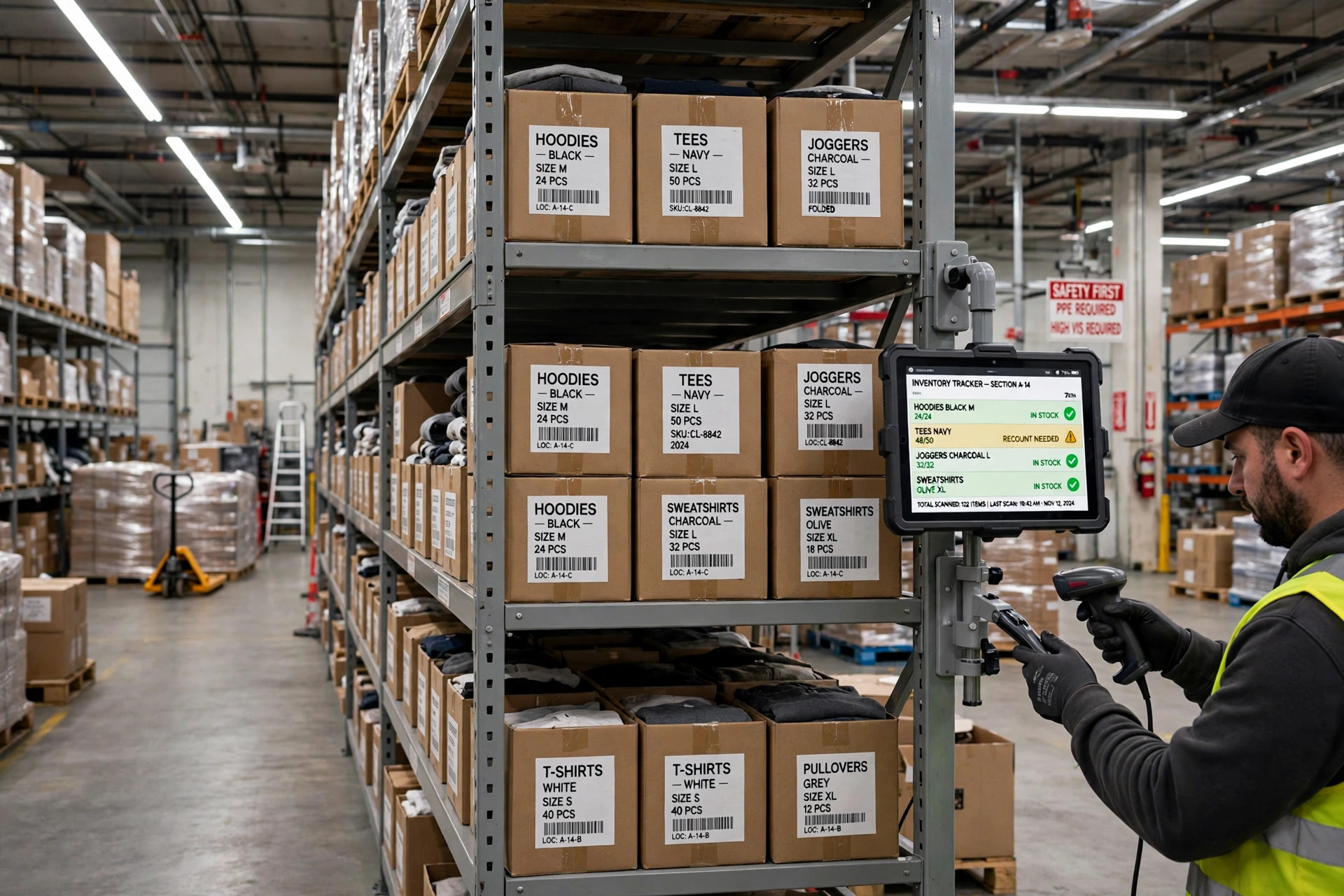
The core record follows each unit from arrival to sale: purchase orders and receipts, quality holds, warehouse locations, allocations against customer orders, pick and pack, shipping with carrier integration, transfers between stores and warehouses, returns back into stock, and physical counts that reconcile the system to the shelves. Radio-frequency warehouse tools let staff scan rather than key, which is where most inventory error is born or prevented.
On top of the record sit the decisions: available-to-promise figures sales can trust, reorder and replenishment signals, and analytics that show stock turns and aged inventory by style. In the integrated suites below, inventory is one face of a single system that also runs order entry — including web B2B and B2C storefronts and tablet order-taking — EDI with retail customers, and accounting integration, so a unit is counted once and seen everywhere.
Inventory Software Suppliers in This Directory
AIMS 360 (Apparel Information Management System) reports more than 5,000 installations and describes itself as the industry's leading apparel ERP, serving manufacturers and wholesalers/distributors of apparel, footwear, handbags, accessories, jewelry and home furnishings. It runs hosted in the cloud on .NET and SQL servers or on-site, with AIMS EasyShop online B2C retail cart, WebLink B2B wholesale cart, RemoteLink iPad order app, EDI integration, general-ledger integration with QuickBooks, Sage and other accounting software, UPS and FedEx shipping integration and Business Analytics for iPad. AIMS, a Microsoft Gold Partner and Gold Level QuickBooks developer, is located in the California Market Center, 110 E. 9th St., Suite A1169, Los Angeles, CA 90079, phone 310-361-5710.
ApparelMagic offers ERP, PDM, CRM, PLM, EDI and accounting in one integrated, web-enabled solution compatible with PC and Mac, built over more than 27 years in the industry, with ApparelMagic To Go for sales teams taking orders anywhere and ApparelMagic Plus for custom scripts, reports and layouts. Laudis Systems and Polygon Software — the developer of PolyPM, which also appears in the PLM directory — complete this list; Laudis's website no longer responds, so its entry is kept unlinked as a record. Live vendor pages are in the references below.
More Software Guides
- Fashion Industry Software
- Inventory Control Jobs
- Fashion Industry
- PDM Product Development Management
- Import & Export Software
- Inventory Control Software
- Warehouse Software
- Pattern Making Software
- Embroidery Software
- Costing Software
- Point of Sale Software
- Knitting and Weaving Software
- Bar Code Software
- Mail Order Software
- Auction Software
- Computer Assisted Design (CAD)
- Trade Show Management Software
- Production Management Software
- Ecommerce Software Solutions
- Retail Software
- Quality Assurance Software
Common Questions
Why does clothing need specialized inventory software?
Because apparel stock is a matrix: each style exists in many colors and sizes, each tracked, sold and reordered separately, and fashion seasons give that stock a short selling window. Apparel inventory software manages the style-color-size matrix natively instead of flattening it into single products.
What does inventory control software connect to?
In the integrated apparel suites it shares one database with order entry, EDI, shipping carriers such as UPS and FedEx, web storefronts for wholesale and retail, tablet order-taking, and accounting systems such as QuickBooks and Sage — so stock is counted once and visible everywhere.
What is available-to-promise inventory?
The quantity a salesperson can honestly promise a customer: stock on hand minus what is already allocated to earlier orders, sometimes plus confirmed incoming receipts. Accurate available-to-promise figures are the difference between shipping complete and apologizing later.
References & Further Reading
- AIMS 360
- ApparelMagic
- Polygon Software
- Laudis Systems — inventory and apparel systems supplier listed in this directory; its website no longer responds, so the entry is kept as a record without a link.