Clothing Production Management Software
From customer order to finished garment: production orders, materials, costing and the production book, in one system
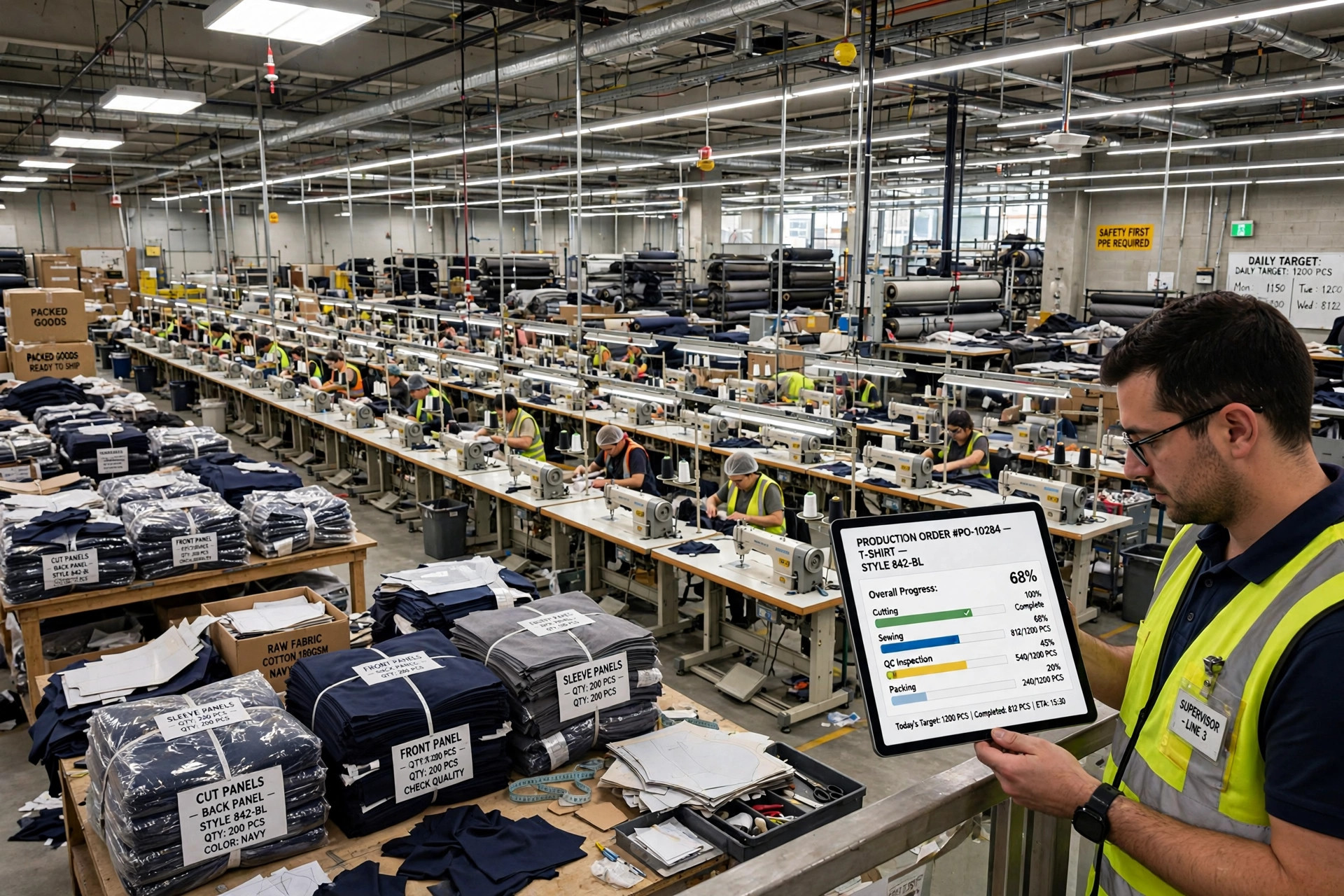
Production management software is the system that runs the making of clothing as an organized flow of information: customer orders in, production orders out to the factory floor or an outside contractor, raw materials consumed, finished garments booked in, deliveries made and invoices raised — with the status of every order visible while there is still time to act on it.
For a manufacturer or wholesaler, that visibility is the product. The questions that decide profit — what will this style actually cost to make, which orders are late and why, how much fabric a production run truly needs — are answered by the production record, or they are answered by guesswork at the end of the season.
Related Software Guides
From Sales Order to Production Order
The workflow begins with the customer order. The system confirms it, splits it into production orders, and breaks each production order down by customer, product, fabric, color and size — the analysis that tells the factory what to make and the warehouse what to pick. Split and partial deliveries are managed as normal events, not exceptions, and each delivery generates its notes, labels and paperwork: order confirmations, pro-formas, delivery notes and invoices, including fully customs-compliant invoices for export orders.
Raw materials run alongside. The system stores fabrics, trims and garment processes with their costs, calculates total requirements for a production run, and raises purchase orders to suppliers — in multiple currencies where the buying is international. Production itself is booked out and booked back in: materials issued to a manufacturer, finished production received, with the status of every production order listed at any moment.
Costing and the Production Book
Product costing is where production software earns its keep. A finished garment's cost is built by selecting raw materials and processes and letting the system total them — accurately and the same way every time — for domestic and imported product and for CMT (cut, make, trim) arrangements alike. Line drawings or digital photos attach to the costing, line sheets generate with sketches and prices, and reports show total make costs and total gross profit by product, customer or country.
Stock positions close the loop: raw material inventory status and finished product inventory status, pick and pack lists that simplify allocation of finished garments, and production labels and swing tags printed from the same record. Financial reports by customer or country turn the production book into the numbers the business is actually run on.
Production Software Suppliers in This Directory
F2IT Limited offers an online order-placement and production system for wholesale and manufacture, designed to be practical and painless: it handles raw materials, sizing and colors in a sensible way, coordinates activities from sales and production to invoicing, cross-references information to spot mistakes, and produces clear order forms and invoices with technical backup and secure data backup (customers still own their own data). Its feature set, summarized in the sections above, spans supplier and customer data, order management, production analysis, product costing, raw material control and book-out/book-in production tracking. F2IT's website no longer responds, so the entry is kept unlinked as a record of the system.
Magnal Solutions, based in Montreal, Canada, develops and markets the FACTS and SDM software lines; FACTS is its production management system for the apparel industry, from a developer focused on fashion manufacturing. Its site is linked in the references below. Companies evaluating production software should map a full order's journey — order, costing, materials, factory, delivery, invoice — against each system, because the gaps between modules are where manual work hides.
More Software Guides
- Fashion Software
- Fashion Industry
- Pattern Making
- Clothing Manufacturing
- Clothing Production Services
- Fashion Technology News Articles
- Supply Chain Management Software
- Import & Export Software
- Inventory Control Software
- Warehouse Software
- Embroidery Software
- Costing Software
- Point of Sale Software
- Knitting and Weaving Software
- Bar Code Software
- Mail Order Software
- Auction Software
- Computer Assisted Design (CAD)
- Trade Show Management Software
- Production Management Software
- Ecommerce Software Solutions
- Retail Software
- Quality Assurance Software
Common Questions
What does production management software do for a clothing manufacturer?
It runs the flow from customer order to invoice: production orders broken down by fabric, color and size; raw material requirements and purchasing; book-out/book-in tracking with outside factories; product costing; deliveries including split shipments; and inventory and profit reporting.
What is production book out / book in?
Booking out records materials and production orders issued to a manufacturer or contractor; booking in records the finished production received back. Together they show exactly what is with each factory, what it consumed and what is still owed — the core control for CMT production.
How does production software handle costing?
Costs are built from components: raw materials selected from stored records plus garment processes, totaled automatically and consistently for domestic, imported and CMT product, with line sheets, make-cost reports and gross-profit reports generated from the same record.
References & Further Reading
- Magnal Solutions
- F2IT Limited — online production and order management system; its website no longer responds, so the entry is kept as a record without a link.