Conveyors for Clothing Warehouses
Belt, roller, chain and overhead garment conveyors — the systems that move clothing through the warehouse.
A conveyor moves work to the worker instead of sending the worker to the work. In a clothing warehouse that simple idea reorganises the whole building: cartons of garments travel on belt and roller conveyors from receiving to inspection, from storage to picking, and from packing benches to shipping, while hanging garments glide overhead on rail and trolley conveyors from pressing to storage to the loading dock. Conveyor machinery ranges from a short gravity roller section behind a packing bench to a fully powered, computer-controlled system with scanning and sortation — and the right choice depends on what is moving, how far, and how fast it has to arrive.
Warehouse Machinery Types
How Conveyors Move Clothing Through a Warehouse
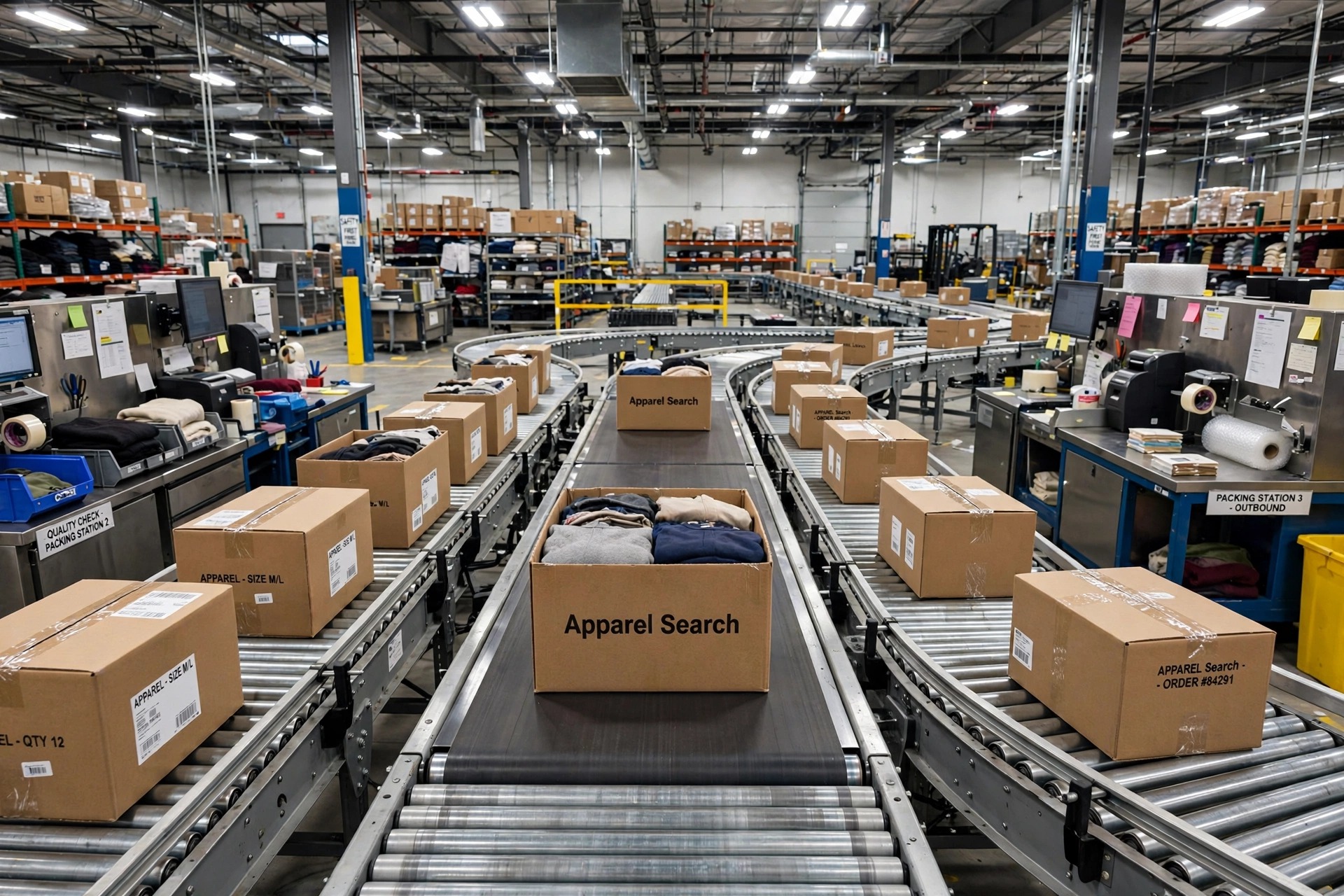
Carton conveyors come in two broad families. Belt conveyors carry cartons on a continuous moving belt and handle the mixed sizes, polybagged garments and awkward shapes common in apparel work, including loads that have no flat, firm base. Roller conveyors carry cartons on a series of rollers — gravity rollers on a slight slope for short, cheap runs, and powered live rollers where the line must climb, accumulate or meter cartons into a workstation. Chain and slat conveyors handle heavier unit loads, and overhead conveyors carry garments on hangers, which is the form in which much clothing actually travels.
Overhead garment conveyors deserve their own mention in an apparel building. A rail, trolley and hook system keeps garments on hangers moving in single file or in trolley loads between the pressing area, quality inspection, storage rails and shipping — the garments never leave the hanger, never get folded into a carton, and arrive at the store rail-ready. The same principle serves laundries and dry cleaners, where garments circulate past finishing stations, which is why several of the suppliers listed below serve the textile care industry as well as distribution.
Powered systems tie these sections together with accumulation zones that let cartons queue without pressure, photo-eye sensors that start and stop zones as cartons arrive, incline and decline sections between floors, and barcode scanners that divert each carton to its packing bench, value-added station or outbound door. In a well-planned apparel warehouse the conveyor is not a single machine but the building's circulatory system, and it is designed around the peak day, not the average one.
Choosing Conveyor Machinery for Apparel Work
Start with the load. Cartons of folded garments are light but bulky, easily crushed and often loosely filled, so they suit wide belts and closely spaced rollers that support the whole carton base. Hanging garments need rail height, trolley spacing and curve radii worked out around the longest garment. Fabric rolls and piece goods are long and heavy for their footprint and may need chain conveyors or cradle attachments. The lightest conveyor that will carry the heaviest real load — not the catalogue load — is usually the right one.
Then work out the route and the rate: how many cartons per hour at the seasonal peak, how many workstations the line must feed, and where cartons must accumulate when a bench stops. Apparel peaks are sharp — a new season drop or a sale event can double the daily volume — so accumulation capacity and a bypass route keep one stopped station from stopping the building. Noise matters more in apparel than in heavy industry, because operators work beside the line all shift; modern belt and roller systems are specified with that in mind.
Finally, plan the controls and the upkeep. Even a modest powered line needs a control panel, emergency stops within reach of every workstation, and guarding where belts meet rollers. Belts wear, rollers collect lint and thread — both abundant in a clothing building — and a weekly cleaning and inspection routine keeps a conveyor system at its rated speed instead of slowly degrading into a bottleneck.
Conveyor Machinery Companies
Ashworth
Ashworth is one of the top conveyor belt manufacturers in the world, built around satisfying customer needs in food processing, industrial, transportation and technology applications, with conveyor belting systems intended to improve yield and help businesses thrive.
Supplies: Conveyor belting systems
Custom Equipment Company
Custom Equipment Company sells material handling, containers, packaging, rack systems, mezzanines, modular offices, wire shelving, collapsible bulk containers and new and used containers and wire decking through a large online catalogue. Address: 10453 Leslie Drive, Raleigh, NC 27615. Phone: 919-518-0900. Fax: 919-847-5765. Contact: Tom McGovern, e-mail tom@custommhs.com.
Supplies: Conveyor systems, pallets and topcaps, pallet rack systems, wire decking, collapsible bulk containers
Dürkopp Fördertechnik GmbH
Dürkopp Fördertechnik is highly regarded by well-known companies in important industries worldwide as a supplier of innovative conveyor systems.
Supplies: Innovative conveyor systems
Eagle Star Equipment
Eagle Star Equipment is one of the industry's most respected distributors of dry-cleaning, coin laundry, on-premise laundry and garment management equipment, distributing equipment from some of the most trusted manufacturers in the world.
Supplies: Garment management and laundry conveyor equipment
Forenta
Forenta manufactures and markets a wide range of products for the textile care industry: garment presses, steam-air finishing machines, conveyors and dry cleaning machines that provide cost-effective solutions for dry cleaners and laundries throughout the world.
Supplies: Garment conveyors, presses and finishing machines for textile care
Iwis
Iwis is a market leader and experienced partner in the development and delivery of high-quality chains and drive systems, including the chains used for conveyor systems.
Supplies: Chains and drive systems for conveyors
Railex Corporation
Railex Corporation is one of the world's largest exclusive manufacturers of garment handling equipment, used in any facility where wearing apparel is cleaned, sorted, stored, shipped, sold or processed. Railex manufactures and fabricates all types of products for handling garments on hangers — trolleys, rail systems, conveyors and speed rail.
Supplies: Garment-on-hanger conveyors, trolley and rail systems, speed rail
Siegling
Siegling's Transilon conveyor and processing belts speed the flow of goods and support economical processing in light materials handling. The standard Transilon construction uses a polyester fabric tension member with synthetic or elastomer coatings, and the standard range includes over 120 conveyor belt types and constructions for diverse application requirements, used in industrial, commercial and service companies worldwide.
Supplies: Transilon conveyor and processing belts, 120+ belt types
White Conveyors
White Conveyors is a manufacturer of conveyor systems characterised as technologically advanced, of the highest quality and reflecting superior engineering.
Supplies: Conveyor systems for garment handling
Conveyors and the Equipment Around Them
A conveyor line is only as useful as the stations it connects. Inbound, it starts where cartons come off pallets or out of containers; outbound, it ends at the strapping, wrapping and labelling stations and the shipping dock. The pallet conveyors and palletizers in this section handle the pallet-sized end of the same flow, and the strapping and wrapping machinery pages cover the machines that secure the cartons the conveyor delivers.
For the materials the line carries, the carton and packaging pages linked below cover the boxes themselves, and the pallets and racking pages cover what cartons rest on before and after their ride. A conveyor decision taken together with those choices — carton sizes, pallet types, rack layout — produces a far better system than one bought machine by machine.
Common Questions
What types of conveyor are used in a clothing warehouse?
The main types are belt conveyors for mixed cartons and soft goods, gravity and powered roller conveyors for carton transport and accumulation, chain conveyors for heavy unit loads, and overhead rail and trolley conveyors that move garments on hangers between pressing, storage and shipping. Most apparel buildings use several types joined into one system.
Why do apparel warehouses use overhead garment conveyors?
Because much clothing travels on hangers. An overhead rail and trolley system moves garments from pressing and inspection to storage and shipping without the garments ever being folded or cartoned, so they arrive rail-ready with less handling, less creasing and less labour per garment.
How do I size a conveyor system for seasonal peaks?
Design around the peak day, not the average day. Work out the cartons per hour the busiest season demands, give the line accumulation zones so cartons can queue when a workstation pauses, and include a bypass so one stopped packing bench cannot stop the whole building. Fashion volumes can double at a season drop or sale event, and the conveyor has to absorb that surge.