Wrapping Machinery for Clothing Warehouses
Stretch wrapping for pallet loads and shrink wrapping for cartons and bundles of clothing.
Wrapping machinery encloses a load in plastic film — stretched tightly around a pallet load, or shrunk snugly around a carton or bundle — so that clothing travels protected and stays together. A wrapped pallet load is one unit instead of a stack of separate cartons: it resists dust, moisture and casual interference, survives forklift handling and long journeys, and arrives with its cartons in the positions they were packed in. Shrink wrapping does the same at carton scale, giving garment bundles and multi-packs a tight, clear, protective skin. Between the two, wrapping is the last operation most apparel freight passes through before it leaves the building.
Warehouse Machinery Types
Stretch Wrapping Pallet Loads
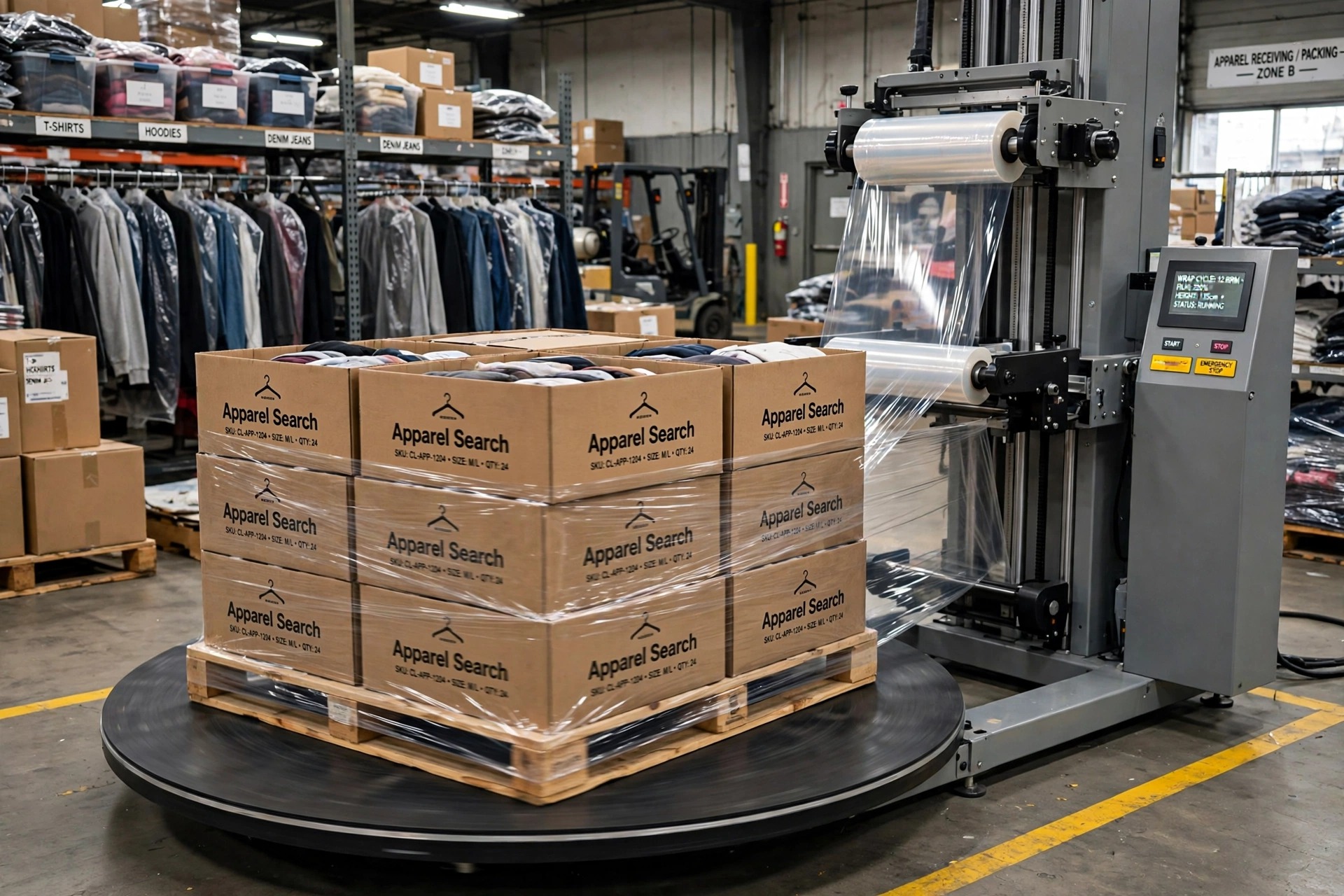
The standard machine is the turntable stretch wrapper: the pallet sits on a rotating turntable while a film carriage travels up and down a mast, applying stretch film with controlled pre-stretch and tension. Semi-automatic machines need an operator to attach the film and start the cycle; automatic machines, fed by conveyor, attach, wrap and cut the film by themselves, often as the final station of a palletizing line. Rotary-arm machines keep the load still and swing the film carriage around it — the right answer for loads too light, tall or unstable to spin — and orbital wrappers pass film through the centre of long or awkward loads.
Film and settings decide the result more than the machine's badge. Pre-stretch rollers elongate the film before it reaches the load, which both saves film and increases its holding force; the number of wraps at the base locks the load to the pallet, the middle wraps contain it, and the top wraps and a film tail finish it. Apparel loads are light and crushable, so containment must come from film placement and overlap rather than brute tension — a garment load wrapped like a load of bricks arrives with its top cartons creased.
A wrapped load also has to breathe with its journey: export cartons may sit in a container for weeks, store deliveries may be handled half a dozen times, and film that is too loose lets cartons walk while film that is too tight distorts them. Test-wrapping the building's real loads — its tallest, lightest and most underfilled cartons — is how the settings are set, and the wrapper's stored programmes let operators recall them load type by load type.
Shrink Wrapping Cartons and Bundles
Shrink wrapping encloses cartons, garment bundles and multi-packs in film that is then heated so it shrinks tight to the product. Side sealers and L-bar sealers form the film envelope around the item at a packing bench, and a heat tunnel shrinks it as the pack passes through; flow-wrappers do the same continuously at line speed. The result is the familiar clear pack around folded garment sets, bundled hosiery and hosiery-style multi-packs, and around the master bundles that clothing factories ship to distribution centres — protection against dust and damp, a tamper-evident surface, and a pack that can be labelled and scanned through the film.
Shrink systems are also part of palletizing work: unsupported shrink-wrapped cases — bundles with no carton at all — are a recognised feed for palletizers designed to handle them, which lets a factory skip cartons entirely for some freight. Film choice follows the job: thin polyolefin film for display-quality garment packs, heavier polyethylene for shipping bundles and tray packs, each matched to the sealer and tunnel temperatures of the line.
The supplier listed below manufactures shrink wrapping machinery alongside its strapping machines — a common pairing, since the two operations sit side by side at the end of a packing line and are often bought, serviced and supplied with film and strap together. The shrink wrap materials page linked below covers the films themselves, as the strapping materials page covers strap.
Wrapping Machinery Companies
Sealers India
Sealers India, the one-stop packaging company based in Chennai, manufactures all types of packaging machinery and packaging materials and specialises in packaging machines including fill and seal, stitching and strapping machines. The company also deals in packaging materials like PVC films, moulded blisters, cups and bottles and trays, manufactures semi-automatic and fully automatic carton strapping machines, and manufactures shrink wrapping machines.
Supplies: Shrink wrapping machines and carton strapping machines
Choosing Wrapping Machinery
Decide first what is being wrapped: pallet loads point to a turntable, rotary-arm or in-line stretch wrapper; cartons and bundles point to a shrink system; many apparel buildings need both, at different points in the flow. Then count the loads at the seasonal peak and choose the automation level — a hand-applied film station with a simple turntable for a few pallets a day, a semi-automatic wrapper for regular shipping, or a conveyor-fed automatic machine closing a palletizing line.
Finally, treat film as part of the machine purchase. The wrapper's pre-stretch capability, tension control and programme memory only deliver their savings with the film specified for them, and the cheapest film per roll is often the most expensive per wrapped pallet. A trial on the building's own loads, measuring film used and load stability, settles the combination before the order is placed.
Common Questions
What is the difference between stretch wrapping and shrink wrapping?
Stretch wrapping stretches elastic film around a load — usually a full pallet — and relies on the film's tension and cling to hold the load together. Shrink wrapping encloses a carton, bundle or pack in film and then applies heat so the film shrinks tightly to the shape of the contents. Stretch film works at pallet scale; shrink film works at carton and product scale.
Can stretch film damage clothing cartons?
It can if it is applied like a heavy industrial load: garment cartons are light and crushable, so containment should come from the number and placement of wraps and the film's pre-stretch, not from maximum tension. Wrapping programmes stored per load type, with gentler settings for underfilled apparel cartons, keep loads stable without creasing the top cartons.
Do clothing warehouses need both stretch and shrink wrapping?
Often, yes, at different points in the flow. Shrink wrapping serves cartons, garment bundles and multi-packs at the packing stage, while stretch wrapping secures the finished pallet load for storage and shipping. A smaller operation may start with one — usually stretch wrapping for outbound pallets — and add shrink capacity as packing volume grows.