Pallet Conveyors for Clothing Warehouses
Chain-driven roller and drag chain conveyors that move full pallets between palletizers, wrappers and storage.
A pallet conveyor moves the whole pallet — a thousand pounds or more of cartons at a time — so that forklifts do not have to. Where carton conveyors handle individual boxes, pallet conveyors form the heavy arteries of the warehouse: they carry full pallets of clothing from the dock to the palletizer, from the palletizer to the stretch wrapper, and from wrapping to the staging lanes and rack aisles. In an apparel distribution centre receiving and shipping palletized cartons all day, a short run of pallet conveyor at the right place removes dozens of forklift journeys, and with them the congestion, damage and risk that forklift traffic brings.
Warehouse Machinery Types
Types of Pallet Conveyor
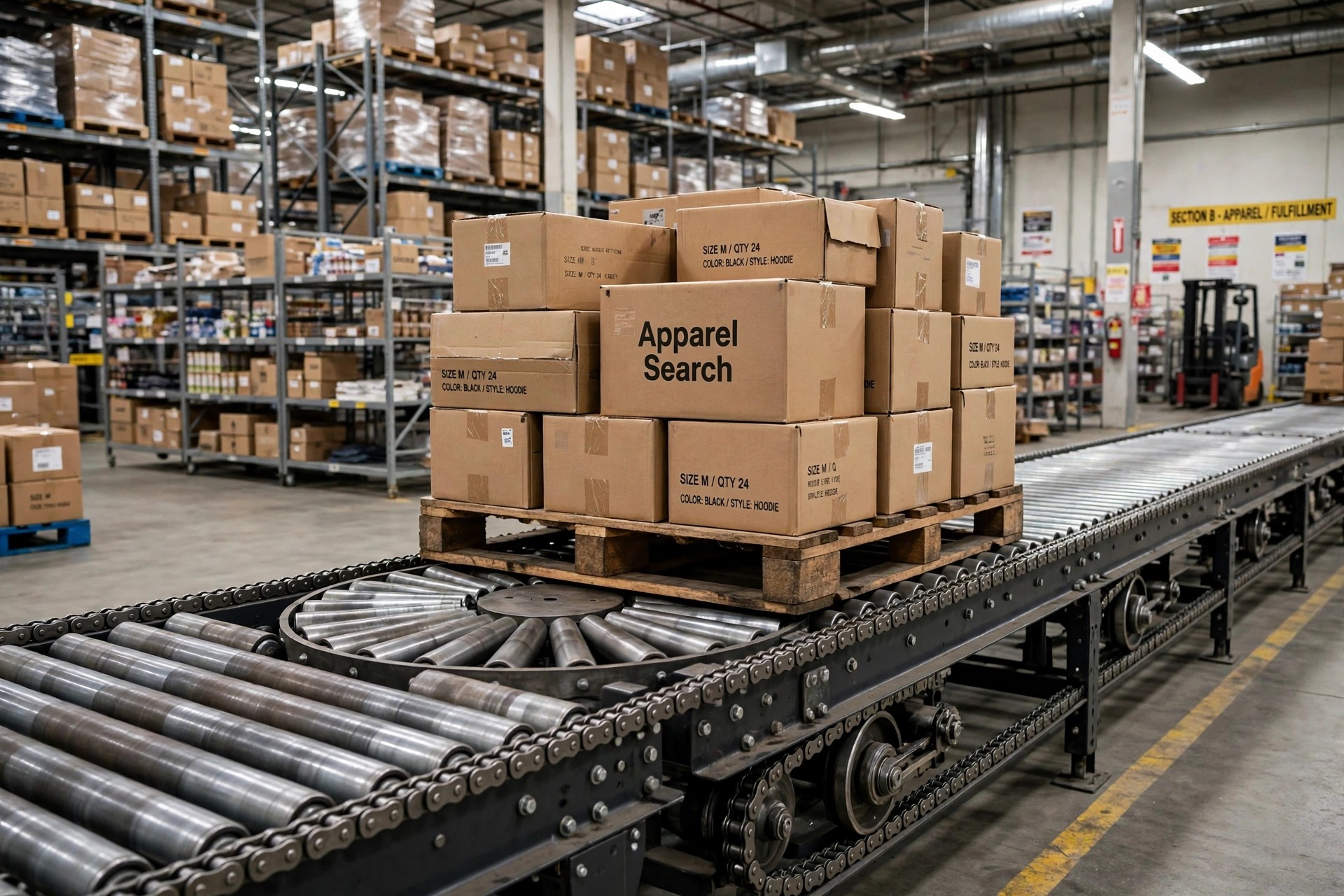
The workhorse is the chain-driven live roller (CDLR) conveyor: a series of heavy rollers turned by a chain running along the frame, able to move loaded pallets steadily and to accumulate them with controlled back-pressure. Drag chain conveyors carry the pallet directly on two or three strands of moving chain and are simpler and tougher still, well suited to pallets in poor condition or to loads on skids. Between and around these straight sections sit the components that make a system: right-angle transfers that change a pallet's direction, turntables that rotate it for wrapping or for entry into a rack aisle, and pallet dispensers that feed empty pallets one at a time into a palletizing cell.
Pallet conveyor is specified by the pallet, not by the product. The pallet's size, its board direction, whether its base is a full perimeter or open stringers, and the condition of its bottom boards all decide which conveyor type will run it reliably. Apparel warehouses receive a mixture — standard domestic pallets, import pallets of several sizes, and slip-sheet loads — so the system designer needs the real range of pallets the building handles, including the worst one, before choosing rollers, chain strands and transfer mechanisms.
Capacity and speed are modest by carton-conveyor standards and that is fine: a pallet conveyor line typically moves a pallet every half-minute or so, matching the rate of the palletizer feeding it and the wrapper clearing it. What matters is reliability under load — a stalled pallet line stops the machines at both ends of it — and safe accumulation so that pallets queue without being pushed into each other.
Where Pallet Conveyors Earn Their Place in Apparel Distribution
The classic apparel layout is a cell: cartons arrive on carton conveyors, a palletizer builds them onto pallets, the pallet conveyor carries each finished pallet through strapping and stretch wrapping, and a forklift or an automated transfer takes the wrapped pallet away to storage or staging. Pallet conveyor joins those machines into one continuous operation in which no one drives between stations at all. The same conveyor run in reverse serves inbound work, carrying received pallets from a checking station to the rack aisles' transfer points.
Forklift reduction is the real return. Every pallet moved by conveyor is a forklift journey that does not cross pedestrian routes, does not queue at the wrapper, and does not risk a fork through a carton of garments. In buildings where the dock, the palletizing area and the shipping lanes are laid out in a line, pallet conveyor also fixes the flow: pallets can only travel the intended route, in the intended order, at the intended rate, which keeps wrapping film use, staging space and dock appointments predictable.
The limits are layout and flexibility. Pallet conveyor is fixed infrastructure — it occupies floor, it crosses aisles only at bridges or gates, and rerouting it when the building's operation changes is a project. Warehouses whose mix of work changes constantly may be better served by forklifts and pallet trucks alone; warehouses with a stable, high-volume pallet flow — the normal case in apparel distribution — recover the investment in labour, damage and safety terms.
Pallet Conveyor Companies
Von Gal (Vongal)
With an installed base of more than 4,000 palletizers, von Gal delivers quality, reliable, high-performance palletizer solutions to diversified industries including baking, bottling, brewing, paint, pet food and publishing, backed by a long material handling legacy of systems solutions, software and engineering. Its palletizers deliver throughputs from 15 cases per minute up to an accelerated 150 cases per minute depending on product and application, handling cases, cartons, sacks, bags, bales and bundles. Von Gal also manufactures pallet conveyor products, from traditional pallet and unit load handling components to specialised pieces designed for a customer's unique needs; its pallet and unit load conveying family includes chain driven live roller (CDLR), chain conveyor, transfers and turntables.
Supplies: Pallet conveyors — CDLR, chain conveyor, transfers and turntables — and palletizers
Specifying and Maintaining a Pallet Conveyor Line
Begin with the pallet survey: sizes, weights when loaded with the densest product (wet denim and fabric pallets weigh far more than tee-shirt pallets), bottom board condition, and whether slip sheets or double-stacked pallets will run on the line. Then set the pass height so the line meets the palletizer's discharge and the wrapper's infeed, plan the accumulation zones, and place the transfers and turntables where the flow genuinely turns — every mechanism is a cost and a maintenance point, so a straight line that works beats a clever one that jams.
Maintenance is straightforward but relentless in a clothing building: lint, thread and strap offcuts collect around chains and rollers, and a cleaning routine is part of the design, with access panels where debris gathers. Chain tension, roller bearings and transfer mechanisms get scheduled inspection, and photo-eyes are kept clean and aligned — a pallet line that stops for a dirty sensor stops the palletizer and the wrapper with it.
Common Questions
What is the difference between a pallet conveyor and a carton conveyor?
A carton conveyor moves individual boxes on belts or rollers. A pallet conveyor is built far more heavily to move the complete pallet — often a thousand pounds or more — on chain-driven live rollers or drag chains, usually over the short fixed routes between palletizers, strapping and wrapping machines, staging and rack transfer points.
Which pallets can run on a pallet conveyor?
Any pallet whose size, base construction and bottom-board condition match the conveyor type. Chain-driven live roller suits most standard pallets; drag chain handles rough pallets and skids well. Import pallets in unusual sizes, damaged bottom boards and slip-sheet loads each need checking against the system design, which is why a survey of the building's real pallets comes first.
Why replace forklift journeys with pallet conveyor?
Every pallet moved by conveyor removes a forklift trip across the warehouse floor — with its pedestrian risk, its queue at the wrapper and its chance of fork damage to cartons. On a stable, high-volume route such as palletizer to wrapper to staging, conveyor also fixes the flow and the rate, making the whole cell predictable.