Airline Uniforms by Airline · Canada
The Air Canada Uniform by Christopher Bates
For Canada 150 and its own 80th birthday, Air Canada dressed 28,000 people in one Canadian designer's tailoring: charcoal-grey wool, black, and a single disciplined accent of flag red. Unveiled on 9 February 2017 and wear-tested for two years before launch, the Christopher Bates collection is still the airline's uniform today. This is its story, piece by piece.
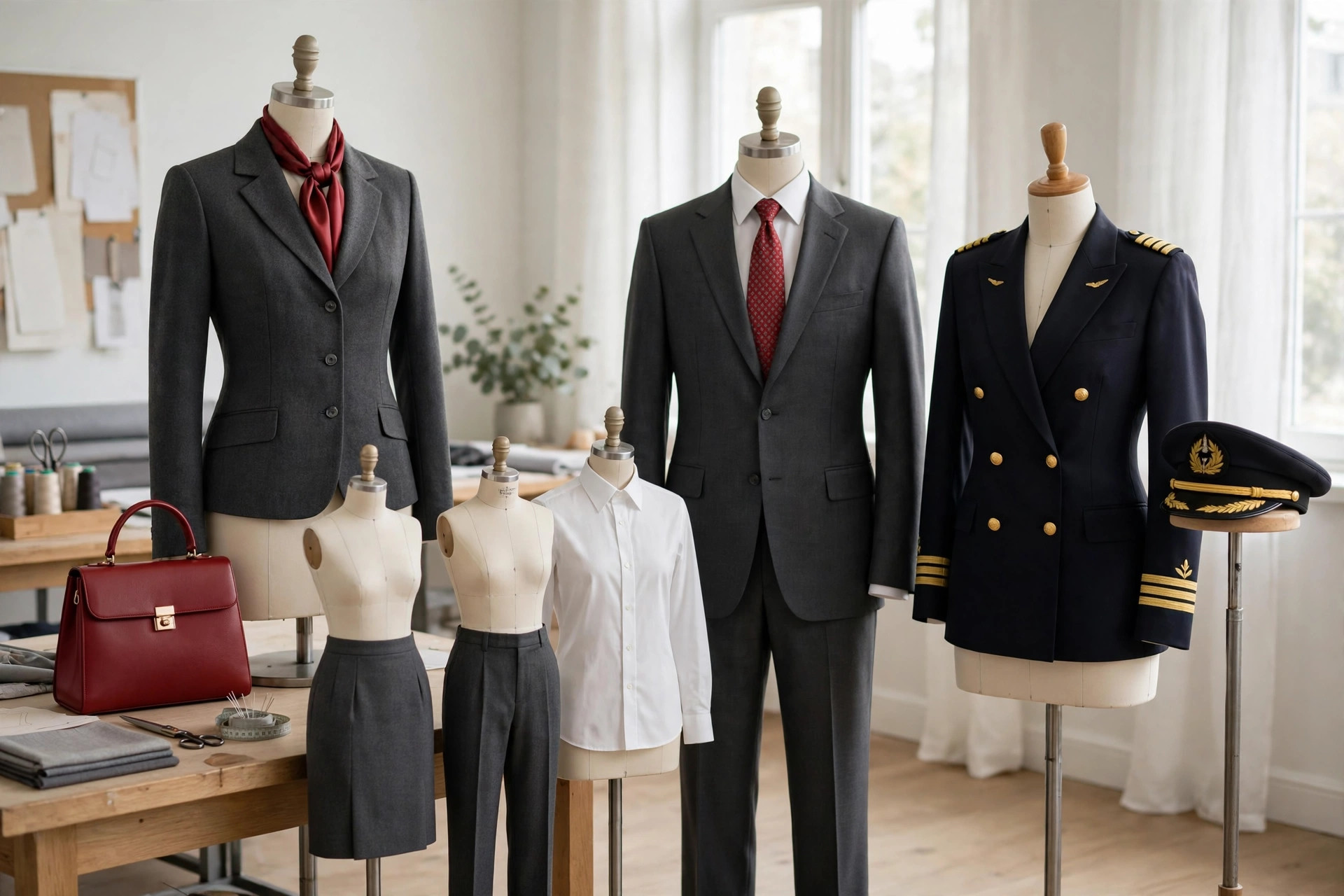
The Design
A Canadian Designer for Canada 150
Air Canada unveiled its current uniform on 9 February 2017, at simultaneous events in Toronto, Montreal and Vancouver held to launch the airline's new livery. The timing was deliberate: 2017 was both Canada 150 — the sesquicentennial of Confederation — and Air Canada's own 80th anniversary, and the airline treated the wardrobe as part of the national celebration. The designer was Christopher Bates, a Vancouver-born Canadian fashion designer selected after a competition among leading Canadian designers. Air Canada's own site states the credit plainly: Bates partnered with the airline on the design of the new employee uniforms, and the launch release described charcoal grey and black uniforms with red accents and accessories by Bates.
The scale was that of a national wardrobe rather than a crew outfit: a collection of around 150 pieces for some 28,000 employees, spanning cabin crew, pilots, airport agents, concierges and below-wing ground staff. It was also a tested wardrobe, not just a designed one. Some 250 employees wear-tested the garments over 2015–2016, in two rounds, and their feedback changed the clothes before launch — the women's shirt, for example, moved to a lighter, wrinkle-resistant fabric, and the handbags first issued to airport agents were replaced with messenger bags that suited the work better. The finished collection was recognised with the NAUMD's 2018 “Best of the Best” award and honours at the Professional Clothing Awards in London.
The design language is disciplined tailoring with a single national accent. The suiting is charcoal grey and black; the colour comes from Air Canada red, carried in the ties, scarves and handbags, in a red sleeve button and red top-stitching, and in the red lining inside the jackets — a flash of the flag's colour that appears when a jacket opens or a cuff turns. It is a uniform designed to read as Canadian without a single novelty motif, apart from one quiet emblem: the Rondelle, the airline's maple-leaf roundel, worked into the men's ties.
The materials were specified as carefully as the cut. The airline's own account of the collection lists 100% wool suiting, 100% silk accessories and soft leather — natural, durable fibres chosen for garments expected to work long days across every climate a Canadian network touches. That specification matters to how the uniform should be read: this was not a fashion capsule dropped onto an airline, but a working wardrobe engineered like one, with the designer's job being to make the engineering look effortless. A 150-piece collection is, in effect, a small clothing system — every piece has to combine with the others, survive industrial laundering and still present as tailoring. The Bates wardrobe's achievement is that passengers see the tailoring and never the system.

The Components
The Outfit, Piece by Piece
- Tailored Suiting
- Charcoal-grey wool jackets, trousers, skirts and dresses form the core of the cabin-crew and airport wardrobe. The suiting fabric is 100% wool, cut as proper tailoring rather than corporate separates.
- Shirts
- White shirts for men and women. After wear-test feedback, the women's shirt was remade in a lighter, wrinkle-resistant fabric — a small change that says a lot about how this wardrobe was developed.
- Scarves, Ties and the Rondelle
- Silk scarves for women and silk ties for men, the ties carrying the Rondelle maple-leaf motif. Accessories are 100% silk, and red is their dominant note. Our scarf definition covers the garment's long history as uniform dressing.
- Red Handbags — and Messenger Bags
- Structured red handbags were part of the launch wardrobe; wear-testing then replaced the bags issued to airport agents with messenger bags, a practical swap kept in the final collection.
- The Waistcoat Option
- A waistcoat (vest) option gives crew a layer that allows mobility in the cabin while keeping the tailored line — worn in place of, or under, the jacket according to the task.
- Outerwear System
- Water-resistant outer coats with removable quilted liners and hoods — essential engineering for a wardrobe that must work a Montreal February as well as a Vancouver drizzle.
- Leather Goods
- Soft leather is used across the accessory range, completing a materials story the airline summarised as wool suiting, silk accessories and leather goods.
Read as a whole, the components explain the collection's reputation for practicality. The waistcoat exists because cabin crew need to move; the quilted liner comes out because a coat specified for a Winnipeg winter would swamp its wearer in July; the hood pulls away on ground equipment because loose fabric and machinery do not mix. Even the famous red handbag carries the story — kept in the wardrobe, while the agents whose work it did not suit received messenger bags instead. Uniform design at this level is ergonomics wearing a designer's name, and the wear-test rounds are where the ergonomics won its arguments. Students of uniform design could do worse than study this collection as the model of the method: design, issue to real staff, listen, change the clothes, and only then launch.
Reading the Uniform
Four Wardrobe Families, Not a Colour Code
Air Canada does not run a scarf-colour rank system of the kind some airlines use. Instead, the Bates collection differentiates by wardrobe family: each job wears a visibly distinct version of the same charcoal, black and red language, so a passenger can tell a pilot from a concierge at a glance while the whole workforce still reads as one team.
| Family | Wardrobe | Distinguishing details |
|---|---|---|
| Pilots | Traditional double-breasted blazer with peak lapels | Modern button arrangement, antique-gold detailing, and a peaked cap carrying AIR CANADA branding. As on most airlines, a pilot's seniority is read from standard sleeve braid rather than from the wardrobe family itself. |
| Airport concierges | Black wool twill suits | White shirts and red accents — the black twill, distinct from the charcoal of the general wardrobe, marks out the premium-service role. |
| Cabin crew & airport agents | Charcoal-grey tailoring | Red scarves, ties and accessories; waistcoat option for cabin mobility. |
| Ground & below-wing staff | Durable workwear | Polo shirts, webbed belts, bonded jackets, reflective detailing and pull-away hoods, for baggage handlers, cargo agents, station attendants and maintenance crews. |
The Men's Uniform
Charcoal Suiting and the Rondelle Tie
Men wear the same charcoal-grey tailoring as their women colleagues: wool jackets, trousers, white shirts and the collection's outerwear system, with a vest option in place of the jacket for working roles. The signature piece is the silk tie with the Rondelle motif — the maple leaf enclosed in a roundel, repeated down the tie in Air Canada red. It is the one place the uniform permits itself a national symbol, and it is handled as pattern rather than badge. The men's uniform is covered by the same wear-test story as the women's: two rounds of staff trials shaped the final fabrics and fits before a single passenger saw the wardrobe.
That parity is itself a design decision worth noticing. In many airline wardrobes the men's uniform is an afterthought — a generic suit ordered to sit quietly beside a much-designed women's outfit. Here the men's tailoring carries the same wool, the same red detailing and the same accessory quality as the women's, and the pilot family's double-breasted blazer with its antique-gold detailing gives the flight deck the most traditional silhouette in the building. The result is a workforce that reads as variations on one tailored idea, which is precisely what a flag carrier's ground and cabin presentation is supposed to do.
A Uniform as a Birthday Present to a Country
Airlines usually launch uniforms when the old ones wear out. Air Canada launched this one for a birthday — two birthdays, in fact. Canada 150 and the airline's 80th anniversary fell in the same year, and the Bates wardrobe, the new livery and the celebrations were planned as one gesture: a flag carrier dressing its 28,000 people in a Canadian designer's tailoring, in the flag's own red, for the country's biggest party in a generation. Few uniform launches are so explicitly acts of national presentation.
The Rules
Grooming: What Is — and Is Not — Public
Some airlines' grooming regimes are documented in detail by journalists and former crew. Air Canada's is not: the airline does not publish a grooming manual, and no reputable public source documents specific hair, make-up or jewellery rules for the current era, so this guide does not invent any. What is publicly documented is the standard the wardrobe itself was built to: a tailored, consistent presentation, tested on real employees before launch, in which the red accents are worn as issued and the four wardrobe families stay visually distinct. Readers who need the airline's current appearance standards should treat Air Canada's own channels as the only authoritative source — uniform programmes keep their detailed standards internal far more often than they publish them.
The absence of public detail is itself the honest finding, and it is not unusual. Labour reporting around Air Canada in 2025, for example, concerned pay and working conditions, not appearance — a reminder that the public record of an airline's people is written by its press releases, its award entries and its retrospectives, and none of those is a grooming manual. Where this guide can be specific it has been, and where the record is silent it says so rather than dressing invention as fact.
Evolution
From Lucile Garner Grant to Midnight Blue to Bates
Air Canada's uniform history, traced in the airline's own retrospectives back to 1938, begins with a designer drawn from the cabin itself: the first stewardess uniforms were designed by flight attendant Lucile Garner Grant — a navy skirt suit with a white blouse or sweater and white gloves, the professional template of the era.
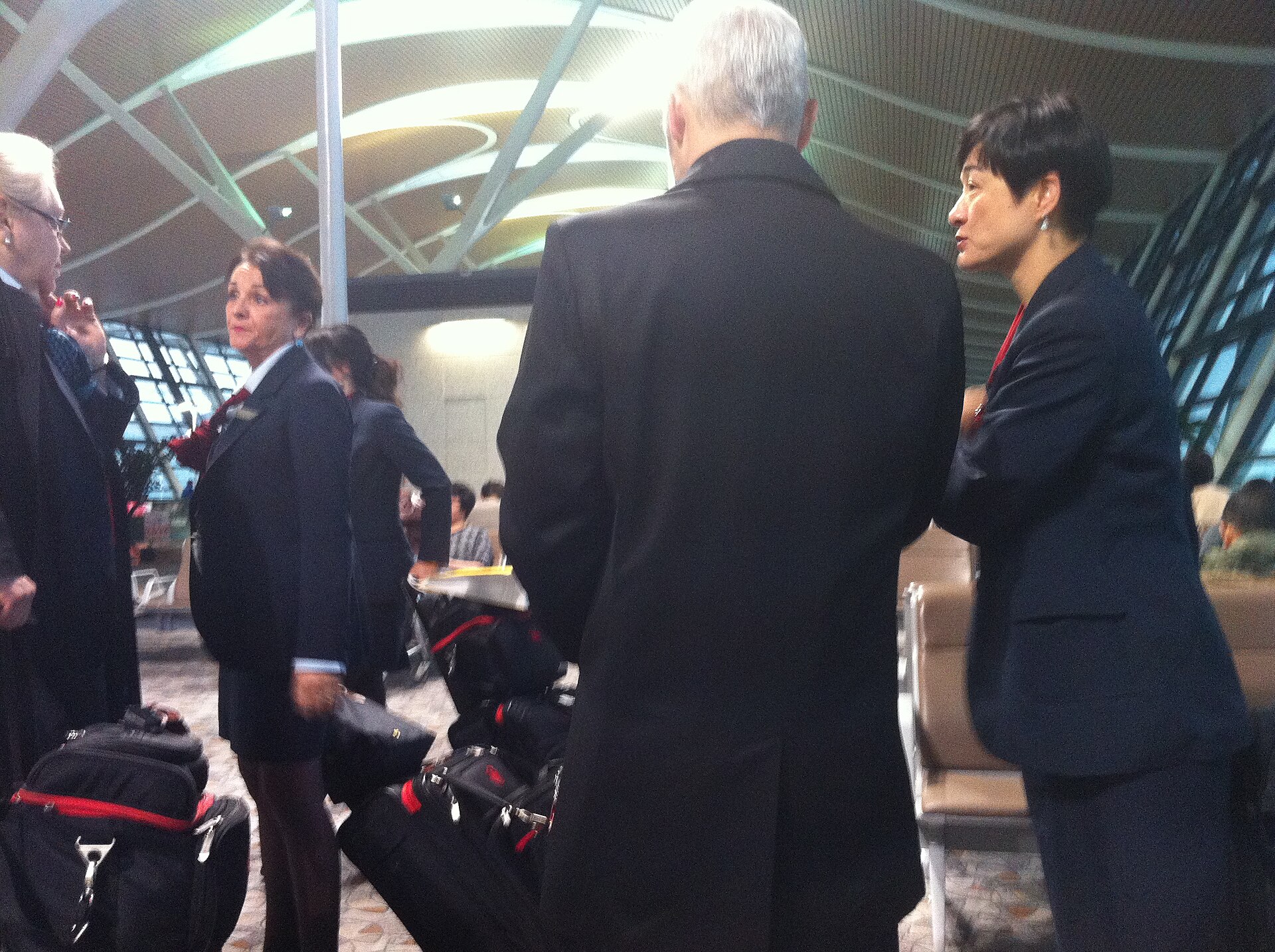
The wardrobe immediately before Bates was the midnight blue uniform by Canadian designer Debbie Shuchat, unveiled on 19 October 2004 as part of the airline's post-restructuring relaunch — with Céline Dion as the face of the relaunch — and in service from late 2005 into 2006. It paired the deep blue suiting with silver-sky shirts and sweaters and ties and scarves carrying a Frosted Leaf motif. It served for over a decade, and it is the uniform in the photograph below.
The Bates collection replaced it in 2017, and it remains the current uniform: Air Canada's September 2025 uniform retrospective, presented at the APEX/IFSA Expo, showed the Bates collection as the 2017–present era, and no successor has been announced.
The Wardrobe Today
Why This Uniform Matters
The Bates wardrobe matters because it is a complete national system: one designer, one palette, four job families, tested on the people who would wear it and adjusted where their feedback demanded. It also shows how a flag carrier can be patriotic with restraint — no tartan, no novelty prints, just charcoal tailoring, a red lining and a maple leaf small enough to sit on a tie. Nearly a decade on, with the airline's own 2025 retrospective still presenting it as the current era, it has also proved durable in the way that matters most for a uniform: it has not dated. Charcoal, black and red were a safe palette in 2017 and remain one now, which is why this collection has needed no successor announcement to stay in the news — it simply continues, flight after flight, as the dressed identity of the airline. For the industry behind the airline, see our Canada clothing industry page.
Airlines refresh their uniforms from time to time, so the details here describe the uniform as documented for this guide — the airline’s own site always carries the latest version.
Common Questions
Common Questions
Who designed the Air Canada uniform?
Canadian fashion designer Christopher Bates, a Vancouver-born designer selected after a competition among leading Canadian designers. His collection was unveiled on 9 February 2017, alongside Air Canada's new livery, in the year of Canada 150 and the airline's 80th anniversary.
What colours is the Air Canada uniform?
Charcoal grey and black tailoring with red accents in Air Canada red: silk ties and scarves, red handbags, a red sleeve button, red top-stitching and a red jacket lining. The men's ties carry the Rondelle, the airline's maple-leaf roundel motif.
How are Air Canada pilots' uniforms different?
Pilots wear a traditional double-breasted blazer with peak lapels, a modern button arrangement and antique-gold detailing, with a peaked cap carrying Air Canada branding. Airport concierges are also distinct, in black wool twill suits, while ground staff wear durable workwear with reflective detailing.
What uniform did the Bates collection replace?
The midnight-blue uniform by Canadian designer Debbie Shuchat, unveiled on 19 October 2004 for the airline's post-restructuring relaunch and in service from late 2005. It paired midnight-blue suiting with silver-sky shirts and Frosted Leaf motif ties and scarves, and served until 2017.
Is the Christopher Bates uniform still current?
Yes. Air Canada's September 2025 uniform retrospective presented the Bates collection as the 2017–present era, and no successor uniform has been announced.
Keep Exploring
More to Explore
In This Series
Airline Uniforms by Airline
The series hub — every airline's guide, the designers behind them, and the ones in preparation.
Read ↑Canada Clothing Industry
The airline's home country in the World Clothing Industry directory.
Read ↑Go Deeper
Uniforms — Definition
What a uniform is, and why organisations dress their people alike.
Read ↑Scarf — Definition
The scarf as garment and uniform accent, defined.
Read ↑Blazer — Definition
The jacket at the heart of the pilots' wardrobe, defined.
Read ↑Tie — Definition
The necktie, from cravat to the Rondelle silk tie.
Read ↑Keep Exploring
Explore Fashion for Travel
The crew are only half the fashion on a flight — the other half is what the passengers are wearing. Our travel guides cover the traveller’s side of the same subject, and they link back here.
Outfits for Flying
Travel Outfits
What to wear when you are going somewhere — outfit systems built for transit days.
Read ↑Airport Outfits
Security-friendly shoes, cabin layers and the full airport dressing system.
Read ↑What to Wear on a Long Flight
Dressing for the overnight haul — comfort, warmth and arriving presentable.
Read ↑What to Wear When Traveling
The destination-rules guide to building a travel wardrobe that works on arrival.
Read ↑Business Travel Wardrobe Guide
A working wardrobe that travels — suits, wrinkle strategy and boardroom-ready arrivals.
Read ↑Packing & Capsule Wardrobes
Travel Capsule Wardrobe Guide
A small set of pieces that combine into a trip’s worth of outfits.
Read ↑Travel Packing Guide
The complete packing method — lists, order and wrinkle control.
Read ↑How to Pack a Suit
Getting a tailored jacket and trousers across the world without the creases.
Read ↑Carry-On Packing Guide
Everything in one bag — the carry-on-only system, piece by piece.
Read ↑Travel Comfort & Accessories
Search Apparel Search