Airline Uniforms by Airline · Chile and Brazil
The LATAM Airlines Uniform by Pedro Lourenço
When LAN and TAM became LATAM, the new airline needed its 23,000 people to look like one company. Brazilian designer Pedro Lourenço, working with a focus group of more than 80 employees, dressed them in indigo and coral — one colour inherited from each predecessor. Unveiled on 28 April 2016 with the new brand itself, the wardrobe is still current. This is its story, including an honest account of what the sources do and do not document.
The Design
One Designer, Two Airlines, 23,000 People
The LATAM uniform was unveiled on 28 April 2016, at simultaneous brand-launch events in the countries where the group operates — because the uniform was never just a uniform. It was one element of the launch of an entirely new airline brand, created when Chile's LAN and Brazil's TAM combined, and it had to dress the merged company as one team from the first day. In the group's own launch release, the credit is exact: the LATAM uniforms “were created by the celebrated Brazilian fashion designer Pedro Lourenço with collaboration from a focus group of over 80 employees from different areas of the company.” Trade coverage of the launch, including the Sydney event, corroborates the credit and the staff collaboration.
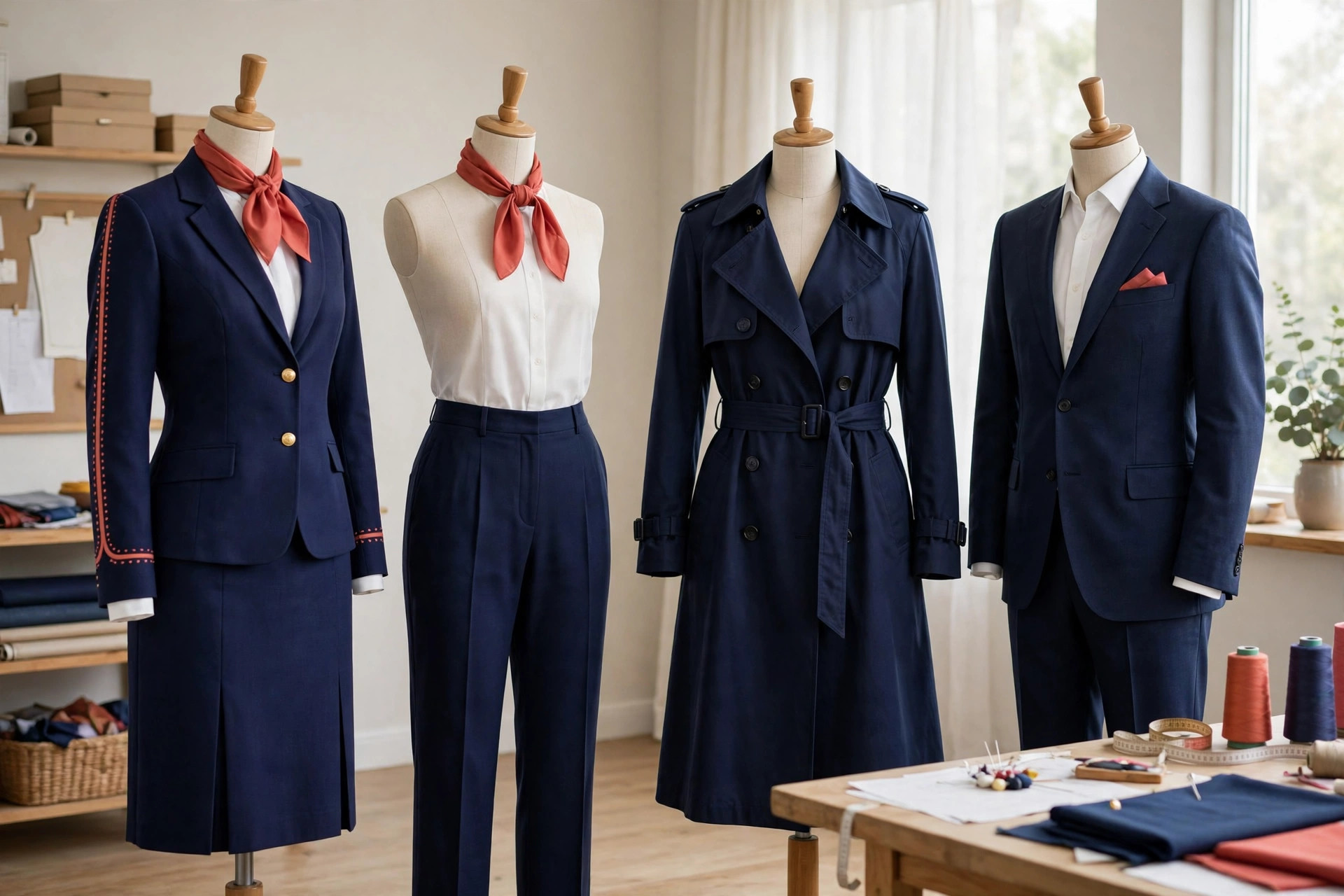
The colours are the brand's signature pair: indigo and coral, the colours of the LATAM logo itself. Brand coverage of the launch read the pairing as a deliberate inheritance — indigo carrying LAN's blue forward, coral carrying TAM's red — so that neither predecessor's people were asked to dress entirely in the other airline's colour. The roll-out was planned at group scale: the global roll-out was to begin before the end of 2016, putting some 23,000 employees into the new uniform over roughly eighteen months.
Consider the logistics that scale implies. Twenty-three thousand people across cabin, airport and sales roles, in a dozen countries, each needing the same indigo-and-coral system fitted and issued — that is a supply operation on the order of a small national clothing programme, executed while the brand itself was changing around it: aircraft being repainted, airports re-signed, the consolidated website replacing two national sites. The uniform was, in that programme, the most personal element: passengers see a livery from the terminal window, but staff wear the brand against their skin for a whole shift, and the eighteen-month roll-out is the honest measure of how long a merger takes to reach the people who embody it.
One credit to keep straight: the wider LATAM brand identity — logo and livery — was the work of brand agency Interbrand. The uniform credit in the airline's release is Lourenço's alone, and this guide keeps the two separate, as the sources do.
The employee focus group deserves emphasis, because it places LATAM in the same modern movement as the wear-tested wardrobes elsewhere in this series — but with a merger's twist. Eighty employees from different areas of the company is not a token panel; it is a cross-section of a workforce that, at the moment of design, still belonged to two different airlines with two different uniform traditions. Their collaboration with a single outside designer gave the merged company something neither predecessor could have supplied alone: a wardrobe that both sides had helped to make, and therefore neither side experienced as the other airline's clothes imposed on them. In merger management that is a small thing that is not small at all — the uniform was one of the first shared objects the new company produced.

The Components
The Outfit, Piece by Piece
LATAM's launch release documents the wardrobe's colours, designer and wearer groups rather than a garment-by-garment list, so the component detail below distinguishes carefully between what the launch coverage establishes and what rests on a single secondary source — those items are marked as reported.
- The Indigo Jacket
- The women's jacket is indigo, reported with coral piping on the sleeve (a single secondary source — Alternative Airlines' launch coverage — so treat the piping detail as reported rather than release-documented).
- Skirts and Trousers
- Matching indigo skirts or trousers complete the women's suiting, in the same indigo-and-coral system that launch coverage describes across skirts, pants, scarves and trench coats.
- The Coral Scarf
- A coral-red neck scarf is the women's signature accent, consistent across launch and crew imagery. Our scarf definition covers the garment's role as the colour-carrier in tailored uniforms.
- Trench Coats
- Indigo and coral trench coats were part of the launch wardrobe as described in contemporaneous coverage — the outer layer of a uniform designed for a continent of climates, from Santiago winters to Caribbean heat.
- The Men's Suit
- Men wear a full suit in the same indigo colouring with a white shirt; coral appears in details such as the pocket square — again a detail resting on a single secondary launch source, and marked here as reported.
- Footwear, as Crew Commentary Has It
- Distinctive clear or silver heels feature in crew commentary on the uniform. That is social, fashion commentary rather than an official component list, and it is recorded here only as such.
The same Lourenço wardrobe was created for cabin crew, sales-office and airport staff alike — the 23,000 wearers span all three groups — though per-group garment differences are not itemised in the launch sources.
That breadth is worth pausing on. Many uniform programmes in this series dress the flying staff first and the ground staff as an afterthought; LATAM's release describes one wardrobe conceived from the start for the cabin, the airport and the sales office together. It follows from the merger logic: the brand had to be equally visible at the check-in desk and in the cabin, because for most passengers the new airline would first be met on the ground. A single indigo-and-coral system across all three groups meant that from the first day of the roll-out, every customer-facing employee — whatever their old airline — presented the same new identity. The cost of that coherence is the thinness of the public garment record: a launch release written to announce a brand, not to catalogue a wardrobe, which is why this section marks its single-source details as carefully as it does.
Reading the Uniform
What LATAM Does Not Publish: a Rank Code
Some airlines in this series document a colour or insignia system by which rank can be read from the uniform. For the LATAM wardrobe, no such system is publicly documented: no scarf-colour code, stripe system or epaulette scheme for cabin crew appears in the launch release or reputable coverage, and this guide does not invent one. What the sources do support is differentiation by role family at the broadest level: cabin crew, airport staff and sales-office staff share the one Lourenço wardrobe, while pilots were shown in launch imagery in a conventional dark pilot uniform distinct from the cabin indigo — a description resting on launch photography rather than an itemised text source, and stated here with that caution. A supervisor variant in navy and coral has been suggested in social commentary on launch photos; a single social source is not enough to build a rank system on, so it is noted only to explain why none is described.
The Men's Uniform
Indigo Tailoring, a Coral Detail
The men's wardrobe is a full indigo suit with a white shirt, the coral carried in small details — the pocket square is the example given in launch coverage, on the single-source caution noted above. No scarf-equivalent neckwear for men is documented in the launch sources, and none is described here. The design intent is nonetheless clear from what is documented: men and women wear the same two colours in the same proportions, so a merged workforce of 23,000 reads as one airline at a glance, in any airport on the continent.
A Uniform for an Airline That Did Not Exist Yet
Most new uniforms dress an existing airline. This one helped create one. LAN and TAM completed their association on 22 June 2012, but for years the two carriers kept their own brands, liveries and clothes. The single LATAM brand was announced in August 2015; the uniform was unveiled with the new livery, airport signage and the consolidated website on 28 April 2016; and the first LATAM-branded flights followed on 5 May 2016. For the 23,000 people who had worn LAN navy or TAM red, putting on indigo and coral was the merger made physical — the day the new airline became visible on its own staff.
The Rules
Grooming: Not Publicly Documented
This guide states plainly what it found: no LATAM grooming manual, press statement or reputable report on hair, make-up or tattoo rules for this wardrobe was found in the sources researched, so no grooming rules are described here — inventing them would be easy and wrong. What is documented is the launch appearance itself: one indigo-and-coral system, specified by a named designer with an 80-employee focus group, worn across cabin, airport and sales roles. Readers who need the airline's current appearance standards should go to LATAM's own channels, which are the only authoritative source for rules the airline keeps internal.
Evolution
Two Wardrobes Become One — and Stay One
The 2016 uniform replaced the separate LAN and TAM uniforms outright; there was no transitional hybrid, which was the point. (One predecessor attribution circulates in crew nostalgia: former LAN uniforms are remembered in crew social commentary as the work of designer Luciano Brancoli. That attribution appears only in social-media comment threads and is unverified, so it is recorded here as crew lore, not as fact.)
Since 2016, no successor uniform has been announced, and the Lourenço wardrobe remains the current uniform. One recent headline deserves a clarification this guide can give with confidence: LATAM's reimagined Premium Business onboard experience, introduced from 1 December 2025 with new serviceware, amenity kits and service protocols, is a service redesign — it is not a uniform redesign, and it does not change what crew wear.
The launch itself was staged to make the point unmistakable: simultaneous events in the countries where the group operates, the uniform shown alongside the new aircraft livery, airport design and the consolidated latam.com website — a single brand presented in four forms at once. That is why the 2016 release reads the way it does, and why its uniform description is short: the document's subject was the brand, and the uniform was one chapter of it. The guide has respected that structure, drawing its firm facts from the release and marking the rest.
The Wardrobe Today
Why This Uniform Matters
The LATAM wardrobe matters as an act of corporate tailoring at continental scale: a single named designer, two inherited colours honestly blended, and 23,000 people moved from two uniforms into one as the visible proof of a merger. It has also proved long-lived: a decade after the launch events, the indigo-and-coral wardrobe remains the group's uniform with no successor announced — a lifespan that compares well with the industry's usual redesign cycle, and a quiet vindication of choosing brand colours, rather than a fashion moment, as the design's foundation. Fashion dates; a logo's two colours, carried in tailoring, mostly do not. It is also a useful lesson in sourcing — its launch release documents the essentials firmly while leaving garment minutiae thin, and this guide has preferred saying so to filling the gaps. The group's roots run through the whole region; for the designer's home country, see our Brazil clothing industry page, and for dress traditions elsewhere in LATAM's network, our Peruvian Andean dress guide.
Airlines refresh their uniforms from time to time, so the details here describe the uniform as documented for this guide — the airline’s own site always carries the latest version.
Common Questions
Common Questions
Who designed the LATAM Airlines uniform?
Brazilian fashion designer Pedro Lourenço, working with a focus group of over 80 employees from different areas of the company. The credit comes from LATAM Airlines Group's own launch release of 28 April 2016. The wider LATAM brand identity was by Interbrand, but the uniform credit is Lourenço's alone.
What colours is the LATAM uniform?
Indigo and coral — the signature colours of the LATAM logo. Brand coverage of the launch read the pairing as an inheritance from the two merged airlines: indigo carrying forward LAN's blue and coral carrying forward TAM's red.
When was the LATAM uniform launched, and who wears it?
It was unveiled on 28 April 2016 at simultaneous LATAM brand launch events, with the global roll-out to begin before the end of 2016. The wardrobe was created for cabin crew, sales-office and airport staff — around 23,000 employees in all.
Does LATAM publish a rank code or grooming rules for its uniform?
No. Neither a rank-coding system (such as scarf colours or stripes for cabin crew) nor grooming rules for this wardrobe are publicly documented in the launch release or reputable coverage, so this guide describes neither rather than inventing them.
Has LATAM announced a new uniform?
No successor uniform has been announced, and the 2016 Pedro Lourenço wardrobe remains current. LATAM's reimagined Premium Business onboard experience from December 2025 covers serviceware, amenity kits and service protocols — it is a service redesign, not a uniform redesign.
Keep Exploring
More to Explore
In This Series
Airline Uniforms by Airline
The series hub — every airline's guide, the designers behind them, and the ones in preparation.
Read ↑Brazil Clothing Industry
The designer's home country — and one of the two predecessor airlines' homes — in the World Clothing Industry directory.
Read ↑Go Deeper
Keep Exploring
Explore Fashion for Travel
The crew are only half the fashion on a flight — the other half is what the passengers are wearing. Our travel guides cover the traveller’s side of the same subject, and they link back here.
Outfits for Flying
Travel Outfits
What to wear when you are going somewhere — outfit systems built for transit days.
Read ↑Airport Outfits
Security-friendly shoes, cabin layers and the full airport dressing system.
Read ↑What to Wear on a Long Flight
Dressing for the overnight haul — comfort, warmth and arriving presentable.
Read ↑What to Wear When Traveling
The destination-rules guide to building a travel wardrobe that works on arrival.
Read ↑Business Travel Wardrobe Guide
A working wardrobe that travels — suits, wrinkle strategy and boardroom-ready arrivals.
Read ↑Packing & Capsule Wardrobes
Travel Capsule Wardrobe Guide
A small set of pieces that combine into a trip’s worth of outfits.
Read ↑Travel Packing Guide
The complete packing method — lists, order and wrinkle control.
Read ↑How to Pack a Suit
Getting a tailored jacket and trousers across the world without the creases.
Read ↑Carry-On Packing Guide
Everything in one bag — the carry-on-only system, piece by piece.
Read ↑Travel Comfort & Accessories
Search Apparel Search