Airline Uniforms by Airline · United States
The American Airlines Uniform: Aviation Blue, by Lands' End
The world's largest airline dresses its frontline in a uniform with no fashion designer at all: a Lands' End collection in Aviation Blue, chosen by union representatives, tested by 1,000 wearers, and certified safe down to its threads after the wardrobe it replaced made crew ill. Debuted on 2 March 2020, it is a uniform whose real design story is trust. This guide tells it — and untangles the famous names that belong only to its predecessor.
The Design
No Couturier This Time — a Supplier, a Union and 1,000 Wear-Testers
The current American Airlines uniform, which debuted on 2 March 2020, is the rare flag-carrier wardrobe with no fashion designer attached to it at all — and that is the point of its story. The collection was manufactured by Lands' End, the American apparel company selected by American's own union representatives to supply it, and it was developed over more than three years with the people who would wear it: frontline team members and a Frontline Uniform Advisory Team, including 1,000 wear-testers over six months. More than 50,000 frontline team members — flight attendants, customer service agents and premium guest services staff — debuted the collection, in roughly 1.7 million manufactured pieces.
The colour is Aviation Blue, a navy-like blue that replaced the slate grey of the short-lived 2016 wardrobe (whose troubled history fills the dark band and evolution sections below). The defining technical decision was about safety certification rather than style: every garment in the collection — threads, buttons and zippers included — is STANDARD 100 by OEKO-TEX certified, and American was the first airline to certify a complete uniform collection that way. After what had happened with the previous wardrobe, the airline wanted a uniform it could prove was safe to wear, fibre by fibre.
A note on credit, because this airline attracts a persistent error: the current collection is a Lands' End supply programme shaped by employee and union design input. No designer — famous or otherwise — designed it. The fashion names in American's story belong to the previous uniform, and even there their roles were narrower than the retellings suggest, as the evolution section sets out precisely.
Consider what the process replaced. The conventional airline method hires a name, unveils a look, and issues it. American's 2020 method inverted the authority: the supplier was selected by union representatives, the design decisions ran through an advisory team of the people who would wear the clothes, and a thousand of those people wore prototypes for six months before the design was final. The result is not anonymous because nobody cared about design; it is anonymous because the airline decided, after the experience described below, that wearability evidence was worth more than a signature. In a series full of couturiers, this guide's American chapter is the control experiment — what a uniform programme looks like when the wearers, not the designer, are the authors of record.

The Components
The Outfit, Piece by Piece
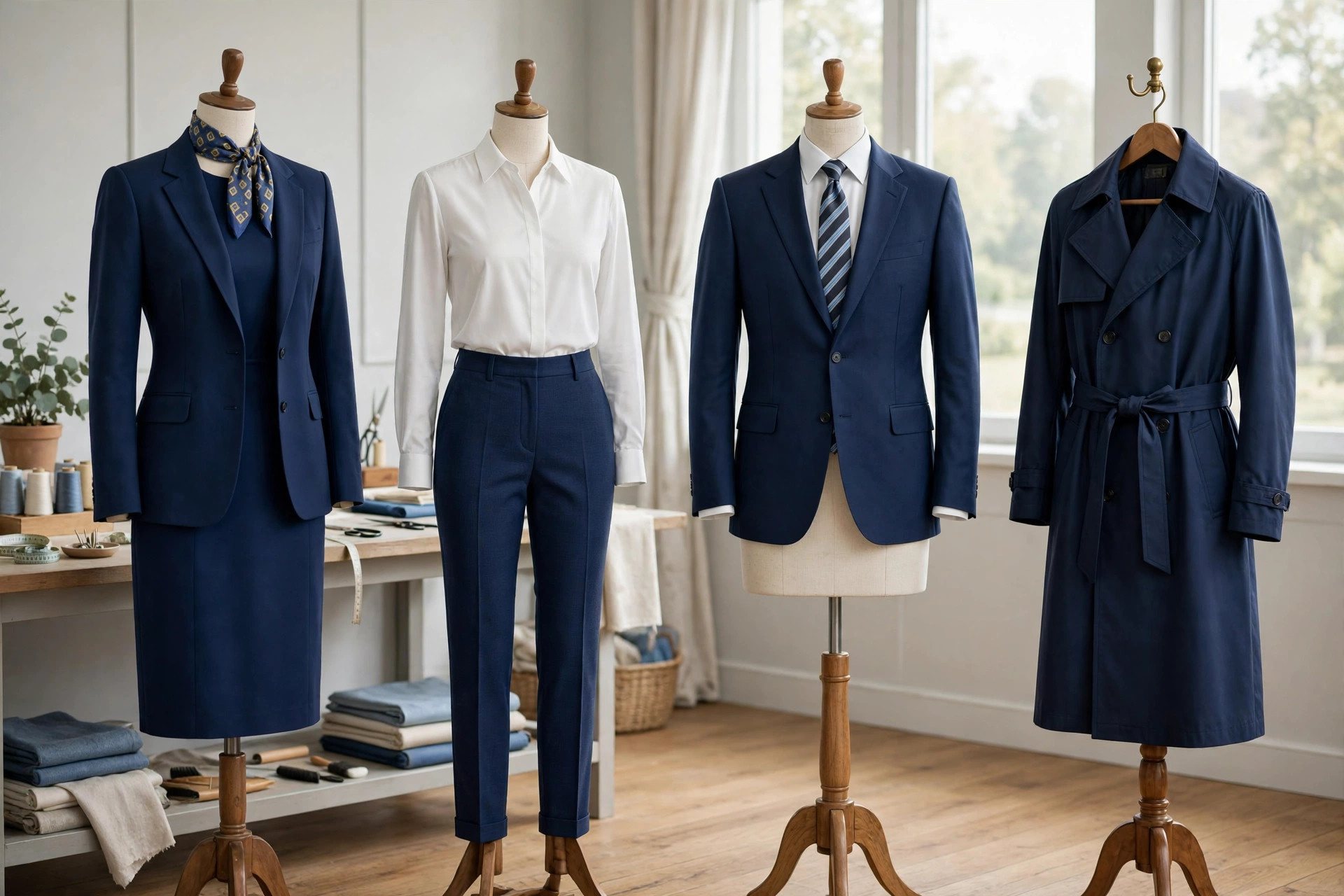
- Aviation Blue Suiting
- The core wardrobe is suiting in Aviation Blue, offered — for the first time at American — in a choice of wool-blend or synthetic fabric, so wearers could choose the cloth that suited their skin and their work.
- Shirts and Blouses
- Shirting designs are unique to each workgroup, so flight service, customer service and premium guest services read as related but distinct families within the one blue wardrobe.
- Dresses, Trousers and Maternity Options
- Women may wear dresses or trousers, and maternity options are part of the collection — the wardrobe was specified around the actual workforce, not a single silhouette.
- Ties and Neck Scarves
- Redesigned ties and neck scarves, the scarves now machine-washable — a practical detail that matters across a 50,000-person laundry reality.
- Slim-Fit Pants
- Trousers were recut to a slimmer fit as part of the 2020 modernisation of the silhouette.
- The All-Season Coat
- A single all-season coat completes the wardrobe, worn — per the reported standards guide discussed below — in extreme cold or inclement weather outdoors.
- Certified, All of It
- Every garment carries STANDARD 100 by OEKO-TEX certification, extending to threads, buttons and zippers. Our Lands' End company page covers the supplier behind the collection.
Reading the Uniform
Workgroups in Blue — and Pilots in a Different Wardrobe Entirely
American does not publish a scarf-colour rank code for this wardrobe. Differentiation runs by workgroup: shirting and accessory designs differ between flight service, customer service and premium guest services, so the job is legible without the palette ever changing. A signature dress for flight attendants was reported as forthcoming after the 2020 launch; treat that as programme reporting rather than a documented core component.
The most important distinction is the one passengers rarely notice: American's pilots do not wear the Lands' End collection at all. The pilot group had already moved, around 2019, to a separate pilot uniform supplied by M&H. So the 2020 launch dressed the cabin and the airport — the flight deck was already wearing something else, from someone else, and it still is. Pilot seniority itself follows the standard convention of sleeve and shoulder stripes.
It is worth stating plainly why the pilot exclusion matters to a reader of this guide. A uniform history that describes “the American Airlines uniform” as one wardrobe would be wrong: the company runs at least two uniform programmes in parallel, from different suppliers, with different launch dates, and the famous 2020 debut date applies only to the larger one. Any photograph used to illustrate “the American uniform” needs the same care — cabin blue and flight-deck navy are different systems, and conflating them is exactly the kind of error this series was set up to avoid.
The Men's Uniform
The Same Blue, the Same Choice
Men's suiting mirrors the women's: Aviation Blue jackets and slim-fit trousers, workgroup shirting, redesigned ties, and the all-season coat. The fabric choice — wool-blend or synthetic — applies across the wardrobe, and it was more than a comfort feature: after the previous uniform's history, letting each wearer choose their cloth was part of how the airline rebuilt trust in what it was asking people to put on their skin for a full working day.
The Uniform That Had to Be Proved Safe
The 2020 collection exists because the 2016 one failed its wearers. Within months of the slate-grey wardrobe's launch, thousands of flight attendants — more than 5,000 in total, with over 1,600 complaints counted early on — reported rashes, hives, headaches and respiratory problems they associated with the garments. American severed ties with the supplier, Twin Hill, in 2017, allowed staff to wear legacy or off-the-rack alternatives, announced a replacement programme that June, and spent the following years in litigation over the episode. The Lands' End wardrobe was the answer: a new supplier chosen by union representatives, a fabric choice for every wearer, and OEKO-TEX certification on every component, down to the thread. It remains the industry's clearest lesson that a uniform is safety equipment as well as clothing.
The Rules
Standards, as Reported from the Internal Guide
American does not issue its uniform standards as a public press document. The detail below comes from reporting of the airline's internal Flight Service uniform standards guide (reported in March 2020), and it is presented here as reported — a window into how the 2020 wardrobe was specified to be worn, not as a public rulebook.
As reported, the guide sets the dress hem at no more than one inch above or below the crease at the back of the knee. Nail polish must be a single colour on all nails — green, orange and yellow are excluded, as are glitter and nail art — and if any nail chips, all of the polish must come off. The all-season coat is reserved for extreme cold or inclement weather, outdoors. Gum is not to be chewed in customer view, and phones, smartwatches and headphones are not to be used on board in the presence of customers. The picture is of a standard built on consistency: one blue, worn one way, by 50,000 people.
Evolution
Navy for Decades, a Designer Saga, Then a Reset
Before 2016, American's navy-blue uniforms had gone essentially unchanged for two to three decades — the 2016 launch was billed as the first full overhaul in over twenty years. That launch, on 20 September 2016, dressed more than 70,000 employees for the merged airline in slate grey, cobalt and white, and its credits need care, because they are the most garbled in this whole series.
The precise record is this. The 2016 uniform was designed by KAUFMANFRANCO — Ken Kaufman and Isaac Franco, hired in January 2013 to design the post-merger wardrobe. By launch, however, reporting by Fashionista and WWD indicated that American would not be moving forward with KAUFMANFRANCO and that Twin Hill, the corporate-apparel arm of Men's Wearhouse/Tailored Brands, was adapting a Kaufmanfranco design; Twin Hill manufactured the wardrobe. How much of the garment finally worn was Kaufman and Franco's and how much was Twin Hill's adaptation was blurred in the launch materials, and this guide hedges it the same way. And Cole Haan? Cole Haan designed accessories only — scarves, pocket squares, handbags and attaché cases — for the 2016 uniform, as American's own May 2016 announcement stated. Cole Haan did not design American's uniforms, in 2016 or any other year, and has no role in the current 2020 collection. Our Cole Haan profile covers the brand itself.
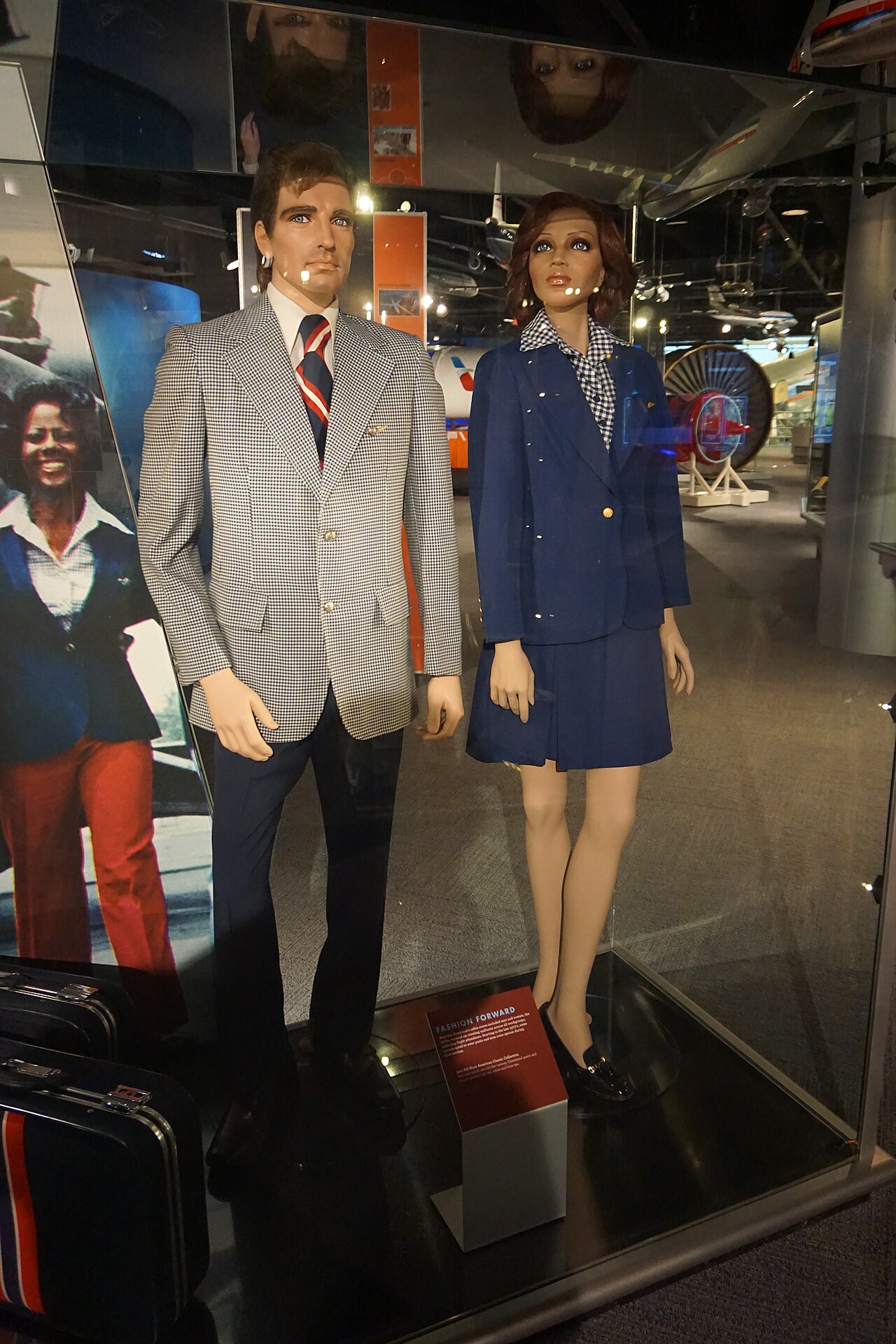
Go further back and the designer story is genuine and museum-kept. Bill Blass designed the 1974 “American Classic” flight-attendant uniforms, and the 1967 “American Beauty” uniforms precede them; both are held and labelled by the airline's C.R. Smith Museum, where the Blass uniforms below were photographed. Earlier stewardess eras, from 1934 onward, are extensively documented in the same museum's collection — American's uniform history is one of the best-preserved in aviation, which is part of why its modern chapter can be told with unusual precision. Our Bill Blass designer profile covers the couturier behind them. The 2020 Lands' End collection closed the saga by removing the couturier from the process altogether — and no successor uniform has been announced.
The Wardrobe Today
Why This Uniform Matters
American's current uniform matters less as design than as precedent: it is the wardrobe that made chemical-safety certification a headline feature of airline uniform programmes, and it proved that a supplier-led, union-chosen, wearer-tested process could dress one of the world's largest workforces without a famous name on the label. The famous names are all in its past — and, as this guide has taken care to show, in narrower roles than legend gives them. There is a broader lesson here for anyone who commissions work clothing: 1.7 million pieces is a manufacturing programme before it is a fashion statement, and the measures that decide whether it succeeds — cloth choice, washable scarves, maternity options, certified fibres — are the unglamorous ones this collection got right. For the industry behind the airline, see our United States clothing industry page.
Airlines refresh their uniforms from time to time, so the details here describe the uniform as documented for this guide — the airline’s own site always carries the latest version.
Common Questions
Common Questions
Who designed the current American Airlines uniform?
No fashion designer did. The current collection, debuted on 2 March 2020, was manufactured by Lands' End, which American's union representatives selected as supplier, and developed over more than three years with frontline team members and a Frontline Uniform Advisory Team that included 1,000 wear-testers.
Did Cole Haan design American Airlines' uniforms?
No. Cole Haan designed accessories only — scarves, pocket squares, handbags and attaché cases — for the previous 2016 uniform. Cole Haan has no role in the current 2020 Lands' End collection, and never designed the uniforms themselves in any year.
Who designed the 2016 American Airlines uniform?
The 2016 uniform was designed by KAUFMANFRANCO (Ken Kaufman and Isaac Franco, hired in January 2013) and adapted and manufactured by Twin Hill; launch reporting indicated American was no longer moving forward with KAUFMANFRANCO and that Twin Hill was adapting their design, so the exact division of the final garment between them is hedged. Cole Haan supplied the accessories.
Do American Airlines pilots wear the Lands' End uniform?
No. Pilots are not part of the Lands' End collection. They had already moved, around 2019, to a separate pilot uniform supplied by M&H, while the 2020 Lands' End wardrobe covers flight attendants, customer service agents and premium guest services staff.
What is OEKO-TEX certification, and why does this uniform have it?
STANDARD 100 by OEKO-TEX certifies that textile products have been tested for harmful substances. After thousands of crew reported skin and respiratory complaints in the previous Twin Hill wardrobe, American certified every garment in the 2020 collection — threads, buttons and zippers included — becoming the first airline to certify a full uniform collection.
Keep Exploring
More to Explore
In This Series
Airline Uniforms by Airline
The series hub — every airline's guide, the designers behind them, and the ones in preparation.
Read ↑United States Clothing Industry
The airline's home country in the World Clothing Industry directory.
Read ↑Go Deeper
Uniforms — Definition
What a uniform is, and why organisations dress their people alike.
Read ↑Bill Blass — Designer Profile
The couturier behind American's 1974 American Classic uniforms.
Read ↑Lands' End
The supplier of the current collection — its history as an American apparel company.
Read ↑Cole Haan
The accessories designer of the 2016 wardrobe — accessories only, as this guide explains.
Read ↑Keep Exploring
Explore Fashion for Travel
The crew are only half the fashion on a flight — the other half is what the passengers are wearing. Our travel guides cover the traveller’s side of the same subject, and they link back here.
Outfits for Flying
Travel Outfits
What to wear when you are going somewhere — outfit systems built for transit days.
Read ↑Airport Outfits
Security-friendly shoes, cabin layers and the full airport dressing system.
Read ↑What to Wear on a Long Flight
Dressing for the overnight haul — comfort, warmth and arriving presentable.
Read ↑What to Wear When Traveling
The destination-rules guide to building a travel wardrobe that works on arrival.
Read ↑Business Travel Wardrobe Guide
A working wardrobe that travels — suits, wrinkle strategy and boardroom-ready arrivals.
Read ↑Packing & Capsule Wardrobes
Travel Capsule Wardrobe Guide
A small set of pieces that combine into a trip’s worth of outfits.
Read ↑Travel Packing Guide
The complete packing method — lists, order and wrinkle control.
Read ↑How to Pack a Suit
Getting a tailored jacket and trousers across the world without the creases.
Read ↑Carry-On Packing Guide
Everything in one bag — the carry-on-only system, piece by piece.
Read ↑Travel Comfort & Accessories
Search Apparel Search