Airline Uniforms by Airline · United States
The Hawaiian Airlines Uniform and the Kū Mākou Print
One print — lehua blossom and bamboo kapa stamps, in purple and Pacific blue — dresses more than 5,000 Hawaiian Airlines employees, from flight attendants to ramp crews. Created by Hilo studio Sig Zane Kaiao with Japanese consultants DESCENDANT and manufacturer Affinity Apparel, unveiled on 11 November 2016 and fully rolled out in late 2017, it is the seventeenth uniform in the airline's history. This is its story, piece by piece.
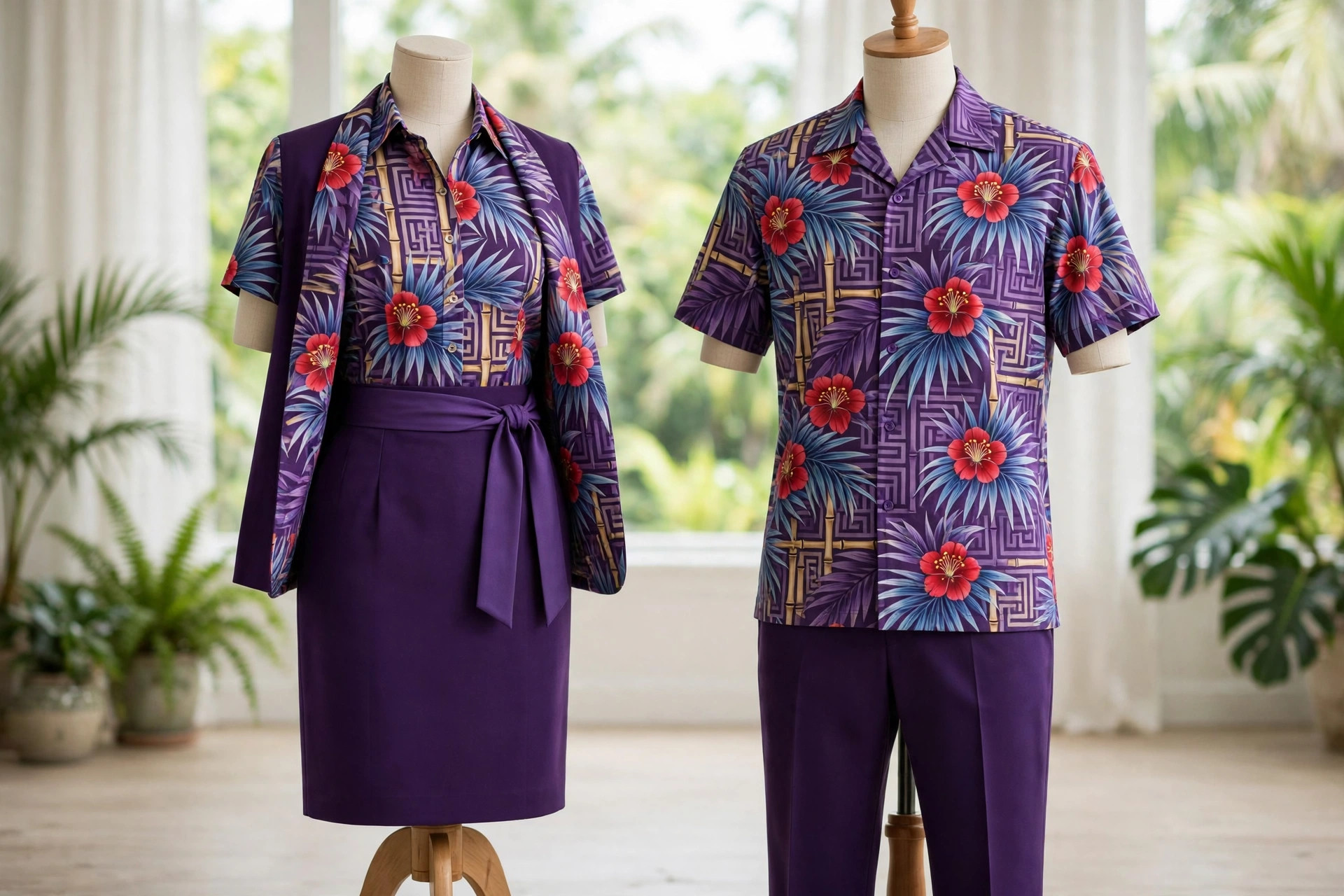
The Design
Three Partners, One Print, 40 Employees at the Table
Hawaiian Airlines' current uniform was built in three documented steps. The design partnership was announced in July 2016: the airline enlisted Hilo-based design studio Sig Zane Kaiao and Japanese design consultants Tetsu Nishiyama and Mikiko Nishiyama of the label DESCENDANT, and entrusted Affinity Apparel to develop and manufacture the uniforms. The collection was then unveiled on 11 November 2016 at the airline's “Runway to Runway” show during HONOLULU Fashion Week, went into on-the-job fit and wear testing from January 2017, and completed its full roll-out in late November 2017, timed to the entry into service of Hawaiian's first A321neo.
Credit where the airline puts it: Sig Zane Kaiao — the Hilo studio of Sig Zane, led in this project by his son Kūha'o Zane — created the print and led the design story; DESCENDANT collaborated as design consultants; Affinity Apparel developed and manufactured; and a committee of 40 front-line employees co-designed throughout. Crediting “Sig Zane” alone would erase two of those contributions, so this guide does not. The wearers numbered more than 5,000 front-line employees — and unusually, the refresh covered the whole workforce at once: Airport Customer Service, Cabin Service, Cargo, In-Flight, Line Service, Maintenance, Ramp and Supply, not just the crew passengers see.
The wardrobe's heart is a single print, Kū Mākou — “Together We Stand.” It combines two elements: the lehua blossom of the 'ōhi'a tree, a symbol of love, strength and resilience, and 'ohe kapala, the carved bamboo stamps traditionally used to decorate kapa cloth. The print runs through every work group's uniform at different scales and tonalities — in garment prints, jacket linings and woven elements — in Hawaiian's signature purple together with the Pacific blue carried over from the previous uniform. One print, honestly shared, is the whole design system.
Both motifs deserve a moment, because they are doing cultural work, not just pattern work. Kapa is Hawaii's traditional bark cloth, beaten from bark fibre and decorated by stamping it with carved bamboo implements — the 'ohe kapala — dipped in dye; a print built from those stamp marks is, in effect, quoting the islands' own textile technology in its pattern language. The lehua is the blossom of the 'ōhi'a, among the most storied trees in Hawaiian tradition, and its red flower is one of the islands' most recognisable natural emblems. A uniform print that combines the stamp and the blossom is therefore closer to a textile citation than a tropical pattern: it says where the airline is from in the vocabulary of how Hawaiians have decorated cloth for centuries. That the same print then scales down into a jacket lining for a pilot, or across a ramp shirt with reflective striping worked into it, is the design's real intelligence — heritage that survives being made practical.

The Components
The Outfit, Piece by Piece
The most precise public record of what flight attendants actually receive is the uniform-issue list in the Hawaiian flight attendants' 2020 collective bargaining agreement (Section 6) — the wardrobe as issued, item by item, rather than as launched.
- The Jacket
- A blazer for women and men, carrying the Kū Mākou print in its lining — the bamboo-stamp pattern appears inside the pilots' jackets too, as the reading-the-uniform section explains.
- Women's Ensembles
- A dress set, or a blouse worn with pants, a skirt or a skort — the skort issued for inter-island flying only. Long-sleeved aloha-print shirts and blouses were introduced for flight attendants and customer-service agents as part of the collection. Print blouses are animated by sashes in purple and aquamarine worn over more traditional suiting, and launch coverage singled out a women's cape carrying the print. Our aloha shirt definition covers the garment tradition the print shirts draw on.
- Men's Print Shirts
- The Hawaiian print shirt in short sleeves (a long-sleeve option exists), issued four to a flight attendant, with four pairs of pants — the working core of the men's in-flight wardrobe.
- Layers and Outerwear
- A sweater option, a car coat or a jacket-and-blazer combination, and an all-weather coat — a full layering system for an airline that flies from Honolulu humidity to mainland winters.
- Belts, Bags and the Working Kit
- Belt, tote bag, lunch tote and a 22-inch rollaboard complete the basic issue — a reminder that a modern uniform is issued as equipment, down to the bag lunch is carried in.
- Buttons with Wings
- Across the wardrobe, buttons carry shiny wings — a deliberate mid-century throwback worked into a thoroughly contemporary uniform.
Reading the Uniform
Differentiation by Work Group, Not by Rank
No colour-coded rank system — no scarf colours or purser variants — is documented for this wardrobe, and this guide does not invent one. Hawaiian's differentiation is by work group: in-flight, customer service, ramp, maintenance and pilots each wear the Kū Mākou story in the form their job requires. Pilots kept a traditional blue and black blazer look, with the 'ohe kapala bamboo-stamp pattern added to the jacket's inner lining — the shared print hidden where only the wearer knows it is there. For ramp and ground crews, reflective safety striping was built directly into the shirt designs, eliminating the separate bulky high-vis vest: safety engineered into the garment instead of worn over it. The wardrobe was also designed, deliberately, to accommodate men, women and nonbinary crew — a break from the women-only “hostess” outfits of the airline's earlier decades.
The Men's Uniform
The Print Shirt as a Uniform in Its Own Right
At most airlines the men's cabin uniform is a suit with the pattern confined to a tie. At Hawaiian, men wear the print itself: the Hawaiian print shirt — short-sleeved as standard, with a long-sleeve option — with tailored pants, belted, layered with the sweater or the car coat and jacket combination as the route demands, and finished with the all-weather coat and the same issued bags as the women's kit. It is the aloha shirt, Hawaii's own contribution to world dress, promoted from souvenir to official uniform — which is exactly where, at this airline, it belongs.
Pualani, the Flower of the Sky
Since the 1950s, Hawaiian's flight attendants have been allowed to wear fresh flowers in their hair instead of a cap — and the flower is not decoration but identity. The airline's Pualani logo, in use since 1973, means “flower of the sky,” and its figure was modelled on Leina'ala Ann Teruya Drummond, Miss Hawaii 1964 and a former Hawaiian flight attendant. The lei and the hair flower are, in effect, part of the uniform that no designer issued: a living component, renewed fresh, that ties the crew member to the islands in a way no printed cloth can. That is why the dress-code change described in the next section — small as it sounds — was news across Hawaii.
The Rules
Flowers, Lei — and a Merger-Era Exception
Hawaiian's best-documented appearance rule is its oldest: flight attendants may wear flowers in their hair and lei as part of the dress code, a permission dating to the 1950s. No fuller grooming manual — no public hair or make-up specification — is documented, and this guide adds none.
What has changed is where the permission applies. Under the Alaska Air Group merger, completed in September 2024, an interim dress-code split now applies, as reported in 2025–2026 coverage of the Hawaii Tribune-Herald's reporting: around 250 Hawaiian flight attendants reassigned to new long-haul international routes from Seattle may no longer wear floral hairpieces, aloha shirts or flower lei on those Alaska-branded routes, wearing neutral tops accented by Alaska's Aurora Borealis-inspired design instead. On any flight touching Hawai'i, the flower and the lei remain permitted regardless of branding — the position stated by Alisa Onishi, managing director of Hawaii marketing for both airlines. Frame it correctly: this is a dress-code change on particular routes, not a new Hawaiian uniform, and no successor uniform has been announced.
The episode is also a lesson in how much a uniform component can carry. A flower in the hair is, on its face, the smallest item in any wardrobe in this series — smaller than a tie, cheaper than a button — yet when it was restricted on one set of routes, the story was reported nationally. It is the one component of a Hawaiian uniform that cannot be manufactured, stored or certified: it has to be picked fresh, worn for a flight, and chosen again. That fragility is what makes it the wardrobe's most distinctive feature, and why the route rule was news rather than housekeeping.
Evolution
Seventeen Uniforms, 1943 to Today
Hawaiian has published its own uniform history, and it runs to seventeen iterations. It begins in 1943 with the first flight attendant in a grey outfit on the 24-seat DC-3, gaining a military-inspired cap and a black sleeve stripe later in the 1940s; the 1949 update kept the grey suit and cap. In the 1950s fresh flowers in the hair became an option in place of the cap — the origin of the tradition above. 1963 brought blue, a beret-style hat and metal wings; 1966 brought high fashion, with uniforms by Fashions by Hino for the DC-9 Royal Fan Jet launch.
The print era followed: the 1969 “Flower Power” A-line dress, its print by Tiger Fabrics of New York, shoes by David Evins and plumeria hairpieces; 1971 brought a two-piece outfit by Richard Tam of San Francisco, its scarves worn as headgear, sash belt or ascot; 1974 and 1975 were Malia International's years — floral long and short dresses, then a jumpsuit, long dress, jacket and print scarf. The 1979 50th-anniversary wardrobe built twenty outfits from six garments around a hibiscus red and orchid print. 1985 turned contemporary and professional as more men joined in-flight crews, with aloha shirts and slacks for men following in the 1980s; 1992 drew on the Hawaiian quilt, with indigenous plants and flowers and Pualani on the chest; 2001 added the 'iwa bird to the millennium print. The immediate predecessor was the 2009 uniform — designed from 2008 — with prints by local textile designer Emma Howard, her “Makahiki” print of fish, petroglyphs and indigenous birds shifting the palette to azure and grey with purple as accent. The Sig Zane Kaiao wardrobe replaced it in 2017 and remains current.
The Wardrobe Today
Why This Uniform Matters
Hawaiian's uniform matters because its print is not a decoration applied to a uniform but a piece of Hawaiian cultural practice — kapa stamping and the lehua blossom — carried into every job in the company, designed with the employees who wear it and credited, by the airline itself, to everyone who made it. It is also, thanks to a flower worn in the hair since the 1950s, the clearest example in this series of a uniform that includes something alive. Set beside its own history, the wardrobe completes an arc: the airline that once imported its fashion — New York prints, San Francisco designers, couture shoes — ended by sourcing its identity at home, from a Hilo studio working in the islands' own textile language, and by extending that identity to the ramp and the cargo bay rather than keeping it for the cabin alone. For the industry behind the airline, see our United States clothing industry page.
Airlines refresh their uniforms from time to time, so the details here describe the uniform as documented for this guide — the airline’s own site always carries the latest version.
Common Questions
Common Questions
Who designed the Hawaiian Airlines uniform?
The print and design were led by Sig Zane Kaiao, the Hilo studio of Sig Zane, with the project led by his son Kūha'o Zane. Japanese label DESCENDANT (Tetsu Nishiyama and Mikiko Nishiyama) collaborated as design consultants, Affinity Apparel developed and manufactured the uniforms, and a committee of 40 front-line employees co-designed throughout.
What does the Kū Mākou print mean?
Kū Mākou means “Together We Stand.” The print combines the lehua blossom of the 'ōhi'a tree — a symbol of love, strength and resilience — with 'ohe kapala, the carved bamboo stamps used in traditional kapa cloth decoration. It appears across every work group's uniform at different scales, in prints, jacket linings and woven elements.
When was the current Hawaiian Airlines uniform introduced?
The design partnership was announced in July 2016 and the uniforms were unveiled on 11 November 2016 at the Runway to Runway show during HONOLULU Fashion Week. After fit and wear testing from January 2017, the full roll-out was completed in late November 2017, timed to the first A321neo entering service.
Can Hawaiian Airlines crew still wear flowers and lei?
On flights touching Hawai'i, yes — the flower hairpiece and lei, permitted since the 1950s, remain part of the dress code regardless of branding. Under the Alaska Air Group merger, around 250 flight attendants reassigned to Alaska-branded long-haul routes from Seattle wear neutral tops instead and may not wear floral hairpieces, aloha shirts or lei on those routes.
How many uniforms has Hawaiian Airlines had?
Seventeen, by the airline's own published history — from the grey DC-3 outfit of 1943 through Fashions by Hino in 1966, the Flower Power dress of 1969, the Hawaiian-quilt uniform of 1992 and Emma Howard's Makahiki print of 2009, to the current Sig Zane Kaiao wardrobe of 2016–2017.
Keep Exploring
More to Explore
In This Series
Airline Uniforms by Airline
The series hub — every airline's guide, the designers behind them, and the ones in preparation.
Read ↑United States Clothing Industry
The airline's home country in the World Clothing Industry directory.
Read ↑Go Deeper
Keep Exploring
Explore Fashion for Travel
The crew are only half the fashion on a flight — the other half is what the passengers are wearing. Our travel guides cover the traveller’s side of the same subject, and they link back here.
Outfits for Flying
Travel Outfits
What to wear when you are going somewhere — outfit systems built for transit days.
Read ↑Airport Outfits
Security-friendly shoes, cabin layers and the full airport dressing system.
Read ↑What to Wear on a Long Flight
Dressing for the overnight haul — comfort, warmth and arriving presentable.
Read ↑What to Wear When Traveling
The destination-rules guide to building a travel wardrobe that works on arrival.
Read ↑Business Travel Wardrobe Guide
A working wardrobe that travels — suits, wrinkle strategy and boardroom-ready arrivals.
Read ↑Packing & Capsule Wardrobes
Travel Capsule Wardrobe Guide
A small set of pieces that combine into a trip’s worth of outfits.
Read ↑Travel Packing Guide
The complete packing method — lists, order and wrinkle control.
Read ↑How to Pack a Suit
Getting a tailored jacket and trousers across the world without the creases.
Read ↑Carry-On Packing Guide
Everything in one bag — the carry-on-only system, piece by piece.
Read ↑Travel Comfort & Accessories
Search Apparel Search