Airline Uniforms by Airline · Ethiopia
Ethiopian Airlines: Green Tailoring, White Tradition
Africa’s largest airline dresses its crew in two wardrobes at once: a dark-green tailored suit specified down to the last button in the airline’s own style manual — and a traditional white shemma, carried by every crew member, that turns a boarding gate into a small ceremony of Ethiopian welcome. This guide documents both, and is candid about what is not known.
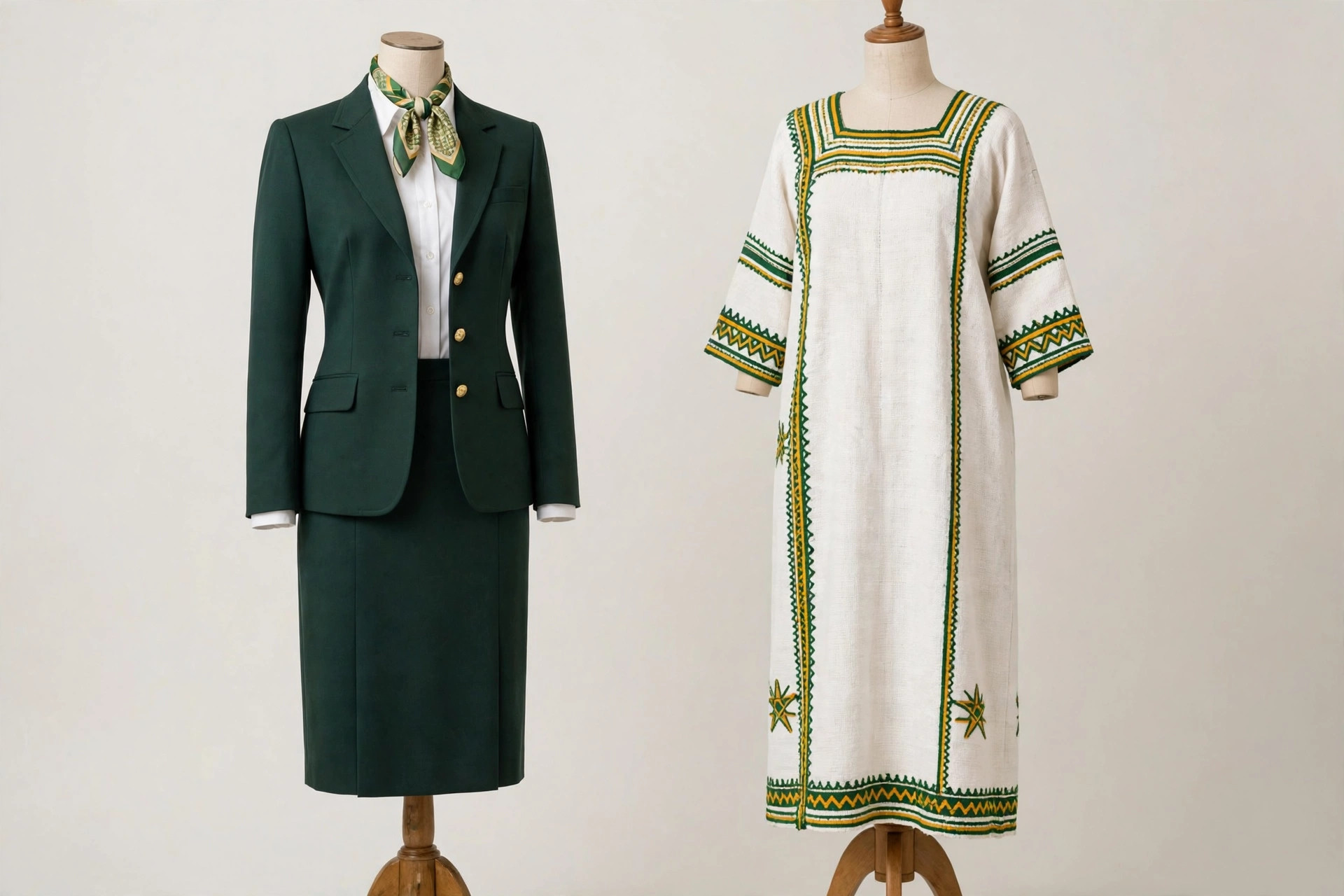
The Design
An Honest Starting Point: No Named Designer, No Launch Date
Most guides in this series open with a designer and a debut year. This one cannot, and it would be a disservice to invent either. Ethiopian Airlines has not publicly credited a designer for its current green wardrobe, and no airline release or reputable report announces a launch date for it. The green suit appears in airline imagery from the mid-2010s onward, and the airline’s own throwback posts draw comments that the 1970s uniform looks “similar today” — the honest reading is that this is a long-evolved design, refined over decades rather than unveiled on a single day.
One designer claim does circulate, and it needs handling with care. A magazine history of airline fashion credits Ethiopian designer Genet Kebede of Paradise Fashion with the airline’s look, including fitted suits and traditional Habesha dresses. But the more credible source — a British Council scoping report on Ethiopian fashion — credits Paradise Fashion with something narrower: it “designed and produced cabin crew uniforms for the Ethiopian Airlines First Class section.” That is the claim this guide stands behind, with its scope stated exactly: Paradise Fashion’s documented work covers the First Class cabin-crew uniforms, not the whole wardrobe. Anything broader rests on a single magazine listicle, and no Ethiopian press release naming any designer for the current uniform was found.
What is documented, superbly, is the wardrobe itself — because the airline’s Cabin Crew Style and Image Manual (Revision 01, October 2022) sets out every garment, issue quantity and wearing rule. The components below come from that manual: the airline’s own internal standard, and the firmest ground this guide stands on.
One corroborating detail supports Paradise Fashion’s real, if narrow, relationship with the airline: the British Council report also notes that the label’s products were stocked in Ethiopian’s in-flight duty-free programme. A supplier relationship existed; it is the leap from “First Class cabin-crew uniforms and duty-free products” to “designer of the entire wardrobe” that the evidence does not support, and this guide does not make it.
The Components
The Outfit, Piece by Piece
- The Women’s Green Suit
- A dark-green tailored jacket — worn fully buttoned, with the combined wing and name plate centred on the left welt pocket — and a dark-green skirt whose hem sits two inches below the knee. Issue: two jackets and two skirts per two years.
- The Trouser Option
- Dark-green trousers (one pair per two-year issue) — optional in winter months on USA, Canada, Europe and UK routes, and mandatory on Saudi Arabia, Hajj and China flights: the uniform adapts to the destination’s expectations by rule, not by preference.
- The White Shirt
- A white company-issue shirt, worn fully buttoned, tucked in, with its collar over the jacket — the crisp constant under the green tailoring for both sexes.
- The Small Scarf
- The uniform’s signature: a small scarf in green, yellow and cream — worn so the cream shows at the top, yellow in the middle and green trims the bottom — tied in a bow at the left side of the neck. It is worn from home or hotel until the doors close, and again from top of descent; during service, it comes off.
- The Big Scarf
- A larger scarf worn over hair, ears and neck on Saudi Arabia and Hajj flights, and for cold-weather protection at the Team Leader’s discretion.
- The Shemma
- The traditional white woven Ethiopian shawl — company-issue only, and it must always be carried in the trolley bag. It is worn on the ground before passenger boarding, removed after disembarkation, and may be worn to disembark at Addis Ababa only. More on the shemma below.
- Service Dress
- An apron for service, with the wing and name plate transferred onto it; overcoat and raincoat issued seasonally — with the rule that the whole team wears them together, or not at all.
- Footwear and Stockings
- Nude stockings are mandatory with skirt and trouser (black stockings are not permitted). Women wear high-heel uniform shoes with the skirt on the ground, changing to plain black low or flat court shoes on board.
- The Men’s Uniform
- A dark-green jacket with stripes on both sleeves and dark-green trousers (two of each per issue), white shirt worn as the women’s, and a company necktie in a Windsor or Four-in-Hand knot. When the jacket comes off, epaulettes are displayed on the shirt. A service vest is worn after take-off; the hat is worn always, except inside the cabin; belt plain black leather, socks plain black and mid-calf.
The manual’s issue table is worth pausing on, because it reveals the system behind the style. Uniforms here are not handed out as outfits but managed as inventory on a two-year cycle — two jackets, two skirts, one trouser, two scarves of each size — with seasonal outerwear issued to whole teams at once. The “all together or not at all” rule for overcoats and raincoats is the tell: at Ethiopian, uniformity itself is the standard, enforced at the level of the roster, so that a crew lines up as one body of green rather than five individuals in similar clothes.
Reading the Uniform
The Team Leader, and the Woman in White
Rank at Ethiopian is shown by behaviour written into the manual as much as by cloth. The Team Leader — the purser equivalent — must wear the uniform jacket throughout the flight except during main meal services, and may not wear the service apron or vest except during those main services: seniority is expressed by staying in the formal layer while others change into working dress. Beyond that, no scarf-colour or stripe rank system for cabin crew was documented; the men’s sleeve stripes and shirt epaulettes are part of the standard male uniform, not a published rank ladder in the manual.
The coffee ceremony itself explains why the role exists. In Ethiopia, coffee — buna — is not a beverage service but a ceremony of welcome, performed in traditional dress, and Ethiopian Airlines has made it a signature of its premium cabins. Dressing the crew member who performs it in the full Habesha-style dress, with its green-and-yellow embroidered sash echoing the scarf colours of the green uniform, ties the ritual to the wardrobe: the two looks are one system, in two registers.
And the woman in white?
Passengers often assume the crew member in the full white Habesha-style dress — green-and-yellow embroidered sash and all — is the most senior person on board. On the evidence available, she is not: crew discussion and airline imagery agree the traditional dress is a role, not a rank. She typically greets at the door and works Business Class (Cloud Nine) — including performing the Ethiopian coffee ceremony, the airline’s signature ritual of welcome. It is hospitality made visible, which is rather the point.The Shemma: A Thousand Years at the Boarding Gate
The shemma is Ethiopia’s traditional white woven cotton cloth — worn as shawl, wrap and dress across centuries of Ethiopian life, its woven borders carrying pattern and meaning. Ethiopian Airlines builds it into the uniform system itself: issued by the company, carried on every flight, worn for the moments when the airline is most on display — the greeting, the ground, home soil at Addis Ababa. The green suit says “airline.” The shemma says whose.
The Rules
Grooming: The Manual Leaves Little to Chance
The style and image manual is one of the most detailed documents behind any guide in this series. For women: hair may be jet black, black, brown or dark brown only — no ombre, highlights or roots showing — with long hair in a low bun with a donut and invisible hairnet, or a French roll. Full makeup is always worn in uniform, and red lipstick is mandatory; eyeshadow stays in the gold, brown and copper family. Nails are capped at 3 mm, square, in French manicure or red polish only (dark red is not permitted). Earrings are gold or pearl studs of at most 1 cm, one per ear; no visible tattoos, and no bracelets, necklaces or cultural accessories with the uniform.
For men: clean-shaven before every flight, with a moustache permitted if trimmed above the top lip and not past the corners of the mouth; sideburns to mid-ear at most; conservative hair with no wet look, dreadlocks or braids; nails clipped short. For everyone: a gold-dial wristwatch is mandatory and digital watches are not allowed, and the Medical Unit checks BMI every six months against a “fit to fly” band of 19–24.9. It is a complete image system — the grooming is not an accompaniment to this uniform; it is half of it.
Evolution
Continuity, Not Relaunches
Seen against the other guides in this series, Ethiopian’s approach is the manual-driven pole of uniform design: where Singapore codified its look in a grooming card and Fiji in a brand book, Ethiopian codified its in a crew manual that reads like an operating procedure — issue scales, wearing windows, substitution rules, medical bands. It is less romantic than a couturier’s sketch, and considerably more useful at 4 a.m. in a crew briefing room, which is where uniforms are actually decided.
That continuity fits the airline itself. Ethiopian is one of the oldest and most self-reliant carriers in Africa, an airline that has historically trained its own pilots, technicians and crew at its own academy in Addis Ababa — an institution that issues its people a total presentation, uniform and grooming together, much as a cadet college would. A wardrobe that evolves by manual revision rather than by designer relaunch is exactly what such an airline produces: change arrives as a new revision number, not a catwalk.The airline’s own 1970s imagery shows the pattern already set:
dark suits and peaked caps for the men, skirt suits for the women — and a traditional white dress appearing alongside the suit even then. The pairing of green tailoring and white tradition is not a recent marketing idea; it is a thread running through half a century of the airline’s presentation. Paradise Fashion’s First Class work belongs somewhere before the 2017 British Council report that records it; its exact date is not documented. No successor uniform or redesign has been announced in any source opened for this guide — at Ethiopian, the story is continuity.The Meaning
Why This Uniform Matters
Ethiopian’s uniform matters precisely because it was never a fashion event. While other airlines relaunch wardrobes with couturiers and catwalks, Africa’s biggest carrier refined one idea — green tailoring, tricolour scarf, white shemma — until it became inseparable from the airline itself, and wrote it down in a manual thorough enough to specify a scarf’s colour order and a lipstick’s shade. The honesty cuts both ways: a guide should celebrate that achievement without dressing it in a designer credit the airline itself has never made. For the dress traditions behind the shemma, see our Traditional Dress guides.
Airlines refresh their uniforms from time to time, so the details here describe the uniform as documented for this guide — the airline’s own site always carries the latest version.
Common Questions
Common Questions
Who designed the Ethiopian Airlines uniform?
The airline has not publicly credited a designer for its current green cabin-crew wardrobe, and no launch release names one. Ethiopian designer Genet Kebede’s Paradise Fashion is documented — in a British Council scoping report — as having designed and produced uniforms for the airline’s First Class cabin crew; claims crediting her with the whole wardrobe rest on a single magazine article and go beyond the credible evidence.
When was the Ethiopian Airlines uniform introduced?
There is no single dated launch to report. No airline release or reputable report announces a debut for the current dark-green wardrobe; it appears to be a long-evolved design, visible in airline imagery from the mid-2010s onward and recognisably related to uniforms the airline was already pairing with traditional dress in the 1970s.
What do Ethiopian Airlines crew wear?
A dark-green tailored suit — jacket and skirt or trousers for women, jacket with sleeve stripes and trousers for men — with a white company shirt and, for women, a small scarf in green, yellow and cream tied in a bow at the left side of the neck. The traditional white shemma is carried by every crew member and worn on the ground before boarding.
What is the white traditional outfit Ethiopian crew wear?
It is built around the shemma, the traditional white woven Ethiopian shawl: company-issue only, always carried in the trolley bag, worn on the ground before passenger boarding and removed after disembarkation. A full white Habesha-style dress with a green-and-yellow embroidered sash is also worn by some crew for greeting and for the Ethiopian coffee ceremony, typically in Business Class.
What are Ethiopian Airlines’ grooming rules?
They are set out in the airline’s crew style and image manual: red lipstick is mandatory for women, with hair restricted to black and brown shades worn in a low bun or French roll; men must be clean-shaven before every flight, with a trimmed moustache permitted. Nails, jewellery, watches and even BMI bands are all specified — the manual is one of the most detailed in this series.
Keep Exploring
More to Explore
In This Series
Airline Uniforms by Airline
The series hub — every airline’s guide, the designers behind them, and the ones in preparation.
Read ↑Traditional Dress Around the World
The dress traditions behind uniforms like this one — the shemma’s world of woven ceremonial cloth.
Read ↑Go Deeper
Uniforms — Definition
What a uniform is, and why organisations dress their people alike.
Read ↑Scarf — Definition
The scarf, defined — here carrying a nation’s three colours in a set order.
Read ↑Traditional Dress Guides
National and regional dress traditions from around the world, garment by garment.
Read ↑Keep Exploring
Explore Fashion for Travel
The crew are only half the fashion on a flight — the other half is what the passengers are wearing. Our travel guides cover the traveller’s side of the same subject, and they link back here.
Outfits for Flying
Travel Outfits
What to wear when you are going somewhere — outfit systems built for transit days.
Read ↑Airport Outfits
Security-friendly shoes, cabin layers and the full airport dressing system.
Read ↑What to Wear on a Long Flight
Dressing for the overnight haul — comfort, warmth and arriving presentable.
Read ↑What to Wear When Traveling
The destination-rules guide to building a travel wardrobe that works on arrival.
Read ↑Business Travel Wardrobe Guide
A working wardrobe that travels — suits, wrinkle strategy and boardroom-ready arrivals.
Read ↑Packing & Capsule Wardrobes
Travel Capsule Wardrobe Guide
A small set of pieces that combine into a trip’s worth of outfits.
Read ↑Travel Packing Guide
The complete packing method — lists, order and wrinkle control.
Read ↑How to Pack a Suit
Getting a tailored jacket and trousers across the world without the creases.
Read ↑Carry-On Packing Guide
Everything in one bag — the carry-on-only system, piece by piece.
Read ↑Travel Comfort & Accessories
Search Apparel Search