Airline Uniforms by Airline · Kenya
Kenya Airways: The Red the Whole Country Recognises
In 1999 a 26-year-old Kenyan designer beat the international fashion houses to dress her national airline — and dressed it in the ruby red of Kenya’s own landscape. A quarter-century later the red is still the airline’s heartbeat. This is the story of Patricia Lulu Mbela’s Millennium uniform, told with its one open question left honestly open.
The Design
The Tender a 26-Year-Old Won
As the millennium approached, Kenya Airways ran an international tender for a new uniform — and the winner was not a Paris house. Patricia Lulu Mbela, a Kenyan designer then aged 26, took the commission against established international fashion houses, reportedly including Balenciaga, encouraged to bid by her mentor Joy Mboya. The design was unveiled in 1999 at an African Heritage gala in Nairobi and entered service in 2000 as the Millennium uniform.
The gala unveiling mattered, too. Launching the uniform at an African Heritage gala — rather than an airport press conference — announced from the first evening that this was a cultural garment as much as a corporate one, presented in the company of Kenya’s heritage arts. The airline has returned to that framing ever since: its uniform campaigns are shot and written as celebrations of Kenyan identity, with the aircraft almost incidental.
The win was no fluke of a thin field: one Kenyan designers’ survey describes her Millennium design as “selected from hundreds of others in a competition,” and she was working at the time through her Native Essence Design Studio period — a young independent, not a house with a Paris atelier behind her. That is what makes the story endure in Kenyan fashion: the national carrier’s most visible garment was entrusted, on merit in open competition, to one of the country’s own emerging designers, at an age when most designers are assisting other people.The credentials behind the upset were serious:
Kenya’s government yearbook biography records Mbela’s UK training at Central Saint Martins (BTEC, 1994) and the Kent Institute of Art and Design (HND, 1996), and lists her work “as a fashion and textile designer for the Kenya Airways millennium uniform from 1999 to 2001.” Her inspiration, as she has described it, was Kenya itself: a ruby red drawn from the country’s red landscape, with black-and-red patterning inspired by its natural environment and wildlife. The red became the core of the airline’s “Pride of Africa” presentation — a uniform that reads, across any airport in the world, as Kenyan before it reads as corporate.
The Components
The Outfit, Piece by Piece
The fullest garment-by-garment account comes from the airline’s own crew uniform walk-through, presented by flight attendant Wendy Mwatha and reported in detail in the Kenyan press — a rare case of an airline itemising its wardrobe on camera:
- Boarding Uniform
- Red trousers, a black-and-red blouse and a matching neck scarf, with a red coat — “court” — detailed in black at the shoulder, pockets and wrist, a white headband, and black shoes. This is the uniform of arrival and departure, the airline’s public face.
- The Skirt Variant
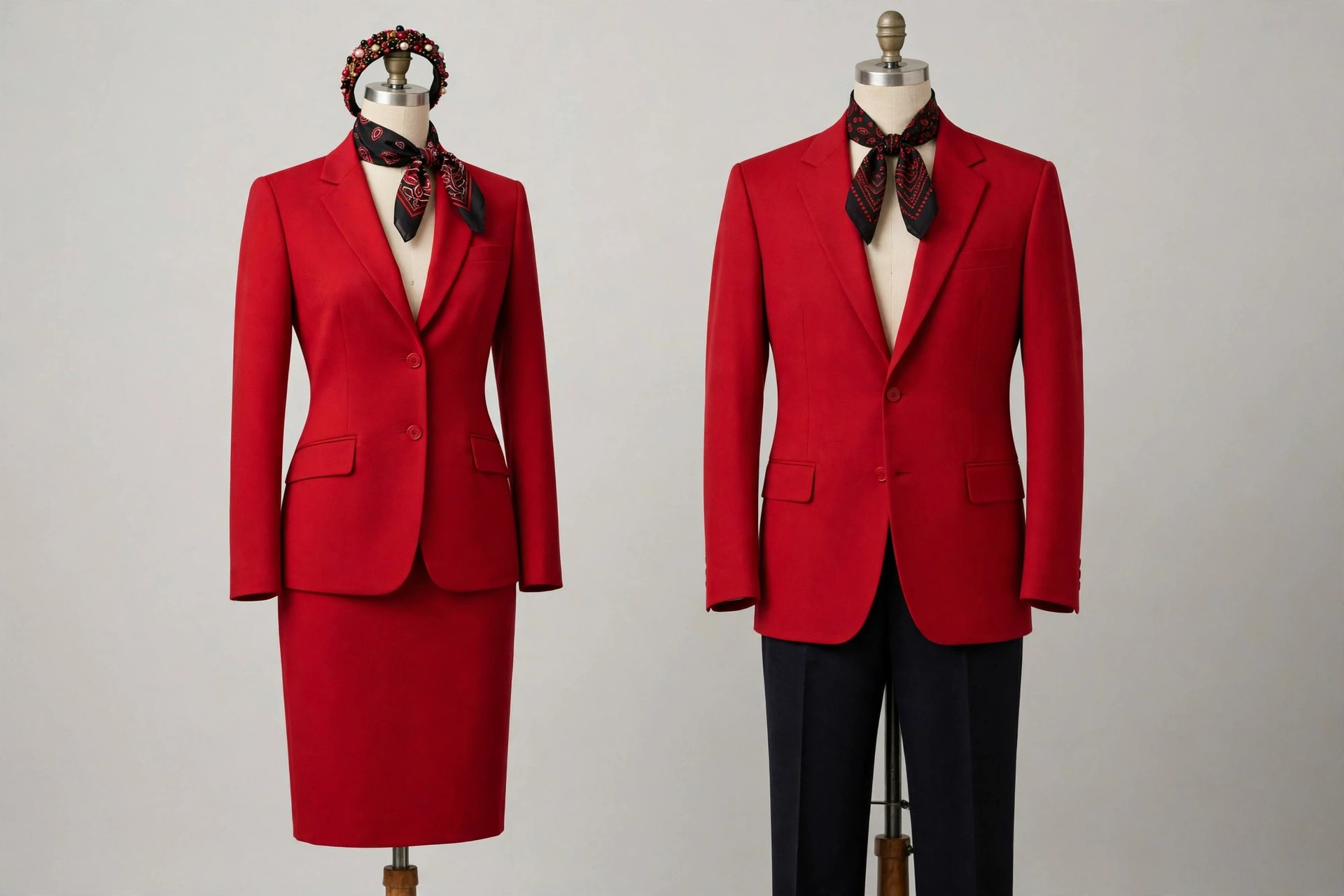
The airline’s own 2025 uniform campaign video adds one more documented variant: a red double-breasted blazer worn with a red-and-black plaid neckerchief and a small brooch — reported here as the campaign presents it, since no press garment list itemises it. Campaigns are how this airline now publishes its wardrobe: on film, on its own crew, in its own words.
Also in regular use across the airline’s own imagery: a red tailored blazer with a knee-length pencil skirt, black patterned neck scarf, black heels and a beaded headband — the headband, in its white or beaded forms, is a signature of this uniform, part of the outfit rather than an accessory choice.- Winter Uniform
- The boarding set plus its red coat layer and a long black trench coat over everything — the tropical red given a proper cold-weather shell.
- Service Uniform
- The same red trousers and black-and-red blouse, with a red apron for the cabin service — the working layer, as on many airlines in this series.
- Crew-Rest Pyjamas
- An all-red two-piece — trousers and sweatshirt — issued for crew rest on long flights: even off duty and out of sight, the colour holds.
- The Men’s Uniform
- Male crew wear the same red-and-black family — the airline’s 2025 uniform campaign shows the red blazer with a black-and-red patterned neckerchief and dark trousers. No opened press source itemises the male wardrobe garment by garment, so this guide describes it no further than the airline’s own presentation supports.
The headband repays attention as design. Airline headwear usually belongs to the hat-and-veil tradition — millinery perched on top of the hair. Kenya’s beaded and white headbands work differently: they frame the face, carry craft and beadwork associations from Kenyan dress, and photograph as a band of identity across a whole crew line-up. It is the smallest garment in the wardrobe and, after the red itself, the most recognisable.
Notice what the wardrobe does with its layers: like Oman Air’s two-act uniform elsewhere in this series, Kenya’s set is organised around the phases of a flight — but where Oman changes for dinner, Kenya changes for work: coat off, apron on, and the public glamour gives way to service practicality without surrendering the red. Even the crew-rest pyjamas keep the colour, which is less about branding discipline than about something simpler — on this airline, red is not a livery accent. It is the uniform, entire.Pilots and ground staff were not separately documented
in the sources opened for this guide; the Millennium commission itself covered Kenya Airways staff uniforms generally, but no per-group breakdown was found, and none is invented here.Reading the Uniform
No Published Rank Code
No scarf-colour, stripe or seniority system for Kenya Airways cabin crew was documented in press or airline material for this guide, and this guide does not construct one. The beaded and white headbands and the neck scarf are standard issue — identity pieces, not rank markers, on current evidence. What the uniform differentiates is phase of flight: coat and headband for boarding, apron for service, trench for winter, pyjamas for rest. It is a wardrobe organised by the working day, not the hierarchy.
That phase-based logic extends to the smallest documented details: the same crew member may present three distinct looks in one duty — coated and headbanded at the gate, aproned at the service, trench-coated on a winter tarmac — while remaining, at every stage, unmistakably in the red. Few uniforms in this series extract so much variety from so few pieces.
“The Heartbeat of the Pride of Africa”
The airline knows what it has. “Our uniform is more than a fabric; it’s the heartbeat of #ThePrideOfAfrica,” ran its own uniform campaign — and in October 2023, for Customer Service Week, CEO Allan Kilavuka worked a round trip in full cabin-crew uniform himself. When the chief executive puts on the red to serve coffee, the uniform has stopped being workwear and become the brand’s flag.
Evolution
An Open Question, Stated Openly
Here this guide owes its readers candour, because the sources disagree. A profile of Mbela’s own later brand, POISA, states that “the Kenya Airways Millennium uniform [was] worn for 12 years (2000–2012),” and dates her selection to 1998 rather than 1999. Against that, a 2026 awards profile says the uniform she designed “is still in use today,” and a Kenyan fashion-industry account likewise says her KQ outfits remain in use. No Kenya Airways press release resolving the question was found — and, tellingly, no successor designer has ever been publicly announced.
The tender story has a postscript worth keeping straight: Mbela was 26 at her selection in 1999, trained in Britain, and working independently in Nairobi — the profile of a new generation of African designers who would spend the next two decades building the continent’s fashion industry. The Millennium uniform is routinely cited as an early proof that the talent was already there, waiting only for a national institution willing to run a fair competition.
What is not in dispute is the airline’s own behaviour. Through 2023–2025 Kenya Airways actively promoted the red uniform as its identity — in its uniform campaign films, in crew social features, and in the chief executive’s Customer Service Week turn in the cabin. Airlines do not build campaigns around a wardrobe they consider retired; whatever the contractual history of the original Millennium production run, the design language Mbela set in 1999 — ruby red, black patterning, the scarf, the headband — is the language the airline still speaks.Mbela’s own career continued — she went on to build her POISA brand — and it is, ironically, her own brand profile that supplies the 2000–2012 dates, most likely describing the years of her direct involvement and original production. Designers’ biographies measure a design by their contract; airlines measure it by what is still on the aircraft. Both measures are honestly reported here, and the difference between them is the whole of the discrepancy.
The accurate summary is therefore this: the red wardrobe in service today is best presented as the continuation and evolution of Mbela’s Millennium design — its red-and-black language retained and refreshed in service — rather than flatly “designed in 1999 and unchanged since.” The 2000–2012 figure may well describe her original production run, after which the design lived on under the airline’s own stewardship. Brand refreshes along the way (a 2008 revamp is mentioned in a single low-authority brand-history source) have retained the red uniform identity throughout.The Rules
Presentation Without a Published Code
No Kenya Airways grooming manual or published appearance rules were found for this guide, and none are stated here as rules. What can be described is presentation: the headband — white in the airline’s own uniform walk-through, beaded across its campaign imagery — is a fixed, signature element of the look, itemised by the airline itself as part of the uniform. Beyond that documented detail, this guide leaves the airline’s internal standards where they belong: internal, until the airline chooses to publish them.
The Meaning
Why This Uniform Matters
There is a wider lesson in this wardrobe for the whole series. Airline uniforms are usually stories of airlines buying fashion — a famous name hired to lend glamour. Kenya’s is the reverse: fashion bought local, and the glamour followed from the authenticity. The red was not chosen from a trend forecast; it was dug out of the Kenyan earth, patterned from its wildlife, and cut by a Kenyan who had beaten the world to win the right. A quarter-century of continuous wear has done the rest.
Kenya Airways’ uniform is one of African aviation’s great local-designer stories:
a national carrier that could have bought a famous European name instead ran an open tender, and a 26-year-old from home won it with the colours of home. The red she chose — landscape red, wildlife-patterned, impossible to mistake — has carried the “Pride of Africa” ever since, through every refresh, worn by the CEO on a service week and recognised across a terminal at a glance. Whatever the precise paperwork of its later years, the design’s authorship of the airline’s identity is not in doubt. For the wider family of African dress traditions it belongs to, see our Traditional Dress guides — the kente cloth of Ghana tells a kindred story of pattern as national language.Airlines refresh their uniforms from time to time, so the details here describe the uniform as documented for this guide — the airline’s own site always carries the latest version.
Common Questions
Common Questions
Who designed the Kenya Airways uniform?
Kenyan designer Patricia Lulu Mbela designed the Millennium uniform: she won the airline’s international tender in 1999 at the age of 26 — reportedly against established houses including Balenciaga — and the design was unveiled at an African Heritage gala in Nairobi, entering service in 2000. Kenya’s government yearbook records her as fashion and textile designer for the uniform from 1999 to 2001.
Is the current Kenya Airways uniform still Mbela’s design?
That is genuinely uncertain, and this guide says so. One profile of the designer’s own brand dates the Millennium uniform’s service to 2000–2012, while other Kenyan sources describe it as still in use today, and no successor designer has ever been publicly announced. The safest accurate statement is that today’s red wardrobe descends directly from Mbela’s Millennium design, whose red-and-black language has been retained and refreshed in service.
What do Kenya Airways crew wear?
Red — unmistakably. From the airline’s own crew uniform walk-through: red trousers and a black-and-red blouse with a matching neck scarf for boarding, a red coat with black detailing, a white headband and black shoes; a red apron over the same base for service; and a long black trench coat added in winter. A red tailored blazer and pencil-skirt variant, with a beaded headband, is also in regular use.
Why is the Kenya Airways uniform red?
By the designer’s own account, the ruby red is drawn from Kenya itself — its red landscape — with the black-and-red patterning inspired by the country’s natural environment and wildlife. The colour became the core of the airline’s ‘Pride of Africa’ presentation.
How is rank shown on the Kenya Airways uniform?
No rank system has been documented in the sources for this guide: no scarf-colour code, stripe ladder or distinct senior outfit was found in press or airline material. The beaded or white headband and the neck scarf are standard issue, not rank markers, on current evidence.
Keep Exploring
More to Explore
In This Series
Airline Uniforms by Airline
The series hub — every airline’s guide, the designers behind them, and the ones in preparation.
Read ↑Traditional Dress Around the World
The dress traditions behind uniforms like this one — pattern and colour as national language.
Read ↑Go Deeper
Keep Exploring
Explore Fashion for Travel
The crew are only half the fashion on a flight — the other half is what the passengers are wearing. Our travel guides cover the traveller’s side of the same subject, and they link back here.
Outfits for Flying
Travel Outfits
What to wear when you are going somewhere — outfit systems built for transit days.
Read ↑Airport Outfits
Security-friendly shoes, cabin layers and the full airport dressing system.
Read ↑What to Wear on a Long Flight
Dressing for the overnight haul — comfort, warmth and arriving presentable.
Read ↑What to Wear When Traveling
The destination-rules guide to building a travel wardrobe that works on arrival.
Read ↑Business Travel Wardrobe Guide
A working wardrobe that travels — suits, wrinkle strategy and boardroom-ready arrivals.
Read ↑Packing & Capsule Wardrobes
Travel Capsule Wardrobe Guide
A small set of pieces that combine into a trip’s worth of outfits.
Read ↑Travel Packing Guide
The complete packing method — lists, order and wrinkle control.
Read ↑How to Pack a Suit
Getting a tailored jacket and trousers across the world without the creases.
Read ↑Carry-On Packing Guide
Everything in one bag — the carry-on-only system, piece by piece.
Read ↑Travel Comfort & Accessories
Search Apparel Search