Airline Uniforms by Airline · Oman
Oman Air: The Uniform in Two Acts
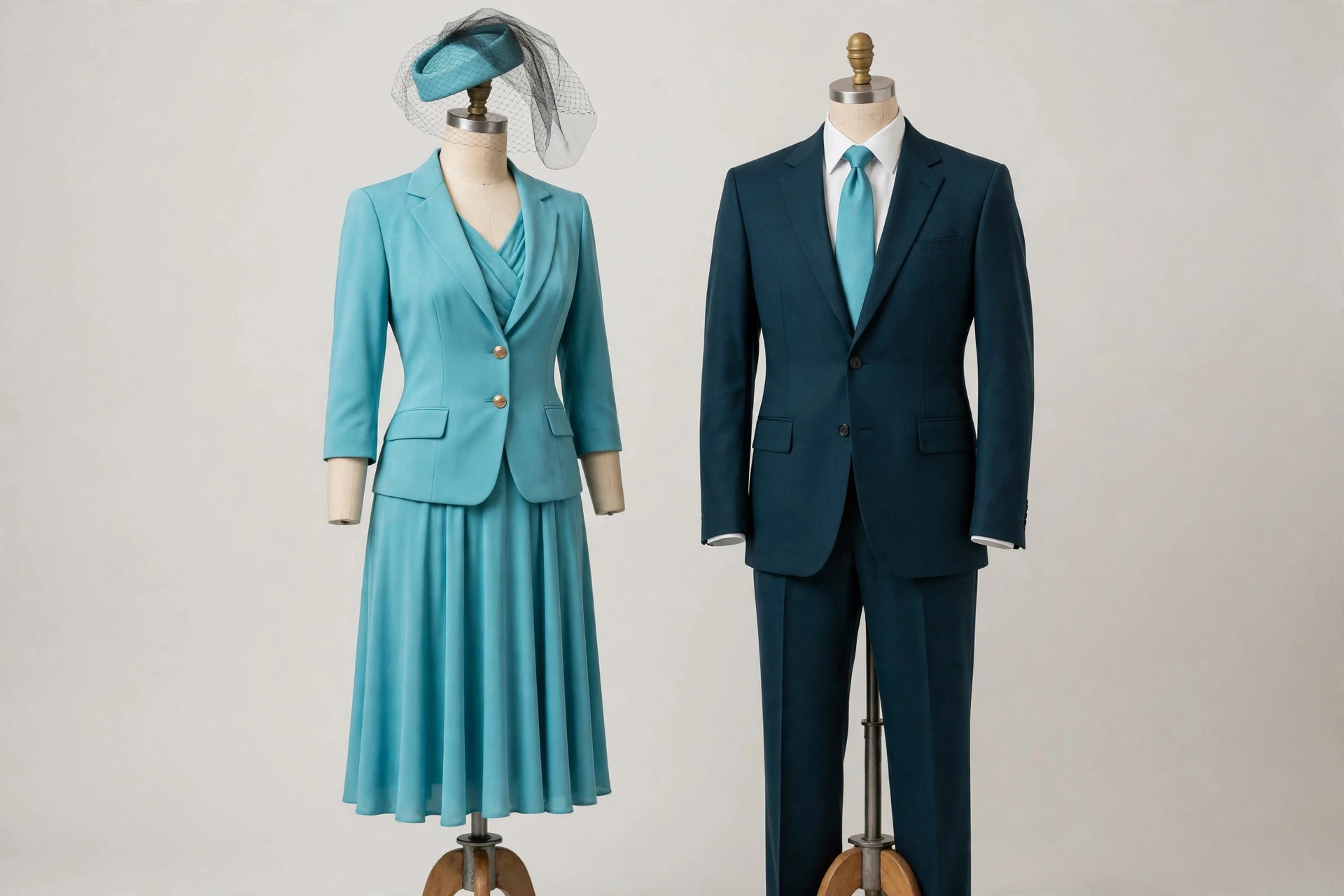
Oman Air’s crew perform a quiet costume change on every flight: hatlet and veil for boarding, then off they come — and on goes a dinner jacket and floral scarf for the meal service. Designed in-house in 2019, in turquoise drawn from the Sea of Oman, it is one of the most completely documented uniforms in this series. Here it is, garment by garment.
The Design
Designed In-House, Launched at Heathrow
The current uniform was launched on 13 June 2019 at London Heathrow and rolled out across the network in phases. It arrived as part of a considered brand evolution — alongside the new Boeing 787-9 First Class of 2018 and the “State of Wonder” masterbrand — and its story was told in the first of five brand films, titled “State of Grace.”
There is no celebrity designer on this one, and the airline is proud of the fact. The launch release states it plainly: the uniform was “developed by Oman Air’s in-house product development and brand team.” CEO Abdulaziz Al Raisi praised “the tremendous amount of effort and time dedicated by our team working through multiple design iterations, and modifications before the precise styling and overall look was achieved in each garment.” Any source crediting a fashion house with the 2019 uniform is mistaken — Balenciaga belongs to this airline’s earlier wardrobes, as the history section explains.
The brand films matter to the uniform’s documentation, too. Because Oman Air told the design story on film — the first of five “State of Wonder” films — the reasoning behind the garments entered the public record alongside the garments themselves: why the turquoise deepened, why the landscape colours were chosen, why the service change exists. Most airlines publish a photograph and a paragraph; Oman Air published an argument, and this guide is richer for it.
The launch was also a statement about how a smaller Gulf carrier competes. Oman Air has never chased the scale of its giant neighbours; its pitch is refinement — and a uniform developed through “multiple design iterations” by its own product team, then launched at Heathrow, the prestige end of its network, was that pitch made visible. The phased network rollout that followed treated the wardrobe the way airlines treat a new aircraft type: introduced route by route until the whole fleet of people matched.The colour story is Oman itself.
The turquoise of the previous uniform was kept but made richer and deeper, inspired by the Sea of Oman; around it, accent colours were drawn from the country’s seasonal landscape — the golden light of its sunsets and the bright magenta-pink of its mountain roses. Few uniforms can name the exact waters their colour came from.The Components
The Outfit, Piece by Piece
- The Turquoise Dress
- The women’s foundation: a one-piece dress in turquoise, in a flattering, flowing cut that falls below the knee.
- The Main Jacket
- A tailored jacket in the same turquoise, cut — in the airline’s words — “to convey flair and elegance,” worn over the dress for the formal phases of duty.
- The Hatlet and Veil
- A newly designed hatlet with a veil, bringing a touch of old-world glamour to the uniform — worn for boarding and ground duties, and removed after boarding. The veil here is a fashion veil, a wisp of netting on a small hat, in the great tradition of airline millinery.
- The Dinner Jacket and Floral Scarf
- The second act: for meal service, crew add a dinner jacket with a contrasting floral scarf that embodies the country’s seasonal colours — turquoise sea, golden sunset, magenta mountain roses — all three in one print.
- The Men’s Suit
- A modern-cut suit in dark teal, worn with a turquoise tie — the deep-water counterpart to the women’s brighter turquoise.
The men’s side of the choreography is quieter but consistent: one suit, one tie colour for the standard issue, and rank expressed only at Cabin Director level by the waistcoat and gold tie. In a region where competitor uniforms layer on braid and insignia, Oman Air’s restraint is a style position in itself — elegance by subtraction, the same instinct that kept the dress a single flowing piece rather than a constructed suit.
Read the wardrobe as a timetable and its logic sharpens. Act one, the ground and boarding: full tailoring, hatlet, veil — maximum formality at the moment of first impressions and photographs. Interval, doors closed: the millinery comes off, because a veil has no place around galley work. Act two, the meal service: on goes the dinner jacket, and the floral scarf turns the crew into hosts at a table rather than attendants in an aisle. The uniform is choreographed like the service it supports — which is precisely what a uniform designed by a product team, rather than a fashion house working to a lookbook, tends to produce.The hatlet deserves its place in airline millinery history. The great Gulf and Asian carriers made the hat-and-veil a regional signature, but Oman Air’s version is deliberately smaller and more tailored — old-world glamour, in the airline’s own phrase, edited for a boutique carrier. It is also practical theatre: a veil reads instantly, across a crowded terminal, as “cabin crew, on duty, approachable,” and its removal after boarding reads just as clearly as “service is beginning.”
Two honest gaps: the launch release covers cabin crew only. It does not itemise a pilot wardrobe or a ground-staff variant, and none was documented in the other sources opened for this guide — so none is described here.The Rank Code
Gold Marks the Cabin Director
Oman Air codes its most senior cabin rank in gold, and the system is set out in the launch release itself:
| Crew member | Uniform | The tell |
|---|---|---|
| Cabin crew (women) | Turquoise dress and jacket, turquoise hatlet and veil | The standard issue — sea-bright turquoise throughout. |
| Cabin Director (women) | The same dress cut in a darker teal, with a golden hatlet and veil | Deeper cloth, golden millinery. |
| Cabin crew (men) | Dark teal suit, turquoise tie | The standard issue. |
| Cabin Director (men) | Dark teal suit with a grey waistcoat and gold tie | The waistcoat appears, and the tie turns gold. |
No epaulette or sleeve-stripe system for cabin crew is documented — the code is carried entirely by shade, waistcoat and tie. Airline imagery from 2025 and 2026 still shows the gold-hatted Cabin Director, consistent with the 2019 coding remaining current.
For readers comparing the Gulf carriers in this series: where its neighbours code rank with scarves, stripes and elaborate insignia systems, Oman Air’s entire hierarchy fits in one sentence — darker teal and gold for the women in charge, a waistcoat and a gold tie for the men. It is among the clearest rank codes in the region precisely because it is among the smallest.
“State of Grace”
Oman Air did not just issue a uniform in 2019; it filmed one. The design story became the first of five brand films under the “State of Wonder” masterbrand — “State of Grace” — treating the wardrobe as a piece of national storytelling: the sea in the turquoise, the sunset in the gold, the mountain roses in the scarf. It is a measure of how seriously the Gulf’s smaller premium carrier takes the garment its people wear.
Evolution
The Balenciaga Years
Before the in-house team took over, Oman Air dressed couture. The uniform unveiled in 2009, with the airline’s three-class Airbus A330 service between Muscat and London, was explicitly “designed by the house of Balenciaga” in contemporaneous reports quoting the airline’s then CEO — and it aged well: when the airline later opened its Uniform Distribution Centre in Muscat, it noted the 2009 uniforms “have since been recognised as one of the most stylish in the airline sector.” That wardrobe served a full decade, until the phased 2019 changeover.
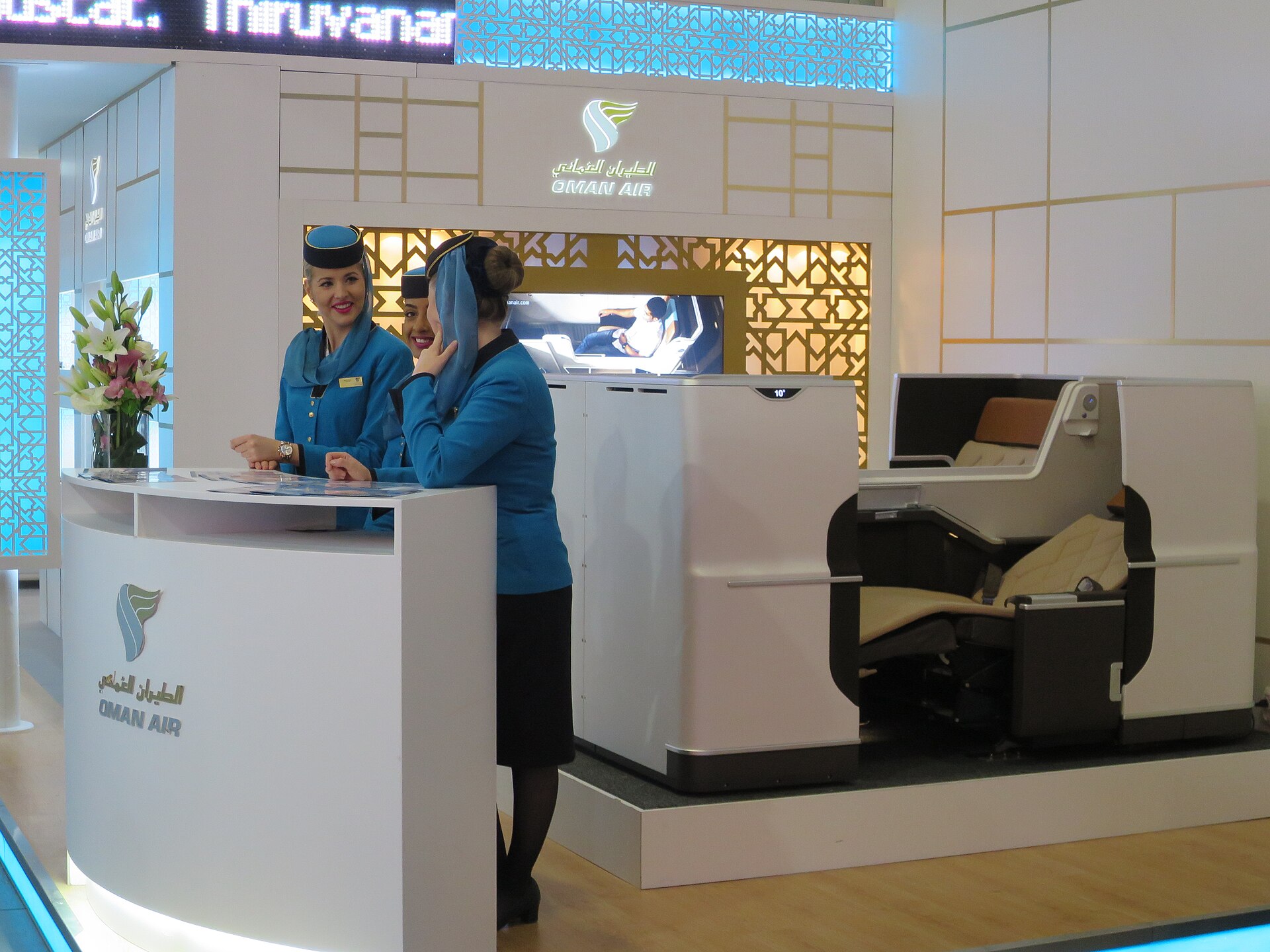
The 2009 wardrobe also set the visual formula the 2019 team inherited: turquoise as the house colour, and a hat with a veil as the women’s signature. Pre-launch commentary in 2019 noted — as observation, not official statement — that the old hat resembled the hat-and-veil of a much larger Gulf neighbour, and that the new beret-like hatlet gave Oman Air a silhouette of its own. Whether or not the comparison drove the change, the effect is real: the 2019 hatlet is smaller, sharper and unmistakably Oman Air’s.
Behind 2009 sits an earlier chapter
, reported more thinly: a turquoise-blue uniform designed by Balenciaga in 1999, coordinated with the livery of the time. The Balenciaga connection makes the claim plausible, but it rests on a single low-authority source in the research for this guide, so it is presented here as reported, not proven. The supply side of the story is firmer: Al Obaidani International of Muscat — an Omani textiles and tailoring house — was named the airline’s official uniform supplier alongside the opening of the distribution centre. The supplier chapter deserves its detail: Al Obaidani International is a wholly Omani-owned Muscat company, part of a group in textiles and tailoring since the 1960s, appointed after a tender as the airline’s official uniform supplier when the Uniform Distribution Centre opened at headquarters — the unglamorous infrastructure, a dedicated centre that fits, issues and replaces uniforms, on which every glamorous launch quietly depends. No successor to the 2019 uniform has been announced.The Rules
Protocol, Not a Published Grooming Code
The choreography extends to the smallest documented detail: the floral scarf is not an optional flourish but a specified garment, its print carrying all three of the landscape colours at once — sea, sunset and roses — so that even seated in a dim cabin, the crew wear the country’s palette at the neck. Airlines that buy uniforms from fashion houses rarely achieve that kind of total integration; it tends to come, as here, from a product team thinking about the whole journey rather than a single look.
No Oman Air grooming manual or published appearance rules were found in the sources for this guide, and none are invented here. What is documented is wearing protocol, and it is unusually specific: the hatlet and veil belong to boarding and the ground, come off once the doors close, and the dinner jacket and floral scarf belong to the meal service. The uniform’s rules, as published, are about when each piece is worn — choreography rather than cosmetics. The region’s wider dress traditions, which the veil and scarf quietly nod to, are covered in our Gulf thobe and abaya guide.The Meaning
Why This Uniform Matters
It also matters as a Gulf counterpoint. The region’s giant carriers dress with famous-name designers and global spectacle; Oman Air, the boutique of the Gulf, first borrowed that glamour honestly through Balenciaga, then outgrew the need for it. The 2019 wardrobe’s confidence is quiet: no borrowed name on the label, just a sea colour, a gold tie for the person in charge, and a scarf that carries a landscape.
Oman Air’s uniform matters because it shows both ways an airline can dress well. For a decade it wore a Paris house’s design with pride; then it brought the work home, iterated in-house until every garment satisfied its own team, and produced a wardrobe specific enough to be itemised in a press release — dress, jacket, hatlet, veil, dinner jacket, scarf, waistcoat, tie. The two-act structure, glamour for boarding and a fresh costume for dinner, treats the flight as theatre and the crew as its cast. For more on the garments themselves, see our scarf definition and the series hub.Airlines refresh their uniforms from time to time, so the details here describe the uniform as documented for this guide — the airline’s own site always carries the latest version.
Common Questions
Common Questions
Who designed the Oman Air uniform?
No outside fashion house: the 2019 uniform was developed by Oman Air’s own in-house product development and brand team, through multiple design iterations, as the airline stated in its launch release. The earlier wardrobes were a different story — the 2009 uniform was designed by the house of Balenciaga.
When did the current Oman Air uniform launch?
On 13 June 2019, launched at London Heathrow and then introduced across the network in phases, as part of a wider brand evolution that included the ‘State of Wonder’ masterbrand and the ‘State of Grace’ uniform film.
How can you spot an Oman Air Cabin Director?
By gold. A female Cabin Director wears the same dress cut in a darker teal shade with a golden hatlet and veil; a male Cabin Director wears a grey waistcoat and a gold tie, against the standard steward’s dark teal suit and turquoise tie.
Why do Oman Air crew change their clothes during the flight?
The uniform is designed in two acts. The hatlet and veil are worn for boarding and on the ground, then removed after boarding; for meal service the crew add a dinner jacket with a contrasting floral scarf in the colours of the Omani landscape — turquoise sea, golden sunset and magenta mountain roses.
Did Balenciaga really design for Oman Air?
Yes — for the previous wardrobe. The uniform unveiled in 2009 with the airline’s three-class Airbus A330 service was explicitly described at the time as designed by the house of Balenciaga, and it was still being praised as one of the most stylish in the industry when it was replaced in 2019. A Balenciaga turquoise uniform in 1999 is also reported, though on thinner sourcing.
Keep Exploring
More to Explore
In This Series
Airline Uniforms by Airline
The series hub — every airline’s guide, the designers behind them, and the ones in preparation.
Read ↑Gulf Thobe & Abaya
The traditional dress of Oman’s region — the garments behind the uniform’s veil and scarf.
Read ↑Go Deeper
Keep Exploring
Explore Fashion for Travel
The crew are only half the fashion on a flight — the other half is what the passengers are wearing. Our travel guides cover the traveller’s side of the same subject, and they link back here.
Outfits for Flying
Travel Outfits
What to wear when you are going somewhere — outfit systems built for transit days.
Read ↑Airport Outfits
Security-friendly shoes, cabin layers and the full airport dressing system.
Read ↑What to Wear on a Long Flight
Dressing for the overnight haul — comfort, warmth and arriving presentable.
Read ↑What to Wear When Traveling
The destination-rules guide to building a travel wardrobe that works on arrival.
Read ↑Business Travel Wardrobe Guide
A working wardrobe that travels — suits, wrinkle strategy and boardroom-ready arrivals.
Read ↑Packing & Capsule Wardrobes
Travel Capsule Wardrobe Guide
A small set of pieces that combine into a trip’s worth of outfits.
Read ↑Travel Packing Guide
The complete packing method — lists, order and wrinkle control.
Read ↑How to Pack a Suit
Getting a tailored jacket and trousers across the world without the creases.
Read ↑Carry-On Packing Guide
Everything in one bag — the carry-on-only system, piece by piece.
Read ↑Travel Comfort & Accessories
Search Apparel Search