Women's Cotton V-Neck T-Shirt Guide
The basic V-neck as a wardrobe staple — collar construction, V depths, and honest cotton jersey weights explained.
Shop Women's Cotton V-Neck T-Shirts Now
Shop Women's Cotton V-Neck T-Shirts on Amazon Shop Women's Cotton V-Neck T-Shirts on eBayThe Amazon and eBay links on this page are affiliate links. If you make a purchase through them, Apparel Search may earn a commission.
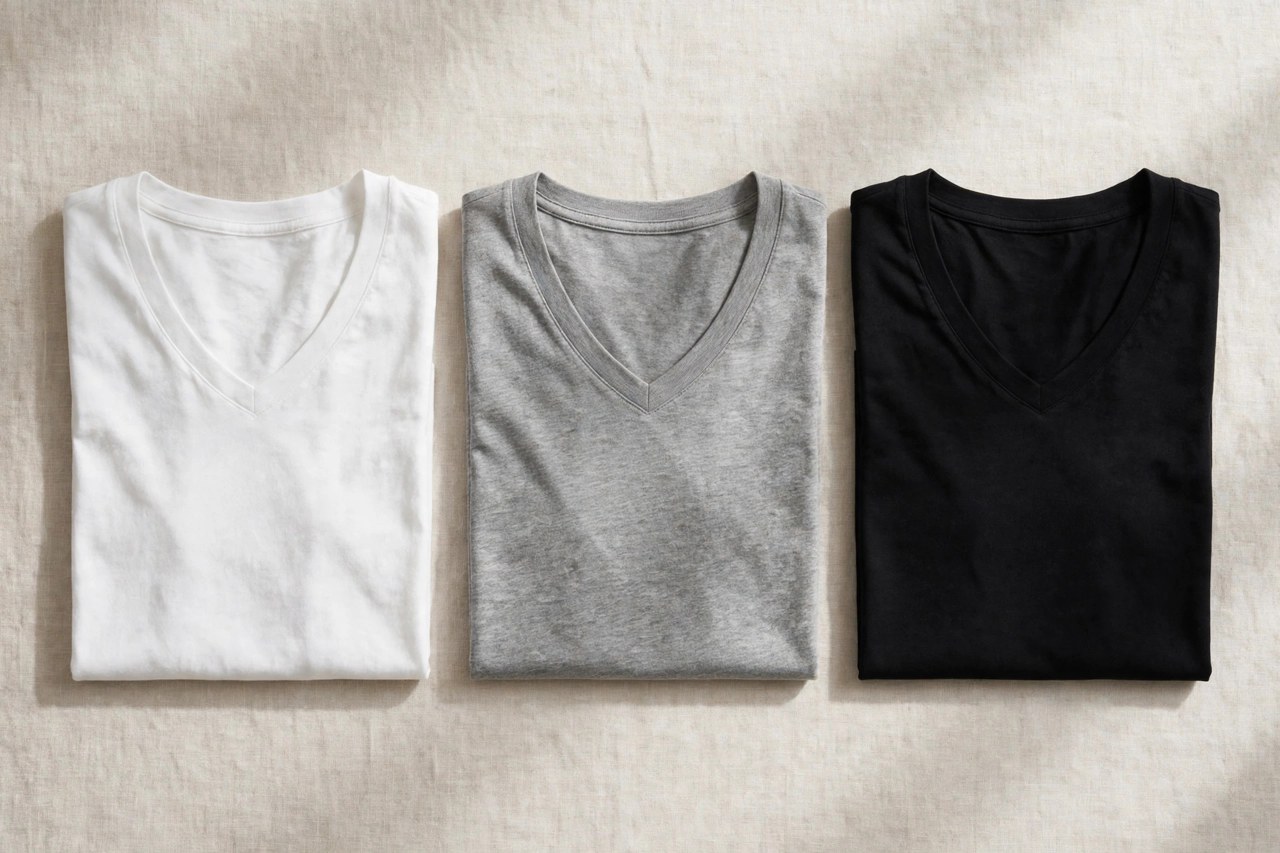
This page is about the V-neck t-shirt as a basic garment — the plain, hard-working version you buy in multiples, wear under everything, and replace without drama. It is cut from cotton jersey, finished with a defined collar band at the V, and made in repeatable fits and core colours. That is deliberately different from the V-neck tee covered on its own page, which is the styled, fashion-led version with softer drape and outfit-first cuts. Here the questions are practical: how deep is the V, how is the collar built, how heavy is the jersey, and will the shirt keep its shape and length after washing? A good basic V-neck answers all four well, costs sensibly, and behaves the same in black, white, and navy.
V Depths: Shallow, Classic, and Deep
Depth is the defining choice. A shallow or high V ends a few centimetres below the collarbone and reads almost like a crew neck with a notch; it layers cleanly under cardigans and works wherever a crew would. A classic V ends mid-chest and is the most versatile depth — open enough to lengthen the neckline visually, modest enough for most workplaces under a jacket. A deep V drops considerably lower, suits layering over a camisole, and changes the shirt from basic to statement, so buy it knowingly. Measure depth from the shoulder seam rather than trusting product photos, which stretch garments on models. If you are between depths, the classic V is the safe basic: it shows a necklace well, never needs adjusting, and pairs with the widest range of bottoms and layers.
Collar Construction: Where Basics Succeed or Fail
On a basic V-neck, the collar band does the structural work. Better shirts use a ribbed cotton band, often with a touch of elastane, that is cut slightly shorter than the neck opening so it pulls the V flat against the chest. The two sides of the V should meet in a clean, reinforced point — look for neat mitred stitching or a small overlap that lies flat, because a puckered or curling point is the first thing to fail on a cheap shirt. Self-fabric bands (made from the same jersey as the body) look softer but stretch out faster than ribbing, so expect to replace those shirts sooner. Turn the shirt inside out: the collar seam should be smooth, with no raw edge that will irritate the neck, and the shoulder seams should be taped or reinforced so the V does not grow wider with wear.
Cotton Jersey Weights and Shrinkage
Most basic V-necks use single jersey between about 140 and 180 GSM. The lighter end feels cool and drapes closer, but shows more through in white and loses shape sooner; midweight jersey around 160 to 180 GSM is the sweet spot for a basic, opaque enough to wear alone and sturdy enough for weekly washing. Cotton shrinks, typically 3 to 5 percent in length on the first warm wash, so a shirt that fits perfectly to the hip in the fitting room may sit noticeably higher after laundering. Pre-shrunk and garment-washed shirts reduce that surprise, and side-seamed construction holds its shape better than tubular knits, which can twist after washing. Check whether the shirt is 100 percent cotton or a cotton-rich blend: a small percentage of elastane in the body improves recovery at the V and hem, while pure cotton gives the driest, most breathable hand feel in summer heat.
Fit Cuts and Sizing a Basic
Basics come in three broad cuts. Classic fit follows the body with room to move and a straight hem that tucks or untucks equally well. Slim fit narrows through the waist and sleeves, which keeps the V looking intentional rather than borrowed, but leaves less tolerance for shrinkage. Relaxed fit adds ease through the torso and a slightly dropped shoulder, useful for layering over long sleeves in cooler months. Sleeve length on a basic V-neck is short and set-in, ending mid-upper-arm; cap sleeves belong to the fashion tee, not the basic. When sizing, fit the shoulders first — the seam should sit at the shoulder point — then confirm the V lies flat without pulling across the chest. If the point of the V lifts away from your body, the shirt is pulling somewhere, usually across the bust or back, and the next size will sit better.
Care, Colours, and Building a Rotation
A basic earns its place by surviving a rotation. Wash V-necks inside out in cool water with like colours, and dry them flat or on a line rather than in high tumble heat, which curls collar bands and shortens length. Folded storage beats hanging for jersey, since hangers stretch the neck opening over time. Core colours — white, black, grey marle, and navy — cover almost every outfit a basic is asked to support, and buying two of the white is sensible because white cotton greys fastest. Replace a basic when the V no longer lies flat, the collar band ripples permanently, or underarm areas thin; those are end-of-life signs no ironing fixes. Kept this way, the humble V-neck t-shirt is one of the cheapest cost-per-wear items in a wardrobe, which is exactly what a basic should be.
Looking for Women's Clothing Stores?
This guide helps you choose women's cotton V-neck t-shirts by V depth, weight and fit. To browse where to buy, visit our women's clothing store directory, where you can find retailers that carry them.