Women's Cotton V-Neck Tee Guide
The V-neck tee as a styled piece — softer drape, fashion cuts, and layering under blazers and knits.
Shop Women's Cotton V-Neck Tees Now
Shop Women's Cotton V-Neck Tees on Amazon Shop Women's Cotton V-Neck Tees on eBayThe Amazon and eBay links on this page are affiliate links. If you make a purchase through them, Apparel Search may earn a commission.
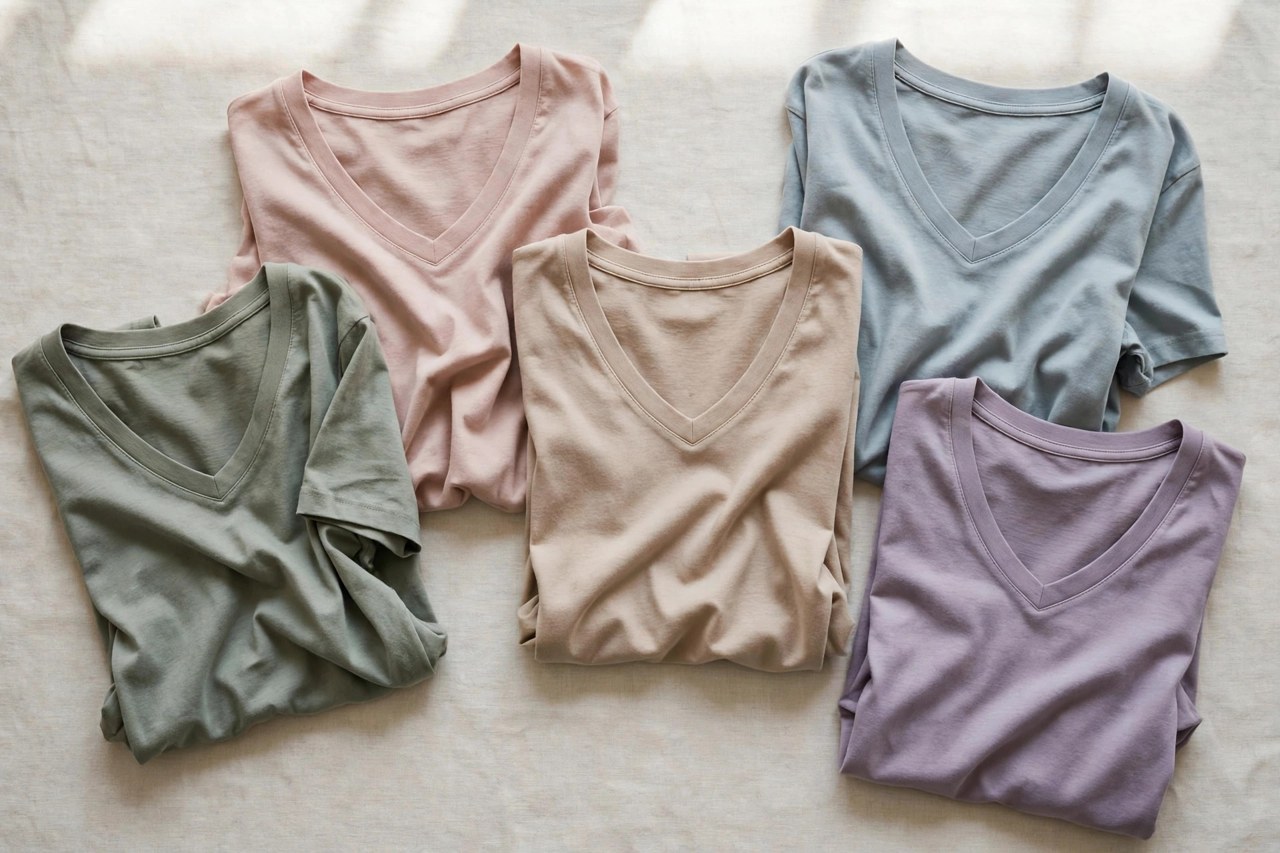
Where the V-neck t-shirt is a basic garment, the V-neck tee is the styled version of the same idea. The neckline is shared, but everything else shifts toward fashion: lighter, drapier cotton jerseys, relaxed or deliberately oversized cuts, curved or high-low hems, and colours chosen by season rather than by staple logic. A V-neck tee is bought one at a time, for how it falls and what it does for an outfit, not in a multipack for rotation duty. This distinction mirrors the crew-neck pair elsewhere in this guide — the t-shirt page covers the classic basic, this page covers its dressed, expressive sibling. If you want a shirt to anchor jeans, slip under a blazer, or soften tailored trousers, you are shopping for the tee, and drape matters more than durability ratings.
Drape First: Fashion Jerseys Explained
Styled tees favour jerseys that fall rather than stand. Slub jersey, knitted with slightly uneven yarns, gives a subtle horizontal texture and a lived-in softness that suits the tee's relaxed character, though it is a little less opaque than smooth jersey. Lightweight single jersey around 120 to 150 GSM drapes closest and tucks without bulk, which is why so many blazer-friendly tees sit in that range. Cotton-modal and cotton-rich modal blends feel silkier and resist the slight stiffness pure cotton develops after washing, at the cost of a less crisp look. Burnout and garment-dyed tees chase a vintage softness; both look wonderful and both are thinner, so check them against the light before buying. A fashion tee should move when you move — if the fabric stands away from the body in stiff folds, it is cut like a basic wearing fashion colours.
Layering Under Blazers, Cardigans, and Jackets
The V-neck tee's best trick is what it does under structure. A tailored blazer over a crew neck can read severe; the same blazer over a V-neck tee softens immediately, and the V echoes the jacket's own open front, creating one long, flattering line. Keep the tee's V shallower than the blazer's closure point so the layers do not compete, and choose smooth jersey under suiting so lapels lie cleanly. Under fine cardigans, a V-neck tee avoids the bunching a crew creates at the neck and lets a necklace sit in the open V. With leather or denim jackets, deeper Vs and slub textures play well against the tougher outer layer. The half-tuck is the tee's signature styling move: tucking just the front centre into a waistband gives shape while keeping the drape, and it works because fashion tees are cut a little longer than basics.
Cuts That Make It Fashion, Not Basic
Relaxed and boyfriend cuts, with dropped shoulders and a straighter body, are the default fashion silhouette and pair best with slimmer bottoms to balance volume. Cropped V-neck tees end at or above the waistband and belong with high-rise trousers, skirts, and jeans, where the proportions do the styling work. Curved hems, side slits, and high-low hems are not decoration for its own sake: they keep a longer tee from cutting the leg line in half and let the shirt move over hips without riding up. Sleeves run longer and looser than on a basic, sometimes with a rolled cuff that is stitched in place. Pockets — a single chest pocket is a classic tee detail — add the casual signal that separates a tee from a t-shirt. None of these details makes a garment better; they make it styled, which is the entire point of this page's split.
Colour and Print With Intent
Because a tee is an outfit piece, its colours can roam further than a basic's: washed pastels, faded earth tones, seasonal brights, and soft neutrals that pair with tailoring. Garment dyeing gives fashion tees their characteristic slightly uneven, sun-softened colour, and also explains why two tees in the same labelled colour may differ slightly — that is the process, not a fault. Graphics and logos appear far more often on tees than on basics; keep them centred in the open space below the V, and remember that a print stiffens the jersey beneath it, slightly changing the drape. Stripes deserve a note: a Breton-style striped V-neck tee is a perennial styling staple, and the V should interrupt the stripe pattern cleanly at the collar band rather than distorting it. Choose colours against the layers you own, not the rail in front of you.
Wearing It Well and Making It Last
A fashion tee still benefits from cotton sense. Lighter jerseys pill faster where bags and seatbelts rub, so rotate tees rather than wearing one daily, and wash inside out on a gentle cycle. Modal-blend and slub tees prefer flat or line drying; tumble heat dulls garment-dyed colour noticeably within a season. Iron on low from the inside if needed, and never iron directly over a print. Styling longevity comes from proportion discipline: one relaxed element per outfit is enough, so a loose V-neck tee wants a defined waistband, a structured jacket, or a slimmer bottom somewhere in the picture. Treat the tee as the soft element and let something else provide the architecture, and the simplest cotton shirt in your wardrobe becomes the one that makes outfits look considered rather than assembled.
More to Explore on Apparel Search
- benefits of cotton
- Clothes
- Cotton
- Cotton Definition
- Cotton News
- Organic Cotton
- Women's Clothes
- Women's Cotton Clothing
- Women's Cotton Crew Neck T-shirts
- Women's Cotton Heavy Weight T-shirts
- Women's Cotton Hooded T-shirts
- Women's Cotton Jersey T-shirts
- Women's Crew Neck T-shirts
- Women's Crew Neck Tees
- Women's Designer T-shirts
- Women's Shirts
- Women's T-shirts
- Women's Tees
- Women's Tops
Photos

Looking for Women's Clothing Stores?
This guide helps you choose women's cotton V-neck tees by drape, cut and colour. To browse where to buy, visit our women's clothing store directory, where you can find retailers that carry them.