Adrian Helmet
Hat & Headwear Definitions — hats, caps, helmets and headwear terms from Apparel Search
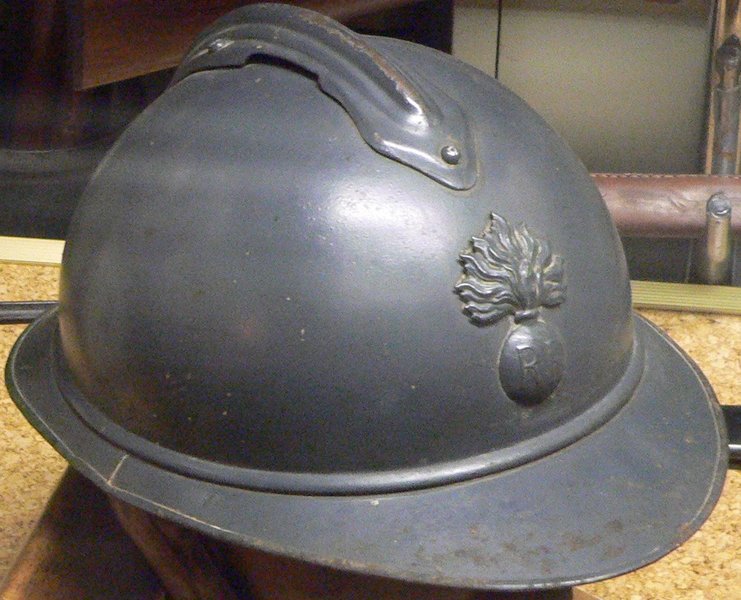
The M26 Adrian helmet was a military helmet issued to the French Army during World War I, designed when millions of French troops were engaged in trench warfare and head wounds had become a significant proportion of battlefield casualties. Made of mild steel with a deflector crest, it was intended to protect the soldier from artillery shell shrapnel from above. It was widely adopted by other countries and remained in French army use until after World War II.
The helmet was intended to protect the soldier from artillery shell shrapnel from above, hence the deflector crest. Like most helmets of this era, it was never designed to protect from the direct impact of rifle or machine gun bullets. It was made of mild steel and weighed only .765kg (1lb.11oz.) which made it lighter than the British Brodie helmet and the German Stahlhelm. More than three million Adrians were produced, and they were widely adopted by other countries including Mexico, Italy, Belgium, Thailand, Russia and Serbia. The Soviet model with a large red star became a classic symbol of the frontline soldier of the USSR.
In the French army the Adrian helmet was standard military issue until after World War II, and was also used by the French police up to the 1970s. Adrian helmets are still prized by collectors today.
 |
|
| Textile & Clothing definitions and Glossaries: | |
Learn about additional fashion or textile industry topics:
Fabric & Textile Industry Definitions
Embroidery Industry Definitions
Hat & Headwear Industry Definitions
Shoe & Footwear Industry Definitions
| The above article is licensed under the GNU Free Documentation License. From Wikipedia, the free encyclopedia https://en.wikipedia.org/wiki/adrian_helmet 6/12/05 |
A Helmet Designed for the Trenches
Trench warfare created a very specific kind of danger, and the Adrian helmet was shaped by that danger. Soldiers lived and fought below ground level, exposed from above to bursting artillery shells that scattered fragments down into the trenches. Head wounds became a significant proportion of battlefield casualties, so protection did not need to stop a bullet fired straight at the wearer; it needed to deflect and absorb shrapnel arriving from overhead. The deflector crest running along the top of the helmet is the clearest sign of that purpose. It strengthened the crown where a fragment was most likely to strike and helped turn falling metal aside rather than letting the full force land on a single flat surface. Understanding that limited, practical goal explains both the strengths and the limits of the design: judged as overhead shrapnel protection for troops in trenches, it answered an urgent need; judged as protection against direct rifle or machine gun fire, it was never intended to serve, and no helmet of its era was.
Material and weight carried the same practical logic. The Adrian was made of mild steel, a workable material that could be produced in very large numbers for an army of millions, and it weighed only 0.765 kilograms, about 1 pound 11 ounces. In the conditions of trench service, weight mattered every hour of the day. A helmet that was too heavy would be taken off, resented, or worn badly, and a helmet not being worn protects nobody. At well under a kilogram the Adrian was lighter than the British Brodie helmet and lighter than the German Stahlhelm, so a soldier could wear it through long duty without the same strain on the neck and shoulders. The balance the design struck, enough steel overhead to meet the shrapnel threat, light enough to be worn continuously, and simple enough to be made by the million, is why it could move so quickly from a French answer to a French emergency into general service.
From French Issue to World Service
The scale of production tells the story of how completely the design was accepted. More than three million Adrian helmets were produced, and they were widely adopted by other countries, including Mexico, Italy, Belgium, Thailand, Russia and Serbia. Each adopting army took the same basic French answer to the same battlefield problem, a light steel helmet against overhead fragments, and put it into its own service. The most recognisable adaptation was the Soviet model with a large red star, which became a classic symbol of the frontline soldier of the USSR. That image shows how far a piece of equipment can travel: a helmet created for French trenches in World War I ended up standing, in photographs and in public memory, for soldiers of another country and another army entirely. For anyone identifying an Adrian today, that wide adoption is the key point to hold in mind, because the same general form can carry the markings and history of many different forces.
Service life at home was just as long. In the French army the Adrian helmet was standard military issue until after World War II, a span that carried it far beyond the war it was designed for, and it was also used by the French police up to the 1970s. A design that stays in use that long has usually earned its place twice over, first as battlefield equipment and then as trusted everyday protective headgear for duties far from the trenches. That second career in police service also helps explain why so many examples survived. Adrian helmets are still prized by collectors today, and their appeal brings the whole history together: the light mild steel shell, the crest shaped by the shrapnel threat, the enormous production run, the long list of countries that adopted the pattern, and the decades of French military and police wear. A collector holding an Adrian is holding the standard French response to the defining danger of World War I trench warfare, in the exact light, crested form in which millions of soldiers wore it. When comparing surviving examples, the details that matter are the ones this history establishes: the mild steel construction, the light weight of well under a kilogram, the crest fitted for the overhead threat, and the markings of the army or police force that issued the helmet, French or one of the many adopting countries, because those markings are what connect an individual helmet to its own particular chapter of a very widely shared story.
Common Questions
What was the Adrian helmet designed to protect against?
The Adrian was intended to protect the soldier from artillery shell shrapnel falling from above, which is why it carries a deflector crest along the top. Like most helmets of its era, it was never designed to protect from the direct impact of rifle or machine gun bullets.
How heavy was the Adrian helmet?
The Adrian was made of mild steel and weighed only 0.765 kilograms, about 1 pound 11 ounces. That made it lighter than both the British Brodie helmet and the German Stahlhelm worn by opposing troops.
Which other countries used the Adrian helmet?
More than three million Adrians were produced and they were widely adopted by other countries including Mexico, Italy, Belgium, Thailand, Russia and Serbia. The Soviet model with a large red star became a classic symbol of the frontline soldier of the USSR.