Outerwear Buyer Job Description
Buying coats and jackets for a whole business — the category where the weather helps write the plan
The outerwear buyer holds responsibility for coats and jackets across an entire retailer or brand — every market, every price tier, one budget. Few buying briefs carry this much exposure per garment: a single coat can cost more to stock than a rail of shirts, it occupies serious warehouse and shop-floor space, and its selling window is dictated by temperatures nobody controls. Getting the category right means ordering the correct mixture of heavy winter protection, transitional layers and rainwear many months before the first frost, then defending the plan when the season behaves unexpectedly. The sections below describe that balancing act in full.
More Buying Job Descriptions by Letter:
Assembling a Coat Range That Covers Every Forecast
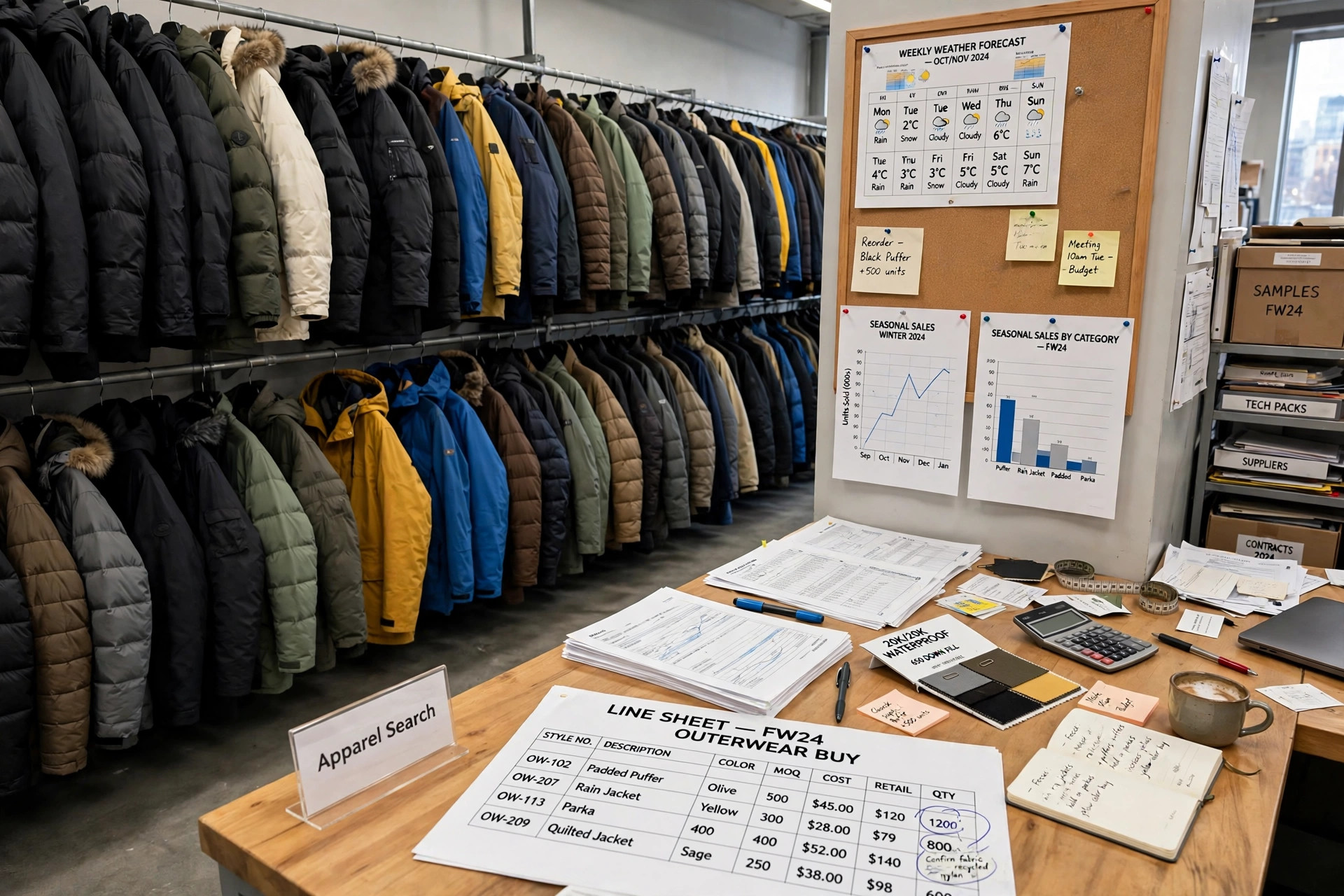
Planning begins with last year's weather diary as much as last year's sales. The buyer reconstructs which weeks turned cold, when rain arrived, and how each event moved heavyweight, midweight and showerproof styles, then builds three demand scenarios — mild, typical and severe — and weights the order book across them. Core protection such as waterproof shells and insulated parkas is committed early at depth, because factories need long lead times for technical fabrics and trims.
Around those anchors the buyer layers transitional merchandise: unlined macs, lightweight padded jackets and wool-blend coats that sell in the shoulder weeks when customers feel a chill without needing full winter armour. Price architecture is mapped deliberately from entry rain jackets to premium wool and down styles, ensuring each market the business serves — value, mid-market and premium — receives a coherent offer rather than leftovers from a single blended range.
Forward Ordering, Delivery Phasing and Stock Exposure
Outerwear is among the earliest categories committed each season, frequently seven to nine months ahead of selling, because shell fabrics, insulation fills and waterproof membranes are produced to order. The buyer negotiates not only price but phasing: staggered deliveries that match the expected temperature curve, with later drops cancellable or switchable between weights if spring forecasts rewrite the autumn outlook. Contracts are read for exactly that flexibility.
Bulky stock punishes mistakes twice — once in markdown, again in storage and handling charges — so quantities are modelled per store cluster rather than as one national figure. Stores in colder regions receive heavier mixes and longer size runs; milder locations lean toward rainwear and layering pieces. In season, weekly temperature-versus-sales reviews trigger transfers between branches long before a clearance decision is considered.
Fabrics, Insulation and Performance Claims
A generalist outerwear buyer must interrogate materials across every market: down fill power versus synthetic insulation weights, membrane waterproof ratings and breathability figures, seam sealing, wool content and pilling resistance in melton cloth, and the durability of zips rated for daily winter use. Claims printed on tickets — waterproof, windproof, responsibly sourced down — have to be substantiated with test reports the buyer requests and files, since trading-standards questions land on the buying office first.
Supplier audits therefore mix the commercial and the technical. The buyer visits factories during production, checks that bulk cloth matches approved lab dips and strike-offs, and agrees tolerance standards for colour variation across a delivery. A coat that passes a showroom inspection can still fail customers if its membrane delaminates in the second winter, so warranty and returns data from previous seasons feeds directly into who receives the next order.
Trading the Season Once Weather Arrives
When selling starts, the buyer's diary follows the forecast. A predicted cold snap prompts feature displays, replenishment of broken size runs in proven styles and advertising support for insulated lines; an unseasonably warm spell pushes rainwear and lighter layers forward instead. Because repeats on technical styles are slow, the realistic levers are transfers, presentation, promotion timing and protecting the best sellers from premature discounting.
End-of-season clearance is planned as carefully as the opening range. Heavy coats rarely improve with age in a stockroom, yet well-chosen classic styles can be carried into an early-bird offer next autumn at full margin if storage economics allow. The buyer weighs that carry-over option style by style rather than clearing everything at any price, and records the reasoning for next year's planning meeting.
Background, Progression and the Wider Buying Career
Employers filling a cross-market outerwear brief usually recruit buyers who have already run a single-market coat department or a neighbouring category such as knitwear or tailoring, where fabric knowledge and seasonal commitment are similarly demanding. Numeracy at a high level is assumed: scenario modelling, open-to-buy control across several sub-departments and margin management on high-value stock are the daily machinery of the role.
From here, promotion typically leads to senior buyer responsibility for a full clothing division, then divisional merchandise management, since outerwear experience demonstrates exactly the risk judgement those jobs require. Some buyers instead deepen the specialism, moving to outdoor or performance brands where technical outerwear is the entire business and the buyer's fabric expertise commands a premium.
Common Questions
How far ahead does an outerwear buyer place orders?
Usually seven to nine months before the selling season for technical and insulated styles, because membranes, down and shell fabrics are made to order. Lighter transitional pieces can be committed later, and phased delivery contracts let the buyer adjust the mix as forecasts sharpen.
What happens to unsold coats at the end of winter?
Most are cleared through planned end-of-season promotion, since storage costs on bulky stock are high. A minority of timeless, well-made styles may be held and reintroduced early the following autumn, a decision the buyer takes style by style based on condition, storage cost and how much of the range it would duplicate.
Does an outerwear buyer cover all markets or just one?
Both structures exist. This page describes the cross-market role found in smaller and mid-sized businesses. Large retailers split the brief, which is why this directory also carries separate descriptions for the children's, men's and women's outerwear buyer roles.