RFID Job Description
Radio-frequency identification in the clothing supply chain — item-level tagging, readers and stock visibility from factory to store
RFID — radio-frequency identification — lets a clothing business identify garments without line of sight, one item at a time, in bulk and at speed. An RFID specialist in fashion plans, deploys and runs that capability: choosing tags and labels, readers and software with technology partners, tagging garments at source factories or distribution centres, reading them through warehouses and stores, and turning the resulting data into the stock visibility the technology is bought for — inventory accuracy, faster stock counts, fewer lost sales, and a supply chain that can prove where its garments are.
More Miscellaneous Job Descriptions by Letter:
Tags, Readers and the Physical System
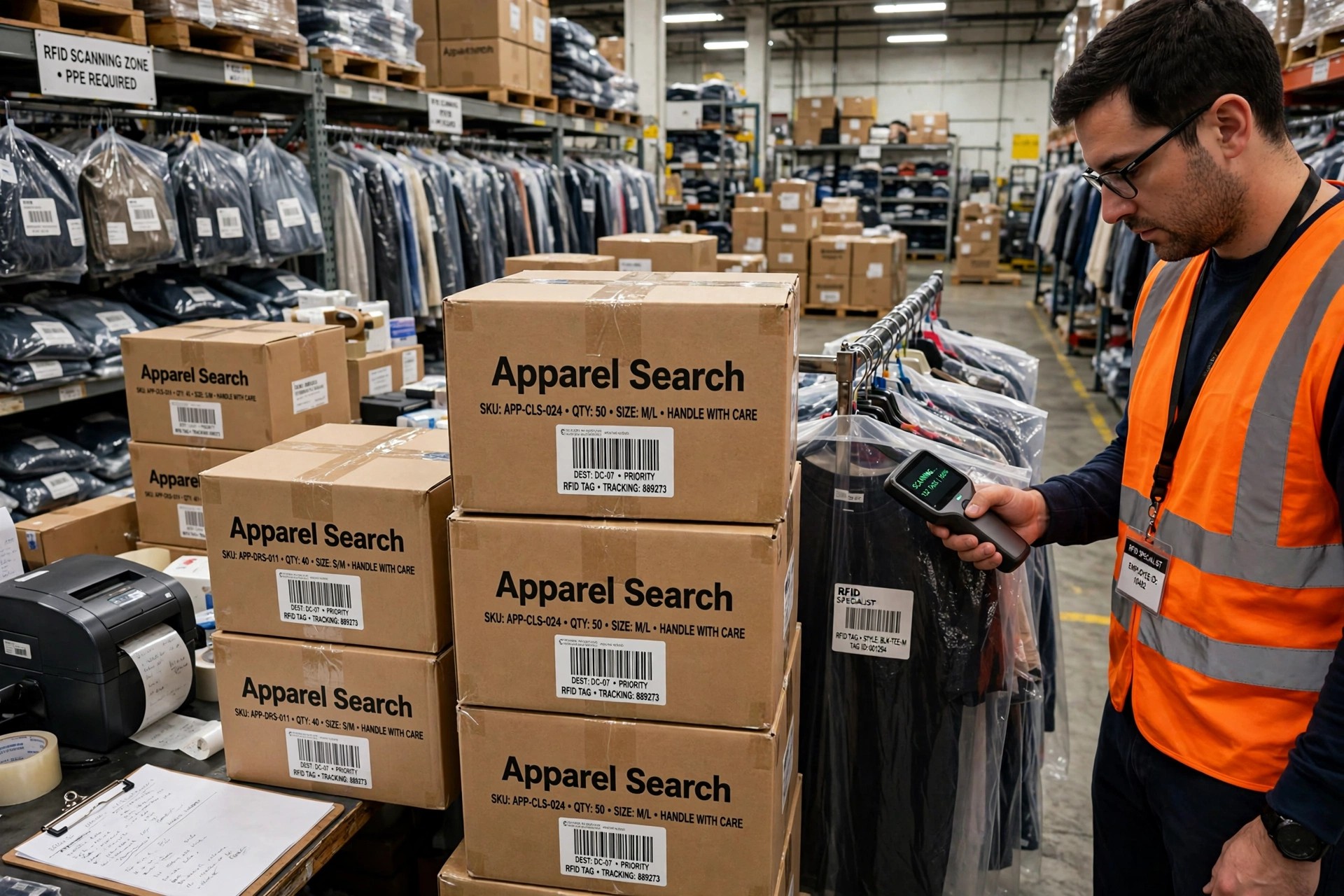
The physical system starts with the tag. Specialists select RFID labels and hang tags suited to garments — readable through folded and boxed clothing, durable through transport and handling, priced for item-level use — and decide where tagging happens: at the factory, where source tagging shares the work across production, in the distribution centre, or a hybrid that covers local and own-brand production differently. Encoding discipline matters from the first carton: each tag carries the item's standardised identifier, and duplicates or dead tags discovered downstream usually trace back to shortcuts at this stage.
Reading infrastructure follows the garments' journey: stationary reader portals at goods-in and dispatch doors, handheld readers for cycle counts, stock searches and fitting-room and exit applications, and point-of-sale reading where the business uses it. The specialist specifies, installs and tunes this estate with vendors — read accuracy on dense rails of clothing is an engineering problem of power, placement and tag orientation, not a hope — and owns its performance measures: read rates, exception handling, and the maintenance and replacement cycle that keeps readers honest in dusty, busy buildings.
Data, Inventory Accuracy and Supply-Chain Visibility
RFID is bought for what its data changes. With item-level reads, stock counts that took a store team a night take an hour, cycle counting becomes frequent enough to keep the stock record continuously true, and the accuracy figures specialists publish — typically transformed from the unreliable levels barcode-only stock records drift to — unlock the commercial uses: confident replenishment, find-in-store and ship-from-store promises, and fitting-room and loss-prevention applications built on knowing what is where.
The specialist integrates those reads with the business's systems — warehouse management, inventory and order systems, EDI flows with suppliers — so a tag read becomes a business event rather than a beep. Supply-chain visibility is the wider prize: cartons and items verified at factory dispatch, port, centre and store create the evidence trail that supports authenticity checks, returns processing and recall or quality investigations. The specialist also guards the boundaries — customer privacy expectations, data retention, and honest separation between stock visibility and people tracking — because the technology's reputation in stores depends on using it for garments, transparently.
Skills and Abilities the Role Requires
The role is a hybrid, and both halves must be real. Technically, the specialist understands radio-frequency behaviour around fabric, liquid and metal, tag and reader standards, encoding and data standards — the family that includes EPC and UPC identifiers alongside EDI — and the software layers that filter raw reads into events systems can trust. Operationally, they understand warehouses, stores and garment flow well enough to place reading points where work actually happens, and to train the staff whose routines the technology changes.
Project and vendor skills carry deployments. RFID rollouts cross factories, carriers, centres and store networks in several countries, each with its own labels, laws and habits; the specialist runs pilots that measure honestly, builds the business case from counted accuracy rather than vendor promises, and manages suppliers of tags, readers and software to service levels. Troubleshooting is empirical: a read-rate dip is traced through tag batches, reader firmware, changed packaging and human shortcuts until the cause confesses in data.
Qualifications, Training and Career Path
Specialists arrive from supply-chain technology, retail systems, logistics engineering and IT projects, and from inventory and operations roles in businesses that adopted RFID early. Degrees in supply chain, information systems, engineering or related fields are common, and vendor and standards-body training in RFID technology and data standards is the specialist credential employers recognise. What hiring managers screen for is deployment evidence: programmes piloted, sites rolled out, accuracy improvements measured and held.
Progression runs to RFID programme management across regions and brands, supply-chain technology and innovation roles, and consultancy with retailers, brands and solution providers. As item-level identification spreads into resale, rental, repair and recycling — where a garment's identity carries its history — specialists find their skills wanted at the circular end of the industry too. It suits methodical technologists who like their systems physical: success in this role is visible, countable, and hanging on rails.
Common Questions
What does an RFID specialist do in the fashion industry?
They plan and run item-level RFID programmes: selecting tags, labels and readers, organising tagging at factories or distribution centres, integrating read data with inventory and warehouse systems, and delivering the stock accuracy and supply-chain visibility the technology is bought for.
How does RFID differ from barcodes for clothing inventory?
A barcode must be seen and scanned one item at a time. RFID tags are read by radio in bulk, without line of sight, so whole rails and cartons are counted in seconds — making frequent, accurate item-level stock records practical across warehouses and stores.
What background do RFID specialists come from?
Supply-chain technology, retail systems, logistics and IT projects, or inventory operations in early-adopting businesses — with standards and vendor training in RFID. Employers screen for measured deployment results: sites rolled out and accuracy gains held.
More to Explore
- Fashion Employment Agencies
- Employment Search Engines
- Fashion Job Description Directory
- Fashion Directory
- Fashion Industry News
- Fashion Schools and Education
- Fashion Careers
- Apparel Industry Links
- RFID — Radio Frequency Identification
- RFID Labels
- RFID Label Machinery and Equipment
- RFID Readers
- RFID Handheld Readers
- RFID Stationary Readers
- Apparel Search Technology
- RFID Definitions for the Clothing Industry
- Hang Tags
- Price Tickets
- EDI — Electronic Data Interchange
- UPC Guide
- Fashion Industry Software
- Apparel Logistics
- Technology Consulting for the Apparel Industry
- Clothing Retailers
- RFID News for the Fashion Industry