Dress Shirt
Clothing Definitions — definitions of garments and clothing terms from Apparel Search
Search Apparel Search
At a Glance
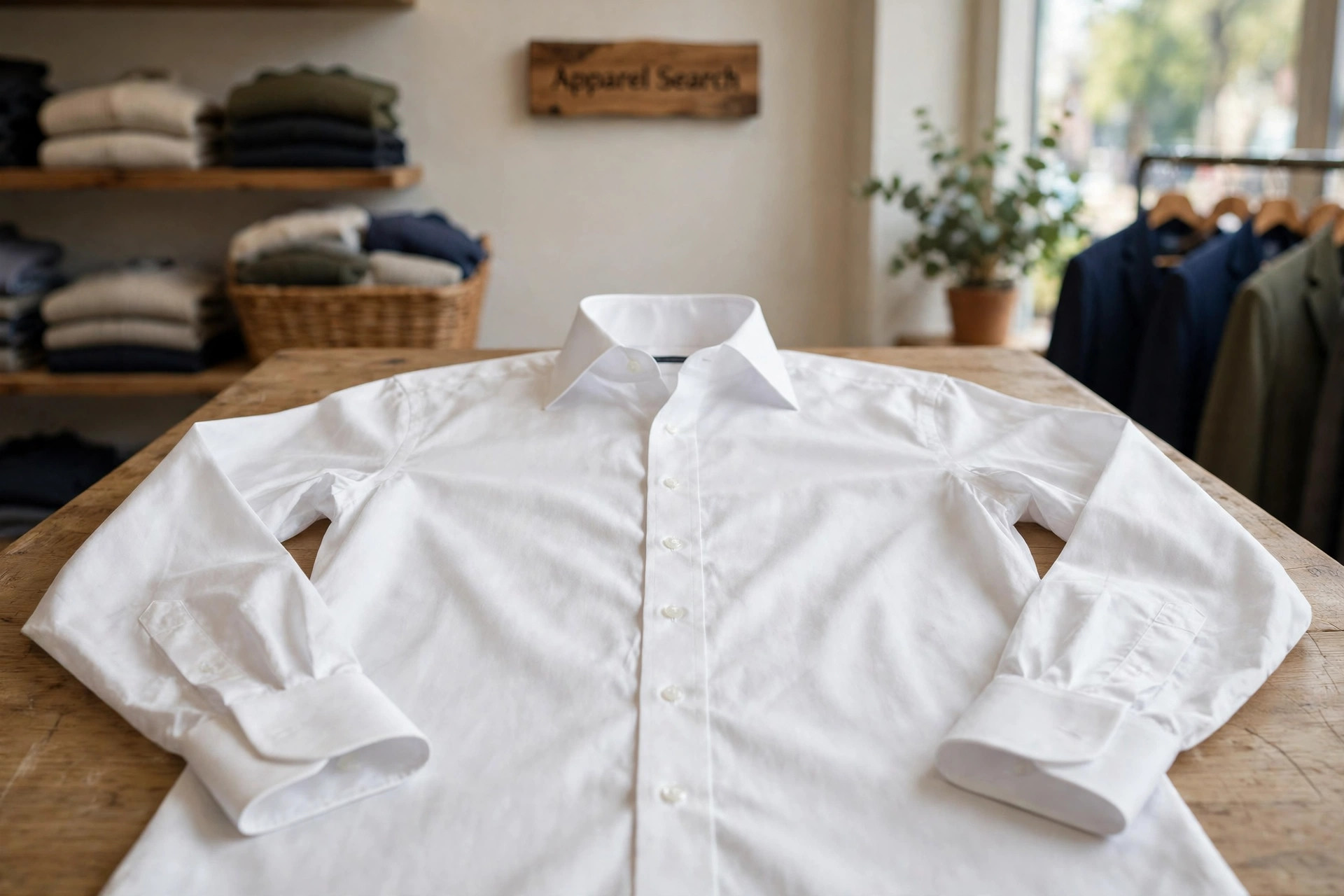
Definition: A dress shirt is a formal collared shirt that fastens down the front with buttons on a placket and has buttoned or double cuffs, designed to be worn with a tie and a suit.
Also known as: Button-up shirt
Category: Clothing Definitions
In the USA, a dress shirt is a shirt with a collar and buttoned or double cuffs, fastened with a placket and buttons down the front, designed to be worn with a tie and suit. In the United Kingdom the same garments are simply called shirts, and a dress shirt there is a formal shirt worn with black tie or white tie. This page explains the parts that define the garment — its collars, cuffs, fabrics and fit — and the very specific evening shirts that sit at the top of its range.
What Makes a Shirt a Dress Shirt
Four features separate a dress shirt from every casual shirt. It has a structured collar designed to frame a tie knot, a full-length front opening closed by buttons on a placket, long sleeves ending in formal cuffs, and a body cut to be tucked in and worn under a jacket. Neckties are commonly worn with dress shirts to formalise an outfit; when a tie is worn, the top button is fastened so the tie sits snug around the neck with a smart appearance. Traditional conservative combinations that work in any circumstances include a plain light blue shirt with a predominantly navy tie, or a blue-and-white Bengal stripe shirt with a red or wine-coloured tie.
The cloth is finer than workwear shirting: smooth cotton weaves such as poplin, twill, herringbone and pinpoint oxford, in white, pale blue and restrained stripes or checks for business, with white reserved for the most formal wear. The fit is close without strain — the collar should admit two fingers when fastened, the sleeves should show a sliver of cuff beyond the jacket sleeve, and the body should stay tucked without billowing. A dress shirt is the tailored foundation of the suited outfit, scaled to sit quietly under a jacket.
Collars: Point, Cut-Away and Button-Down
The regular collar — technically a point collar — has points that angle down and appear narrow, and it suits most faces and most tie knots. The cut-away or spread collar opens wider toward the shoulders, leaving room for a large knot; the Windsor collar is cut away very widely indeed, originally to complement the wide Windsor tie knot. The button-down collar fastens its points to the shirt with small buttons; it began as sportswear, holds the tie neatly without a pin, and is not suitable for more formal occasions. Our guide to the types of collars shows the full range.
Collar construction matters as much as shape. A good dress-shirt collar has removable stays or fused interlining so the points lie flat and crisp through the day, and the collar band is cut high enough to lift the tie slightly above the shirt front. The evening end of the range adds two special forms: the turndown collar of the black-tie shirt and the upright wing collar of the white-tie shirt, both covered below. Choosing a collar is choosing what will sit inside it: knot size and the occasion's formality decide the shape.
Cuffs, Studs and the Formal Evening Shirt
The standard dress-shirt cuff is the single or barrel cuff: the two ends overlap and close with a button, and it is the norm on business shirts. The double or French cuff folds back on itself and fastens with cufflinks; it is both more traditional and more dressy, and it is required at the formal end of the range. In the United Kingdom a dress shirt in the strict sense is a particular formal shirt — always white, with French cuffs — worn with evening wear; in the United States that same garment is usually called a tuxedo shirt.
The shirt required for white tie is the most specific of all. It is made of piqué — also called marcella — with a wing collar and a front fastened with shirt studs instead of buttons, the studs in gold or silver with a mother-of-pearl inlay (black onyx is also permissible) and cufflinks to match. The front panels are heavily starched and polished stiff; traditionally the shirt was collarless and took a detachable wing collar held by collar studs, though all-in-one designs are now common. Black tie allows more leeway: a soft, unstarched shirt, often with a turndown collar, a piqué front or soft pleats down the front, and studs that are optional and usually black.
Wearing and Caring for Dress Shirts
A dress shirt earns its keep as part of a system: shirt, tie and suit are chosen together, in that order of size — the suit frames the shirt, and the shirt frames the tie. Plain shirts carry patterned ties, striped shirts want plainer ties, and the collar and cuff are the two places where quality shows first, because they are the parts that remain visible when the jacket is on. The women's counterpart tradition is covered by the blouse, which follows the same logic of collar, front fastening and cuffs in softer cloth and cuts.
Care is mostly a matter of collars and cuffs, which soil and wear before the body of the shirt does. Wash promptly, treat collar grime before it sets, and press the collar flat from the points inward so it does not curl. French cuffs should be folded and pressed as a double layer, and studs and links kept with the shirt they belong to. A well-made dress shirt in good cotton outlasts several seasons of regular wear — which is why the style remains the standard formal shirt on both sides of the Atlantic.
Not to Be Confused With
A button-down shirt is not a separate kind of shirt: it is any shirt whose collar points are fastened to the shirt front with small buttons. Many dress shirts have button-down collars, and many do not — point and cut-away collars have no buttons at all — so every button-down dress shirt is a dress shirt, but not every dress shirt is a button-down. The button-down collar is also the least formal collar style, which is why it is avoided for evening dress.
Common Questions
What is a dress shirt in the United States?
In the United States a dress shirt is a collared shirt fastened with a placket and buttons down the front, with single or double cuffs, designed to be worn with a tie and a suit.
Is a button-down shirt the same as a dress shirt?
No. Button-down describes a collar whose points button to the shirt front. A dress shirt may have a button-down collar, but dress shirts also come with point and cut-away collars that have no buttons, and the button-down collar is the least formal option.
What shirt is required for white tie?
The white-tie shirt is very specific: pique or marcella cloth, a wing collar, and a front fastened with shirt studs instead of buttons, the studs in gold or silver with a mother-of-pearl inlay and cufflinks to match.