Rudolph Moshammer
Fashion Definitions — fashion history, brands and industry terms from Apparel Search
Rudolph Moshammer, born on September 27, 1940 in Munich, Germany, was a fashion designer trained in retail trading who began designing fashion in the 1960s. His base was his boutique Carnaval de Venise on Maximilianstrasse, Munich's high society street, which he had inherited from his mother, Else Moshammer. There he created fashion for wealthy men from furs, cashmere and silk, attracting clients including Arnold Schwarzenegger, Prince Johannes von Thurn und Taxis, Richard Chamberlain, King Carl XVI Gustaf of Sweden, Jose Carreras and Siegfried and Roy. He was famous for appearing everywhere with his Yorkshire Terrier, Daisy, and for his commitment to homeless people. He died on January 14, 2005.
Rudolph Moshammer
(September 27, 1940 January
14, 2005) was a German
fashion
designer. Although
according to his own previously
stated birth date he would
have been 59 at the time
of his violent death, he
was often estimated a few
years older, and police
reports said Moshammer was
64 years old.
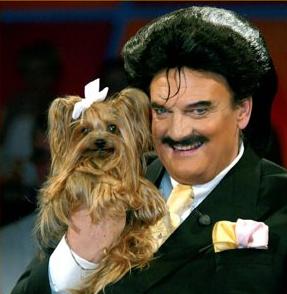
Rudolph Moshammer and Daisy,
from the cover of the DVD "Rudolph
Moshammer - Den eigenen
Traum leben"
Life
Born in Munich, Germany, Moshammer had an education in retail industry trading. He began to design fashion in the 1960s.
His base of existence was his boutique "Carnaval de Venise" in Munich's high society street, Maximilianstraße. There he created fashion for wealthy men from furs, cashmere, and silk. With this strategy he attracted the high society of Munich and Germany. His international clients included:
Governor Arnold Schwarzenegger
Prince Johannes von Thurn und Taxis
actor Richard Chamberlain
King Carl XVI Gustaf of Sweden
star tenor José Carreras
magicians Siegfried and Roy
German media personality Thomas Gottschalk.
He had inherited the boutique from his mother, Else Moshammer. He had a strong relationship with her and frequently appeared in public with her. She died in 1993.
Moshammer was an eccentric and iridescent personality. He was well-known for carrying his Yorkshire Terrier dog Daisy in public wherever he went, and even wrote a book about her. She has her own website on the Internet. Daisy was Moshammer's darling, his trademark and his constant companion.
Moshammer had a strong commitment for homeless people. For this he was awarded the "Martin's Coat 2000" of the radio station, "Sankt Michaelsbund".
nchner Zwietracht" ("Munich Dissension"), with whom he was a contestant in the German Eurovision Song Contest preliminary round show in 2001. The song was entitled "Share Fun and Joy".
His death
On the morning of January
14, 2005, at 9 AM, his personal
driver found him dead in
his mansion in Gr
nwald, a suburb south of
Munich. According to first
reports of the public prosecutors,
Moshammer had been strangled
with a black telephone cable.
The cable was found near
the dead body. Daisy was
found unharmed in the living
room of his mansion.
The Munich police gave a press conference at noon on Sunday, January 16, reporting that a 25 year-old Iraqi asylum seeker, who had been tracked down through a DNA database, had admitted murdering Moshammer. It has been alleged that Moshammer had refused to pay 2000 Euro to the man, who was in financial difficulties, in return for homosexual favors.
His legacy
Moshammer was one of Germany's most successful fashion designers after Karl Lagerfeld and Wolfgang Joop. Furthermore, he committed his wealth to helping homeless people. He had recently begun to build a house for the homeless in Munich.
| The above article is licensed under the GNU Free Documentation License. From Wikipedia, the free encyclopedia https://en.wikipedia.org/wiki/Rudolph_Moshammer 2/7/06 |
Designer Definition (from U.S Department of Labor)
Moshammer's business had a single, precise address: the boutique Carnaval de Venise on Maximilianstrasse, Munich's high society street. He had inherited the boutique from his mother, Else Moshammer, with whom he had a strong relationship and alongside whom he frequently appeared in public until her death in 1993. His own preparation was commercial rather than artistic — an education in retail industry trading — followed by designing fashion from the 1960s. The strategy pursued from that boutique was narrow and clear: fashion for wealthy men, made from furs, cashmere and silk. Those three materials are a positioning statement. Fur, cashmere and silk are among the most expensive raw materials in menswear, difficult to work and impossible to mistake for mass production. A small boutique selling them is not competing with department stores; it is offering rarity, handwork and personal service to clients for whom price is not the deciding factor. The client list shows the strategy working at an international level: Governor Arnold Schwarzenegger, Prince Johannes von Thurn und Taxis, the actor Richard Chamberlain, King Carl XVI Gustaf of Sweden, the tenor Jose Carreras and the magicians Siegfried and Roy, alongside German media personality Thomas Gottschalk. Royalty, film, opera and politics in one list means the boutique's reputation travelled by word of mouth through high society itself — the only advertising channel that reaches that clientele. He is ranked, accordingly, as one of Germany's most successful fashion designers after Karl Lagerfeld and Wolfgang Joop. Moshammer was an eccentric and colourful personality, and his trademark was alive: his Yorkshire Terrier, Daisy, whom he carried in public wherever he went. She was his darling, his trademark and his constant companion, and he wrote a book about her; she even had her own website. In fashion terms Daisy functioned as a logo that no competitor could copy — a designer recognised instantly, in any photograph, by the small dog in his arms. The recognition extended beyond fashion: he played in made-for-TV movies including the German crime series Tatort, and he had a musical band, Munchner Zwietracht, with which he competed in the German Eurovision Song Contest preliminary round in 2001 with a song entitled Share Fun and Joy. A menswear designer appearing in crime dramas and Eurovision preliminaries is building fame of a general, popular kind, far beyond the readership of fashion pages. Against the luxury of the boutique stood his commitment to homeless people, for which he was awarded the Martin's Coat 2000 by the radio station Sankt Michaelsbund, and he had begun to build a house for the homeless in Munich, committing his wealth to helping them. The contrast is real and was evidently deliberate: a man who sold furs and cashmere to kings and film stars directed part of the proceeds to people with no home at all, and the award's name — a coat shared with a beggar, in the legend of Saint Martin — fits a clothing designer's charity almost literally. On the morning of January 14, 2005, his personal driver found him dead at his home in Grunwald, a suburb south of Munich; Daisy was found unharmed in the living room. Police announced two days later that a suspect tracked down through a DNA database had admitted the killing. He was 64 years old. The death ended, violently and prematurely, a career that had joined three things rarely combined in one designer: a single inherited boutique, a clientele at the very top of European society, and a public commitment to the people at the very bottom of it. His boutique was Carnaval de Venise on Maximilianstrasse in Munich, inherited from his mother Else Moshammer. From it he created fashion for wealthy men from furs, cashmere and silk. Moshammer carried his Yorkshire Terrier Daisy with him in public wherever he went. She was his darling, his trademark and his constant companion, and he even wrote a book about her. For his strong commitment to homeless people he was awarded the Martin's Coat 2000 by the radio station Sankt Michaelsbund. He had also begun building a house for the homeless in Munich.A Boutique on Munich's Grandest Street
Daisy, and a Public Personality
Charity, and His Death
Common Questions
What was Rudolph Moshammer's boutique?
Why was Moshammer's dog Daisy famous?
How was Moshammer's charity work recognised?
More to Explore