Bridal Industry Research: Finding Information on the Business of Weddings
A research guide to the business side of weddings, built around Library of Congress research resources
This guide is not about planning a wedding. It is about finding information on the business of weddings: the dresses, consultants, caterers, photographers, musicians and other smaller enterprises that together make up a large industry. Tracking where the money in that industry goes is difficult precisely because it is split across so many component parts, each much smaller than the whole. The research path runs through industry statistics and classification codes, trade associations for each bridal specialty, directories of bridal stores and services, and the fashion side of the business — gowns, veils, gloves, garters and bridal trade shows.
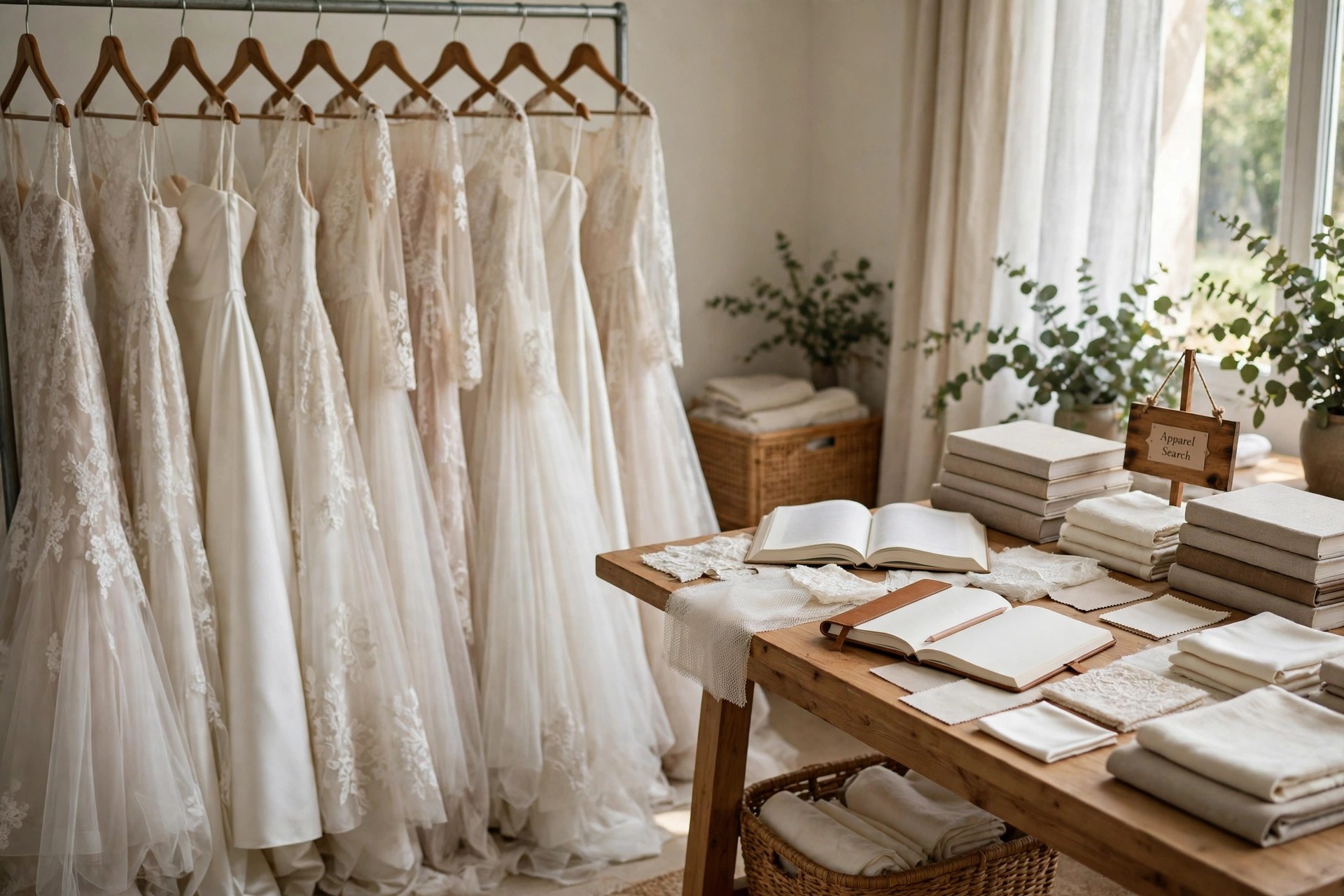
Bridal Industry Research: Learn More About the Bridal Industry from the Library of Congress
Bridal Stores Apparel Research Reports Government Resources Apparel Industry Research Bridal Fashion Guide Bridal Fashion News Women's Fashion Bridal Trade Shows Bridal Industry Fashion Group
Help with Bridal Industry Research by taking this short fashion poll: Should wedding dresses always be white?
If you are doing research on the bridal industry, the below research may be of assistance to you. The research includes bridal dresses (the fashion aspect of the bridal business), but it also includes other aspects of the bridal industry. For example, wedding destinations, wedding food, wedding DJ's etc. Although Apparel Search is intended to provide information only regarding clothing and textiles, we wanted to provide you easy access to this research because the bridal industry is very important to the apparel industry. Well, it is certain important to bridal shop owners and wedding gown designers...
Overview
Let us be clear at the beginning. This is not a guide on how to plan a wedding, but rather on how to find information on the business of weddings.
The wedding industry is a large industry in terms of dollars, but tracking where that money is spent is more difficult for several reasons.
First, it is an industry that is made up of multiple smaller enterprises like caterers, wedding consultants, dresses, various beauty suppliers (hair, makeup), photographers, favors/bridesmaids gifts, music, honeymoon related, etc. While the industry as a whole represents a lot of money, each of the component parts is much smaller -- some smaller than others. These smaller composite suppliers can be very local and likely will be small and privately owned -- traditionally the types of businesses that do not necessarily report financial information to any agency other than the IRS. This is in sharp contrast to larger industries, comprised on many public companies which are required to file with the SEC making it much easier to find information. These larger industries also affect the economy as a whole on a much more obvious scale, also making it
Table of Contents
Overview
Services
> Dresses
> Consultants
> Food/video/dJ
> Favors/bridesmaids Gifts
> Destination Weddings
Statistics Associations
Articles
Magazines/journals/books
Commercial Sites
SubjectsLearn how to become a bridal shop owner or become an event planner.
- easier to find out information on them.
- Second, many of the smaller
components like caterers, DJs, and photographers, wedding
favors, invitations, etc. also do other events without
necessarily breaking their business down into wedding
versus non-wedding.
- Third, because some of the individuals and businesses that provide services and products may only work part-time on wedding-related services to supplement their income or out of friendship, there will either be a minimal charge or no charge at all. Figures if there are any, will likely not be in any "industry" tally.
Since overall industry numbers are going to be hard to come by, other ways of finding the information will be necessary. One way is by searching local (and community) newspapers,which may provide information on a local market. Also, there may be individual accounts of weddings that would be relevant. Contacting local companies/people will provide someone with experience and knowledge on the local scene. Try the local phone books under weddings, party planning, catering, event planning, etc. to find the local companies/professionals. Also, ReferenceUSA (often available in local public libraries) is an electronic directory with SIC/nAICS codes search limitable by various geographic search functions.
Many times keywords, Standard Industrial Classification (SIC), or North American Industrial Classification Codes (NAICS) will be helpful in finding information. For example, the following codes can be used to search for companies in databases like ReferenceUSA or D&B. They can also be used to locate information in the Economic Census. This Census comes out every 5 years and has information on sales and numbers of establishments (national and by state).
- SIC
-
- 5812 Eating Establishments (includes Caterers)
- 2335 Women's, Misses', and Juniors' Dresses (includes Wedding Dresses, Wedding Gowns)
- 5621 Women's Clothing Stores (includes Bridal shops, except custom-retail)
- 5699 Miscellaneous Apparel and Accessory Stores includes Custom Dress Making Shops)
- 7299 Miscellaneous Personal Services, Not Elsewhere Classified (includes Wedding Gown Rental and Wedding Planning)
- 5943 Stationery Stores
- NAICS
-
- 722320 Caterers
- 315233 Women's and Girls' Cut and Sew Dress Manufacturing (includes Wedding Gowns, Bridal Dresses, Wedding Gowns)
- 315212 Wedding dresses, women's, cut and sew apparel contractors
- 448190 Other Clothing Stores (includes Bridal gown shops -except custom)
- 532220 Formal Wear and Costume Rental (includes Bridal Wear Rental)
- 812990 All Other Personal Services (includes Wedding Planning)
- 45321 Office Supplies and Stationery Stores (pt)
Bridal Fashion Guides
Services
Dresses
When looking for data on the size of this industry, the first thing to note is that, while there is a lot of money in the wedding industry, gowns represent only one segment of the industry.
Second, wedding gowns are part of a larger women's clothing industry -- depending on how the business reports itself and how deep the search functionality is of the database, separating wedding dresses from the larger industry may be difficult. It might help to use the two NAICS codes that are applicable to help you find companies and numbers (that is, sales figures). Databases like Duns Million Dollar Directory and ReferenceUSA allow searches by the NAICS codes given above, while other databases still use SIC codes. To have a complete picture, however, it is necessary to also consider those establishments that sell used gowns and those offering rental gowns. Lastly, neither of those take into account those women who have someone make their dress. There are SIC codes for all of these others but not for the instance where a friend or family member makes the dress.
Lastly, there are many definitions of wedding dress. When most people in the U.S. think of wedding dresses, they think in terms of the traditional long, white dress. However, there are brides who only buy a nice outfit and go to the judge's chambers and others who plan "ethnic" weddings where the bride wears a traditional costume from her country.
You may have more luck with industry information by searching through articles and gathering snippets. I would suggest searching in wedding/bridal magazines such as -Bride's, Modern Bride, as well as clothing trade magazines such as Women's Wear Daily, all of which cover this area. In addition, there are full-text databases that local public and university libraries subscribe to such as Infotrac, (which has all three of the above titles) and ABI-Inform, among others. Also, both databases index articles. For example, Infotrac uses the index terms Wedding, Costume and Wedding Supplies, and Services Industry). One caveat, many of the articles will be more fashion-oriented and less business- oriented.
Consultants
If you want to find information on this industry, try one of the associations listed below or contact a local consultant through your phone directory or web sites such as http://respondweddings.com/ or http://www.afwpi.com/consultants/ and see what they may offer.
For those who want to get into the wedding planning/consulting business, Sell the Bride offers tips as well as some books and reports
Food, Videography, Disc Jockey
These three industries are ones where some of their business is not wedding related. There may not necessarily be caterers whose only business it to cater only to weddings. The same could be said about Disc Jockeys and videographers.
However, the two associations for videographers and disc jockeys have interesting data about their particular industry and their industry in regards to weddings.
Favors/bridesmaids Gifts
Finding industry information for favors also presents difficulties: the biggest of which is that the choice of favor is individual -- it could be anything the bride/groom chooses. There may be things that are more likely to be chosen (picture frames, jewelry, etc.) but these items are not solely for the wedding industry. There is no way to distinguish between those that are bought for weddings and those that are not. Also, the places where favors or gifts can be bought is not limited to the "wedding favor store." Most stores sell a variety of products and will not mark items specifically as "wedding favors." There may be estimates of the average amount that a bride spends per party favor/gift, but such "averages" fail to take into account the number of people to whom she is giving a gift - which can vary from one to five to eight, and on up. Searching through publications geared to gift markets may be one way to find information on such gifts.
Destination Weddings
There has been an increase in what is known as destination weddings - those weddings held where neither the bride or the groom lives or necessarily has family. It has been estimated the one in ten weddings are destination weddings - a massive increase over the last decade.
Modern couples are often older then they were 15 or 20 years ago, they are often more well traveled, and/or they may want something more exotic. Top destinations for U.S. couples include Hawaii, the Caribbean, Mexico, and in Europe, southern France and Italy. Resorts and hotels in hot areas are becoming increasingly proactive in their wedding business by putting together packages and offering more services for those seeking wedding services.
There is no single statistical source for data on this segment of the wedding industry; rather much of the information is anecdotal and derived from surveys/questions to hotels/resorts, couples, wedding planners, and others. Thus, article searches may yield the best information on this topic.
Statistics
Statistical data related to the wedding industry can be found in the Statistical Abstract of the United States, where you will find information, not on weddings per se, but on marriages and marital status. According to introductory information in the Vital Statistics section of the Statistical Abstract for 2006, data on marriages and divorces have been collected at the national level since 1887-88. Periodic updates took place after 1888, with annual updates beginning in 1944.The Statistical Abstract of the United States for 2006 shows figures for 1990, 2000, and 2004. [PDF: 1.9 MB / 34 p.] Data for other years can be found in earlier editions of the Statistical Abstract.
Statistics on the total number and rates of marriages in the United States at the national and state levels is compiled by the U.S. Center for Health Statistics (NCHS) in the National Vital Statistics Reports, formerly the Monthly Vital Statistics Report (MVSR). The most recent comprehensive analysis issued by NCHS appeared in the Advance Report of Final Marriage Statistics, 1989-90 [PDF: 201 KB/ 24 p]Additional data on marriage in the United States can be found in The National Survey of Family Growth (NSFG). Conducted by NCHS, the data was published in Series 23, Number 22, "Cohabitation, Marriage, Divorce and Remarriage in the United States" [PDF: 5.5 MB/ 103 p.]
Other sources of statistics include:
Statistics for the Wedding Industry Association of Wedding Professionals
Wedding and Honeymoon Statistics TopWeddingLinks.com
Wedding and Honeymoon Statistics About.com
Wedding Industry Statistics SellMoreWeddings.com
The Wedding Report Shane McMurray
The above site includes wedding industry trends, news, statistics, and market research aimed primarily at the wedding professional, although consumers may also find helpful information. Products available from this source for a fee include the U.S. Wedding Market Overview and wedding statistics and market details by state.
Associations
There are several large national/international associations, as well as small state/regional ones; a selection of such associations are listed below:
Association of Bridal Consultants (ABC)
Association of Wedding Gown Specialists
Association for Wedding Professionals International
American Association of Wedding Planners
Mississippi Bridal Association
Central Valley Bridal Association
Association of Bridal Retailers
Association of Certified Professional Wedding Consultants
Wedding and Event Videography Association
American Disc Jockey Association
International Bridal Manufacturer Association
Bridal Marketing Association
International Special Events Society
International Caterers Association
Articles / Web Articles
"A Big Wedding with a Smaller Bill," by Francine Parnes. May 25, 2002, New York Times
"The Bridal Business Branches Out," by Rosemary Feitelberg. WWD, December 20, 2005, p. 8.
"By the Numbers: Divvying Up the Wedding Cake," March 10, 2003, HFN The Weekly Newspaper for the Home Furnishing Network
"Can't Buy Me Love? Maybe Just a Wedding?" by Julie Dunn. Feb. 11, 2001, New York Times
"The Copycat Wedding," by Lauren Lipton. May 21, 2004, Wall Street Journal
"Destination Weddings: Exotic Locales and Stress-free Nuptials Could Mean the End of Bridezillas," by Janeen Christoff, Marty Wentzel, and Jamie Wetherbe. TravelAge West, October 31, 2005, p. 20.
"Destined to be Different: In Their Search for Paradise, More and More Contemporary Couples Are Choosing Destination Weddings," by Beth Bernstein. Lustre, March-April 2005, p. 60.
"For Love and Money Amid Economic Sickness, Bridal Industry Radiates Health," by Dina El Boghdady. May 25, 2003, Washington Post
"Hotels Say 'I do' to Destination Weddings, Ring in Profits," by Shannon McMullen-Coyne. Hotel & Motel Management, February 21, 2005, p. 33.
"Internet Sales Threaten Bridal Salons. - Focus on the Bridal Industry," by Dominic Mariani. Nov 5, 2001 v40 i45 p17(1), Fairfield County Business Journal
"Murphy's Law: The Wedding Version," by Christine DiGrazia. June 16, 2002, New York Times
"You're Getting Married," by Rebecca Mead. April 21, 2003 - March 10, 2003, p38, New Yorker
"Wedding industry costs soar even as growth slows," by Kirby Lee Davis. Journal Record, November 21, 2005.
"Love is Priceless; Weddings Cost," by Leslie Haggin Geary. June 2, 2003 CNNMoney
The Trouble with Weddings Touchstone Magazine
It's How It Ends That Matters Focus on the Family Magazine
Magazines / Journals / Books
Bridal Market Advertising Guide
National Mail Order Association
A wedding market advertising directory to help small business
entrepreneurs, merchants, and service providers find print
and online sources for advertising.
City magazines
More business journals
Bride's
Magazine. New York, N.Y. : Cond
Nast Publications.
LC Call Number: BJ2051.A1 B7
LC Catalog Record: 42024730
Modern
Bride. [New York, etc., CBS Magazines,
etc.]
LC Call Number: HQ1 .M63
LC Catalog Record: 53036160
Consumerism,
romance, and the wedding experience
by Sharon Boden.
New York : Palgrave Macmillan, 2003.
LC Call Number: HQ745 .B67 2003
LC Catalog Record: 2003042912
Publisher Description
Table of Contents
Commercial Sites
Bridal Fashion Links:
Sell The Bride
National Bridal Service
Bridal Buyers' Guide
Respond Weddings
The above bridal industry research report was compiled by Ellen Terrell Business Reference Services March 2004 (http://www.loc.gov/rr/business/wedding/). Apparel Search retrieved the bridal industry research report from the library of congress website 1/23/2010. The report above listed has also been modified by Apparel Search. The Library of Congress moved the Wedding Industry Research page to https://guides.loc.gov/wedding-industry
Learn more about bridal fashion from the bridal fashion guide.
Bridal Fashion Guides
Here are a few more links of
interest:
Bridal Fashion Group
Common Questions
Is this a guide to planning a wedding?
No. It is a guide to finding information on the business of weddings — industry data, associations, directories and sources for each part of the bridal trade, from dresses to consultants and services.
Why is bridal industry spending hard to track?
Because the industry is made up of many smaller enterprises — caterers, consultants, dress shops, beauty suppliers, photographers, music and honeymoon services — so spending is spread across many small categories rather than one measurable market.
What kinds of sources help research the bridal business?
Government statistics and industry classification codes, trade association directories, bridal store and service directories, and fashion resources covering gowns, veils, gloves and bridal trade shows.
More to Explore
- Bridal Stores
- Apparel Research Reports
- Government Resources
- Apparel Industry Research
- Bridal Fashion Guide
- Bridal Fashion News
- Women's Fashion
- Bridal Trade Shows
- Should wedding dresses always be white?
- bridal gowns guide
- bridal garters guide
- bridal gloves guide
- bridal shoes guide
- bridal veils guide
- Overview
- Services
- Dresses
- Consultants
- Food/video/dJ
- Favors/bridesmaids Gifts
- Destination Weddings
- Statistics
- Associations
- Articles
- Magazines/journals/books
- Commercial Sites
- Subjects
- become a bridal shop owner
- become an event planner
- Economic Census
- SIC
- NAICS
- wedding dress
- wedding gowns
- bridesmaid dresses
- 2006
- earlier editions
- Association of Bridal Consultants (ABC)
- Association of Wedding Gown Specialists
- Association for Wedding Professionals International
- American Association of Wedding Planners
- Bridal Association of America
- Mississippi Bridal Association
- Central Valley Bridal Association
- Association of Bridal Retailers
- Association of Certified Professional Wedding Consultants
- Wedding and Event Videography Association
- American Disc Jockey Association
- International Special Events Society
- International Caterers Association
- Wedding Careers Institute
- "Love is Priceless; Weddings Cost,"
- Bridal Market Advertising Guide
- Business journals
- Table of Contents
- Bridal Stores Pg. 2
- Bridal Garter Shops
- Bridal Glove Shops
- Bridal Shoe Stores
- Bridal Veil Shops
- Lingerie Shops
- 1800Bride2B.com
- BridalExpo
- AllBridalStores.com
- AllWeddingCompanies.com
- WeddingChannel.com
- The Knot
- Beyond 4Cs
- Women's Clothing Stores
- Retail Clothing Stores
- Bridal Clothing Wholesalers
- Women's Fashion Retailers
- Flower Girl Dresses