Fashion Columnist Job Description
A personal voice on fashion — opinion, judgement and a regular column readers come back for
A fashion columnist writes opinion. Where news reporting tells readers what happened, a column tells them what to make of it — whether a collection deserved its applause, why a trend reveals something about the moment, what a retailer's decision says about where clothing is heading. The column appears regularly, in the same place, under the same name, and its value is the columnist's own voice: informed, distinctive and consistent enough that readers seek the column out for the judgement itself, not merely for the facts it happens to contain. Columnists work for newspapers, magazines and their digital editions, and increasingly in established personal publications of their own.
More Miscellaneous Job Descriptions by Letter:
What a Fashion Columnist Does
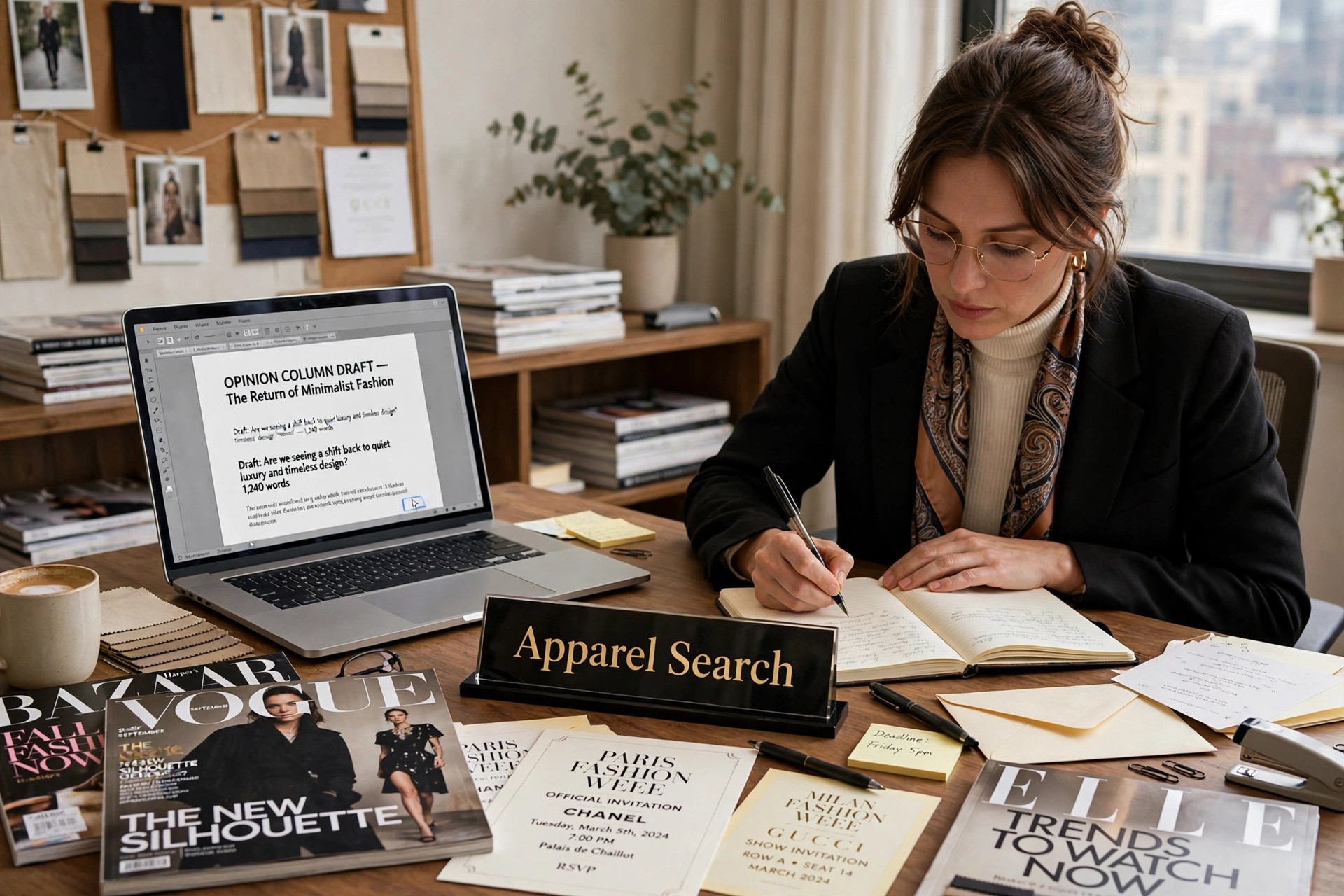
The visible work is a column on a deadline — weekly, fortnightly or tied to the fashion calendar — of a set length, written in the first person or in a clearly personal editorial voice, and argued rather than merely described. A columnist chooses their own subjects within the column's territory: a show that crystallised a season, a high-street phenomenon, a change in how people dress for work, an industry controversy. Each piece must land as a position a reader can agree or argue with, supported by observation and knowledge rather than by volume of assertion.
The invisible work is attendance and accumulation. Columnists go to shows, presentations, store openings and industry events not to file reports but to gather the material opinion is made from — the room's reaction, the detail nobody photographed, the conversation afterwards. Between columns they read widely, keep notes, watch retail and street style as evidence, and maintain the contacts who will explain, off the record, why something happened. A columnist who stops showing up runs out of authority within a season, however well they write.
Voice, Judgement and the Columnist's Contract
A column is a contract between writer and reader: the reader gives loyalty, and the columnist gives honesty in a recognisable voice. That voice is the columnist's professional capital — wry, severe, scholarly, populist or lyrical, it must be genuinely theirs, because readers detect ventriloquism quickly and editors even faster. Fashion knowledge underwrites it: judgements about a designer's development across seasons, a fabric's real quality, or a brand's history carry weight only when the columnist demonstrably knows the field's past as well as its present.
Opinion also carries obligations. Columnists are expected to be fair even when being sharp — to criticise the work accurately rather than the person lazily, to declare interests where they exist, and to correct errors as visibly as other journalists do. Publications keep a legal eye on columns precisely because strong views attract disputes, and experienced columnists learn the difference between a defensible judgement and a careless claim. Independence is guarded practically too: the hospitality of an industry built on invitations and gifts must never visibly purchase the verdict.
Skills and Abilities the Role Requires
Writing craft at a high, personal level is the first requirement: structure that carries an argument, sentences with rhythm and point, openings that earn attention and endings that stay with the reader. Subject authority is the second — a deep, current command of designers, fashion history, retail and dress culture, refreshed constantly — and originality of angle is the third, because a column that says what every other commentator said has failed even if it says it elegantly.
Professional habits complete the profile. Columnists are ruthlessly reliable with deadlines and length, since a hole in a page cannot be filled by good intentions; they generate more ideas than they use, so a quiet week never becomes a weak column; and they withstand response — praise, abuse and the letters page — without letting any of it bend the next judgement. Digital editions add audience awareness: headlines, search and social reaction shape how a column is found, though never what it should say.
Qualifications, Training and Career Path
Columnists are made by prior writing. The usual route runs through fashion journalism — reporting, features or reviewing — where the writer's voice and reliability become visible to editors, though some arrive from inside the industry itself, as designers, retailers or stylists whose perspective editors want in print. Formal training in journalism or English helps with craft and media law, but appointment to a column rests on published work: editors hand a regular platform to a voice that has already proven it can hold readers.
An established column is itself a career asset that travels. Columnists move between publications, expand into books, broadcasting and documentary work, and build syndication or subscription audiences around a name that began as a byline. Others step sideways into editorial leadership, though the temperaments differ. The role suits writers with real knowledge and real opinions who can produce both, elegantly, on the same day every week for years — a rarer combination than either talent alone.
Common Questions
What does a fashion columnist do?
A fashion columnist writes a regular column expressing informed opinion on fashion — collections, trends, designers and the industry's behaviour — in a distinctive personal voice, for a newspaper, magazine, website or their own publication.
How is a columnist different from a fashion writer or reporter?
A reporter establishes what happened; a feature writer explores a subject in depth; a columnist judges. The column's value is the writer's own argued point of view, delivered under their name on a regular schedule.
How do you become a fashion columnist?
By proving a voice in print first — usually through fashion reporting, features or reviewing — until an editor trusts you with a regular platform. Industry insiders with a distinctive perspective sometimes take the second route, from practice into print.
More to Explore
- Fashion Employment Agencies
- Employment Search Engines
- Fashion Job Description Directory
- Fashion Directory
- Fashion Industry News
- Fashion Schools and Education
- Fashion Careers
- Apparel Industry Links
- Fashion Books
- Fashion Blogs
- Fashion Newspaper
- Online Fashion News
- Fashion Book Directory
- Clothing Retailers
- Fashion Week
- Clothing Industry Portal