Air-Laid & Wet-Laid Nonwovens Directory
Air-laid and wet-laid nonwovens are the two web-forming routes that borrow nothing from spinning or weaving: fibres are carried to a forming surface by air or by water and bonded into a sheet. This directory explains both processes and carries the producers this section lists for them.
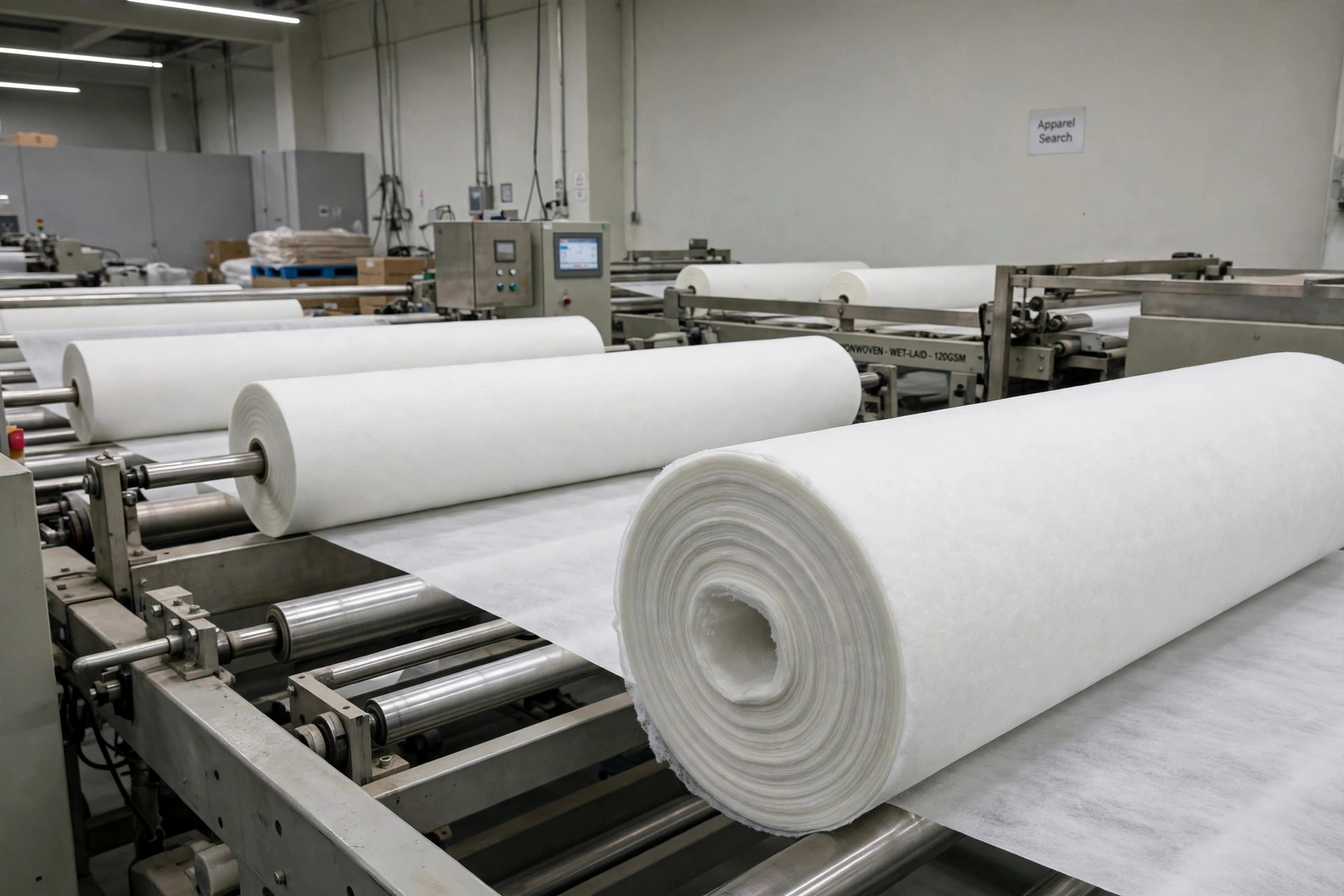
Two Ways to Lay a Web
In air-laying, dry fibres are opened, metered and blown or drawn onto a moving screen, where they land in a random, lofty mat. The classic raw material is fluff pulp — short wood fibres hammer-milled from a pulp sheet — often blended with synthetic binder fibres or superabsorbent granules before the mat is bonded with latex, heat, or both. The result is a soft, bulky, highly absorbent web that can be made at very even weights, which is why air-laid material dominates absorbent cores and tabletop and wiping products.
Wet-laying is papermaking adapted to longer, synthetic fibres. Fibres are dispersed at very low consistency in water, flowed onto an inclined wire, dewatered and dried, then bonded. Because water carries fibres so evenly, wet-laid webs are exceptionally uniform and isotropic — similar in strength in every direction — and they accept glass, aramid, polyester and other fibres that air cannot handle well. Wet-laid plants look like small paper mills, and many wet-laid specialists grew out of the paper industry.
Where Air-Laid and Wet-Laid Webs Work
Air-laid webs earn their place wherever absorption and softness matter together: absorbent cores in hygiene products, food pads, medical underpads, industrial and household wipes, and tabletop napkins that feel closer to cloth than to paper. Wet-laid webs dominate precision jobs — engine and high-efficiency air and liquid filtration media, battery separators, gasket and friction materials, roofing and construction carriers, and specialty industrial sheets where uniformity decides performance.
The directory below lists the producers this section carries for these technologies. The lead listing, Hollingsworth & Vose Company of the USA, describes wet-laid, dry-laid, meltblown and composite capabilities supplying filtration, battery separator and gasket applications — a fair picture of the wet-laid side's technical end of the market. Other listings span absorbent-product makers, filtration specialists and smaller regional producers, each with the description stated for it.
Choosing Between the Two Routes
The practical question is what the web must do. If the product must absorb many times its weight and feel soft, air-laid is usually the shorter route; if it must filter to a rating, separate a battery reliably for years, or hold tight tolerances in a thin sheet, wet-laid is usually the answer. Basis weight range, fibre cost, line speed and bonding chemistry all feed the decision, and many converters buy both webs and laminate them into composite products.
Buyers specifying either web should ask for basis weight, thickness, absorbency or pore-size data measured to a named test method, and should test converted samples — a web that performs on the roll can behave differently after embossing, laminating or die-cutting. Use the listings below to reach producers directly, and the sibling directories in the chips below for the neighbouring nonwoven families, from meltblown filtration media to spunbond coverstock.
A Note on Composites and Blends
In practice the two routes are often combined rather than compared. A wet-laid glass or synthetic sheet may be laminated to an air-laid absorbent core; an air-laid web may carry a wet-laid facing for strength; and producers with both technologies — several are listed below — sell the combination as a single engineered material. The composite is usually worth more than either web alone, because each layer is made by the process that suits it best.
Fibre developments keep widening both routes: finer synthetic fibres for wet-laid uniformity, bio-based and recycled fibres for air-laid absorbency, and binder systems that cure faster and smell less in the finished product. Buyers who last specified these webs a decade ago will find the current datasheets noticeably better in uniformity and strength at the same weights — one more reason to re-sample from the producers below rather than reorder an old grade by habit.
Air-Laid & Wet-Laid Producers Listed Here
24 companies and organisations are listed in this directory, each with its country and a description of its products and processes. Follow a name to the company's own website.
Advanced Fiber Nonwovens (USA)
Hollingsworth & Vose Company, with its advanced R&D and pilot manufacturing facilities, drives value in their customers' products by inventing next-generation materials with superior performance. H&V' products are found in applications such as engine filtration, high efficiency air and liquid filtration, battery separators, gasket materials, and specialty and industrial nonwovens. Their expertise and process capabilities include wet laid, dry laid, melt blown, and composite technologies. Established in 1843, H&V has supplied specialty, industrial, and technical papers and nonwovens for over 150 years. Wet-laid fabrics for reinforcement in composites, electromagnetic shielding and friction applications, from a variety of high-performance fibers. Part of the Hollingsworth and Vose group.
Ahlstrom Corp (USA)
Engineered web materials for life science, liquid, air and food filtration, membrane substrates, and absorbent and technical products, from glass fiber, high purity cellulose, polyester, vegetable fibers and composites thereof. Custom design and manufacturing, and converting and laminating services.
Bontex, Inc (USA)
Development and manufacture of wet-laid, impregnated, coated and uncoated nonwoven substrates for footwear, visorboard, electronic, luggage and fashion accessory applications, from virgin and recycled cellulose fiber. Detailed materials catalogs, including technical specifications and information.
Buckeye Technologies, Inc (USA)
Versatile manufacturing company, active in cellulose products, paper, pulp and nonwovens. Air- and wet-laid fabrics for wipes, diapers and hygiene applications. Also, rayon and acetate fiber and filament for textiles, reinforcement, plastics and fiber spinning.
C-Airlaid Company (Russia)
Manufacturers of air-laid nonwovens for hygiene and medical, filtration, cleaning, food products and packaging applications. English and Russian.
Carolina Nonwovens Corp (USA)
Manufacturers of airlaid nonwovens for construction, automotive, filtration, consumer products, home furnishing and specialty applications, from natural, synthetic and recycled fibers.
Concert Industries Ltd (Canada)
Air-laid nonwovens for hygiene, baby care, firltration media, medical and home products. Resin and thermal bonding, and spunlace technologies. Extensive product specifications and description of air-laid production technology.
Consolidated Fiber Glass Products Co (USA)
Wet-laid fabrics for the roofing, construction and filtration media industries, from glass fiber. Detailed specifications, and MSDS sheets. Part of Consolidated Fiberglass Products Co.
Crane Nonwovens (USA)
Design and manufacture of wet-laid, resin and thermobonded nonwovens for composite, filtration, electronic and electrical, and general industrial applications, from glass, polymer and natural fibers. Detailed product information, including technical specifications. Links to trade events. Part of Crane and Co, Inc.
Danish Airlaid Technology A/s (Denmark)
Manufacturers of thermal bonded airlaid nonwoven fabrics for food packaging, incontinence and feminine hygiene, healthcare and personal care applications. English and Danish.
Gusmer Enterprises, Inc (USA)
Manufacturers and distributors of processing aids and equipment in the food and beverage industry. Wet laid nonwovens in sheet or roll form for filtration, absorption and custom applications, from natural and man-made fibers. Extensive technical information, articles and white papers on PDF files.
James Cropper Plc (United Kingdom)
Diversified company, active in paper, nonwovens and converting. Wet laid veils and mats for insulation, separation, conduction and protection in a range of technical market applications, from high-performance fibers. Custom development and manufacturing services. Extensive technical information.
Keratech Group (Czech Republic)
Group of manufacturing companies, active in nonwovens and refractory products. Wet-laid nonwoven fabrics for insulation, battery separation, and air and liquid filtration applications, from glass and silicum microfiber. Technical specifications on PDF files.
Knowlton Specialty Papers, Inc (USA)
Specialty papermakers and nonwovens manufacturers. Wet-laid nonwovens and filled composites for industrial substrates, filtration, medical, molding absorbent and automotive applications.
MAIN Spa (Italy)
Single- and multi-layered, air-laid nonwovens for hygiene disposables, packaging, cleaning and filtration applications, from pulp, and polyester and polypropylene bonding fibers. Links to partner companies. Technical specifications on ZIP files.
McAirlaid's Vliesstoffe GmbH (Germany)
Patented air-laid, absorbent nonwoven composite fabrics for the hygiene disposables, medical and food packaging industries.
Neenah Lahnstein GmbH (Germany)
Diversified papermaking and nonwovens manufacturing company. Wet-laid, coated and uncoated, natural white or custom colored fabrics for printing, wallpaper and labeling applications, from pulp and man-made fibers. Technical information and product finder. Part of Neenah Paper, Inc. English and German.
Neu Kaliss Spezialpapier GmbH (Germany)
Wet-laid paper and nonwovens for hygiene, personal care and medical applications. Site in muliple languages.
Polimeros y Derivados SA (Mexico)
Dry-laid, wet-laid and air-laid nonwoven fabrics from natural and man-made fiber, for industrial, medical and filtration purposes. Resin and thermal bonding, needlepunch, stitchbond and spunlace technologies, and a variety of finishing techniques. English and Spanish.
Rexcell Tissue & Airlaid AB (Sweeden)
Manufacturers of latex and thermobonded air-laid nonwovens for table top and hygiene applications. Part of Duni AB.
Royalin Nonwovens GmbH (Germany)
Wet-laid fabrics for filtration, coating technologies, construction, and industrial applications, from viscose, polyester, polyamide, polyacryl, glassfiber and blends. English and German.
Technical Fibre Products, Ltd (United Kingdom)
Wet-laid specialty nonwoven fabrics for fire protection, composites, reinforcement, insulation and medical applications, from a wide variety of mineral and man-made, high performance fibers. Custom converting, coating and printing services. List of world wide agents. Part of James Cropper PLC.
Unifrax Corp (USA)
Manufacturers of woven and wet-laid nonwoven fabrics, products and materials for high-temperature insulation in automotive, fire protection and industrial applications, from silicate and ceramic fibers. Extensive technical information.
Werstern Nonwovens, Inc (USA)
Random air-laid and carded waddings and needlepunch fabrics for industrial and domestic applications, filtration media, insulation and technical uses.
Common Questions
What is the difference between air-laid and wet-laid nonwovens?
Air-laying forms a dry web from fibres carried in air onto a screen; wet-laying disperses fibres in water and forms the sheet on a wire, like papermaking. Air-laid webs are lofty and absorbent; wet-laid webs are thinner, denser and exceptionally uniform.
What are air-laid nonwovens used for?
Absorbent cores in hygiene products, food pads, underpads, wipes and tabletop products — anywhere softness and high absorbency in a light web are the job.
What are wet-laid nonwovens used for?
Filtration media, battery separators, gaskets, roofing carriers and specialty industrial sheets, where uniformity, fine pore structure and fibre choice (including glass and aramid) matter most.
More to Explore - Nonwovens & Fabric Directories
- Nonwovens - Section Hub
- Fabric Mills - Fabric Section Hub
- Artificial Leather Nonwovens
- Nonwoven Associations
- Coating & Laminating Nonwovens
- Composite Fabrics & Structures
- Nonwoven Consultants
- Nonwoven Converters
- Diversified Nonwoven Technologies
- Nonwoven Education & Training
- Geotextiles
- Nonwoven Import & Export
- Nonwoven Machinery & Equipment
- Meltblown Nonwovens
- Needlepunch & Pressed Felts
- Spunbond Nonwovens
- Spunlace Nonwovens
- Stitchbond Nonwovens
- Nonwoven Test Facilities
- Thermobonded Nonwovens
- Waddings & Battings
- Nonwoven Wholesale Distributors
- Nonwoven Definition
- Interlining
- Fabric Factories
- Textile Machinery Directory
- Nonwoven Machinery
- Textile News
- Textile Industry News
- Textile Fiber News
- Textile Articles
- Fashion Industry
- Fashion News
- fashion
Looking for Fabric Mills and Suppliers?
Return to the Nonwovens hub for the full nonwovens section, or browse the Fabric Directory for the wider fabric mill trade.