Meltblown Nonwovens Directory
Meltblown is the filtration fibre of the nonwoven world: polymer blown from a die by hot air into microfibres a fraction of a human hair's width, collected as a web whose fine pores stop particles, oil and bacteria. This directory explains the process and carries the meltblown producers this section lists.
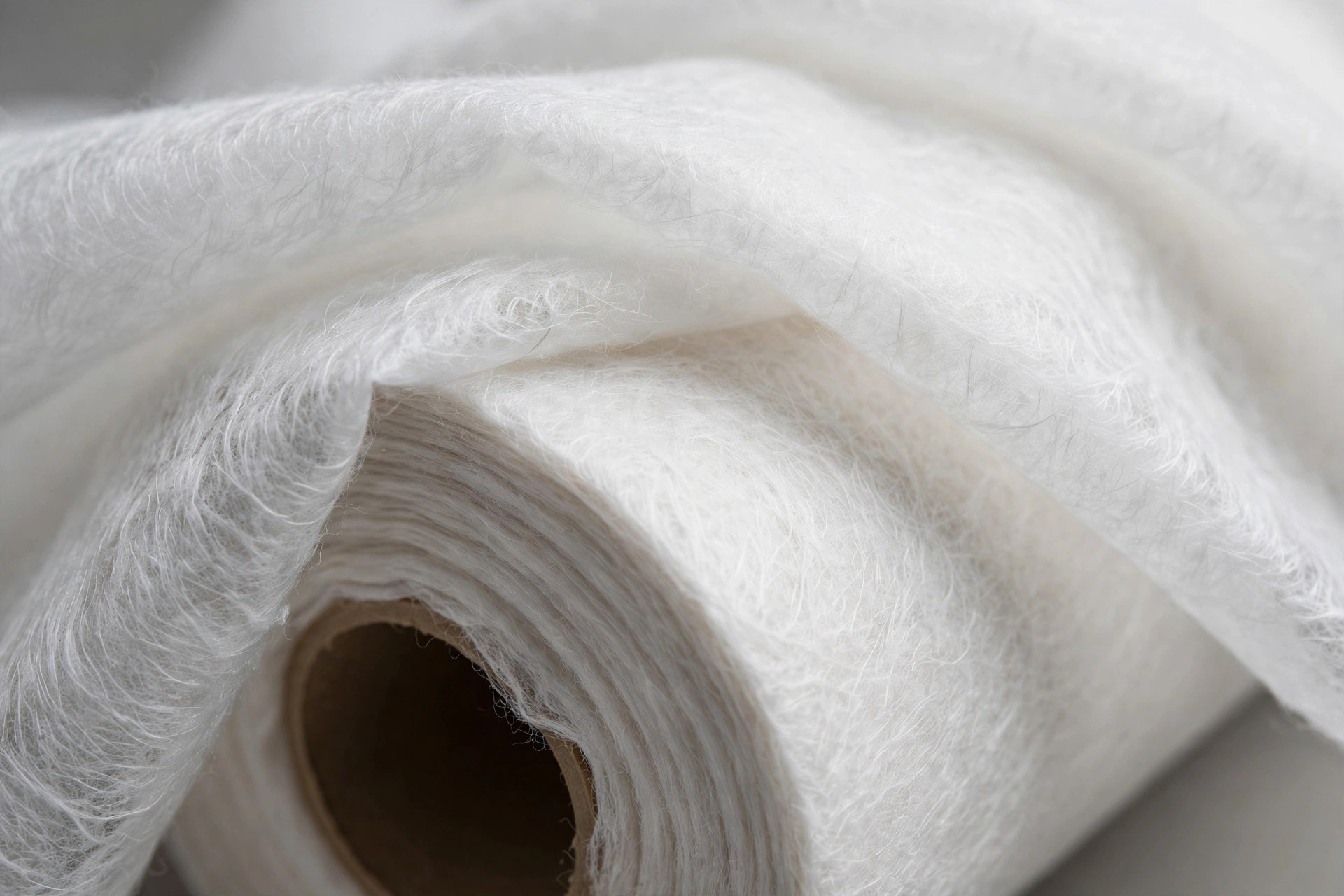
Blown, Not Spun
In a meltblown line, molten polypropylene is extruded through hundreds of fine capillaries while converging jets of hot, high-velocity air stretch the streams as they leave the die. The fibres attenuate to one to five micrometres — finer than any spun process reaches — break into short lengths, and land on a collector as a self-bonded web, held together by entanglement and the fibres' own residual tack. No separate bonding step is needed, and the web's pore structure is set by fibre fineness and laydown, not by any later treatment.
That structure is the whole point. A meltblown web packs enormous fibre surface into a thin, light sheet, so it intercepts particles by several mechanisms at once and holds oil many times its weight. An electrostatic charge, applied during or after production, can multiply filtration efficiency for airborne particles without adding breathing resistance — the principle behind high-grade respirator and HVAC media, usually built as a spunbond-meltblown-spunbond sandwich so the fragile meltblown layer survives handling.
The Producers Listed Here
Delstar Technologies, Inc (USA) is listed for meltblown fabrics for industrial filtration, healthcare and medical uses and battery separators, plus plastic extruded nettings. Ecotextil, Ltd (Czech Republic) covers meltblown fabrics for filtration media, textile sorbents, thermal insulation and bonding webs from polypropylene and LDPE, with product descriptions and technical specifications. Innovatec Microfiber Technology GmbH (Germany) manufactures melt-blown nonwovens for filtration, insulation and absorption across automotive, medical, protective clothing, bedding and construction markets.
The remaining listings complete a short, specialist page — meltblowing has always been a concentrated technology, with fewer producers than spunbond and a know-how premium on die design and process control. Each entry keeps its original country and description, and the descriptions name the application families — filtration, sorbents, separators — that organise the whole meltblown market.
Specifying Meltblown Media
Specify by performance test: filtration efficiency and pressure drop at a stated face velocity, oil absorption capacity for sorbents, or pore and thickness figures for separators. Basis weight alone predicts little, because charge treatment, fibre fineness and web uniformity move performance more than grams do. Ask whether the quoted efficiency is mechanical or charged, and how it ages — charge decays with heat, humidity and oil loading, and honest producers state the conditions behind their figures.
Handle meltblown as the delicate material it is: it compresses, it charges-static clings, and its surface abrades. Most buyers take it laminated or composited with spunbond for exactly that reason. The spunbond directory in the chips lists the usual partner-layer producers, and the test facilities directory covers the laboratories that verify filtration claims independently.
Partners, Rivals and Relatives
Meltblown's closest relative is spunbond — the same polymer family, the opposite fibre philosophy: spunbond draws continuous filaments for strength, meltblown sacrifices strength for fineness, and the composite of the two is worth more than either. Electrospun and nanofibre webs compete at the finest end for membrane and medical niches, while glass microfibre media — wet-laid rather than meltblown — hold the highest-efficiency industrial filtration ground. A specifier choosing media should compare across those families on efficiency per unit of pressure drop.
Capacity in meltblown arrives in waves, driven by public events — epidemics, clean-air rules, automotive filtration standards — and between waves the specialist producers below serve the steady industrial demand: oil sorbents for spill response, battery and capacitor separators, acoustic insulation, blood and liquid filtration. That steadiness is why the directory is short but durable: meltblown know-how concentrates in few hands, and those hands keep their customers for decades once a medium is qualified into a product.
Meltblown Producers Listed Here
10 companies and organisations are listed in this directory, carried from the original Apparel Search listing with each company's country and description as originally stated. Follow a name to the company's own website.
Delstar Technologies, Inc (USA)
Meltblown fabrics for industrial filtration, healthcare and medical uses and battery separators. Also, plastic extruded nettings for a variety of industrial applications.
Ecotextil, Ltd (Czech Republic)
Meltblown fabrics for filtration media, textile sorbents, thermal insulation and bonding webs, from polypropylene and low density polyethylene (LDPE). Product descriptions, technical specifications and magazine references.
Innovatec Microfiber Technology GmbH (Germany)
Manufacturers of melt-blown nonwovens for filtration, insulation and absorption applications in the automotive, medical, protective clothing, bedding and construction industries. Technical information and specifications. Description of technology.
Irema Ireland
- Manufacturers of meltblown filtration media for industrial and medical applications, from synthetic polymers. Also, global suppliers of respirator and surgical face masks.
Monadnock Paper Mills, Inc (USA)
Papermakers and nonwovens manufacturers. Meltblown fabrics for liquid and air filtration, and battery separator applications. Custom manufacturing and specialty finishing services.
Nuovo Latus Srl (Italy)
Manufacturers of chemical bonded and meltblown fabrics for liquid filtration, from viscose, polyester and polypropylene. Technical information and specifications.
Schoeller Hoesch Nonwovens (France)
Meltblown fabrics for spill control and industrial wiping applications, from polypropylene microfiber. Also, fabrics for filtration media, insulation materials and hygiene products. Part of Schoeller Hoesch GmbH.
Teda Group (China)
Diversified group of companies, active in medicines, transportation, energy, textiles, nonwovens, environmental protection and pharmaceutics. Melt-blown nonwovens for air, liquid and particle filtration applications. Also, nonwovens for the garment industry.
Tonen Tapyrus Co., Ltd (Japan)
Manufacturers of meltblown nonwovens for filtration, medical and battery separation applications, from polyester, polypropylene and polyamide. Detailed product information. Description of melt-blown technology.
Johns Manville Inc (USA)
Diversified, multi-national manufacturing corporation. The nonwovens division produces meltblown fabrics for medical, insulation, industrial and environmental end uses. Fiber division manufactures micro-strand glass fiber for filtration media. Monadnock Paper Mills, Inc (USA) : Papermakers and nonwovens manufacturers. Meltblown fabrics for liquid and air filtration, and battery separator applications. Custom manufacturing and specialty finishing services. Nuovo Latus Srl (Italy) : Manufacturers of chemical bonded and meltblown fabrics for liquid filtration, from viscose, polyester and polyprop
Common Questions
How is meltblown fabric made?
Molten polymer is extruded through fine dies into hot, high-velocity air that stretches it into microfibres of one to five micrometres; the fibres collect as a self-bonded web needing no separate bonding step.
Why does meltblown filter so well?
Its extremely fine fibres pack huge surface area into a thin web with fine pores, intercepting particles efficiently — and an electrostatic charge raises efficiency further without adding breathing resistance.
What should a meltblown specification state?
Tested performance — efficiency and pressure drop at a stated velocity, absorption capacity or pore size — not basis weight alone, plus whether efficiency figures are charged or purely mechanical.
More to Explore - Nonwovens & Fabric Directories
- Nonwovens - Section Hub
- Fabric Mills - Fabric Section Hub
- Air-Laid & Wet-Laid Nonwovens
- Artificial Leather Nonwovens
- Nonwoven Associations
- Coating & Laminating Nonwovens
- Composite Fabrics & Structures
- Nonwoven Consultants
- Nonwoven Converters
- Diversified Nonwoven Technologies
- Nonwoven Education & Training
- Geotextiles
- Nonwoven Import & Export
- Nonwoven Machinery & Equipment
- Needlepunch & Pressed Felts
- Spunbond Nonwovens
- Spunlace Nonwovens
- Stitchbond Nonwovens
- Nonwoven Test Facilities
- Thermobonded Nonwovens
- Waddings & Battings
- Nonwoven Wholesale Distributors
- Nonwoven Definition
- Interlining
- Fabric Factories
- Textile Machinery Directory
- Nonwoven Machinery
- Textile News
- Textile Industry News
- Textile Fiber News
- Textile Articles
- Fashion Industry
- Fashion News
- fashion
Looking for Fabric Mills and Suppliers?
Return to the Nonwovens hub for the full nonwovens section, or browse the Fabric Directory for the wider fabric mill trade.