Thermobonded Nonwovens Directory
Thermobonding makes fabric with heat alone: a web containing low-melting fibres or powder is passed through a patterned calender or a through-air oven, and the melted binder locks the structure as it cools. This directory explains both thermal routes and carries the thermobonded producers this section lists.
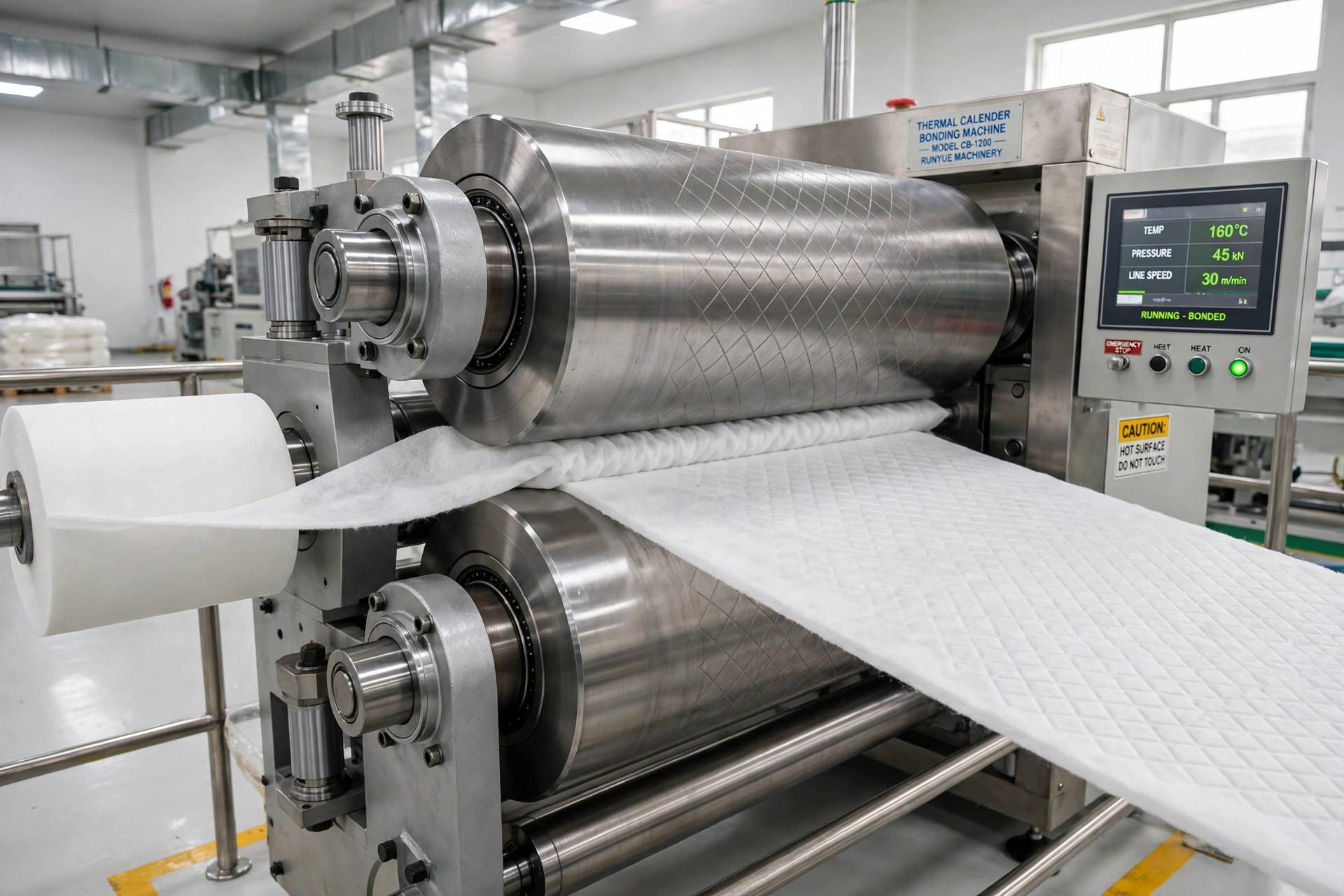
Two Machines, One Principle
Calender bonding presses the web between heated rollers, one often engraved with a dot or diamond pattern. Only the fibres under the pattern points melt and weld, so the fabric keeps soft, unbonded areas between firm bond points — the familiar look of hygiene coverstock and many carded webs. Through-air bonding instead blows hot air through a lofty web on a permeable drum or belt, melting binder fibres throughout the thickness; nothing compresses the web, so it stays bulky and springy — the route for high-loft waddings, absorbent cores and filtration depth media.
The binder is usually part of the web itself: bi-component fibres with a low-melt sheath over a strong core, or low-melt homopolymer fibres blended through a carded web of regular fibres. Temperature, pressure and dwell time form a narrow working window — too cool and the web delaminates, too hot and it films, stiffens or glazes — and process control in that window is the thermobonder's core skill.
The Producers Listed Here
AB Tec GmbH (Germany) is listed for thermobond adhesive fabrics and tapes for the automotive, filtration, footwear, luggage and furniture industries from polyamide, polyester and polyolefin. Bezci Tekstil Sanayi AS (Turkey) covers woven and nonwoven interlinings for the garment industry and thermobond fabrics for lining and quilting, wipes and coverstock from polypropylene, plus polypropylene fibres. The remaining listings extend the family through interlining, insulation and hygiene producers.
Each listing keeps its country and description as originally stated. Read together they show thermobonding's two homes: flat, precise calender-bonded fabrics for garments, hygiene and adhesive applications, and lofty through-air fabrics for filling and insulation — one principle, two very different shelves in the warehouse, both represented below.
Choosing a Thermobonded Web
Decide first whether the product needs flat or lofty: calender bonding for thin, strong, printable surfaces; through-air for bulk, resilience and absorbency per gram. Then the binder system — fibre blend and bond ratio set softness and strength together, and a web bonded for dry strength alone can disappoint when wet, so test in the product's real state. Heat history matters downstream too: a thermobonded web will be re-heated in laminating or moulding, and its maker should know the temperatures it has already seen.
The waddings directory in the chips covers the loftiest thermobonded products in their own right, and the spunbond directory covers the polymer-laid fabrics whose point bonding is the calender principle applied inside a spinning line. For adhesive fabrics and tapes — thermobonding's close cousin — the coating and laminating directory is the neighbouring stop.
Where Thermobonding Wins and Loses
Thermal bonding wins wherever a clean, adhesive-free bond, good uniformity and high line speed meet: hygiene topsheet and coverstock, garment interlinings, tea-bag and filter papers' synthetic cousins, adhesive tapes and the lofty fills of the wadding trade. It loses where the web must contain fibres that melt at processing temperatures, where wet strength without binder chemistry is demanded, or where the product's hand must come from entanglement rather than weld points — spunlace and needlepunch ground, respectively.
Energy economics keep pulling work toward it: melting a fraction of the web's fibre is cheaper than drying a water-borne binder, and lines run without the effluent a chemical bonding plant must treat. As bi-component fibre prices fall, more carded webs default to thermal bonding, and the producers below — several of whom also run other bonding routes — position their thermobond capacity as the efficient core of a wider offer.
Thermobonded Producers Listed Here
21 companies and organisations are listed in this directory, carried from the original Apparel Search listing with each company's country and description as originally stated. Follow a name to the company's own website.
AB Tec GmbH (Germany)
Manufacturers of thermobond adhesive fabrics and tapes for the automotive, filtration, footwear, luggage and bags, and furniture industries, from polyamide, polyester and polyolefin. English and German.
Bezci Tekstil Sanayi AS (Turkey)
Versatile textile and nonwovens manufacturing company. Woven and nonwoven interlinings for the garment industry. Thermobond fabrics for lining and quilting, wipes and coverstock, from polypropylene. Also, polypropylene fibers for the textile and nonwovens industries. English and Turkish.
Bondex, Inc (USA)
Manufacturers of carded, flat and point bonded nonwovens for cleaning, insulation, pipe wrapping and filtration applications, from viscose, polyester, polypropylene, high-performance fibers and blends. Part of Andrew Industries, Ltd.
Danyan Synthetic Fibre Co., Ltd (China)
Diversified manufacturing company, active in man-made fibers and nonwovens. Thermobond nonwovens for interlining applications, from polypropylene, polyester and polyamide. Also, polypropylene and bi-component staple fiber. English and Chinese.
Dern Lin Textile Co., Ltd (Taiwan)
Diversified textile and nonwovens manufacturers. Thermobond fabrics for luggage and bags, from polyester. Also, warp and circular knitted fabrics for apparel, sports wear, footwear and fashion accessories. Detailed product catalogs, including technical information. English and Chinese.
Don & Low, Ltd (United Kingdom)
. Manufacturers of woven and nonwoven industrial fabrics, geotextiles and floorcoverings. Thermobond, nonwoven fabrics for a variety of industrial end uses.
Hassan Group (Turkey)
Diversified group of manufacturing companies, active in textiles, nonwovens, information technology and automotive components. Thermobond nonwovens for hygiene and apparel interlining.
INC Corp (Australia)
Manufacturers of technical textiles and nonwovens for acoustic and thermal insulation, filtration, automotive trim, upholstery and industrial applications. Vertically alligned, thermobonded nonwovens for acoustic insulation, from polyester. Extensive information, technical articles and presentations on PDF files.
Jeong Hwan Corp (Korea)
Nonwoven, hot-melt adhesive fabrics for industrial laminating end uses. English and Korean.
Meida Europe (Denmark)
Design and manufacture of chemical free and non-allergic, breathable, wind- and waterproof nonwoven thermal insulation waddings for outerwear, bedding, footwear and sleeping bags, from polypropylene microfiber. Technical information and specifications, and care guide.
Melded Fabrics (Australia)
Manufacturers of heat bonded nonwoven fabrics and latex backed floor coverings for commercial, institutional, marine, leisure and automotive markets, from polyester, polypropylene and polyamide. Also, back coating technology for floor coverings. Detailed product catalogs. Extensive technical information, specifications and care guides on PDF files. List of world wide distributors. Part of the Nylex Group.
Midwest Padding, LLC (USA)
Manufacturers of air-laid nonwoven insulation paddings for a wide range of industrial and consumer applications, from cellulose, and natural and man-made fibers.
Powell, LLC (USA)
Dry-laid, thermally bonded reinforcement fabrics, and substrates for electrical insulating materials, pressure sensitive tapes and filtration membranes, from polyester fibers. Also, custom lamination and calendering services. Detailed material specifications in PDF file format.
PT Megah Industries (Indonesia)
Group of textile and nonwovens manufacturing companies. Paste and dot coated nonwoven fabrics for coverstock and garment interlining applications, from polyester and rayon blends.
PT Megah Sembada Industries (Indonesia)
Thermobonded fabrics for garment interlining, diaper and sanitary napking applications. Also, woven interling fabrics, and one ply tissue converting services.
Sun Kingdom Co., Ltd (Taiwan)
Manufacturers of thermobond nonwoven fabrics for hygiene, medical, cleaning, agricultural and industrial applications, from viscose, polyester, polypropylene, polyamide and blends. Also, processors and converters of disposable nonwoven products. English and Chinese.
Tai Tung International Group (Hong Kong)
Group of textile and nonwovens companies, active in woven and nonwoven fabrics for apparel, bedding and furnishing, and accessories. Thermobonded, fusible and non-fusible polypropylene interlining fabrics. Also, suppliers of spunbond fabrics. Some technical information.
Textile Products, Ltd (Turkey)
Woven, knitted and nonwoven, fusible and non-fusible interlining fabrics for the garment industry. Also, needlepunch collar felt, and tapes and waistbands. Detailed product catalogs. English and Turkish.
United Saudi Co (Saudi Arabia)
Manufacturers of carded and thermobonded nonwoven fabrics for coverstock and hygiene disposable, industrial, wiping, and medical, domestic and commercial cleaning applications, from hydrophobic and hydrophilic polypropylene, and blends with cotton and viscose. Part of the Shairco Group.
US Nonwovens Corp (USA)
Manufacturers of nonwoven fabrics and substrates for sanitary disposables, apparel interlining and embroidery backing, filtration, acoustical wrappings and geotextile applications. Also, wipes, soap pads and dryer sheets.
Xinyu Nonwoven Co., Ltd. (China)
Carded and thermobonded fabrics for garment interlining and industrial applications, from polyester. viscose, cotton and blends. Custom coloring, embroidery and laminating services. Part of the Timbering Group. English and Chinese.
Common Questions
How does thermal bonding work?
A web containing low-melt fibres is heated — between calender rollers that weld patterned bond points, or by through-air ovens that bond throughout the thickness — and the melted binder locks the structure as it cools.
Calender or through-air bonding — which for bulk?
Through-air: hot air bonds the web without compressing it, preserving loft for waddings, cores and depth filtration. Calender bonding suits thin, strong, flat fabrics.
What sets a thermobonded web's softness and strength?
The binder fibre blend and bond ratio, and the temperature-pressure window in production — too little heat delaminates, too much films and stiffens the web.
More to Explore - Nonwovens & Fabric Directories
- Nonwovens - Section Hub
- Fabric Mills - Fabric Section Hub
- Air-Laid & Wet-Laid Nonwovens
- Artificial Leather Nonwovens
- Nonwoven Associations
- Coating & Laminating Nonwovens
- Composite Fabrics & Structures
- Nonwoven Consultants
- Nonwoven Converters
- Diversified Nonwoven Technologies
- Nonwoven Education & Training
- Geotextiles
- Nonwoven Import & Export
- Nonwoven Machinery & Equipment
- Meltblown Nonwovens
- Needlepunch & Pressed Felts
- Spunbond Nonwovens
- Spunlace Nonwovens
- Stitchbond Nonwovens
- Nonwoven Test Facilities
- Waddings & Battings
- Nonwoven Wholesale Distributors
- Nonwoven Definition
- Interlining
- Fabric Factories
- Textile Industry Directory
- Textile Machinery Directory
- Nonwoven Machinery
- Textile News
- Textile Industry News
- Textile Fiber News
- Textile Articles
- Fashion Industry
- Fashion News
- fashion
Looking for Fabric Mills and Suppliers?
Return to the Nonwovens hub for the full nonwovens section, or browse the Fabric Directory for the wider fabric mill trade.