Textile Lab Manager Job Description
Running the laboratory that tests fabric and garments — methods, standards, accreditation and a team of technicians
A textile lab manager runs the laboratory where fabrics and garments are tested before anyone is allowed to trust them. Mills, dyehouses, brands and independent testing houses all keep laboratories that answer physical questions — will this fabric shrink, fade, pill, tear, stretch out of shape, or fail a legal standard? — with numbers instead of opinions. The lab manager owns the methods, the equipment, the accreditation and the people that produce those numbers, and signs off results on which buying decisions, bulk approvals and product claims depend.
More Production Job Descriptions by Letter:
Running the Laboratory and Its Test Programme
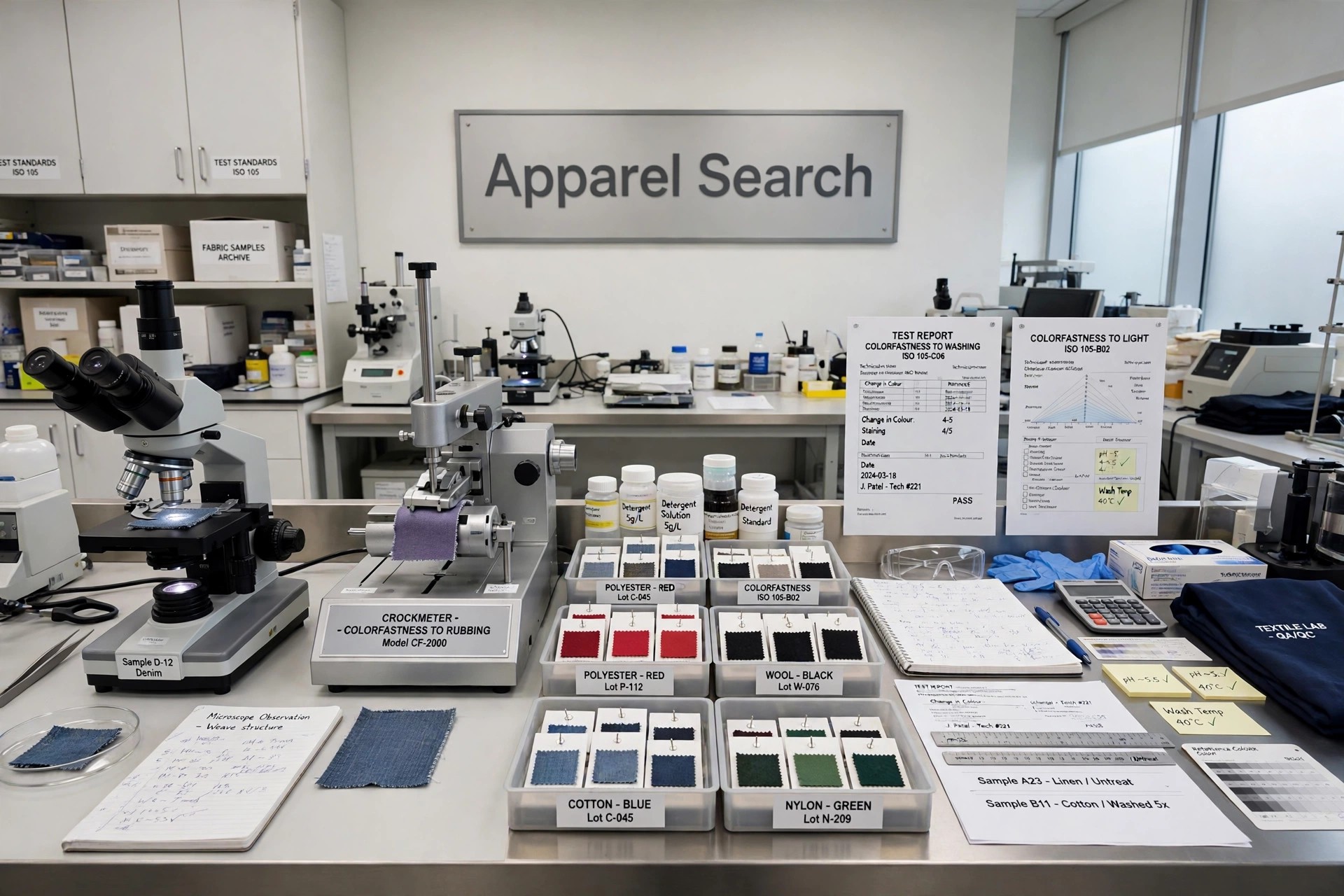
The manager organises the lab's work from sample receipt to report. Samples arrive from mills, factories and product teams, are logged, conditioned in the laboratory's controlled atmosphere — textile results change with temperature and humidity, so conditioning is science, not housekeeping — and scheduled through the test programme: dimensional stability and shrinkage, colourfastness to washing, rubbing, light and perspiration, strength and tear tests, pilling and abrasion, stretch and recovery, fibre composition and flammability where the product requires it. The manager sequences this flow so development samples, bulk approval tests and urgent investigations each get their proper priority.
Method discipline is the manager's core responsibility. Every test follows a recognised standard method — the published procedures of the international and national standards bodies and the retailers' own protocols built on them — performed on calibrated equipment by trained technicians, with reference materials and control fabrics run alongside so a drifting machine is caught by the controls before it corrupts a customer's result. When results are disputed, and in textiles they regularly are, the lab that can produce its method, its calibration records and its control charts wins the argument.
Accreditation, Quality Systems and Reporting
Serious textile laboratories work to formal quality systems, and accredited labs are assessed against the international laboratory competence standard by external auditors. The manager maintains that system: documented procedures, training and authorisation records for each technician and test, equipment maintenance and calibration schedules, participation in proficiency testing where the lab's results are compared blind against other laboratories, and corrective action when anything deviates. Accreditation is what turns a lab's numbers into evidence that brands, regulators and courts can rely on.
Reporting is where the science meets the business. The manager reviews and authorises test reports, translates results into decisions — this fabric passes bulk approval, that dye lot fails colourfastness and must not ship, this care claim cannot be made on this evidence — and explains failures constructively, because a good laboratory does not merely reject: it helps a mill or product team understand which property failed, by how much, and what change would pass. Trend reporting across a season's results, showing which suppliers and fabric types generate repeat failures, is among the most valuable work a lab manager produces.
People, Equipment and Budgets
Laboratories are teams of technicians with graded skills, and the manager builds them: recruiting, training technicians test by test until each is authorised to perform and record it unsupervised, and developing senior technicians who can investigate anomalies rather than merely process samples. The manager also owns the equipment estate — tensile testers, colour measurement spectrophotometers, lightfastness and wash wheels, abrasion and pilling machines — planning maintenance, calibration, replacement and the capital bids for new capability as standards and customer requirements evolve.
Budgets and turnaround are managed together. Test volume peaks with development calendars and bulk shipping seasons; the manager plans staffing, overtime and outsourcing to satellite labs against those peaks, prices internal or commercial testing honestly, and protects the rule that speed never purchases accuracy — a fast wrong answer costs a brand more than a slower right one, in claims, recalls and rejected bulk.
Skills, Qualifications and Career Path
A textile lab manager needs genuine textile science: fibre and fabric behaviour, dyeing and finishing chemistry, and the physics of the standard test methods understood deeply enough to defend a result and to spot an impossible one. Textile technology or science degrees are the usual foundation, followed by laboratory experience across the main test families and, for management, quality-system and accreditation training. Statistical confidence matters — control charts, measurement uncertainty and inter-laboratory comparisons are the manager's everyday tools for knowing whether a number deserves trust.
Career paths lead to senior laboratory and technical management in testing houses, mills and brands — head of quality, technical director — and into consultancy on standards and compliance. Lab managers who prefer the field side move toward audit and inspection leadership, the complementary discipline described on the Textile Test Auditors page, where testing knowledge is applied in factories and warehouses rather than in the laboratory itself.
Common Questions
What does a textile lab manager manage?
A textile testing laboratory: its test programme (shrinkage, colourfastness, strength, pilling, composition and more), standard methods and calibrated equipment, its accreditation and quality system, its technicians, and the authorised reports on which approvals and claims depend.
How is a lab manager different from a textile test auditor?
The lab manager runs a fixed laboratory and its team, methods and accreditation. Test auditors travel to mills, factories and warehouses, checking products and processes on site against standards. The two roles share testing knowledge and work closely together.
What qualifications do textile lab managers need?
Usually a textile technology or science background plus broad laboratory experience across the standard test families, quality-system and accreditation competence, and the statistical confidence to defend — or reject — a result.
More to Explore
Textile Testing Resources
Production Directory Pages by Letter
References & Further Reading
More Job Description Categories
- Buying Job Descriptions
- Design Job Descriptions
- Marketing & PR Job Descriptions
- Miscellaneous Job Descriptions
- Planning & Allocation Job Descriptions
- Production & Sourcing Job Descriptions (current)
- Sales & Selling Job Descriptions
- Transportation & Warehouse Job Descriptions