Textile Test Auditors Job Description
Testing and auditing textiles where they are made — mills, factories and warehouses, checked against the standard
Textile test auditors take testing out of the laboratory and into the places textiles are made and stored. Employed by brands, buying offices and independent inspection companies, auditors travel to mills, dyehouses, garment factories and warehouses to check that production matches the approved standard: examining fabric and garments, drawing samples for laboratory testing, verifying measurements and workmanship, and reporting — with evidence — whether a consignment may ship, needs correction, or must be rejected. Where the laboratory produces numbers, the auditor produces a judgement on the spot, at the point where a decision can still change the outcome.
More Production Job Descriptions by Letter:
The Audit: Sampling, Inspection and Testing on Site
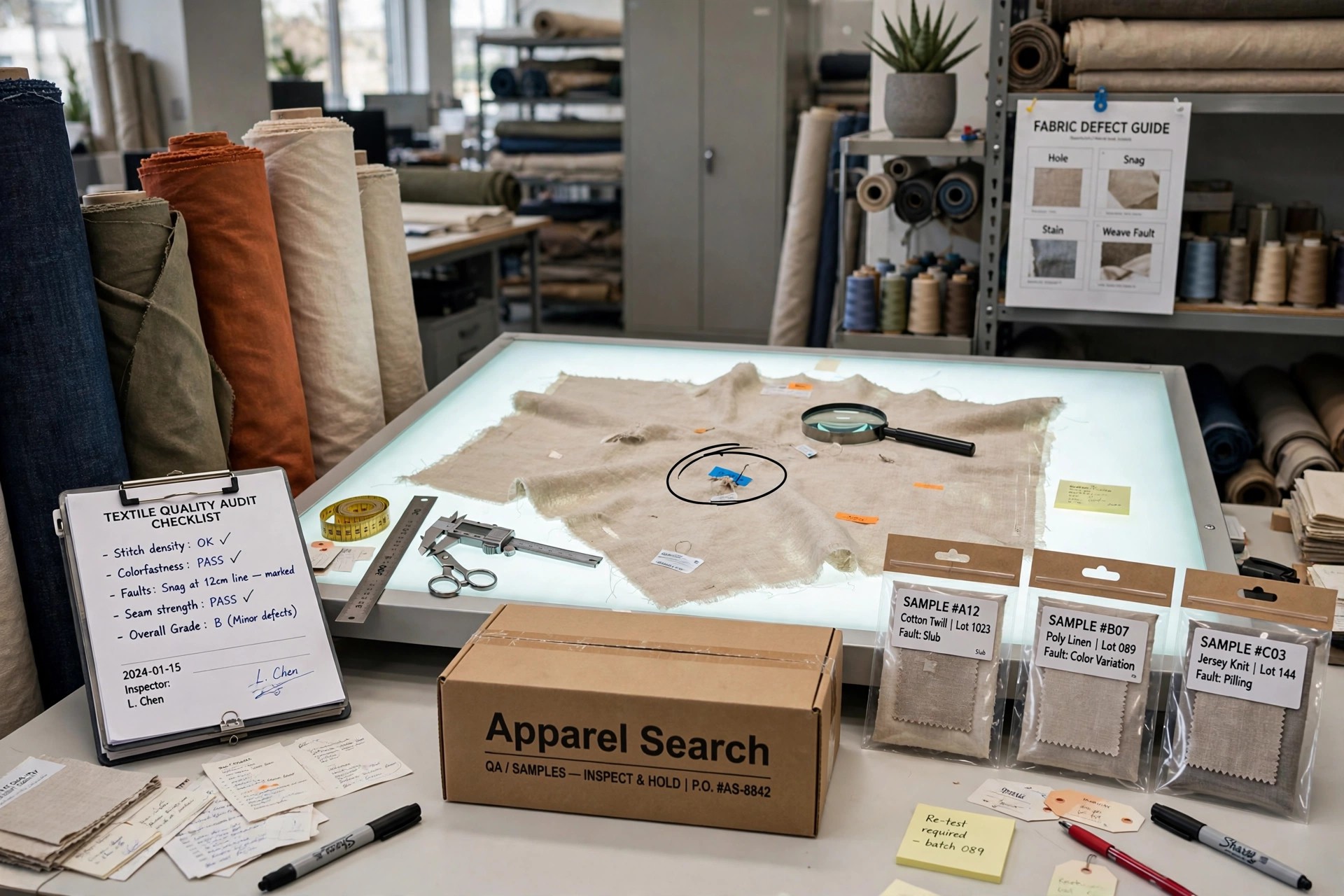
An audit begins with sampling discipline. The auditor selects cartons and pieces at random from the finished, packed production — never the samples a factory offers — following recognised sampling plans that tie the quantity inspected to the size of the consignment and the agreed quality level. Fabric rolls are examined on inspection machines or light tables, metres unrolled and faults marked and counted per length; garments are measured against the specification, checked for workmanship defects — open seams, skipped stitches, stains, shading between panels, faulty trims and attachments — and tested for function: zips, snaps, buttons and closures worked as a customer would work them.
Field testing supports the eye. Auditors carry the portable end of the laboratory: measurement tapes and templates, light boxes for shade assessment, crocking and simple colourfastness checks, needle and metal detection verification where the product requires it, and barcode and labelling checks against the customer's packing rules. Samples requiring full laboratory methods are sealed, labelled and sent under chain-of-custody so the lab result can be tied to the consignment the auditor actually saw. Defects are classified as critical, major or minor, counted against the acceptance limits agreed for the order, and photographed as they are found.
Process Audits and Corrective Action
Beyond the product, auditors examine the process that produced it. A factory audit walks the production line: fabric inspection on arrival, cutting and bundling control, in-line inspection at sewing, finishing and pressing standards, final inspection procedure, packing and carton marking, and the factory's own quality records. The auditor compares what the factory's system claims with what the floor actually does, because a consignment that passes today from a process out of control is a consignment that fails next month without warning.
Findings become corrective action. The auditor issues the report — pass, fail, or pending with conditions — agrees what must be re-worked, re-inspected or re-tested, sets the evidence required to close each finding, and returns or reviews evidence until the actions are complete. Diplomacy is a working tool: auditors must deliver failing verdicts to factory managers whose cooperation they will need next season, firmly enough that standards hold and fairly enough that honest factories welcome the scrutiny.
Reporting, Standards and Independence
The audit report is the product. It records the sampling basis, the defects found and their classification, measurements and test results, photographs, and the verdict, in terms a brand's production team can act on without having been present: ship, hold, re-work, re-inspect. Reports are written against the customer's standard and the order's specification, not the auditor's personal taste, and experienced auditors keep their language factual and their evidence complete, because reports are read in disputes — between brands and factories, insurers and shippers — long after the audit day.
Independence is the auditor's professional foundation. Auditors declare conflicts, refuse hospitality that could bend a verdict, rotate assignments where their employer requires it, and never audit production they have consulted on. Brands pay for that independence as deliberately as for the inspection itself: a report is worth exactly as much as the trust that the auditor could not be influenced.
Skills, Qualifications and Career Path
Textile test auditors need broad product knowledge — fabric construction, garment making, dyeing and finishing faults and their causes — combined with the standard inspection and sampling methods used across the industry, and enough laboratory testing knowledge to know which questions only a lab can answer. Report writing, photography, measurement accuracy and the stamina for constant travel, early factory starts and production-floor conditions complete the profile; a driving, self-organising working pattern suits people who prefer the field to a desk.
Auditors commonly arrive from quality control and quality assurance roles in factories, from laboratory technician posts, or from production and merchandising jobs that put them inside factories daily. Employers train them in their audit protocols and grade their judgements against senior auditors before unsupervised verdict work; textile or quality qualifications strengthen applications. Progression leads to senior auditor and audit team leadership, quality management for brands and buying offices, compliance and social-audit specialisms, and laboratory or technical management — the fixed-site counterpart described on the Textile Lab Manager page.
Common Questions
What do textile test auditors do?
Travel to mills, factories and warehouses to audit textile and garment production: drawing random samples, inspecting fabric and garments against the specification, classifying defects, running field tests, sending sealed samples to laboratories, and reporting a ship, hold or reject verdict with corrective actions.
How are test auditors different from lab staff?
Auditors work on site where production happens and judge consignments and processes in person; laboratory staff test samples under controlled conditions in a fixed lab. Auditors use portable tests and send samples needing full methods to the lab.
What background do textile test auditors come from?
Usually factory quality control or assurance, laboratory technician work, or production and merchandising roles with factory exposure, followed by employer training in audit protocols and graded verdict practice.
More to Explore
Testing & Audit Resources
Production Directory Pages by Letter
References & Further Reading
More Job Description Categories
- Buying Job Descriptions
- Design Job Descriptions
- Marketing & PR Job Descriptions
- Miscellaneous Job Descriptions
- Planning & Allocation Job Descriptions
- Production & Sourcing Job Descriptions (current)
- Sales & Selling Job Descriptions
- Transportation & Warehouse Job Descriptions