Women's Strappy Sandals Guide
A strappy sandal is held on by straps and little else — multiple slim bands across the foot and ankle that make the sandal the most open, dressiest member of the sandal family.
Shop Women's Strappy Sandals Now
Shop Women's Strappy Sandals on Amazon Shop Women's Strappy Sandals on eBayThe Amazon and eBay links on this page are affiliate links. If you make a purchase through them, Apparel Search may earn a commission.
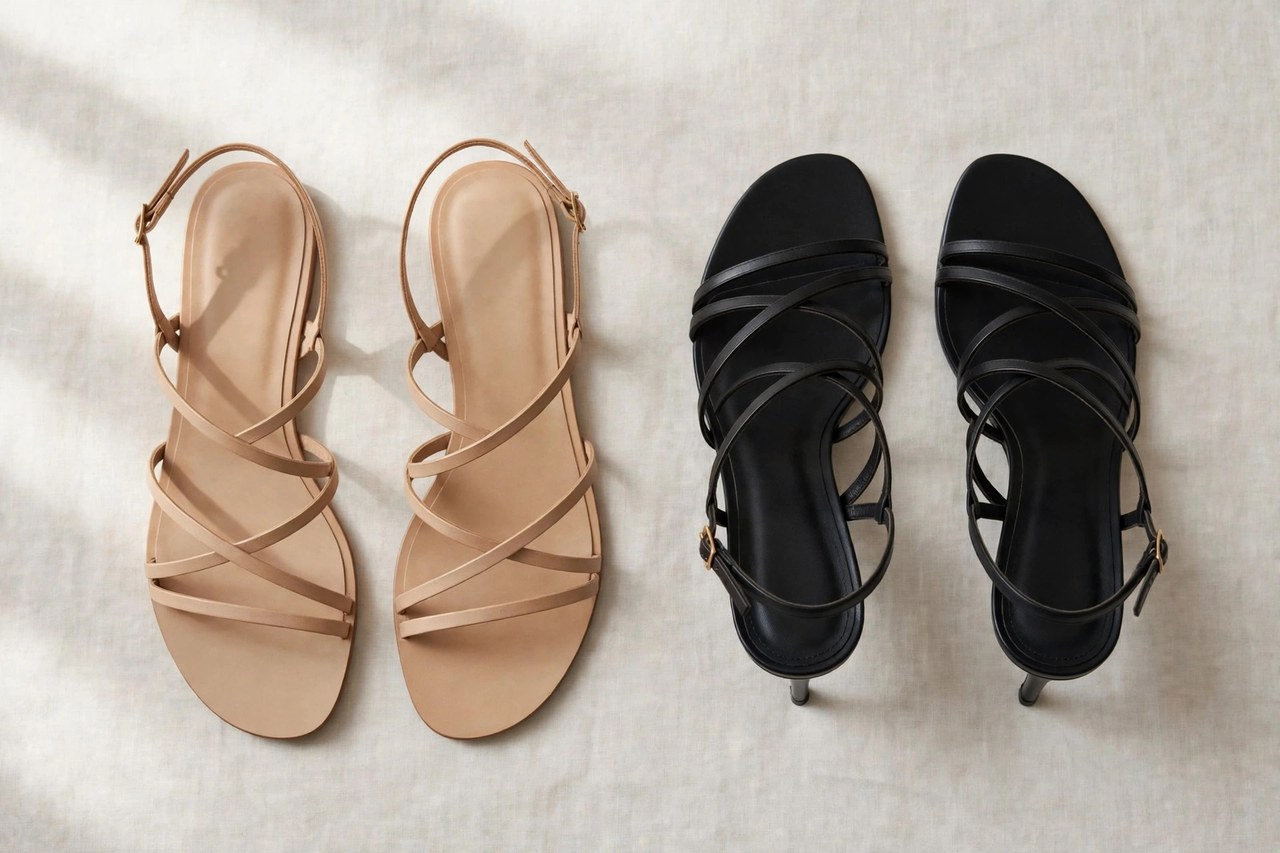
A strappy sandal is defined by its straps: instead of a single band or a closed upper, several slim straps cross the toes, the foot and often the ankle, holding an open sandal together with line rather than coverage. The result is the sandal at its most minimal and most decorative — the style chosen when footwear should frame a dress, a hemline or a summer evening rather than disappear under it. Flats, heels and wedges all come in strappy form.
This guide covers the strappy sandal on its own terms: the main strap configurations from two-strap slides to full gladiators, where straps rub and how good construction prevents it, how heel height changes what the straps must do, and how to fit a shoe with no upper to hide a poor fit behind. With so little shoe, every strap's placement is a fit decision, and small differences separate the pair worn all evening from the pair carried home.
Strap Configurations: From Two Bands to Gladiator
The simplest strappy sandals use two or three parallel straps across the toes and instep, sometimes with a slingback or ankle strap added for hold. Ankle-strap sandals add a buckled or tie band at the ankle, which is both the style's signature and its security system on heeled versions. T-strap and cage designs run a central strap up the foot with cross straps branching from it, distributing hold over more contact points and suiting feet that slide forward in open shoes.
At the elaborate end, gladiator sandals multiply the straps up the ankle and sometimes the calf, lacing or buckling at several levels; they are a statement style that anchors a plain dress or shorts and asks for patience at every fastening. Lace-up and wrap straps trade buckles for ties that finish in a bow at the ankle or calf. Count the fastenings honestly before buying: a beautiful ten-buckle sandal worn weekly will test anyone's affection for it.
Where Straps Rub, and What Good Construction Does
Thin straps concentrate pressure on thin lines of skin, so construction quality is comfort quality in this category. Look for straps with soft, finished edges — rolled, padded or lined leather rather than a cut edge that saws at the toe joints — and for strap joins set into the sole rather than glued on top of the footbed where they form ridges underfoot. Metallic and patent straps look sharp and forgive nothing; matte leather and fabric straps are kinder over a long day.
Placement is the other half. The front strap should sit behind the toe joints, not across them; ankle straps should clear the ankle bone rather than sawing across it; and between-toe posts, where a thong element is present, should be soft and flat. Walk the shop's full circuit, turn, and climb any available step: strappy sandals reveal their intentions quickly, and a strap that merely touches in standing will bite in walking. Blister prevention begins with refusing the pair that starts negotiating in the store.
Flats, Heels and Wedges: What the Straps Must Do
On a flat strappy sandal, the straps are nearly the whole shoe, so hold matters most: an ankle strap or back strap keeps the foot from sliding and the toes from gripping, which is the hidden cause of most flat-sandal fatigue. On a heeled strappy sandal — the classic evening shoe — the pitch throws weight forward, and the straps must stop the foot sliding toward the toes; a secure ankle strap and a front strap set well back are functional, not decorative, choices.
Wedge and platform strappy sandals split the difference, offering height on a stable base with straps doing the holding, and they suit outdoor events where a stiletto would sink. Across all heights, a cushioned footbed earns its place because there is no padded upper to absorb anything, and a rubber sole insert prevents the slide that an all-leather sole invites on polished floors. Match the version to the event's floor, distance and duration, in that order.
Styling and Strap Care
Strappy sandals are the finishing shoe: metallic flats with a summer dress, black heeled straps with almost any formal outfit, tan leather straps grounding prints and bright colors. The ankle strap visually shortens the leg line, a fact worth using deliberately — nude-toned straps lengthen, contrasting ankle straps suit cropped trousers and shorter hemlines that give the strap room to be seen. Keep the rest of the jewelry restrained when the sandals are elaborate; the feet are already decorated.
Care for straps as you would a belt: condition leather straps so they stay supple and do not crack at the buckle holes, keep buckles and studs dry to prevent tarnish marks on skin and fabric, and store sandals with straps loosely fastened so they hold their curve rather than creasing flat. Mend a lifting strap join early, while a cobbler can still stitch it invisibly. A strappy sandal has few parts and nowhere to hide wear, but looked after, those few parts age gracefully.
Related Women's Guides
More to Explore on Apparel Search
- Women's Sandals Guide
- Women's Shoes
- Women's Footwear
- Fashion
- Clothing Retail Stores
- Fashion News
- Fashion Designers
- Popular Brands
- Apparel
- Women's Clothing Stores
- Women's Clothing Wholesalers
- Women's Fashion
- Women's Shoe Stores
- Women's Footwear Guide
- Women's Shoes
- Footwear Definitions
- Shoe Search
- Fashion Videos
- Fashion Calendar
- Celebrity Fashion
- Fashion Designer Directory
- Women's Athletic Shoes
- Women's Boots
- Women's Casual Shoes
- Women's Dress Shoes
- Women's Trend Shoes
Women’s Clothes Guide by Letter: Women's Apparel Directory N · Women's Clothes Directory O · Women's Clothing Directory P · Women's Apparel Directory Q · Women's Fashion Directory R · Women's Clothes Directory T
Looking for Women's Clothing Stores?
This guide helps you choose women's strappy sandals. To browse where to buy, visit our women's clothing store directory, where you can find retailers that carry them.