Boardshorts
Clothing Definitions — definitions of garments and clothing terms from Apparel Search
Search Apparel Search
At a Glance
Definition: Boardshorts are knee-length, quick-drying swim shorts with a fixed lace-up waist, developed for surfing and now worn as general beach and leisure wear by men and, more recently, women.
Also known as: boardies (Australian slang); baggies (South Africa)
Category: Clothing Definitions
Word Origin
Boardshorts names the sport, not the garment's shape: the shorts were developed for aquatic sports played on a board — surfing first, then wakeboarding and paddleboarding. The slang forms follow the map: boardies in Australia, baggies in South Africa.
Boardshorts are what surfing did to the swimming short. Every detail of the design answers a problem the ocean sets: a waist that cannot be dragged down by a wave, fabric that dries between sessions, and a leg long enough to protect skin from board wax and fibreglass. From that functional start they spread — through skate and punk fashion as much as through surf shops — into general beach and warm-weather wear around the world. Our boardshorts product guide covers buying in depth; this page explains the garment itself.
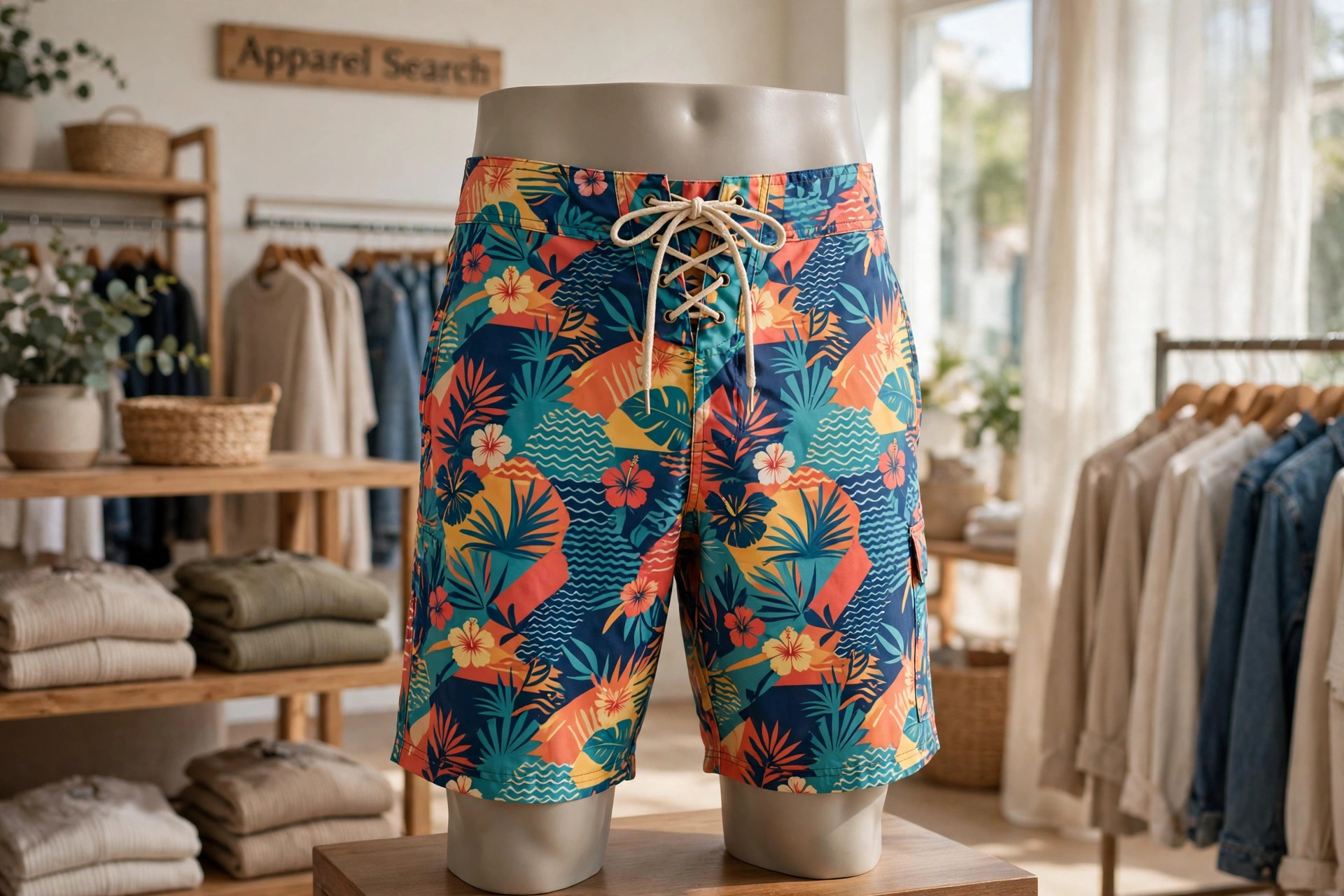
Built for the Board
Boardshorts are a style of men's — and, more recently, women's — swimwear, originally developed for aquatic sports that use a board, above all surfing, and since adopted as general beachwear. The name records the origin directly: these are the shorts of board sports, a family that now includes wakeboarding and paddleboarding as well as surfing. They are especially popular in North America, spread further as the skater punk fashion trend carried surf styling inland, and they are standard wear in men's beach volleyball; other parts of the world still favour briefer suit styles.
Length is the first design decision. Boardshorts are normally longer than ordinary shorts or form-fitting Speedo styles, running from the waist to around the knee or slightly above it, with fashion pushing the hem up and down over the years. The length is functional before it is fashionable: it protects the thigh from the surfboard's waxed surface during hours of paddling and sitting, and it prevents the chafing that shorter cuts allow. Many designs use vibrant colour, Hawaiian floral prints and highlighted stitching, though plain performance styles are just as common.
The Fixed Waist and Other Working Details
The defining feature is the waist. Boardshorts do not have an elastic waist like most swim shorts; instead they have a rigid, non-stretch waistband that opens at the front, usually with a Velcro fly, and is held together by a lace-up tie. The two systems back each other up deliberately: if the Velcro gives under the force of a wave, the laces hold, and vice versa. A surfer tumbled in a wipeout keeps his shorts — that is the entire point of the design.
Smaller details follow the same logic. Authentic surf boardshorts often carry one very small pocket, sealed with Velcro and vented with a grommet so it drains, sized to keep a car or house key secure in the water. Fabric is smooth polyester or nylon — lightweight, quick-drying and durable against constant contact with a board, with four-way stretch woven into many modern styles so the shorts move with a crouching, paddling wearer.
Refinements: Flies, Seams and What Goes Underneath
Because boardshorts are commonly worn without underwear, two discomforts drove the design forward. Velcro flies can entangle hair and skin, so some makers substituted a neoprene fly panel: it does not open fully, but stretches enough to let the shorts be pulled on and off, and nothing catches. And stitching at the inseam rubbed raw against wet skin, so many manufacturers moved to seamless construction, or welded and glued seams, in the areas that bear against the body.
Wearing practice varies. Many surfers wear boardshorts alone, as designed. Some men prefer boxers, a jockstrap or briefs underneath for support or modesty, and some women wear a swimsuit or bikini bottom beneath them. None of this is required — the shorts are a complete garment — but a liner or underlayer can reduce chafing on very long sessions.
The Specialist Makers
Almost all swimsuit manufacturers and many designer brands now produce boardshorts, but the style was built by specialists who made shorts for surfers for decades. Billabong and Quiksilver of Australia, Rip Curl of Australia, and Hurley and Volcom of the United States anchor the list, alongside older Southern California makers such as Birdwell Beach Britches and Kanvas by Katin, whose names appear on shorts that predate the fashion spread entirely.
Choosing a pair comes back to the surf test even for buyers who never surf: a waist that laces and stays, fabric that dries fast and gives a little, seams that lie flat where they touch skin, and a leg length that covers the thigh without catching at the knee. Boardshorts that pass those tests at the beach will serve just as well as travel and leisure shorts — which is how a piece of specialist sports equipment became warm-weather clothing for everyone.
Not to Be Confused With
Boardshorts are often lumped in with swim trunks, but the construction differs where it matters. Swim trunks are casual swim shorts with an elastic or drawstring waist and usually a mesh brief inside. Boardshorts were engineered for surfing: a fixed, non-stretch waistband that laces shut so surf cannot pull them down, no mesh liner in most styles, a longer leg for board protection, and flat, low-friction seams. If the waist is fixed and laced and the leg reaches toward the knee, you are looking at boardshorts, whatever the label says. Both belong to the wider swimwear family.
Common Questions
Why are boardshorts longer than other swim shorts?
Boardshorts were designed for surfing, where the longer leg protects the skin from friction against the surfboard and its wax. The length, usually reaching toward the knee, also gives coverage when sitting and paddling on the board for long periods.
What are boardshorts made of?
Boardshorts are made from lightweight, quick-drying synthetic fabrics such as polyester or nylon, often with stretch woven in. Unlike casual shorts they have no mesh inner brief in many designs, and they use a fixed waist with a drawstring or lace-up closure so they stay secure in surf.
Can boardshorts be worn away from the beach?
Yes. Although developed for aquatic sports, boardshorts have become popular general leisure wear in warm weather. Their quick-drying fabric and relaxed cut make them practical for travel and outdoor activity as well as swimming.