Stitch 504 · Class 500 Overedge
Stitch 504 — Three-Thread Overedge
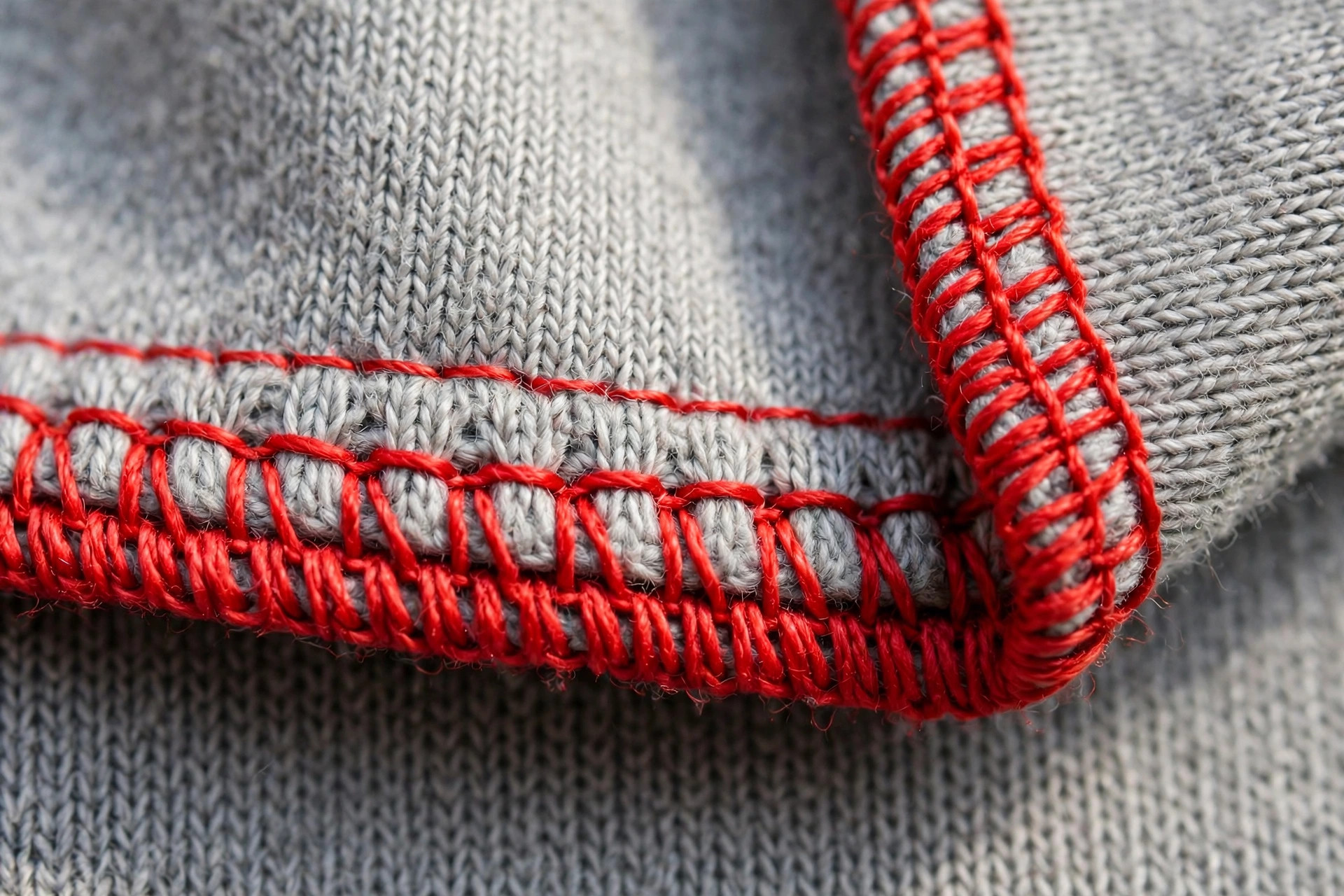
Stitch 504 is the three-thread overedge stitch: one needle thread and two looper threads interlooping over the cut edge of the material, the upper looper covering the top and the lower looper the underside, meeting in a purl on the edge. It is the standard serger stitch — the most widely used overedge stitch in the world.
What Stitch 504 Is
If you own a serged garment, stitch 504 is almost certainly what finished it. One needle works near the edge while two loopers divide the wrapping work between them: the upper looper lays thread across the top of the material out to the edge, and the lower looper does the same underneath, the two interlooping with each other on the edge and with the needle thread in the material. The result is a complete, balanced envelope of thread around the raw edge.
That completeness is why 504 became the default. It covers a fraying edge fully — no yarns escape — it stretches well enough to seam most knits, it runs at very high speed, and it asks only three cones of the machine. Set narrow with a short stitch it becomes a rolled-edge finish; set wide it is a serviceable seam. No other single stitch covers so much of the everyday ground.
How Stitch 504 Forms
- The knives trim the edge clean an instant before sewing. The needle carries its thread down through the material at the set bite from the edge.
- The lower looper passes its thread through the needle-thread loop beneath the material, then travels out toward the edge.
- The upper looper picks up the lower looper's thread and carries it up and over the edge, laying it across the top of the material toward the needle line.
- The needle descends again through the upper looper's thread, and the lower looper takes the new needle loop: all three threads interloop — needle with loopers in the material, loopers with each other on the edge, forming the purl.
- Tensions draw the interloopings snug: the purl sits on the edge, the upper looper covers the top, the lower looper covers the underside, and the feed advances the work.
Formation diagram for stitch 504, shown in cross-section at the fabric edge. Red is the needle thread; dark blue is the looper thread. Illustration by Apparel Search.
The Threads
| Element | Detail |
|---|---|
| Thread count | 3 — one needle thread, two looper threads (upper and lower). |
| Needle thread | The only thread that passes through the material; it anchors the whole formation and forms the straight line of segments on the top. |
| Upper looper thread | Covers the top surface from the needle line out to the edge, where it interloops with the lower looper. |
| Lower looper thread | Covers the underside the same way and carries the formation around the edge; it does most of the visible wrapping underneath. |
| Typical threads | Spun polyester in all three positions for general work; texturized (woolly) threads in the loopers for soft, covering finishes on knits and fleece. |
| Thread use | Moderate for the class — several times a lockstitch seam's consumption, rising with stitch width and density. |
What It Looks Like
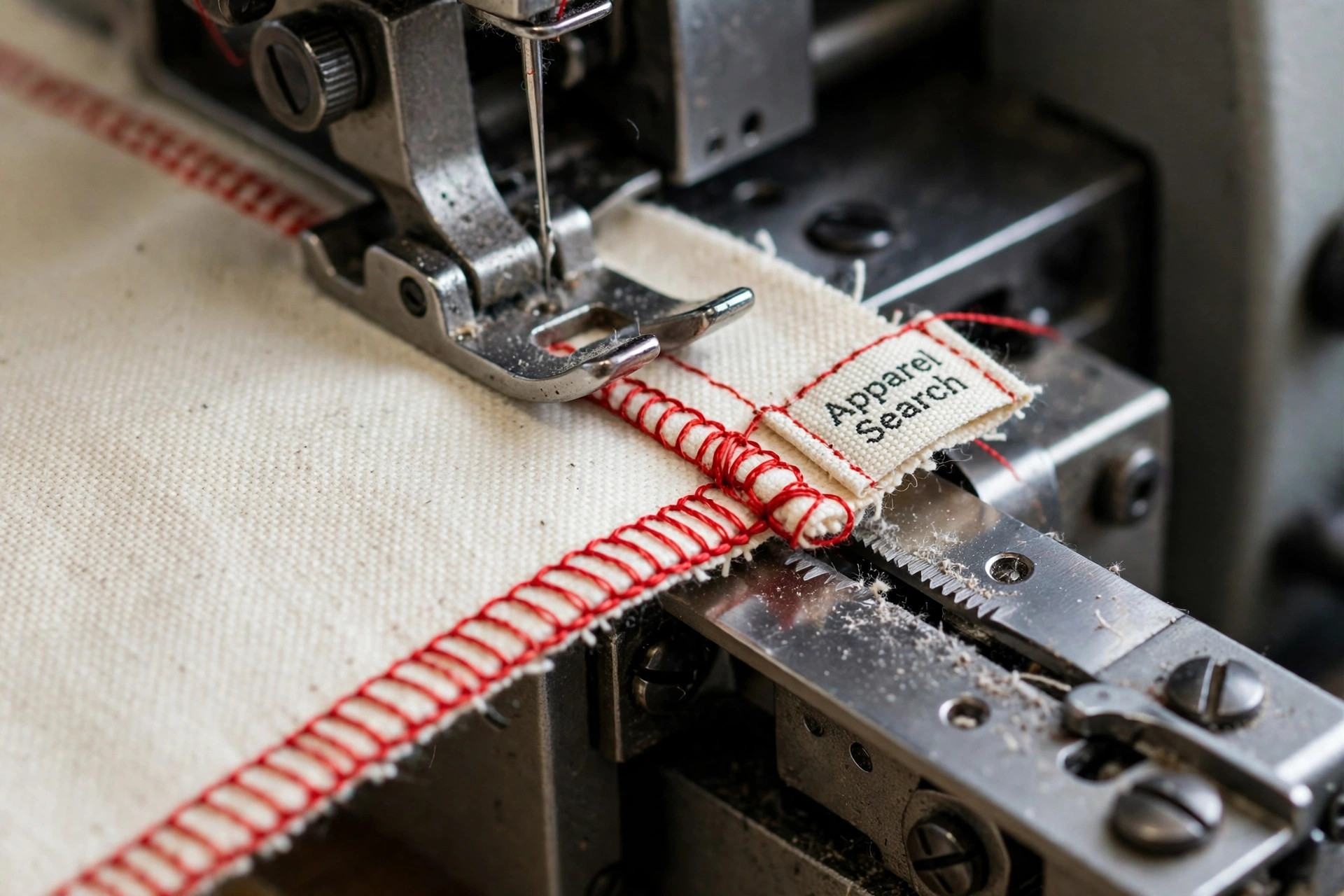
On the top, stitch 504 shows the needle thread as a straight row of short segments, with the upper looper thread filling the ground between the needle line and the edge in neat diagonal strokes. The edge wears a firm, even purl — a tiny beaded line where the two looper threads interloop.
On the underside, the lower looper lays a matching field of diagonals from the edge back toward the needle line. A balanced 504 looks almost the same from both sides, and that symmetry is the setup test: if the purl pulls to one face, the looper tensions are unequal.
Strengths and Limits
Strengths
- Complete edge coverage: the two loopers enclose the raw edge fully, so even fray-prone fabrics are contained.
- Good stretch and recovery — enough to seam most knit garments on its own.
- Fast and economical to run: three cones, no bobbin, very high machine speeds.
- Versatile: width and density settings take it from rolled edges to firm seaming.
Limits
- As a seam it is good, not great: under heavy strain the single needle row can grin, showing the threads between the plies.
- Uses several times the thread of a lockstitch seam, and the wrap adds bulk at crossed seams.
- The formation can run back from a broken looper thread more readily than a lockstitch can.
Where Stitch 504 Is Used
Stitch 504 does two great families of work. As a finish, it serges the edges of woven garment parts — trouser panels, jacket fronts, skirt sections — before or after seaming, and finishes the seam allowances inside unlined clothing. As a seam, it joins the majority of the world's T-shirts, sweatshirts, underwear and casual knitwear, trimming, joining and finishing in one pass. Narrow settings give rolled and picot-style edges on napkins, scarves and dancewear.
Typical fabrics: jersey, interlock and rib knits, fleece, French terry, and — for finishing — almost any woven from shirting to denim. When a knit seam must carry more load, the two-needle types 512 and 514 widen the formation; when a woven seam must be independent of its finish, stitch 516 pairs this same 504 wrap with a chainstitch row.
Common Questions
Is stitch 504 the stitch my home serger makes?
Very likely — the three-thread overlock is the standard serger formation, and most home and industrial overlock machines are set up for it by default. Four-thread machines add a second needle to make 512 or 514.
Can stitch 504 seam and finish at the same time?
Yes — that is the overlock principle. The knives trim, the needle joins the plies, and the loopers wrap the trimmed edge in the same pass. On knits that is usually the whole seam; on wovens the 504 is more often the finish beside a separate seam.
What is the purl on a 504 stitch?
The purl is the row of small interloopings the upper and lower looper threads form with each other along the very edge of the material. In a balanced stitch it sits exactly on the edge; if it rolls to the top or underside, the looper tensions need adjusting.
Sources & the photographic reference
The stitch and seam classifications on this page follow ASTM D-6193, Standard Practice for Stitches and Seams, explained here in Apparel Search's own words with original diagrams. For photographs of these stitches and seams, see the Garmenco guide's Class 500 page — Professor Bernard Kahn's photographic guide, which Apparel Search has recommended for years and continues to link as the photo reference for this classification. Our guide is the permanent on-site companion to it.
Related Stitches
 Stitch 503 — Two-Thread OveredgeOne needle, one looper: the lightest edge finish in the class.
 Stitch 505 — Double-Purl OveredgeThree threads building a doubled purl cord on the edge.
 Stitch 512 — Mock Safety StitchFour threads imitating a safety stitch in one pass.
 Stitch 514 — Four-Thread OveredgeTwo needles, two loopers: the strong knitwear seam stitch.
 Stitch 515 — Four-Thread Safety StitchA 401 chainstitch row plus a 503 overedge row, sewn together.
 Stitch 516 — Five-Thread Safety StitchA 401 chainstitch row plus a 504 overedge row, sewn together.
 Stitch 519 — Six-Thread Safety StitchA 401 chainstitch row plus a wide 514 overedge row.
 Stitch Class 500 — OveredgeThe whole class: how overedge stitches form, and how all eight types compare.
More to Explore
Search Apparel Search
Stitch and seam classifications follow ASTM D-6193, Standard Practice for Stitches and Seams. Diagrams on these pages are original Apparel Search drawings.