Airline Uniforms by Airline · Portugal
The TAP Air Portugal Uniform: Green, Red and Golden Stars
Green or red — the crew choose. TAP Air Portugal’s uniform, designed in 2007 by Manuel Alves and José Manuel Gonçalves and still in force today, lets attendants pick their flag colour, and since 2019 has spelled out rank in golden stars. Behind it stands the best-documented uniform history in aviation, published by the airline itself.
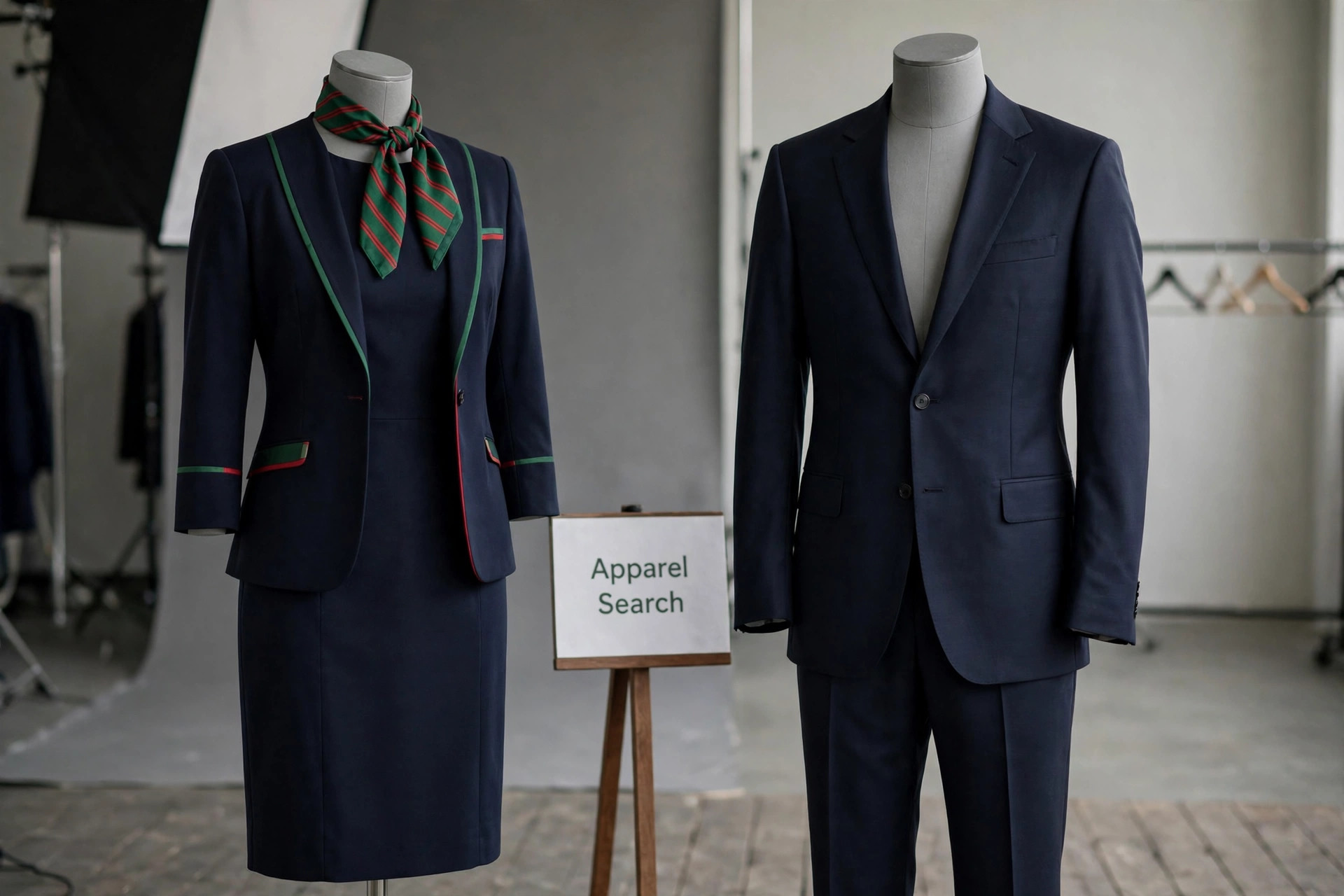
The Design
A Portuguese Competition, a Portuguese Answer
When TAP Air Portugal last renewed its uniform, it restricted the competition to Portuguese creators \u2014 and the winners, in 2007, were the duo Manuel Alves and Jos\u00e9 Manuel Gon\u00e7alves, of the Alves/Gon\u00e7alves atelier. In the words of TAP\u2019s own official uniform history, \u201cthe duo Manuel Alves and Jos\u00e9 Manuel Gon\u00e7alves signed the new image of the crew, which is still in force today.\u201d Nearly two decades later, that makes the current TAP wardrobe one of the longest-serving designs in this series \u2014 and, unusually, one whose entire ancestry the airline itself publishes, era by era, on a single official history page. This guide leans on that page heavily, and says so: TAP is the rare airline that documents its own uniform past better than anyone else can.
The wardrobe\u2019s colour idea is national and simple: green and red are the dominant colours \u2014 the two colours of Portugal\u2019s flag, between which crew can choose \u2014 combined with dark blue, the grounding note that runs through almost every TAP uniform since 1945. It is a mix-and-match wardrobe rather than a single fixed outfit, as the components section explains. The colourway has a lineage of its own inside TAP\u2019s record: red and green first appear together as accents in F\u00e9raud\u2019s 1980\u20131987 wardrobe, set against a return to dark blue. Alves and Gon\u00e7alves promoted that accent pairing to the wardrobe\u2019s dominant colours while keeping the dark blue beneath it \u2014 a design that reads, on the airline\u2019s own historical page, less like a rupture than like the latest verse of a long song: dark blue from 1945, folk details from Nazar\u00e9 and the Algarve, F\u00e9raud\u2019s gold accessories, and now the flag\u2019s two colours given equal billing and a personal choice between them. Few current uniforms can be traced through their own airline\u2019s archive this precisely, because few airlines keep one.

The Components
Mix, Match, Choose Your Colour
- A Wardrobe, Not an Outfit
- TAP documents the current collection as a set of pieces to combine: trousers, dresses, overcoats, blazers, coats and knitted sweaters \u201camong other elements\u201d \u2014 flight attendants choose between several pieces to build their working dress.
- Green or Red
- The signature choice: green and red are the dominant colours of the wardrobe, and crew can choose between them, combined with dark blue. Two colleagues on the same flight may be wearing the same design in different national colours.
- Observed Details
- Current TAP photography shows a dark navy dress or suit with red piping, a green-and-red neck scarf and red gloves. These details are recorded here as observed in photography, not as a published TAP specification \u2014 the airline\u2019s history page lists the wardrobe\u2019s pieces without itemising its trims.
- The Men\u2019s Uniform
- TAP notes that its men\u2019s uniforms have always kept a more militaristic line \u2014 a through-thread from the 1940s to today. The men\u2019s version of the current wardrobe is not itemised on the airline\u2019s history page, and this guide does not itemise it either.
- Pilots
- Pilots wear the standard pilot uniform of sleeve stripes and epaulettes, visible in TAP photography; no TAP-published pilot specification was found, so flight-deck dress is described here only at that level.
The Rank Code
Golden Stars Since 2019
TAP operates the clearest documented rank-coding system of any airline in this wave \u2014 and it is written in stars. Since 2019, flight attendants have worn golden star insignia identifying their role within the cabin:
| Insignia | Role |
|---|---|
| Golden stars | Flight Attendant |
| Golden stars | Purser |
| Golden stars | Cabin Supervisor |
TAP\u2019s history page confirms the star system and the three roles it distinguishes \u2014 flight attendant, purser and cabin supervisor. It does not state the exact number of stars per role, and this guide does not guess at the counts: the system is documented, the arithmetic is not. The stars also complete a pattern in TAP\u2019s record. Gold has been the wardrobe\u2019s metal since F\u00e9raud\u2019s third era, when gold buttons carried the airline\u2019s fourth logo and coloured and gold accessories multiplied across the uniform. The 2019 insignia took that established gold vocabulary and gave it a job: information. Even so, the 2019 change matters. For its first seven decades TAP identified its crew the way most airlines did, by dress and deportment; the golden stars gave the Alves/Gon\u00e7alves wardrobe a legible hierarchy that a passenger can read across a cabin \u2014 a small, bright piece of information design added twelve years into the wardrobe\u2019s life.
The F\u00e9raud Legend \u2014 and the Retro Jet
TAP\u2019s most famous uniform name is not its current one. Louis F\u00e9raud designed three successive TAP wardrobes between 1970 and 2007, and his first \u2014 above-knee dresses in yellow, red or blue, small-brim hats still carrying the Nazar\u00e9 pom-pom \u2014 is still considered one of the airline\u2019s most iconic uniforms. In 2017 TAP reproduced the F\u00e9raud look for special retro-jet flights, dressing crew in the 1970s design to celebrate the era. It is the surest sign of a uniform\u2019s afterlife: an airline does not revive a wardrobe for nostalgia flights unless the public already loves it. The current designers work in that shadow \u2014 and TAP\u2019s history page, which credits F\u00e9raud fully, is also the page that confirms Alves and Gon\u00e7alves as the present.
The Rules
Choice, Again \u2014 and an Honest Silence
TAP has not publicly documented a grooming code for the current wardrobe in press or reputable reporting \u2014 no published hair, make-up or tattoo standard was found for this guide, and none is supplied from imagination. What TAP documents instead, like several of its European peers in this series, is structured choice: attendants select among the wardrobe\u2019s pieces and between its green and red colourways. A uniform system that lets the wearer pick the colour of the national flag they wear is making a deliberate point about individual presentation inside a collective identity \u2014 the closest thing to a published styling rule this wardrobe has. The pattern repeats across this series\u2019 European guides \u2014 Iberia\u2019s footwear choice, ITA\u2019s skirt-or-trouser and formal-or-casual options, TAP\u2019s colourway choice \u2014 and it marks a generational shift in uniform design: the twentieth-century uniform prescribed a total appearance, while the twenty-first-century wardrobe prescribes a system and licenses the wearer inside it. TAP\u2019s version is the most visible of the three, because the choice it offers is not a shoe or a hem but a colour \u2014 half the flag or the other half, worn at the wearer\u2019s discretion, on the same aircraft, on the same day.
The Archive
An Airline That Publishes Its Own Uniform History
Almost everything in this guide\u2019s history section comes from a single, remarkable source: TAP\u2019s official page, \u201cA journey through the history of TAP uniforms,\u201d on the airline\u2019s own website. Airlines are not usually their own uniform historians. Most carriers\u2019 early wardrobes have to be reconstructed from museum holdings, auction listings and enthusiasts\u2019 photograph collections, with designers guessed at and dates argued over. TAP instead publishes the whole sequence itself \u2014 the BOAC instructor who designed the first uniform in 1945, the tropical kit for the Africa line, the chief pilot who designed the 1955 wardrobe, the Nazar\u00e9 pom-poms, the three F\u00e9raud eras, and the 2007 competition that produced the uniform still worn today.
The page is honest in a way corporate histories often are not. Where authorship is uncertain, TAP says so \u2014 the tropical uniform\u2019s designer is unrecorded, and Ana Maravilhas\u2019s 1959 attribution is given as \u201calmost certain\u201d rather than certain. Where a detail is a matter of national culture, it is explained: the felt hat\u2019s pom-poms quote the regional costume of Nazar\u00e9, and the 1959 white silk scarf was worn \u00e0 algarvia, in the manner of the Algarve. For the uniform researcher, that combination \u2014 primary source, dated eras, named designers, admitted gaps \u2014 is the gold standard, and it is why this guide can present eighty years of TAP dress with a confidence it cannot match for most other carriers. It also sets the standard the 2007 wardrobe will one day be judged by: Alves and Gon\u00e7alves are already written into the airline\u2019s own canon, on the same page as F\u00e9raud.
TAP does not just wear its history. It publishes it \u2014 pom-poms, attributions, uncertainties and all.
Evolution
1945 to Today, in the Airline\u2019s Own Record
1945\u20131947 \u2014 Miss Summers. TAP\u2019s first uniform was designed by Lucienne Marie \u201cMiss\u201d Summers, the ex-BOAC instructor of TAP\u2019s first class: a dark blue blazer and skirt, beige collared blouse, black tie, military-style cap and lace-up, thick-heeled black shoes.
1946\u20131953 \u2014 the tropical uniform. For the Africa line, a short-sleeved blouse, twill skirt, khaki panama hat and honey-coloured leather bag; its authorship is unknown, attributed to the crew themselves. A crew-authored update followed in 1948\u20131954: side-pleated skirt, white blouse, rounded felt hat, black suitcase.
1955\u20131963 \u2014 captains and couturiers. The Super Constellation era uniform of 1955\u20131956 was designed by Captain Silva Soares, the airline\u2019s chief pilot: grey, belted jacket, tight skirt, tie and cap restored. After a 1957\u20131958 return to dark blue \u2014 the tie dropped, a flat-shoe option introduced \u2014 the 1959\u20131963 wardrobe is attributed by TAP, as \u201calmost certain,\u201d to haute-couture designer Ana Maravilhas: the military line abandoned, and a white silk scarf worn \u00e0 algarvia over the hat.
1964\u20131969 \u2014 S\u00e9rgio Sampaio. Teal arrived, with a felt hat carrying two pom-poms inspired by the regional costume of Nazar\u00e9, a blazer with an above-knee skirt, a yellow collared blouse and white gloves \u2014 Portuguese folk dress quoted in an airline uniform, decades before \u201cheritage dressing\u201d had a name.
1970\u20132007 \u2014 the F\u00e9raud eras. Louis F\u00e9raud won three successive TAP wardrobes: the iconic 1970s dresses in yellow, red or blue; a 1980\u20131987 return to dark blue with red and green accents, pleated skirts and wide-brim felt hats; and a 1988\u20132007 third version rich in coloured and gold accessories, gold buttons bearing the airline\u2019s fourth logo, and a dark blue cardigan with detachable collars. Thirty-seven years of one designer is a record few airlines can match.
2007\u2013today \u2014 Alves/Gon\u00e7alves. The current wardrobe, described above, with the golden-star rank insignia added in 2019. No successor has been announced. Its longevity deserves a moment\u2019s attention: by the standards of TAP\u2019s own history, in which wardrobes turned over every five to nine years for six decades, a design still in force after nearly twenty years is a departure \u2014 closer to the thirty-seven-year F\u00e9raud span than to the rapid post-war cycle. Whether that reflects satisfaction with the design, the economics of uniform renewal, or both, the airline\u2019s page does not say; what it says, in the present tense, is that the 2007 image remains the crew\u2019s image today.
The Record Keeper
Why This Uniform Matters
TAP\u2019s uniform matters for two reasons. The first is the wardrobe itself: a flag-coloured, mix-and-match system that has served since 2007 and acquired, in its golden stars, the clearest rank language in this wave of guides. The second is the record. No other airline in this series publishes its complete uniform history \u2014 every era, designer and garment, from a BOAC instructor\u2019s 1945 blazer to the present duo \u2014 on its own website. That act of documentation is a design decision in itself: TAP treats its uniforms as national heritage, which, after eighty years of Nazar\u00e9 pom-poms, Algarvian scarves and F\u00e9raud dresses, they plainly are. One more distinction belongs to TAP. In a series where several airlines cannot document their rank systems, their grooming codes or even their current designer from public sources, TAP documents all three of the things it has \u2014 designer, colours and stars \u2014 on one official page, and dates them. That transparency is why this guide can be specific where others must be careful, and it is a standard worth naming: an airline that publishes its uniform history gets a better uniform guide. For the country behind the colours, see our Portugal clothing industry page.
Airlines refresh their uniforms from time to time, so the details here describe the uniform as documented for this guide — the airline’s own site always carries the latest version.
Common Questions
Common Questions
Who designed the current TAP Air Portugal uniform?
The Portuguese duo Manuel Alves and José Manuel Gonçalves, winners of TAP’s 2007 uniform-renewal competition, which was restricted to Portuguese creators. TAP’s own history page states their design ‘is still in force today.’
What colours is the TAP Air Portugal uniform?
Green and red are the dominant colours — crew can choose between them — combined with dark blue. The wardrobe is mix-and-match: trousers, dresses, overcoats, blazers, coats and knitted sweaters among other elements.
What do the golden stars on the TAP uniform mean?
Since 2019, flight attendants wear golden star insignia identifying their role: flight attendant, purser or cabin supervisor. TAP’s page confirms the star system and the three roles; the exact star count per role is not stated there.
Who designed TAP uniforms before 2007?
Louis Féraud designed three successive wardrobes between 1970 and 2007. Earlier designers in TAP’s own record include Lucienne Marie ‘Miss’ Summers (1945), Captain Silva Soares (1955), Ana Maravilhas (attributed, 1959) and Sérgio Sampaio (1964).
Has a successor to the current TAP uniform been announced?
No. The Alves/Gonçalves wardrobe of 2007 remains in force, with the golden-star insignia added in 2019, and no successor had been announced in the sources behind this guide.
Keep Exploring
More to Explore
In This Series
Airline Uniforms by Airline
The series hub — every airline’s guide, the designers behind them, and the ones in preparation.
Read ↑Portugal Clothing Industry
The airline’s home country in the World Clothing Industry directory.
Read ↑Go Deeper
Keep Exploring
Explore Fashion for Travel
The crew are only half the fashion on a flight — the other half is what the passengers are wearing. Our travel guides cover the traveller’s side of the same subject, and they link back here.
Outfits for Flying
Travel Outfits
What to wear when you are going somewhere — outfit systems built for transit days.
Read ↑Airport Outfits
Security-friendly shoes, cabin layers and the full airport dressing system.
Read ↑What to Wear on a Long Flight
Dressing for the overnight haul — comfort, warmth and arriving presentable.
Read ↑What to Wear When Traveling
The destination-rules guide to building a travel wardrobe that works on arrival.
Read ↑Business Travel Wardrobe Guide
A working wardrobe that travels — suits, wrinkle strategy and boardroom-ready arrivals.
Read ↑Packing & Capsule Wardrobes
Travel Capsule Wardrobe Guide
A small set of pieces that combine into a trip’s worth of outfits.
Read ↑Travel Packing Guide
The complete packing method — lists, order and wrinkle control.
Read ↑How to Pack a Suit
Getting a tailored jacket and trousers across the world without the creases.
Read ↑Carry-On Packing Guide
Everything in one bag — the carry-on-only system, piece by piece.
Read ↑Travel Comfort & Accessories
Search Apparel Search