Airline Uniforms by Airline · Finland
The Finnair Uniform by Ritva-Liisa Pohjalainen
Dark navy, white stripes like cherry blossom, and a small pillbox hat called a suikka: the Finnair uniform that has flown since December 2011 is the work of Finnish designer Ritva-Liisa Pohjalainen — and its story runs back to 1947, when six flight attendants had their first suits cut by a Helsinki men’s tailor. What follows is the current wardrobe, its hedged rank code, and a design history that includes space-age minis and a yellow “tea cosy” skirt.
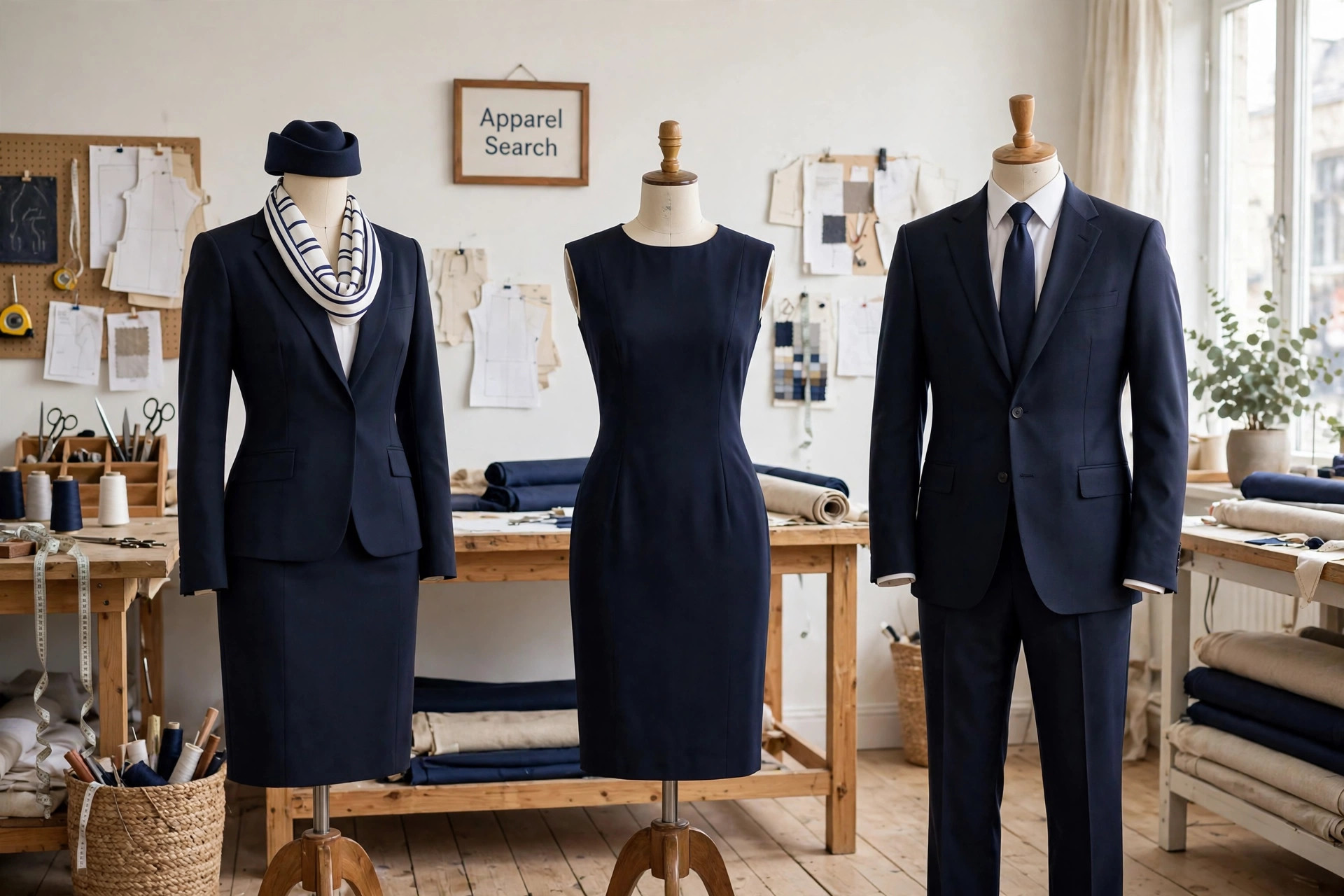
The Design
Pohjalainen’s Dark Blue, Twice Stated by the Airline
Few designer attributions in this series are as well sourced as this one. Finnair’s own website, in two separate Blue Wings articles, states that “Finnair’s current uniform is designed by Ritva-Liisa Pohjalainen and has been in use since 2011.” The Finnish jewellery and clothing designer’s wardrobe was unveiled in September 2011 and crew began wearing it in mid-December 2011, as part of the brand renewal that followed the airline’s logo change in December 2010.
The design decision is a darkening. The previous uniform had been “icy blue” for almost ten years; Pohjalainen replaced it with a dark blue — dark navy — contrasted with stripes of “cherry blossom white”. The phrase comes from the contemporary launch reporting, and it captures the wardrobe’s character: Nordic dark, with a white counterpoint drawn from the airline’s Japanese market as much as from its Finnish one. The men’s and women’s wardrobes share the palette entirely, so a Finnair crew in a terminal reads as one dark-blue group with white accents, whatever the role.
Sequencing mattered to the result. The logo changed first, in December 2010; the uniform followed a year later, in December 2011, so the new brand identity met passengers on the aircraft and the signage before it met them on the crew — and when the crew’s clothes did change, the change of shade did the talking. Going darker is a classic flag-carrier move when a brand matures: the icy blue of the 2000s had been distinctive but light, where the dark navy reads as established, photographs better against both snow and tarmac, and gives the white scarf and stripes something to contrast against. Pohjalainen, whose own design practice spans jewellery as well as clothing, treated the palette the way a jeweller treats a setting — one dark ground, one bright accent, nothing else competing.

The Components
The Outfit, Piece by Piece
- Skirt, Trousers or Dress
- Women choose a skirt or trousers, or a dress — the basic wardrobe offering, cut in dark navy across sizes 30 to 52 and four body types, in some 1,000 item variants.
- Jacket, Blouse and Jumper
- The jacket, blouse and jumper layer the wardrobe for cabin temperature and season; a top and a tunic were discontinued from 2022.
- The Scarf
- A white scarf with navy stripes for women — the cherry-blossom white made visible at the neck. Our scarf definition covers the garment itself.
- The Suikka
- An optional pillbox-style hat, the suikka — a small, close-fitting piece of headwear that nods to the airline’s earlier uniform hats without copying any of them.
- Gloves and Winter Coat
- Black leather gloves and a woollen winter coat complete the cold-weather kit — and the gloves are also a safety item, as the rules section below explains.
- The Men’s Suit
- A dark blue suit — jacket and trousers — with shirt, tie, jumper and a vest with epaulettes for rank, plus gloves and a winter coat.
Practicality is designed into the collection: fire-retardant materials and practical pockets are built in, the sort of specification passengers never notice and crew notice every shift. And the wardrobe keeps being extended rather than replaced: black sneakers joined as a footwear option in 2023, and a gender-neutral Makia winter coat — by the Helsinki brand Makia, based on its AY100 collection jacket — was added in November 2024 for Finnair and Norra cabin crew and airport customer-service staff.
The Rank Code
Stripes, Hedged Honestly
This section carries a deliberate caution. Finnair does not publish a stripe table in its press material, and no Finnair press page stating one was opened for this guide — the code below is sourced from Wikipedia’s Finnair article, consistent with crew imagery, and is carried as such. The one- and three-stripe ends of the ladder are the safe ground; the middle step is attributed, not asserted:
| Stripes | Rank | Note |
|---|---|---|
| 1 stripe | Cabin Crew | Normal cabin crew; on epaulettes for male crew wearing vests. |
| 2 stripes | Senior Cabin Crew as Purser | Attributed to outsourced Spanish crew in the source; carried here as sourced, not confirmed. |
| 3 stripes | Purser / Chief Purser | The senior cabin rank. |
Two further details ride with the code. Some female pursers are said to have a white vertical stripe on the dress or blouse indicating years of service — but the source’s wording is ambiguous, and it may denote service years rather than rank, so it is phrased here as a report, not a rule. And the gloves are required during take-off and landing for safety reasons — a wearing rule that belongs to the uniform itself, whatever the rank.
The Men’s Uniform
Dark Navy, Epaulettes on the Vest
The men’s wardrobe is the dark-blue suit at its most complete: jacket and trousers in the same navy as the women’s tailoring, a shirt and tie, a jumper for layering, and a vest with epaulettes that carries the rank stripes — the men’s rank board is the vest, worn open over the shirt, rather than the sleeve alone. Gloves and a winter coat complete it, and the same 2023 sneaker option and 2024 Makia coat apply. Like the rest of the collection, it is a wardrobe specified for a Nordic carrier’s working conditions first and a photograph second.
One boundary is worth recording for completeness: the sources for this guide describe the 2011 wardrobe as the cabin and ground crew uniform, and do not separately document a flight-deck wardrobe — so, unlike some guides in this series, this one makes no claims about a distinct pilots’ dress at Finnair.
The Uniform That Comes Back
Finnair’s most modern uniform story is not about design but about lifespan. From early 2023 the airline has run a reuse and recycling programme covering cabin and ground crew uniforms, keeping the 2011 wardrobe in service and out of landfill — worked-out garments are recycled through the work-clothing manufacturer Image Wear, which supplies the collection. Extending a uniform’s life by years, then issuing it a new winter coat rather than a new design, is a quieter kind of sustainability than a launch, and a fitting one for a wardrobe whose designer set out to make something durable in the first place.
The Rules
Grooming: Not Publicly Documented
This guide states plainly what it cannot document: Finnair’s grooming code is not publicly documented in press or reputable reporting. What is documented is the uniform-wearing side of presentation: gloves during take-off and landing, and black footwear — now including the black sneaker option introduced in 2023. Numbers sometimes quoted from a crew member’s personal social video — earring sizes, heel heights, stocking deniers — are not used here, because personal social media is not a press or reputable source for a published code. The honest summary, again, is a short one: a complete wardrobe with published wearing rules, and a grooming code the airline has not made public.
Evolution
From 1947 to Pohjalainen
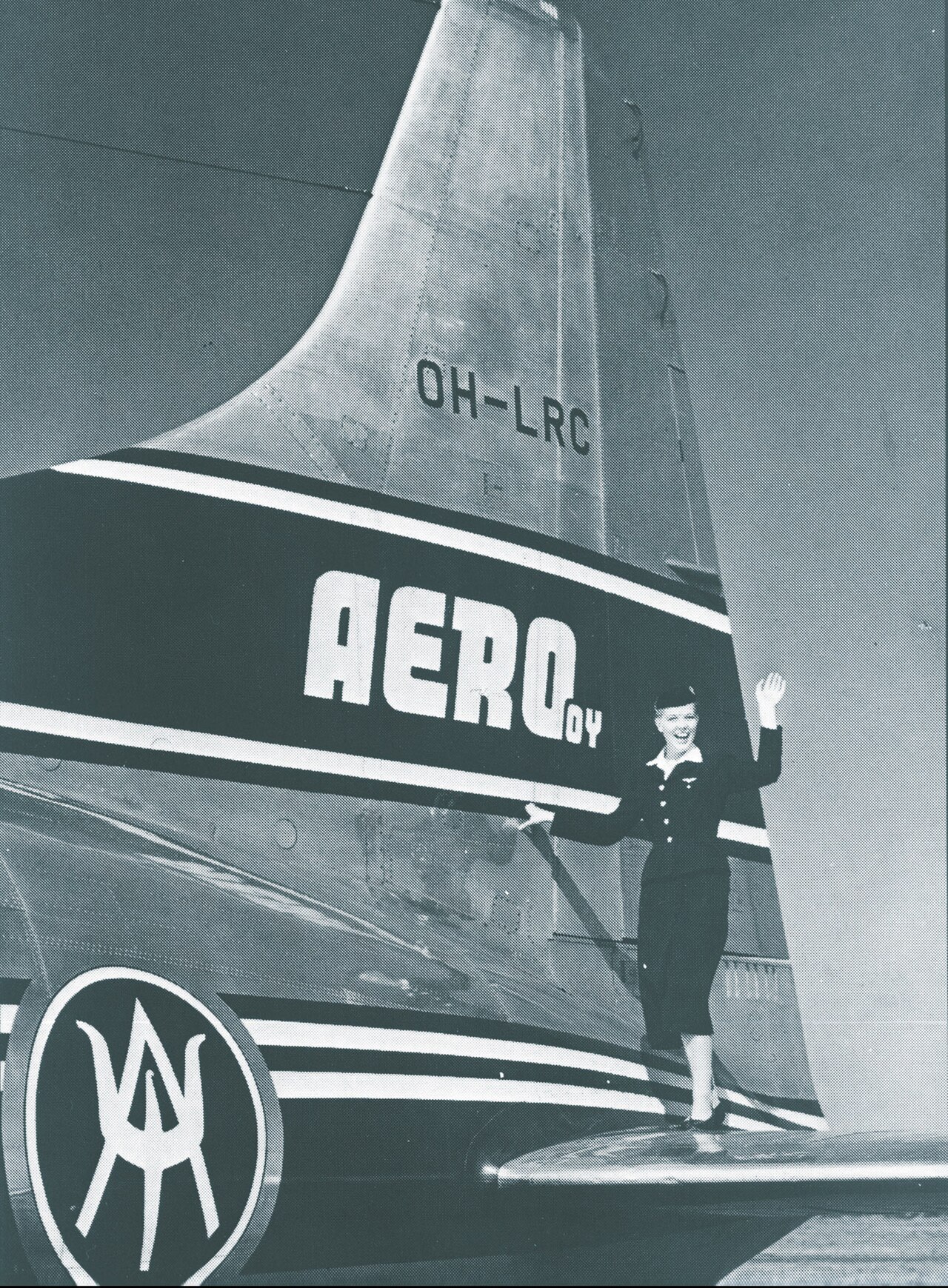
The first Finnair uniforms date from 1947, when Aero O/Y, the airline’s predecessor, employed six female flight attendants: the dark blue suit was made with a Helsinki Stockmann men’s tailor, the attendants themselves working with the tailor on the fit. That is the whole lineage in miniature — a dark-blue suit, made in Helsinki, fitted to its wearer.
This history is not locked in an archive: it has been exhibited. Finavia, the Finnish airport operator, celebrated the cabin-crew uniforms across the years in an exhibition showcase at Helsinki Airport, drawing on the Finnish Aviation Museum’s material — the same museum provenance behind the 1973 Vuokko photograph in this guide. An airline whose old uniforms are museum pieces in its own home airport is an airline whose design history is part of its public identity, and it sets the context in which Pohjalainen’s restraint makes sense. The 2011 wardrobe did not need to quote the mini skirts, the velour prints or the tea-cosy skirt; it needed to be worthy of the same exhibition case in forty years’ time, which is a brief for dark cloth, clean lines and nothing that dates.
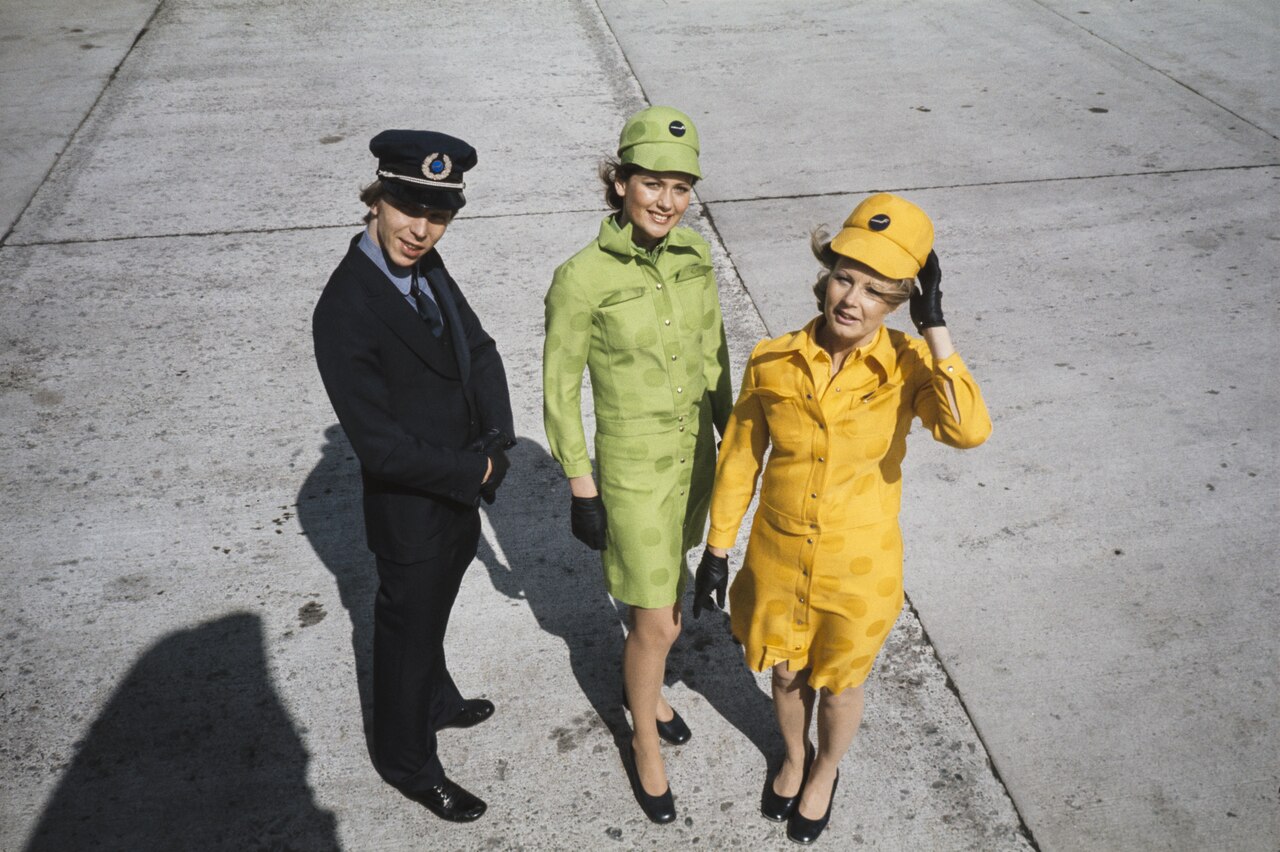
The 1960s and 1970s are the wardrobe’s exuberant decades. In 1969 came a space-age look — knee-length mini skirts and silver tops, inspired by the Moon landing and the airline’s first US route. The 1970s “Finn Hostesses” on long-haul were dressed by a yearly competition of Finnish designers: blue-and-white Suomen Trikoo velour graphic-print dresses, a long beige leather skirt by Friitala, the bright yellow padded “tea cosy” skirt, mink hats and silver jewellery by Björn Weckström. The named designers of those decades — Marimekko, Vuokko and Pertti Palmrooth — are the reason a 1973 photograph of the Vuokko-designed summer working clothes still reads as fashion, not uniform.
The scale hidden inside the modern wardrobe deserves its own note. A collection spanning skirts and trousers, dresses, jackets and blouses in sizes 30 to 52, for four body types, in around 1,000 item variants is less a uniform than a small clothing range with one colour scheme — and it explains both the recycling programme’s value and the absence of a redesign. Replacing a wardrobe of that complexity is a multi-year industrial project; extending it, as Finnair has done with sneakers, a new coat and a reuse pipeline, keeps the investment working. The 2022 discontinuation of the top and the tunic shows the same logic in miniature: a living wardrobe is edited piece by piece, not only replaced in revolutions.
Trousers for women arrived in the late 1990s. The pre-2011 uniform was an “icy blue” design worn for almost ten years, roughly 2001 to 2011 — its designer was not found in the sources for this guide — and it was once ranked fifth most stylish by the French magazine Bon Voyage. Pohjalainen’s dark blue, from December 2011, closed that era and opened the current one, now in its fifteenth year and still being extended rather than replaced.
The Icon
Dark Blue, Made to Last
The Finnair uniform’s achievement is a durable one, in two senses: a dark-blue wardrobe that has lasted fifteen years without a redesign, and a design history that has survived as national fashion history, from a Stockmann tailor’s cutting room in 1947 through Vuokko’s 1973 summer clothes to the recycling programme of today. Pohjalainen’s contribution was to choose a dark, confident palette and leave it alone — the airline has spent the years since extending the wardrobe’s life rather than its look. For the country whose designers made it, see our Finland clothing industry page.
Airlines refresh their uniforms from time to time, so the details here describe the uniform as documented for this guide — the airline’s own site always carries the latest version.
Common Questions
Common Questions
Who designed the Finnair uniform?
Finnish jewellery and clothing designer Ritva-Liisa Pohjalainen. Finnair states on its own website, in two separate articles, that its current uniform was designed by Pohjalainen and has been in use since 2011. It was unveiled in September 2011 and crew began wearing it in mid-December 2011, as part of a brand renewal that followed the airline's logo change in December 2010.
What colours is the Finnair uniform?
Dark blue — dark navy — and white. The darker blue replaced the icy blue the previous uniform had used for almost ten years, and it is contrasted with stripes of cherry blossom white. The women's scarf is white with navy stripes; the men's suit is dark blue throughout.
What do the stripes on a Finnair uniform mean?
The rank code is not stated on a Finnair press page, so it is carried here hedged, from Wikipedia's Finnair article: one sleeve stripe is normal cabin crew, two stripes a senior cabin crew member acting as purser, and three stripes a purser or chief purser. Some female pursers are also said to have a white vertical stripe on the dress or blouse indicating years of service — a detail whose wording is ambiguous in the source.
What is the suikka?
The suikka is the optional pillbox-style hat of the current Finnair uniform — a small, close-fitting hat worn with the dark navy wardrobe. It belongs to the collection of headwear in a uniform whose full kit runs from skirt or trousers and dress through jacket, blouse and jumper to black leather gloves and a woollen winter coat.
Is Finnair replacing its 2011 uniform?
No successor has been announced as of late 2026. Instead, Finnair is extending the 2011 uniform's life: a reuse and recycling programme for cabin and ground crew uniforms runs from early 2023, black sneakers became a footwear option in 2023, and a gender-neutral Makia winter coat joined the wardrobe in November 2024.
Keep Exploring
More to Explore
In This Series
Airline Uniforms by Airline
The series hub — every airline’s guide, the designers behind them, and the ones in preparation.
Read ↑Finland Clothing Industry
The airline’s home country in the World Clothing Industry directory.
Read ↑Go Deeper
Uniforms — Definition
What a uniform is, and why organisations dress their people alike.
Read ↑Scarf — Definition
The white striped scarf of the current wardrobe, defined.
Read ↑Epaulette — Definition
The vest epaulettes that carry the men’s rank stripes, defined.
Read ↑Woolen Fabric — Definition
The woollen cloth of the winter uniform, defined.
Read ↑Keep Exploring
Explore Fashion for Travel
The crew are only half the fashion on a flight — the other half is what the passengers are wearing. Our travel guides cover the traveller’s side of the same subject, and they link back here.
Outfits for Flying
Travel Outfits
What to wear when you are going somewhere — outfit systems built for transit days.
Read ↑Airport Outfits
Security-friendly shoes, cabin layers and the full airport dressing system.
Read ↑What to Wear on a Long Flight
Dressing for the overnight haul — comfort, warmth and arriving presentable.
Read ↑What to Wear When Traveling
The destination-rules guide to building a travel wardrobe that works on arrival.
Read ↑Business Travel Wardrobe Guide
A working wardrobe that travels — suits, wrinkle strategy and boardroom-ready arrivals.
Read ↑Packing & Capsule Wardrobes
Travel Capsule Wardrobe Guide
A small set of pieces that combine into a trip’s worth of outfits.
Read ↑Travel Packing Guide
The complete packing method — lists, order and wrinkle control.
Read ↑How to Pack a Suit
Getting a tailored jacket and trousers across the world without the creases.
Read ↑Carry-On Packing Guide
Everything in one bag — the carry-on-only system, piece by piece.
Read ↑Travel Comfort & Accessories
Search Apparel Search