Airline Uniforms by Airline · Spain
The Iberia Uniform: Teresa Helbig’s Navy Wardrobe
Navy for professionalism, fawn like a second skin, and the red and yellow of Spain placed stitch by stitch: Teresa Helbig — the first woman to design for Iberia — built a twenty-piece wardrobe that was unveiled on a fashion-week runway in 2020 and only took to the air in June 2022. This guide tells both halves of that story.
The Design
A First for Iberia: A Woman at the Drawing Board
Spanish couturiers have designed Iberia\u2019s uniforms since 1952 \u2014 the airline itself recites the lineage: Pedro Rodr\u00edguez, Manuel Pertegaz, Elio Berhanyer, Alfredo Caral and Adolfo Dom\u00ednguez. The current wardrobe broke that seventy-year pattern in one important way: it was designed by Teresa Helbig, the Catalan designer who, in Iberia\u2019s own words, is the first woman to design a uniform for the airline. Helbig was chosen in 2018, and she approached the job as a wardrobe rather than a costume \u2014 twenty garments and pieces that flight crew and ground staff mix across roles, seasons and body types.
The chronology matters, because this uniform has two birthdays. The collection was presented at Mercedes-Benz Fashion Week Madrid in February 2020 \u2014 a catwalk unveiling, with the clothes photographed, reviewed and celebrated. Then the pandemic grounded the rollout. The uniform\u2019s actual in-service debut came more than two years later, in June 2022, when it was first worn \u201cin the air\u201d from Iberia\u2019s Madrid hub and then across the network, on nearly 7,000 flight crew and ground staff. So the Helbig wardrobe was unveiled in 2020 but has only been worn since June 2022 \u2014 a distinction Iberia\u2019s own reporting is careful to keep, and so is this guide. The twenty pieces were manufactured by El Corte Ingl\u00e9s, according to launch reporting.
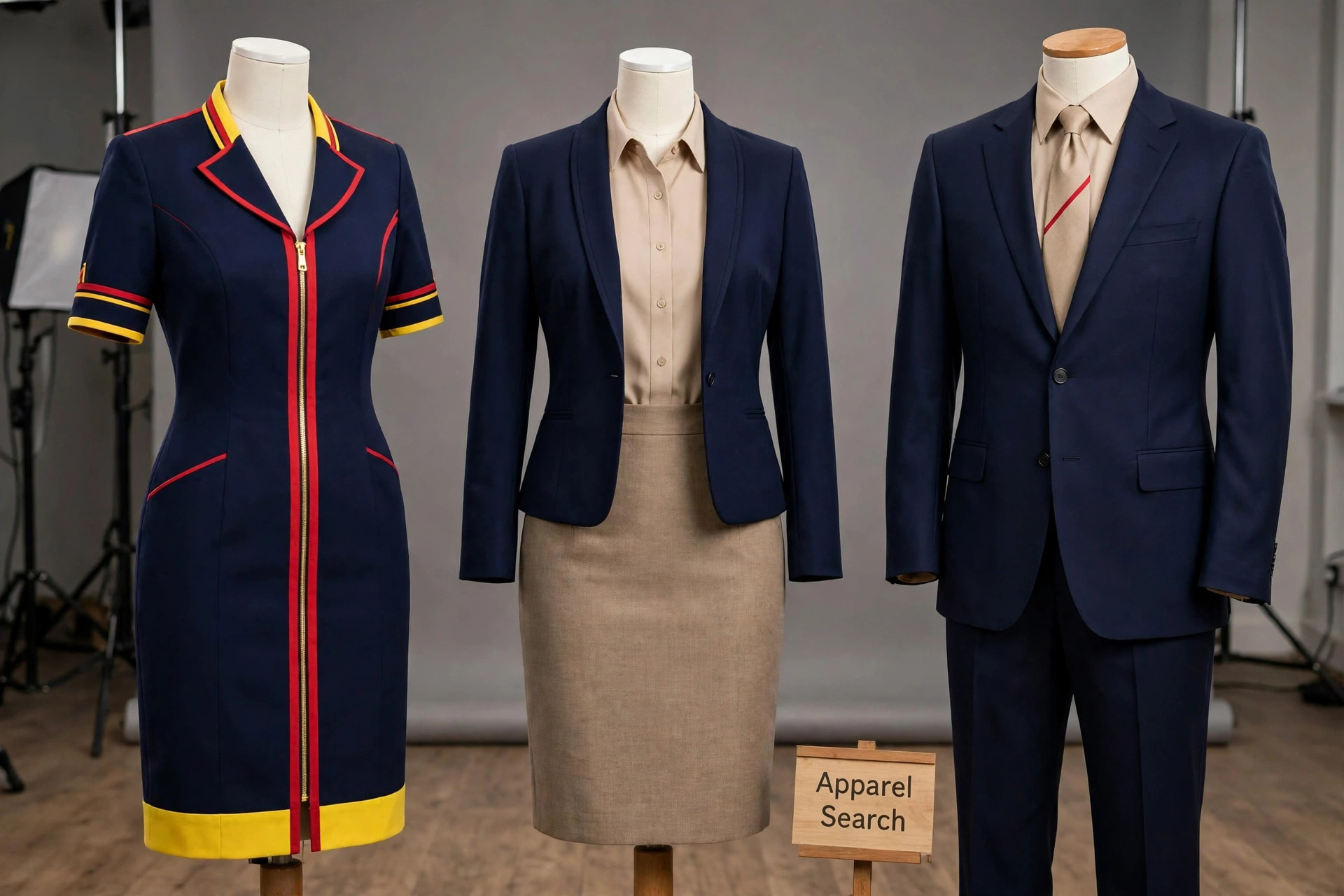
Helbig built the wardrobe on three colour ideas. Navy blue predominates \u2014 in the airline\u2019s words, for balance and professionalism. Against it she set blouses and shirts in a soft fawn tone, described as authenticity and neutrality, \u201clike a second skin.\u201d And through both run Iberia\u2019s signature red and yellow, placed as details rather than blocks: at cuffs, collar, back and openings, as the stripe on the tie and the trim on the dress. The effect is a uniform that reads sober navy at a distance and unmistakably Spanish up close.

The Components
Twenty Pieces, One Wardrobe
- The Dress
- The iconic piece of the collection: a navy dress finished with grosgrain ribbons, red-and-yellow details and a gold zip \u2014 the garment Helbig\u2019s presentation made the face of the wardrobe.
- Skirt and Trousers
- A reinterpreted straight \u2014 pencil \u2014 skirt, and trousers cut to aid movement, so crew choose the lower half that suits the duty and the wearer. Our pencil skirt definition covers the silhouette the skirt reworks.
- The Jacket
- A short-fit jacket with a high break and narrow lapels \u2014 deliberate retro touches that nod to the tailored Iberia uniforms of earlier decades.
- Blouse and Shirt
- In fawn, for women and men alike: the soft neutral layer worn under the navy tailoring, with the red-and-yellow detail appearing at collar and cuffs.
- Knitwear and Coats
- Knitted layers for the cabin and a coat for winter stations; men are offered a feather gilet as an alternative to the coat.
- Scarf, Gloves and Bag
- A scarf that can be worn open or closed, gloves, and a handbag inspired by a Chanel classic complete the women\u2019s accessories.
- Footwear Choice
- A genuine first for Iberia: alongside the classic high- or medium-heel shoe, women can choose flat ballet pumps or a sports shoe \u2014 footwear as a choice, not a prescription. Men also have a sports shoe option.
- The Men\u2019s Suit
- A tailored navy suit with the fawn shirt and a narrow tie carrying a single red stripe \u2014 the red-and-yellow signature reduced to one confident line.
One wardrobe family covers both flight crews and ground staff \u2014 the twenty pieces were designed as a single collection for the whole customer-facing airline. Iberia\u2019s published material does not itemise a separate flight-deck design within the collection, so this guide does not invent one: what is documented is one Helbig wardrobe, worn in the cabin and on the ground. Launch reporting also noted a pregnancy uniform within the collection, a detail reported by a single source and carried here as such.
Reading the Uniform
Red Knitwear: The One Published Signal
Most airlines publish a ladder of stripes, bars and braid. Iberia, for this wardrobe, has published something simpler and more practical. In the airline\u2019s own launch wording, the knitwear is solid red for easy identification of flight attendants, supervisors and duty managers \u2014 a block of Iberia red that lets a passenger (or a colleague in a crowded terminal) spot a member of the uniformed team at a glance.
That is the extent of the documented system. The sources behind this guide do not describe a finer stripe or epaulette ladder within the Helbig wardrobe, or a distinct purser outfit, and this guide will not manufacture one. The red that appears at the dress and blouse neck trim and as the stripe on the men\u2019s tie is a design detail \u2014 the signature colours placed where the eye lands \u2014 rather than a rank code. Where other airlines encode hierarchy, Iberia\u2019s current uniform encodes findability: one red layer, worn by the people whose job is to be found.
Unveiled in 2020, Worn from 2022
A uniform\u2019s unveiling is theatre; its first day in service is logistics. Iberia\u2019s Helbig collection had its theatre in February 2020, on a Madrid fashion-week runway \u2014 and then waited out a pandemic on the hanger while the airline flew on in the old Adolfo Dom\u00ednguez wardrobe. When the new clothes finally boarded in June 2022, nearly 7,000 people changed their working dress at once. Few uniforms carry a two-year gap between the photographs and the reality; remembering which date is which is the difference between describing this uniform and misdating it.
The Rules
What Is \u2014 and Is Not \u2014 Published
Iberia has not publicly documented a grooming code for this wardrobe in the press and reputable reporting behind this guide: no published make-up specification, tattoo rule or hair standard accompanies the Helbig collection in the sources available. This guide says so plainly rather than filling the silence with the generic cabin-crew rules that circulate online.
What is documented is a philosophy of choice built into the garments themselves. Women choose between skirt and trousers, between a heel, a flat ballet pump or a sports shoe; the scarf can be worn open or closed; men choose between coat and feather gilet. Within a tightly colour-controlled wardrobe \u2014 navy, fawn, red, yellow \u2014 the individual decisions are deliberately left to the wearer. That balance, prescription at the level of colour and freedom at the level of combination, is the closest thing to a published \u201crule\u201d this uniform has.
Evolution
Seventy Years of Spanish Couture
Iberia is unusual among airlines in treating its uniform history as a chapter of national fashion history. Its first cabin crew uniform, in 1946, was military-inspired \u2014 a detail carried by secondary histories rather than the airline\u2019s own releases. From 1952 the airline turned to Spain\u2019s couturiers, and the dated episodes below are corroborated by Iberia\u2019s own archive captions.
1962 \u2014 Pedro Rodr\u00edguez. The first professional fashion designer to work for Iberia produced four uniform types, setting the template of the couturier commission that the airline still follows.
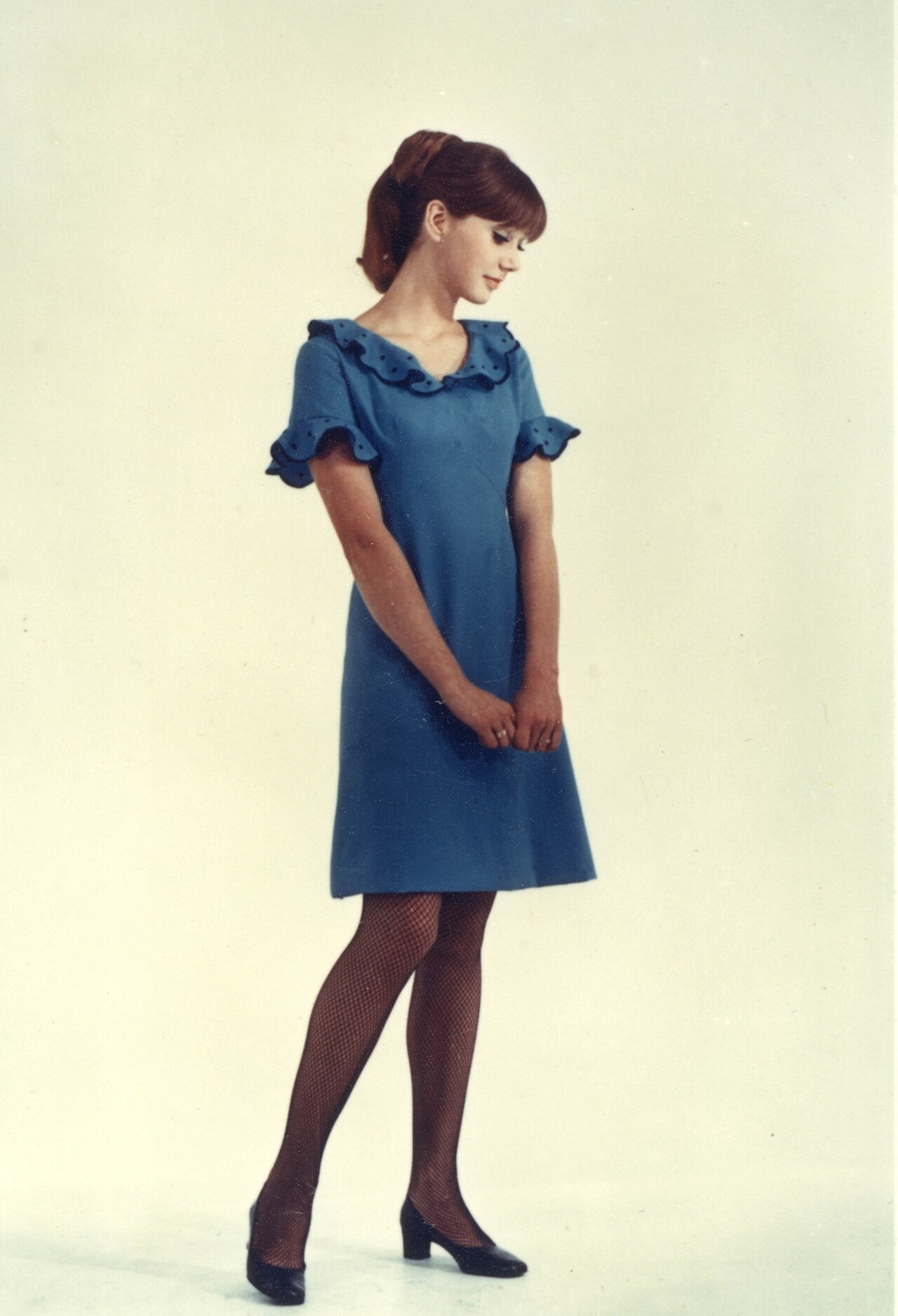
1968 \u2014 Manuel Pertegaz. A total overhaul: a turquoise dress with Andalusian overtones for cabin crew \u2014 the most flamboyant chapter in the airline\u2019s uniform story, and a reminder that Iberia red-and-yellow was not always the palette.
1972 and 1983 \u2014 Elio Berhanyer. Berhanyer brought blue back in 1972, designing on aesthetics, functionality and identity, and returned in 1983 with a design the airline calls \u201cCanary Islands Blue.\u201d
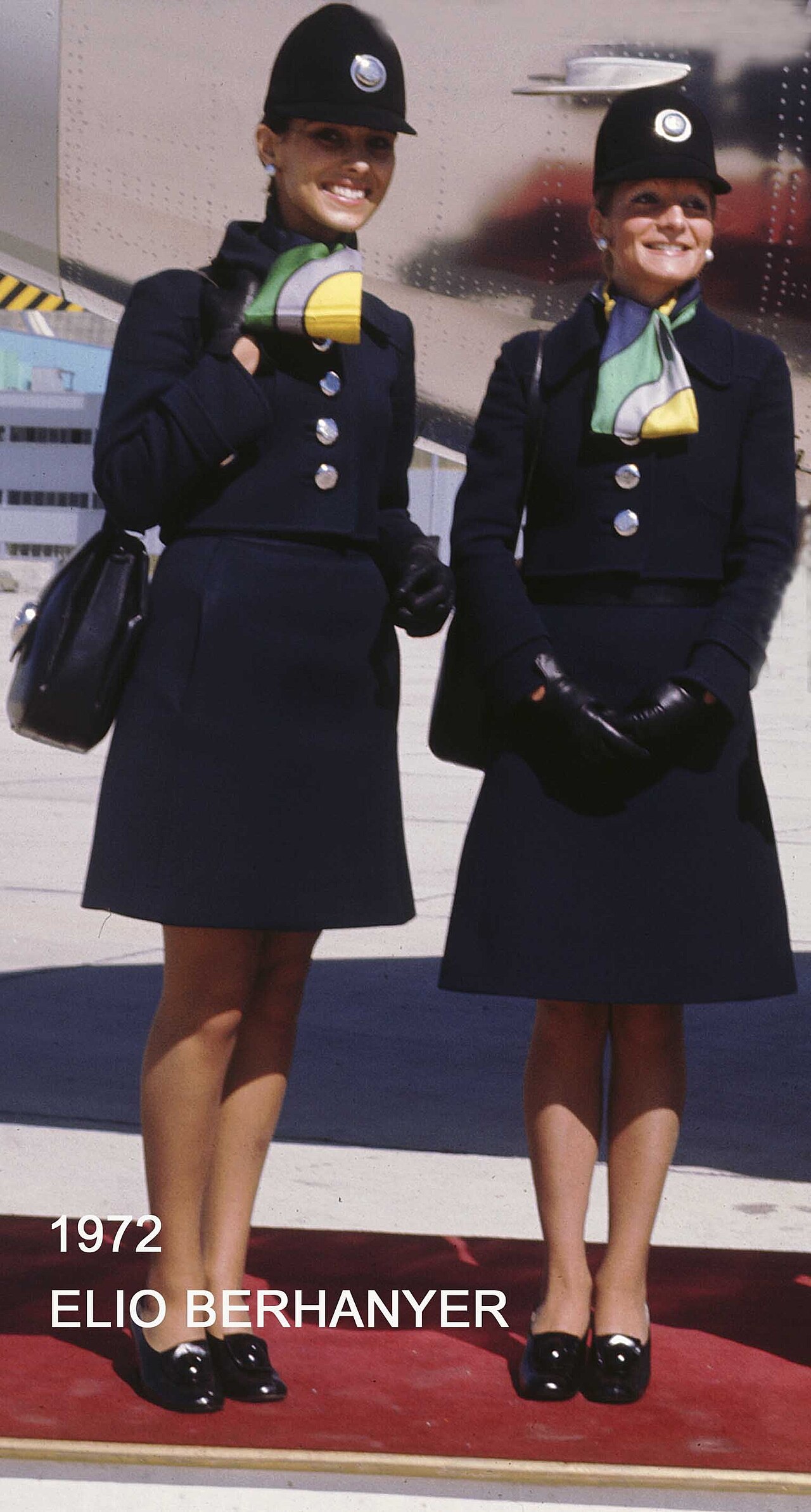
Iberia keeps this history unusually visible: the airline has published its archive uniform photographs \u2014 the Rodr\u00edguez, Pertegaz and Berhanyer designs among them \u2014 through its own photo channels with captions naming the designer and the year. For a uniform guide, that matters. Most airlines\u2019 early wardrobes survive only in enthusiasts\u2019 scans of uncertain origin; Iberia\u2019s survives as an airline-curated record, which is why the lineage in this section can be dated and attributed from the carrier\u2019s own captions rather than from memory. It is also a clue to how the airline sees the current wardrobe: not as a break with that archive, but as its next captioned entry \u2014 the Helbig design of 2020, worn from 2022, filed alongside Rodr\u00edguez 1962, Pertegaz 1968 and Berhanyer 1972.
2005\u20132022 \u2014 Adolfo Dom\u00ednguez. The long-serving predecessor: minimalist formal suits, a narrow V-neck jacket, a skirt-or-trouser choice and white or red open-collar shirts in dark navy. It flew for seventeen years \u2014 and, thanks to the delayed rollout, two years longer than planned. No successor to the Helbig wardrobe has been announced; four years into its service life, it remains the current uniform.
From Runway to Runway
Making Twenty Pieces for 7,000 People
A fashion-week presentation shows a uniform as an idea; a rollout shows it as an industrial programme. Helbig\u2019s wardrobe had to be manufactured \u2014 by El Corte Ingl\u00e9s, per launch reporting \u2014 in twenty distinct pieces, sized and issued to nearly 7,000 flight crew and ground staff, and introduced hub-first: Madrid in June 2022, then worldwide. That scale explains design decisions that can look purely aesthetic. A mix-and-match wardrobe of twenty pieces lets one production run dress a purser in Bilbao and a check-in agent in Buenos Aires from the same rail; a restricted palette of navy, fawn, red and yellow keeps every combination on-brand; and offering three footwear options inside the wardrobe removes the most common source of uniform discomfort without breaking the silhouette.
The details repay a closer look. The dress\u2019s grosgrain ribbons \u2014 a stiff, ribbed woven tape \u2014 give a soft garment a tailored edge that survives industrial laundering better than applied decoration. The gold zip is both closure and jewellery. The jacket\u2019s high break and narrow lapels reach back past the minimalist Dom\u00ednguez years to the sharper tailoring of the Berhanyer era, while the fawn blouse does quieter work: a warm neutral that flatters a wide range of skin tones under cabin light, which is what the airline\u2019s \u201csecond skin\u201d phrase is really describing. Even the handbag carries a reference \u2014 modelled on a Chanel classic, it is the one openly Parisian note in an otherwise insistently Spanish wardrobe, a small acknowledgement that airline glamour has always spoken two languages.
Unveiled in 2020, worn from 2022 \u2014 few uniforms carry a two-year gap between the photographs and the reality.
That gap also makes the Helbig wardrobe a useful case study in how uniforms age. A design frozen in February 2020 \u2014 before remote work, before the post-pandemic reset of business travel \u2014 entered service in a different aviation world in June 2022, and has worn well in it precisely because its bets were conservative: navy tailoring, a neutral blouse, national colours as accents, and comfort options (trousers, flats, sports shoes) that the industry has only moved further toward since.
The Lineage
Why This Uniform Matters
Every national carrier\u2019s uniform is an argument about its country. Iberia\u2019s argument is continuity: an unbroken line of Spanish designers from 1952 to a Catalan designer chosen in 2018, the flag\u2019s red and yellow carried as accents through every era, and a wardrobe that treats a ballet pump and a couture dress as parts of the same professional kit. Helbig\u2019s collection also closed a gap in that story \u2014 after seven decades of men designing what Iberia\u2019s largely female cabin crews wear, the airline\u2019s own release made a point of the fact that a woman had finally designed it. For the country whose fashion industry produced every name in that lineage, see our Spain clothing industry page \u2014 and for the dress tradition that still shapes Spanish occasionwear, our flamenco dress guide.
Airlines refresh their uniforms from time to time, so the details here describe the uniform as documented for this guide — the airline’s own site always carries the latest version.
Common Questions
Common Questions
Who designed the current Iberia uniform?
Teresa Helbig, the Catalan designer chosen in 2018 — the first woman to design a uniform for Iberia, in the airline’s own words. Her twenty-piece collection covers flight crew and ground staff in one wardrobe family.
When did the Teresa Helbig Iberia uniform enter service?
It was presented at Mercedes-Benz Fashion Week Madrid in February 2020, but the in-service debut was delayed and took place in June 2022, worn by nearly 7,000 flight crew and ground staff. It was unveiled in 2020; it has been worn since June 2022.
What colours is the Iberia uniform?
Navy blue predominates, for balance and professionalism; blouses and shirts are fawn, described as being like a second skin; and Iberia’s signature red and yellow appear in details — cuffs, collar, back, openings, the tie stripe and the dress trim.
How can you identify Iberia crew roles from the uniform?
By the knitwear: Iberia’s launch wording states that the knitwear is solid red for easy identification of flight attendants, supervisors and duty managers. No finer stripe or epaulette rank ladder for this wardrobe has been published.
Who designed Iberia uniforms before Teresa Helbig?
Spanish couturiers have designed Iberia uniforms since 1952. The airline’s own lineage names Pedro Rodríguez (1962), Manuel Pertegaz (1968), Elio Berhanyer (1972 and 1983), Alfredo Caral and Adolfo Domínguez, whose minimalist wardrobe served from 2005 until the Helbig collection replaced it in 2022.
Keep Exploring
More to Explore
In This Series
Airline Uniforms by Airline
The series hub — every airline’s guide, the designers behind them, and the ones in preparation.
Read ↑Spain Clothing Industry
The airline’s home country in the World Clothing Industry directory.
Read ↑Go Deeper
Uniforms — Definition
What a uniform is, and why organisations dress their people alike.
Read ↑Flamenco Dress — Traditional Dress of Spain
The ruffled dress of Andalusia — the regional tradition Pertegaz’s 1968 Iberia uniform nodded to.
Read ↑Pencil Skirt — Definition
The straight, narrow skirt silhouette Helbig reinterpreted for the wardrobe.
Read ↑Scarf — Definition
The accessory Iberia’s crew can wear open or closed, defined.
Read ↑Keep Exploring
Explore Fashion for Travel
The crew are only half the fashion on a flight — the other half is what the passengers are wearing. Our travel guides cover the traveller’s side of the same subject, and they link back here.
Outfits for Flying
Travel Outfits
What to wear when you are going somewhere — outfit systems built for transit days.
Read ↑Airport Outfits
Security-friendly shoes, cabin layers and the full airport dressing system.
Read ↑What to Wear on a Long Flight
Dressing for the overnight haul — comfort, warmth and arriving presentable.
Read ↑What to Wear When Traveling
The destination-rules guide to building a travel wardrobe that works on arrival.
Read ↑Business Travel Wardrobe Guide
A working wardrobe that travels — suits, wrinkle strategy and boardroom-ready arrivals.
Read ↑Packing & Capsule Wardrobes
Travel Capsule Wardrobe Guide
A small set of pieces that combine into a trip’s worth of outfits.
Read ↑Travel Packing Guide
The complete packing method — lists, order and wrinkle control.
Read ↑How to Pack a Suit
Getting a tailored jacket and trousers across the world without the creases.
Read ↑Carry-On Packing Guide
Everything in one bag — the carry-on-only system, piece by piece.
Read ↑Travel Comfort & Accessories
Search Apparel Search