Airline Uniforms by Airline · Iceland
The Icelandair Uniform by Steinunn
Most airlines replace a uniform every few years. Icelandair kept one for fifteen. The midnight-navy wardrobe designed in 2008 — drawn, its launch coverage said, from Icelandic nature, the airline’s history and the Icelandic national costume — served essentially unchanged until November 2023, when the airline chose not to replace it but to evolve it: wider choice for crew, accessories designed through a university competition, and a parka made with Iceland’s own outdoor brand. This is that wardrobe, piece by piece.
The Design
A 2008 Wardrobe Drawn from the National Costume
Icelandair’s current uniform begins with a date the airline itself is proud of. In the airline’s own words, “our classic uniforms were designed in 2008, and it’s a testament to just how well they were designed that only now are we looking to expand and improve them.” That sentence, from Icelandair’s November 2023 uniform page, frames the whole story: this is not a wardrobe that failed and was replaced, but one that lasted — fifteen years in service, essentially unchanged, before the airline decided to build on it rather than discard it.
The designer of that 2008 base wardrobe was the Icelandic designer Steinunn Sigurðardóttir, of the label STEiNUNN — a credit this guide carries with one honest qualification. Icelandair’s own current page dates the design to 2008 but does not name her; the Steinunn attribution rests on the airline’s 2008 launch coverage and contemporaneous reporting of the rebrand, which described the new uniforms as designed by Steinunn and as reflecting Icelandic nature, Icelandair’s history and the Icelandic national costume. That triple inspiration matters, because it explains the wardrobe’s character: tailored and formal enough for a flag carrier, but rooted in national dress rather than in a generic international template. Where many uniforms of the period chased a fashion moment, this one was briefed from heritage — one reason, perhaps, that it could stay in service for a decade and a half without dating.
The 2008 uniform arrived as part of a full rebrand — new website, new seats, new interiors and a third cabin class alongside the new clothes — so the wardrobe was designed as one element of a complete identity, not as an isolated clothing order. Its modern supply line is equally worth stating precisely, because uniform credits are often blurred. The airline’s current uniform supplier is Olino Uniforms, a Danish company — Icelandair says it is “happy to continue our collaboration with Olino Uniforms” — but Olino is the manufacturer and supplier of the wardrobe, not its named fashion designer, and this guide credits it as such. The named creative credits belong to Steinunn for the 2008 base, and to the two 2023 collaborators — Arthur Moreillon for the accessories and 66°North for the parka — whose work is covered below.
The Components
The Outfit, Piece by Piece
- The Blazer
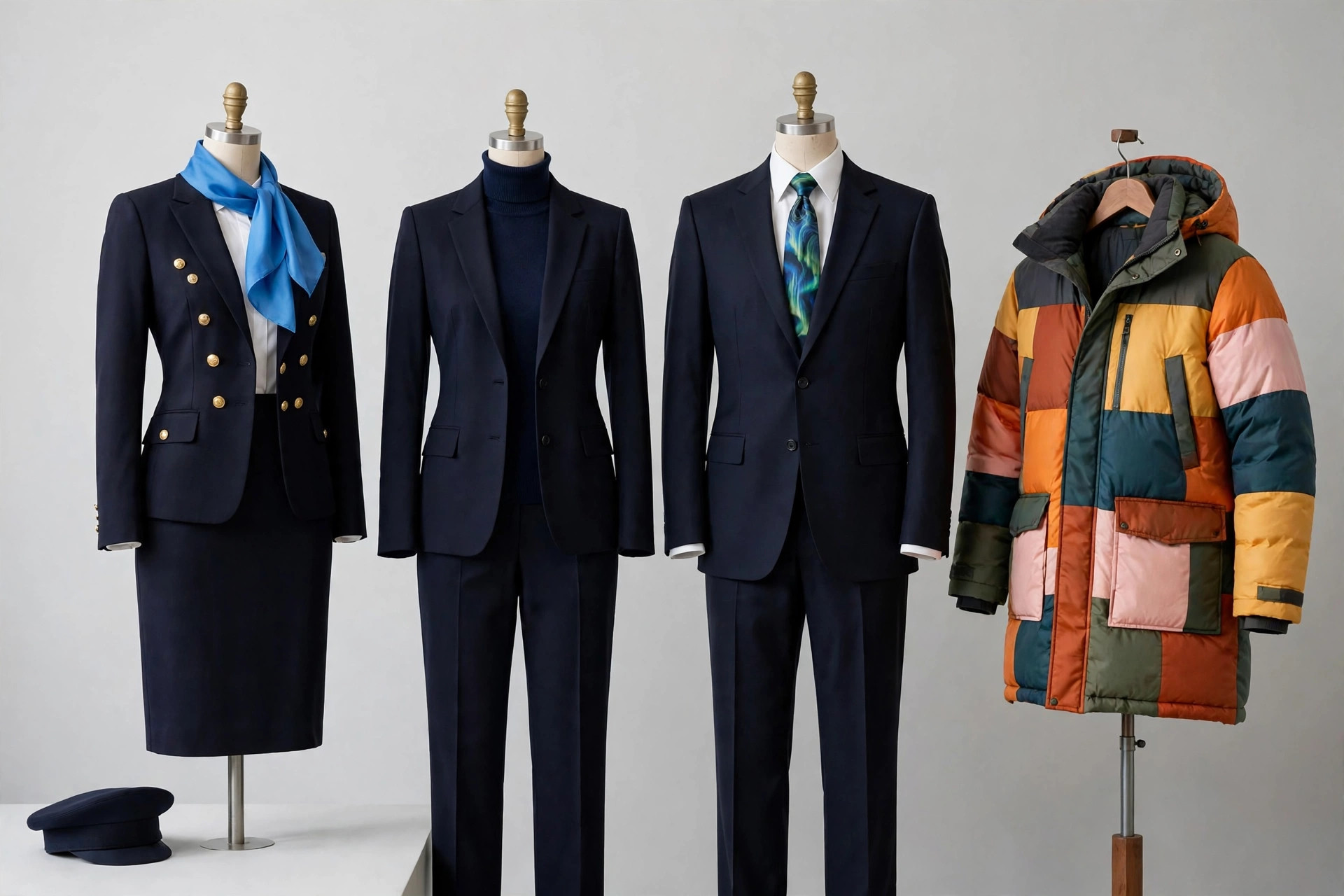
- A fitted blazer in dark, midnight navy, finished with gold buttons — the tailored centrepiece of the women’s wardrobe and the garment that sets its formal register.
- The Pencil Skirt
- A matching knee-length pencil skirt in the same navy, worn with the blazer as the classic 2008 silhouette.
- The Blouse
- A white blouse under the blazer — the light contrast piece against the navy tailoring.
- The Cabin-Crew Hat
- A dark navy cabin-crew hat, part of the documented 2008 women’s outfit.
- The Silk Scarf
- A silk scarf in vivid, bright blue — the wardrobe’s signature flash of colour against the navy, and the accessory redesigned in 2023, as the darkband story below explains. Our scarf definition covers the accessory itself.
- The Wing Badge
- A silver wing badge worn on the uniform — the one piece of insignia documented for the cabin wardrobe.
- Tights and Heels
- Black tights and black heels completed the 2008 women’s issue — the heel being one of the items the 2023 refresh turned into a choice rather than a requirement.
- The Choice Layer, from 2023
- Since November 2023 the wardrobe is assembled, not simply issued: crew may choose a dress or trousers, a shirt or a turtleneck sweater, and heels or flats, from an expanded range of sizes and shapes with more unisex options. The 2008 design remains the foundation; the wearer now decides more of its final form.
- The 66°North Parka
- The outerwear layer, co-designed with Icelandic outdoor brand 66°North for 2023: brand-coloured, lightweight and water-resistant, with shell and lining in 100% recycled polyester and Polartec Power Fill insulation made from recycled bottles. Our parka definition covers the garment type.
One uniform family covers far more than the cabin. Icelandair describes the same system dressing flight attendants, pilots, Saga Lounge staff, check-in and boarding staff, baggage staff and even fuel handling at small domestic airports — role-appropriate variants within a single design system, so that the person fuelling a domestic departure in Iceland wears recognisably the same uniform idea as the crew member greeting passengers at the aircraft door. That breadth is part of why the 2023 changes were framed around fit and choice: a wardrobe worn by that many different jobs, in that many different weathers, has to flex.
Reading the Uniform
One System, Many Roles — and No Colour Code
Some airlines in this series spell out rank in colour — a different kebaya, scarf or stripe for every step of seniority. Icelandair, on the published evidence, does not. The sources opened for this guide document exactly one piece of insignia on the cabin uniform: the silver wing badge. No scarf-colour rank system is documented, and no distinct outfit for a senior or purser rank is described in the airline’s published material — so this guide records the absence honestly rather than inventing a code to fill the table other guides in this series can complete.
What can be read from the uniform is role, not rank. The same design family spans the airline — cabin crew, pilots, lounge, check-in and boarding, baggage and domestic fuel handling — with variants appropriate to each job. Pilot-specific items, however, are not itemised in the material the airline has published about the wardrobe, and this guide does not guess at them: the honest statement is that pilots wear the same uniform family, in a form the airline has not publicly broken down garment by garment. In a series full of stripe ladders and colour codes, Icelandair’s system is the quiet counterexample — identity carried by the tailoring and the blue scarf, not by a visible hierarchy.
The Men’s Uniform
The Navy Counterpart
The men’s wardrobe is the tailoring counterpart of the women’s: navy suiting within the same 2008 design language, worn across the same range of roles. Icelandair’s own description of the pre-2023 system is disarmingly simple — there was “mainly one outfit for men, and one for women” — and that simplicity is itself the documented fact about the men’s uniform for most of its life: one standard navy outfit, without the layered options the women’s wardrobe description itemises.
The 2023 refresh changed the men’s position in two documented ways. First, the redesigned accessories explicitly include men’s pieces: the tie and bow tie were part of the university-competition redesign described below, so the northern-lights pattern entered the men’s wardrobe directly. Second, the refresh’s wider architecture — the expanded size and shape range and the more unisex options — was presented as a system-wide change, not a women’s-only one. Beyond that, the airline has not published a garment-by-garment breakdown of the men’s outfit, and this guide leaves the detail where the record leaves it: a navy tailored uniform, one outfit deep for fifteen years, widened — like the rest of the system — in 2023.
A Scarf Drawn from a Church, a Tie Drawn from the Sky
The most Icelandic design story in the 2023 refresh is its smallest. Icelandair redesigned its silk scarf, tie and bow tie through a competition with Listaháskóli Íslands — the Iceland University of the Arts — and the winning entry came from Arthur Moreillon, a Swiss graphic and product-design student on exchange in Iceland. His tie carries a northern-lights pattern; his scarf is built around the star and compass rose of Hallgrímskirkja, Reykjavík’s great church, with Iceland itself at the centre, ringed by the aurora, in a motif inspired by weaving and embroidery. A flag carrier’s neckwear, designed by a visiting student, from the country’s most famous building and its most famous sky — it is hard to imagine a more concentrated piece of national branding, or a better argument for running a competition instead of commissioning a safe design.
The Rules
Choice, Documented — Grooming Rules, Not Published
Icelandair does not publish a grooming manual, and no set of hair, make-up or jewellery rules for its crew was found in the sources for this guide — so this section will not invent any. What is publicly documented, and what genuinely changed crew members’ daily experience in November 2023, is not grooming policy but uniform choice: the move from mainly one outfit per gender to a system in which crew choose between a dress or trousers, a shirt or a turtleneck sweater, and heels or flats, across an expanded range of sizes and shapes, with more unisex options throughout.
That distinction is worth keeping sharp, because the two are often blurred in uniform writing. A heel that becomes optional is a uniform-design decision, published by the airline as part of a wardrobe refresh; it is not evidence of a wider grooming code, and none is claimed here. The documented Icelandair story is about what the airline issues and lets its people choose — and on that subject, unusually, the airline has been specific and public.
Evolution
Fifteen Years, Then an Evolution — Not a Replacement
2008. The Steinunn wardrobe debuts as part of a full Icelandair rebrand, its inspiration stated as Icelandic nature, the airline’s history and the Icelandic national costume. 2008–2023. The wardrobe then does the rarest thing a uniform can do: nothing. For roughly fifteen years it serves essentially unchanged — a span the airline itself cites as proof of how well it was designed. Uniform history is usually a sequence of redesigns; Icelandair’s modern history is a single long tenure, and any honest evolution section has to say plainly that the pre-2008 wardrobes were not documented in the sources opened for this guide, rather than padding the timeline with unverified earlier eras.
November 2023. The refresh arrives as part of a wider livery and colour-palette update, and its watchword is expansion: an expanded size and shape range, more unisex options, the choice architecture described above, Moreillon’s redesigned scarf, tie and bow tie, and the 66°North parka, with supply continuing through Olino Uniforms. The sustainability thread runs through the whole package — a parka whose shell, lining and insulation are all recycled materials, and old uniforms recycled rather than discarded, including through DesignMarch projects that gave retired garments a second, designed life. And the position since is explicit: the 2023 programme was framed as “expand and improve,” and no successor uniform has been announced. The 2008 design is not awaiting replacement; it has been renewed in place.
The Icon
Why Longevity Is This Uniform’s Signature
Every guide in this series ends by asking what its uniform proves. Icelandair’s proves something unfashionable: that a uniform can be a fifteen-year asset rather than a three-year campaign. Steinunn’s 2008 wardrobe — hedged in its attribution, as this guide has been careful to keep it, but consistent in its documented facts — took its brief from the national costume and national landscape, and was then left alone long enough for consistency itself to become recognition. When change finally came, it came in the most Icelandic forms available: a parka built with the country’s own outdoor brand from recycled materials, neckwear designed by competition at the national art university from a church tower and the northern lights, and retired uniforms recycled into design projects instead of landfill. The result is a uniform system that reads, at any airport it serves, as Iceland dressing its own airline. Iceland files within our Europe clothing industry coverage — Apparel Search does not publish a separate Iceland country page — and the traditional-dress inspiration behind the 2008 design belongs to the same European dress heritage that section surveys.
Airlines refresh their uniforms from time to time, so the details here describe the uniform as documented for this guide — the airline’s own site always carries the latest version.
Common Questions
Common Questions
Who designed the Icelandair uniform?
The base wardrobe was designed in 2008 by Icelandic designer Steinunn Sigurðardóttir, of the label STEiNUNN, according to the airline's 2008 launch coverage; Icelandair's own current uniform page dates the design to 2008 without naming her. The November 2023 refresh was developed by Icelandair with its uniform supplier Olino Uniforms, with accessories by Arthur Moreillon and a parka co-designed with 66°North.
Has the Icelandair uniform changed since 2008?
Not by replacement. The 2008 design served for about 15 years essentially unchanged, and in November 2023 Icelandair expanded and improved it rather than replacing it: a wider size and shape range, more unisex options, crew choice between dress or trousers, shirt or turtleneck sweater and heels or flats, redesigned scarf, tie and bow tie, and a new 66°North parka. No successor uniform has been announced.
What does the Icelandair uniform consist of?
The documented 2008 women's wardrobe is a fitted dark navy blazer with gold buttons, a matching knee-length pencil skirt, a white blouse, a dark navy cabin-crew hat, a bright blue silk scarf, a silver wing badge, black tights and black heels, with navy tailoring as the men's counterpart. Since 2023 crew can choose dress or trousers, shirt or turtleneck sweater, and heels or flats, and wear a brand-coloured parka co-designed with 66°North.
Who designed the Icelandair scarf, tie and parka?
The silk scarf, tie and bow tie were redesigned in 2023 through a competition with the Iceland University of the Arts, won by Swiss exchange student Arthur Moreillon: a northern-lights pattern on the tie, and a scarf pattern built around the Hallgrímskirkja star and compass rose with Iceland at its centre. The parka was co-designed with Icelandic outdoor brand 66°North, in brand colours, with a shell and lining of 100% recycled polyester.
Is there a rank code in the Icelandair uniform?
No colour-coded rank system is documented. The one insignia described in the sources for this guide is the silver wing badge worn on the cabin-crew uniform. No scarf-colour rank system and no distinct senior-crew outfit are documented, and pilot-specific items are not itemised in the airline's published material.
Keep Exploring
More to Explore
In This Series
Airline Uniforms by Airline
The series hub — every airline’s guide, the designers behind them, and the ones in preparation.
Read ↑Europe Clothing Industry
The airline’s home region in the World Clothing Industry directory. Apparel Search does not publish a separate Iceland country page, so Icelandair is filed here under Europe.
Read ↑Go Deeper
Uniforms — Definition
What a uniform is, and why organisations dress their people alike.
Read ↑Parka — Definition
The hooded cold-weather coat — the garment 66°North reworked for Icelandair crew, defined.
Read ↑Scarf — Definition
The wardrobe’s brightest accent — and, since 2023, its most Icelandic design story — defined.
Read ↑Tie & Necktie — Definition
The men’s finishing piece, redesigned in 2023 with a northern-lights pattern, defined.
Read ↑Keep Exploring
Explore Fashion for Travel
The crew are only half the fashion on a flight — the other half is what the passengers are wearing. Our travel guides cover the traveller’s side of the same subject, and they link back here.
Outfits for Flying
Travel Outfits
What to wear when you are going somewhere — outfit systems built for transit days.
Read ↑Airport Outfits
Security-friendly shoes, cabin layers and the full airport dressing system.
Read ↑What to Wear on a Long Flight
Dressing for the overnight haul — comfort, warmth and arriving presentable.
Read ↑What to Wear When Traveling
The destination-rules guide to building a travel wardrobe that works on arrival.
Read ↑Business Travel Wardrobe Guide
A working wardrobe that travels — suits, wrinkle strategy and boardroom-ready arrivals.
Read ↑Packing & Capsule Wardrobes
Travel Capsule Wardrobe Guide
A small set of pieces that combine into a trip’s worth of outfits.
Read ↑Travel Packing Guide
The complete packing method — lists, order and wrinkle control.
Read ↑How to Pack a Suit
Getting a tailored jacket and trousers across the world without the creases.
Read ↑Carry-On Packing Guide
Everything in one bag — the carry-on-only system, piece by piece.
Read ↑Travel Comfort & Accessories
Search Apparel Search