Airline Uniforms by Airline · Switzerland
The SWISS Uniform by Ruth Grüninger
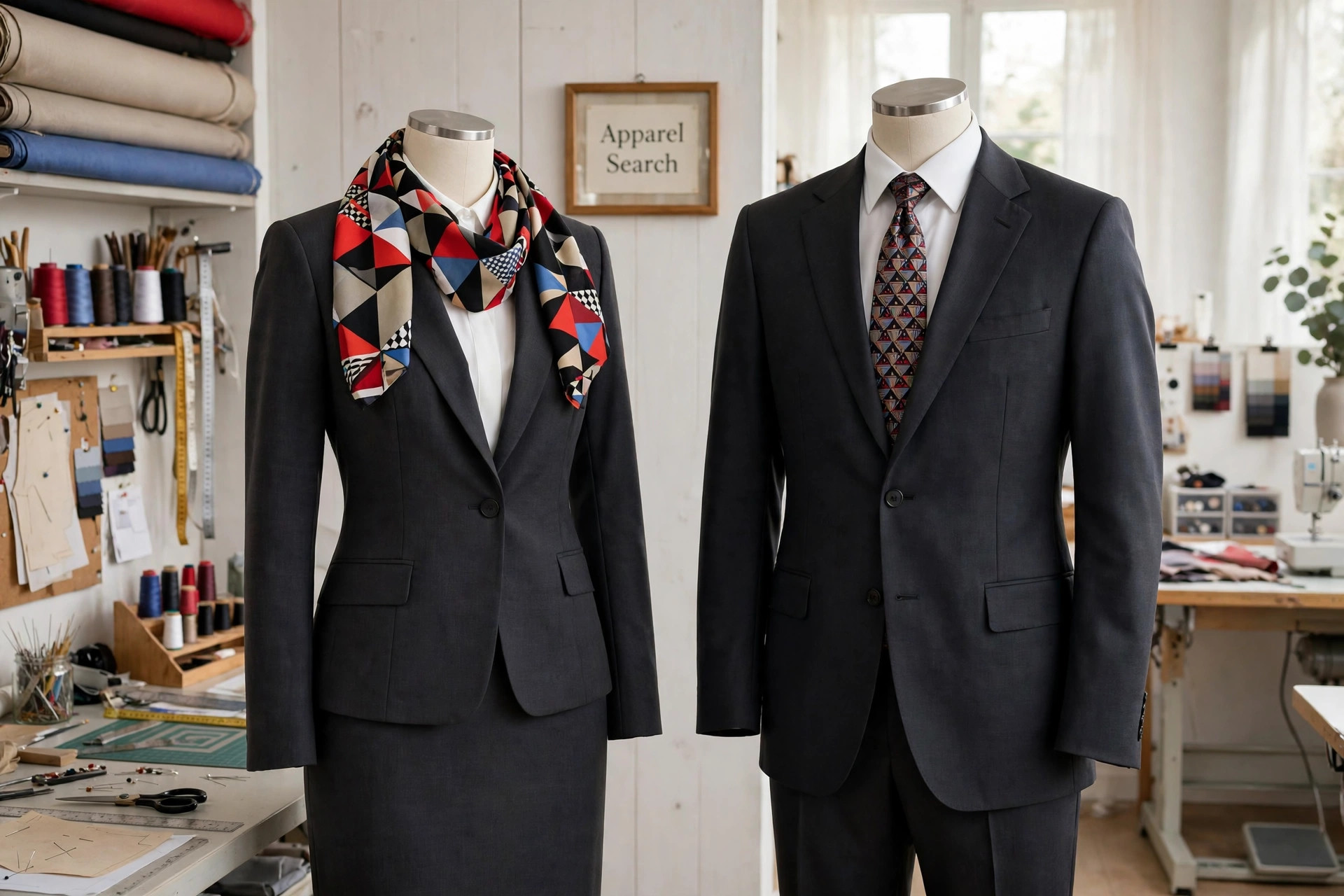
Anthracite, not black; wool, not synthetics; and a scarf that arrived four years after the suit it brightens. The uniform SWISS has worn since 7 December 2009 is a piece of quiet Swiss tailoring by Ruth Grüninger — with its most colourful element, the geometric scarf, designed later by Caroline Flueler. Two designers, one wardrobe: this guide keeps their work separate, the way the airline’s own releases do.
The Design
Grüninger’s Anthracite, Made by JAS
The current SWISS uniform is a primary-source story, because the airline documented it unusually well. Its press release of 1 December 2009 states it plainly: “The new uniforms are the creation of renowned Swiss designer Ruth Grüninger, and have been produced by Swiss manufacturer JAS.” The wardrobe entered service on 7 December 2009, worn from that day by more than 3,400 flight attendants, over 1,100 pilots and around 1,200 ground staff — one design system for the whole airline, developed over a two-year project in which some sixty cockpit and cabin staff acted as expert trial wearers before a single passenger saw it.
The colour is the first design decision to understand: anthracite, a near-black dark grey, specially produced in a hard-wearing woollen fabric. Against it, a white blouse or shirt and one deliberate splash of colour at the neck. Grüninger’s tailoring is intentionally quiet — this is a uniform designed to look correct in a Zurich winter and a Singapore summer, and to let the wearer, not the clothes, do the talking.
The two-year development, with some sixty crew as expert trial wearers, is the other half of the design story. Airline uniforms fail in predictable places — a blazer that pulls across the shoulders during the service, a skirt that cannot climb airstairs, cloth that wilts by the third sector of a long-haul day. Putting the wardrobe on working crew for extended trials before the launch is how those failures get designed out rather than complained about afterwards, and it is part of why a 2009 wardrobe can still be the current one: the clothes were tested against the job, not against a mood board. The launch scale underlines the point — when more than 5,700 people change uniform on a single December morning, there is no soft opening in which to fix a bad pocket.
One attribution needs care, and this guide gives it: the scarves and ties worn today are not Grüninger’s. On 1 September 2013 SWISS introduced new scarves and ties designed by Caroline Flueler — the geometric-pattern accessories in red, black, beige, blue and white that are now the most recognisable part of the whole look. The current uniform is therefore a collaboration across four years: Grüninger’s 2009 tailoring, Flueler’s 2013 colour. Crediting the whole wardrobe to either woman alone would be wrong, and SWISS’s own releases never do.
The Components
Six Mandatory Pieces — and Fifteen in Winter
- The Basic Six
- The basic cabin uniform is six mandatory pieces: blazer, skirt or trousers, blouse, scarf or tie, belt and name tag — a complete, checkable kit, issued the same way to everyone.
- The Full Kit
- Around the six sit the working extras: shoes, tights worn with a skirt, a handbag and a crew bag.
- Cold-Weather Additions
- Coat, cardigan, knit scarf and leather gloves take the full uniform to over fifteen pieces — a wardrobe built for Alpine winters as much as for the cabin. Our coat definition covers the outer layer.
- The Cloth
- Blouses and shirts are 100% cotton; blazers, trousers, skirts and vests are a high-percentage virgin wool — breathable, temperature-regulating and fire-resistant. SWISS notes, with practical Swiss pride, that a blazer or vest can be used to smother a fire.
- The Fit
- The tailoring is issued in five lengths per size, so the anthracite suit is fitted to the wearer’s proportions rather than merely to their chest measurement.
- The Scarf and Tie
- Flueler’s 2013 geometric pattern — red, black, beige, blue and white — is the wardrobe’s single flourish, worn as a scarf by women and a tie by men. Our scarf definition covers the garment’s wider history.
The Rank Code
Stripes on the Shoulder
SWISS carries rank where airlines traditionally put it — on the shoulder — and nowhere else: there is no distinct purser outfit, only stripes. They appear on the epaulettes of the blazer or vest, or on loops on the blouse or shirt, and SWISS’s own magazine sets the code out in full:
| Stripes | Rank | Role |
|---|---|---|
| 1 stripe | Cabin Crew Member | The cabin team’s working rank. |
| 1 wide + 1 narrow | Maître de Cabine — short-haul | Cabin manager on European services. |
| 1 wide + 2 narrow | Maître de Cabine — long-haul | Cabin manager on intercontinental services. |
| 3 wide stripes | First Officer | The co-pilot on the flight deck. |
| 4 wide stripes | Captain | In command of the aircraft. |
Two pilot details complete the code: the pilot hat must be worn in public areas, and the pilot wing pin is worn above the name tag on the blazer or jacket — and on the hat itself.
The system’s elegance is that it needs no second uniform to express seniority. A Maître de Cabine wears the same anthracite tailoring as the crew member beside them; only the shoulder changes. Compare the airlines in this series that encode rank in whole garments — a different kebaya colour, a different jacket — and the Swiss approach is the economical one: rank as information, carried on two small pieces of braid, readable by colleagues and invisible as a design event to passengers. That the code distinguishes short-haul from long-haul cabin managers by a single narrow stripe is equally characteristic: the difference matters operationally, so it is marked; it does not matter visually, so it is marked small.
The manufacture closes the circle. A Swiss designer, a Swiss manufacturer in JAS, cloth specially produced for the purpose, and a fitting system of five lengths per size: the 2009 wardrobe is a domestic industrial product as much as a design, closer to the way Switzerland makes watches than to the way most airlines buy uniforms. That helps explain the absence of a successor. A wardrobe produced as equipment, to a specification, is replaced when the specification fails — and by the airline’s own 2025 account, it has not.
The Men’s Uniform
The Same Anthracite System
There is no separate men’s design story at SWISS, and that is the point: the 2009 wardrobe is one system. Men wear the same anthracite tailoring — blazer or vest, trousers, shirt, tie, belt and name tag — with rank shown by the same shoulder epaulettes on the blazer or vest and the same loops on the shirt. The men’s colour note is Flueler’s tie, carrying the same 2013 geometric pattern as the women’s scarf, so the whole crew’s neckwear matches even though the garments differ. Pilots of both sexes wear the wide-stripe cockpit code described above, hat and wing pin included.
Heritage, Carefully Labelled: Nelly Diener
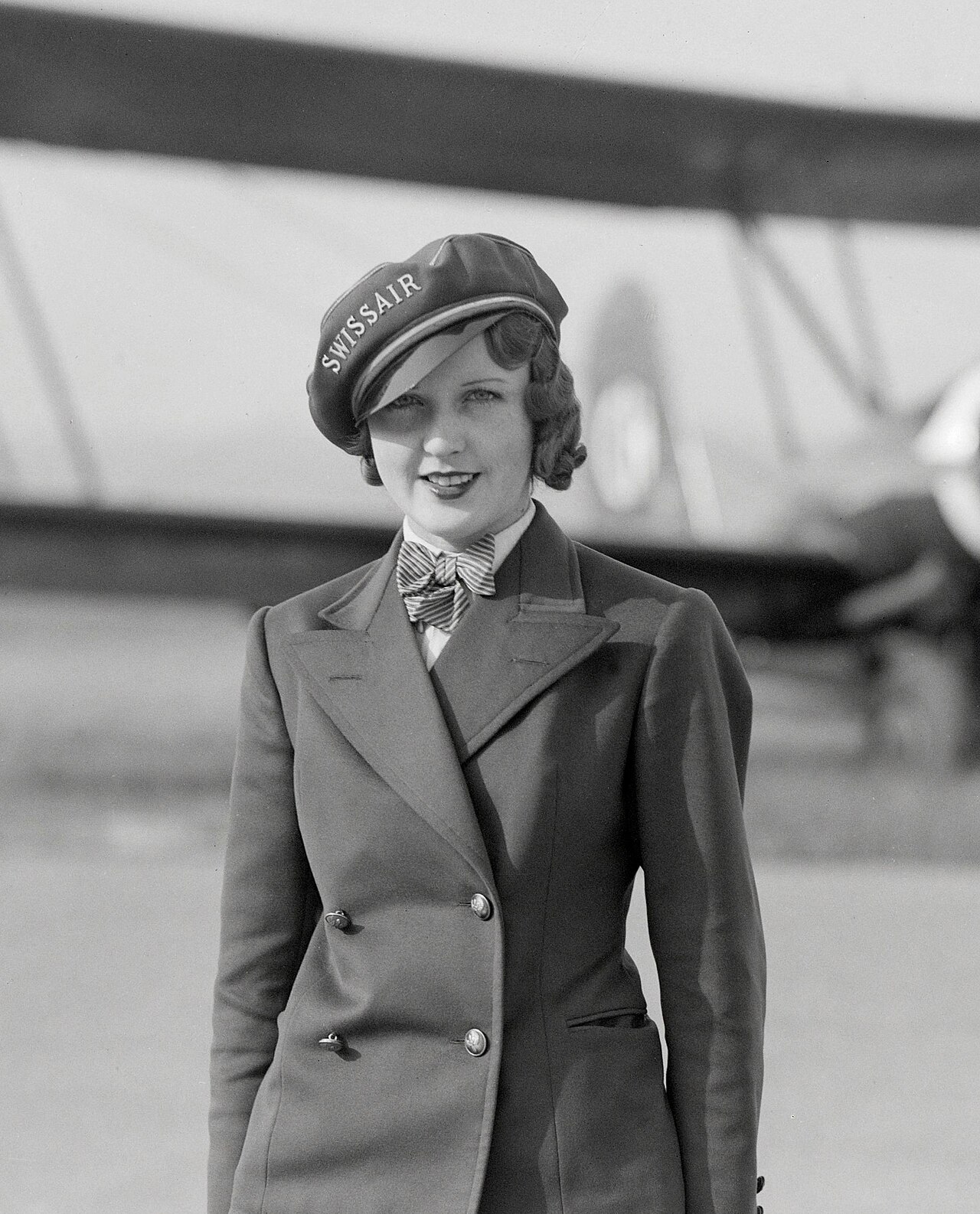
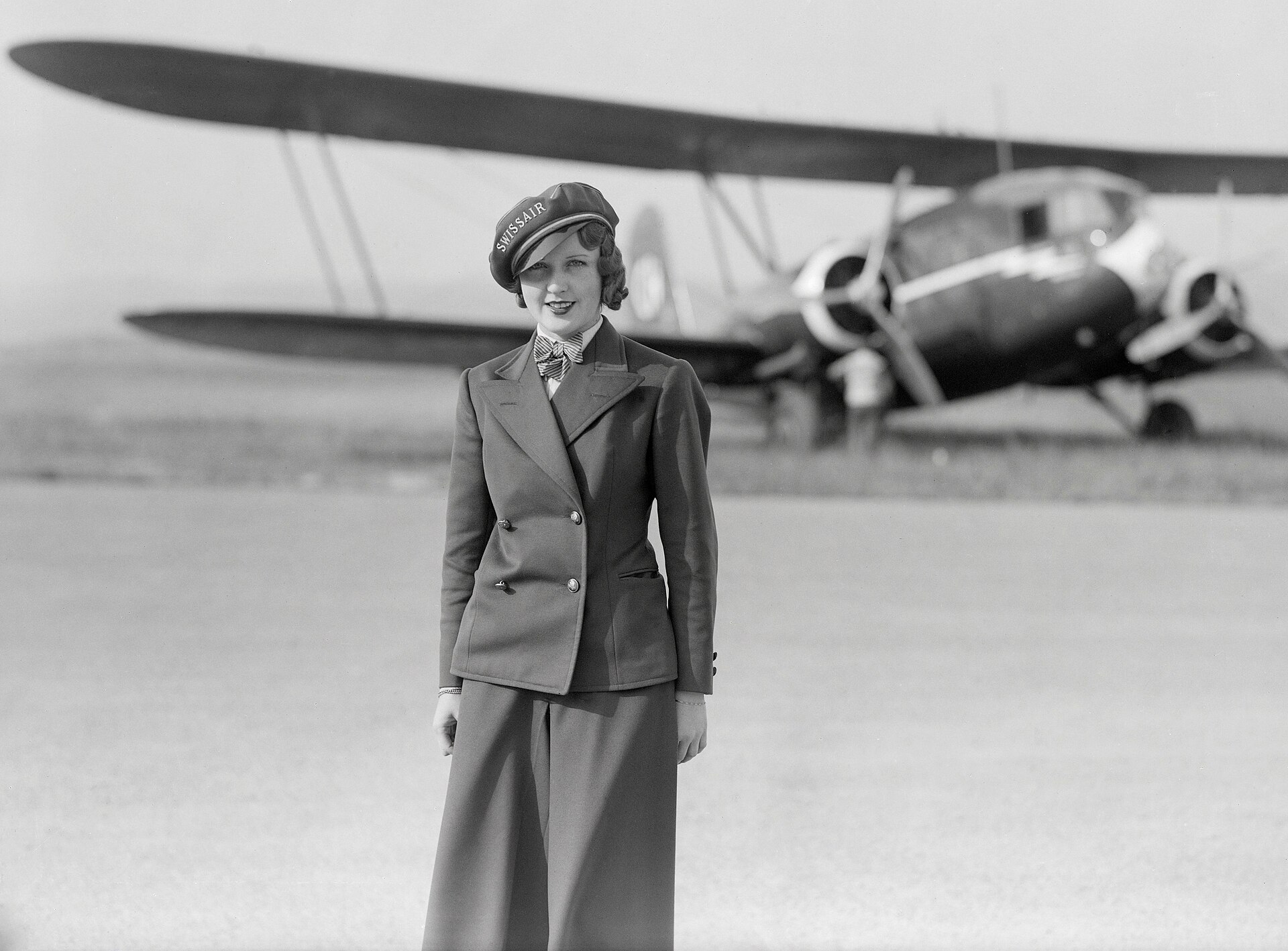
Every Swiss aviation uniform story reaches back to Nelly Diener, who in 1934 became Europe’s first stewardess — but she flew for Swissair, the predecessor carrier that collapsed in 2001, not for SWISS, which was founded in 2002 from Crossair. The heritage photographs in this guide are Swissair photographs, captioned as such: a borrowed ancestry, worn honestly. Diener’s portrait endures because she began the profession this uniform still dresses — the line from her 1934 cabin to Grüninger’s anthracite cabin is real, even if the airlines are not the same company.
The Rules
Grooming: Documented, and Loosening
SWISS is one of the few airlines whose grooming standards can be written from the airline’s own published account — its magazine’s 2025 uniform feature — and the picture is of rules being deliberately relaxed. Red lipstick is no longer mandatory for female cabin crew; lipstick and tinted lip gloss are allowed, though bright colours such as pink are prohibited. Footwear is the crew member’s own purchase, supported by an annual allowance, within measured limits: the heel must be at least 1.5 cm, and no more than 3 cm for men or 8 cm for women.
The modernised rules go further than most legacy carriers have gone in public: visible tattoos are generally allowed, with exceptions for the face and ears and for large tattoos on the hands, and tattoos with profanity, violence, drugs, sexism, political or discriminatory themes are not tolerated. A discreet ear piercing or nose stud is permitted. Set against the anthracite formality of the tailoring, it is a telling combination — a conservative uniform worn under liberal presentation rules, each making the other easier to keep.
The material specification belongs in this section too, because at SWISS the rules and the cloth were designed together. Virgin wool in high percentage is not a luxury choice for a uniform; it is a functional one. Wool regulates temperature across the swing between a heated cabin and a cold jet bridge, breathes through a long service, resists odour across a multi-day pairing and — the property airlines quietly value most — does not melt, which is why SWISS can note that the blazer or vest doubles as a fire-smothering tool. Cotton shirting keeps the layer against the skin washable and comfortable. A uniform specified this way ages slowly, which is precisely what the record shows: the 2009 cloth is still the 2026 uniform, and the changes passengers might notice — a scarf pattern in 2013, a lipstick rule relaxed, a tattoo visible — have all happened around an unchanged tailored core.
Evolution
A Young Airline in a Long-Serving Uniform
SWISS itself is young: founded in 2002, built from Crossair after Swissair’s collapse. Its first uniform, worn from 2002 to 2009, is a genuine gap in the public record — this research found no designer for the 2002–2009 wardrobe named in airline or reputable sources, and this guide leaves the gap open rather than filling it with a guess. What is documented begins in 2009: Grüninger’s anthracite system, then Flueler’s accessories in 2013, then a long, quiet maturity in which the airline’s own magazine, in March 2025, still describes the 2009 uniform as the current one — its news value by then being the grooming liberalisation around it, not the clothes.
No successor redesign has been announced as of late 2026. A seventeen-year-old uniform at most airlines would be a story about delay; at SWISS it reads as a story about a design that was specified conservatively enough — wool, anthracite, a complete seasonal kit — to absorb a decade and a half of changing presentation rules without needing to change itself.
The Icon
Quiet Tailoring as a National Style
The SWISS uniform’s distinction is restraint. Where other flag carriers brief designers for an icon, SWISS briefed one for a wardrobe: anthracite wool, cotton shirting, a six-piece basic kit that expands past fifteen pieces for winter, and colour confined to a single patterned scarf and tie. It is the uniform as Swiss product design — specified, durable, documented down to the centimetre of a permitted heel — and its longevity is the proof of the approach. The airline it dresses is a successor, not a continuation, and the uniform honours that honestly too: the Swissair past is heritage to be labelled, not a brand to be borrowed. For the country behind both airlines, see our Switzerland clothing industry page.
Airlines refresh their uniforms from time to time, so the details here describe the uniform as documented for this guide — the airline’s own site always carries the latest version.
Common Questions
Common Questions
Who designed the SWISS uniform?
Swiss designer Ruth Grüninger designed the uniform, produced by Swiss manufacturer JAS and worn from 7 December 2009. The scarves and ties worn today are a later layer: they were designed by Caroline Flueler and introduced on 1 September 2013, so the current look is Grüninger's tailoring with Flueler's accessories.
When was the current SWISS uniform introduced?
On 7 December 2009, when more than 3,400 flight attendants, over 1,100 pilots and about 1,200 ground staff began wearing it. SWISS confirmed in its own magazine in 2025 that the 2009 uniform is still in use, and no successor has been announced.
What do the stripes on a SWISS uniform mean?
Rank is shown on the shoulder epaulettes of the blazer or vest, or on loops on the blouse or shirt. One stripe is a cabin crew member; one wide and one narrow stripe is a Maître de Cabine on short-haul services; one wide and two narrow stripes is a Maître de Cabine on long-haul. In the cockpit, three wide stripes mark a first officer and four a captain.
Are SWISS crew allowed tattoos?
Generally yes. Under the grooming standards SWISS documented in 2025, visible tattoos are allowed, with exceptions for the face and ears and for large tattoos on the hands, and designs involving profanity, violence, drugs or discriminatory themes are not tolerated. A discreet ear piercing or nose stud is also allowed, and red lipstick is no longer mandatory for female cabin crew.
Is SWISS the same airline as Swissair?
No. Swissair was the predecessor flag carrier that collapsed in 2001; SWISS — Swiss International Air Lines — was founded in 2002 from Crossair. Historical photographs of Swissair crew, including Nelly Diener in 1934, are heritage of a different airline and are labelled as such in this guide.
Keep Exploring
More to Explore
In This Series
Airline Uniforms by Airline
The series hub — every airline’s guide, the designers behind them, and the ones in preparation.
Read ↑Switzerland Clothing Industry
The airline’s home country in the World Clothing Industry directory.
Read ↑Go Deeper
Uniforms — Definition
What a uniform is, and why organisations dress their people alike.
Read ↑Scarf — Definition
The Flueler accessory that brings the colour, defined.
Read ↑Epaulette — Definition
The shoulder-stripe system that carries SWISS rank, defined.
Read ↑Tie & Necktie — Definition
The men’s Flueler finishing piece, defined.
Read ↑Keep Exploring
Explore Fashion for Travel
The crew are only half the fashion on a flight — the other half is what the passengers are wearing. Our travel guides cover the traveller’s side of the same subject, and they link back here.
Outfits for Flying
Travel Outfits
What to wear when you are going somewhere — outfit systems built for transit days.
Read ↑Airport Outfits
Security-friendly shoes, cabin layers and the full airport dressing system.
Read ↑What to Wear on a Long Flight
Dressing for the overnight haul — comfort, warmth and arriving presentable.
Read ↑What to Wear When Traveling
The destination-rules guide to building a travel wardrobe that works on arrival.
Read ↑Business Travel Wardrobe Guide
A working wardrobe that travels — suits, wrinkle strategy and boardroom-ready arrivals.
Read ↑Packing & Capsule Wardrobes
Travel Capsule Wardrobe Guide
A small set of pieces that combine into a trip’s worth of outfits.
Read ↑Travel Packing Guide
The complete packing method — lists, order and wrinkle control.
Read ↑How to Pack a Suit
Getting a tailored jacket and trousers across the world without the creases.
Read ↑Carry-On Packing Guide
Everything in one bag — the carry-on-only system, piece by piece.
Read ↑Travel Comfort & Accessories
Search Apparel Search