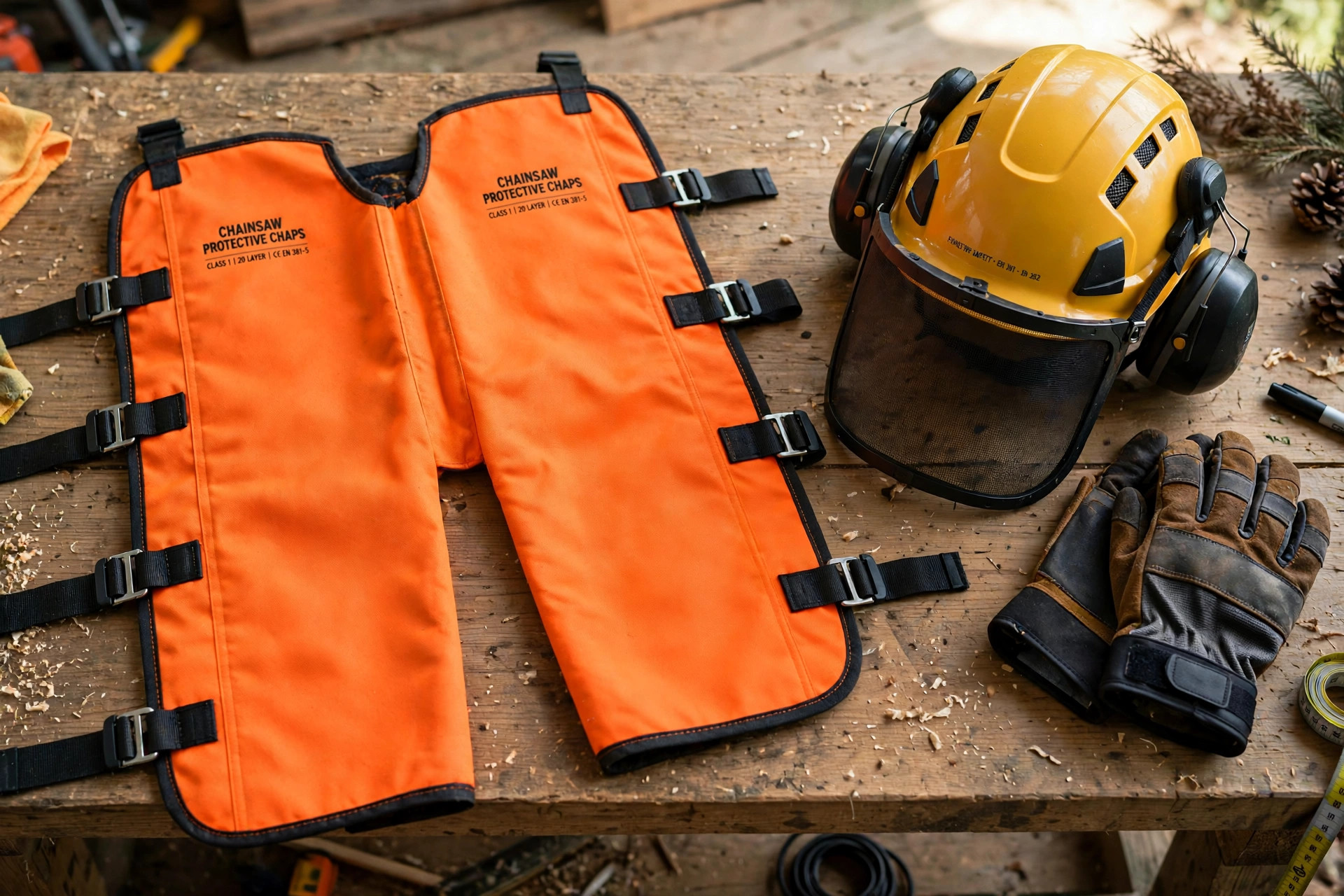
Chainsaw chaps (protective leggings) are worn over work trousers by chainsaw operators. Their protective padding is filled with long, loose fibers: if a moving chain contacts the chap, it pulls those fibers out and into the saw’s drive sprocket, clogging it and slowing or stopping the chain before it can cut through to the leg. Chaps are a last line of defense — they reduce injury severity; they do not make contact with a running chain safe.
Styles and Fit
Apron-style chaps strap around the waist and legs and protect the front of the legs, where most contacts occur; they are cooler and faster to put on. Wrap chaps add coverage around the calf, and full protective trousers build the padding into the garment itself. Fit is by leg length and waist: chaps should cover from the waist to the top of the boot without dragging, straps snug enough that the chap cannot shift, and worn over boots with good ankle support. Forestry and tree-care crews pair chaps with the wider PPE set — helmet, eye and ear protection, gloves, and sturdy boots (see safety toe boots).
Who Needs Them, and the Standards Picture
Loggers, arborists, utility and municipal crews, and landowners who cut firewood or clear storm damage all work under employer or industry requirements for leg protection; in the United States, OSHA’s logging rules and ASTM protective-clothing standards are part of that picture, and manufacturers label chaps to the applicable standard. Occasional users are not exempt from the physics: most chainsaw leg injuries happen to people cutting at ground level, exactly the work occasional users do.
Care and Retirement
Chaps that have taken a chain contact have done their job once — the fiber system is spent in the contacted area and the chap should be retired, not repaired. Wash chaps only as the manufacturer directs, since aggressive laundering can mat the protective fibers; keep them free of bar-oil saturation where possible, store them dry, and inspect straps, buckles, and the shell before each use. Replace chaps with cuts in the shell, missing fibers, or damaged closures, and never lend ill-fitting chaps: coverage gaps follow the wearer, not the saw.
FAQs
- How do chainsaw chaps actually stop a chain?
- The padding contains long fibers that a contacting chain tears loose and drags into the drive sprocket. The fibers jam the sprocket and absorb energy, slowing or stopping the chain. The system works once in the contacted spot, which is why contacted chaps are retired.
- Do chaps protect the back of the leg?
- Apron-style chaps mainly protect the front. Wrap styles add calf coverage, and protective trousers cover more fully. Know which style you are wearing and its coverage before cutting.
- Can chainsaw chaps be washed?
- Only as the manufacturer directs. Some allow gentle washing; others warn that laundering can damage the fiber system. Follow the label on your specific chaps rather than general advice.
Workwear & PPE Guides
This guide is part of the Apparel Search workwear and PPE systems series. Browse the full series and the related trade uniform guides below.
- High-Visibility Clothing
- Hi-Vis Classes
- Arc-Rated Clothing
- NFPA 2112
- Flame-Resistant Clothing
- Welding Apparel
- Cut-Resistant Sleeves
- Disposable Coveralls
- Protective Aprons
- Safety Toe Boots
- Composite Toe Boots
- Specialty Safety Toe Features
- Steel-Toe Boots (Men's Clothes Guide)
Trade Uniform Guides
Apparel Search: explore the Clothes Guide and shopping directory for more workwear and uniform resources.
Please note: Chainsaw protective clothing requirements are maintained by ASTM International and the Occupational Safety and Health Administration (OSHA) and revised over time. This page is a general overview provided for information only — it is not legal or compliance advice, and it may not reflect the most current version. Always confirm the current requirements directly with ASTM International and the Occupational Safety and Health Administration (OSHA) rather than relying on this website.